Catholic mysticism is the Christian tradition of seeking an intimate union with God through grace, prayer, the sacraments, contemplation, and interior transformation. Although it is often associated with visions, ecstasy, or other extraordinary experiences, its central purpose is much simpler: to know and love God more deeply and to become more fully united with Christ.
This tradition stretches from the Desert Fathers and Mothers of early Christianity to medieval monastic writers, Carmelite Doctors of the Church such as St. Teresa of Ávila and St. John of the Cross, and modern figures such as St. Thérèse of Lisieux and St. Faustina Kowalska. This guide explains what Catholic mysticism means, how it developed, who the best-known Catholic mystics were, and how ordinary Catholics can begin a contemplative life today.
What Is Catholic Mysticism?
At its core, Catholic mysticism is the deepening of the Christian life toward intimate union with God. The Catechism of the Catholic Church teaches that spiritual progress tends toward an ever more intimate union with Christ. It also explains that all Christians are called to this union, even though extraordinary signs or special mystical graces are given only to some.
Catholic mysticism is therefore not a separate religion, a secret doctrine, or an alternative to ordinary Catholic life. It grows within the same faith expressed through Scripture, the Eucharist, the sacraments, prayer, charity, and obedience to God. Mystical experience is considered authentic only when it leads to deeper faith, humility, love, and holiness.
Mysticism, Faith, and Theology
Theology studies God through reason, Scripture, tradition, and Church teaching. Mysticism emphasizes a personal and transforming knowledge of God through prayer and grace. The two are not enemies. Catholic theology helps interpret spiritual experience, while authentic mysticism gives lived depth to theological truth.
Catholic writers often use the term infused contemplation for a form of prayer in which awareness of God is received as a gift rather than produced by technique or effort alone. A person can prepare for contemplation through prayer and discipline, but mystical union is never treated as something that can be forced or earned.
Mystic vs. Saint vs. Visionary
These terms are related, but they do not mean the same thing:
- A saint is a holy person. In the formal sense, a canonized saint is someone the Catholic Church has officially recognized as having lived a life of heroic virtue and being in heaven.
- A mystic is someone whose spiritual life includes an unusually deep experience of union with God, often through contemplation and interior transformation. A mystic may or may not experience visions or other extraordinary phenomena.
- A visionary is someone who reports a vision, apparition, locution, or similar experience. A visionary is not automatically a mystic or a saint.
Many famous Catholic mystics, including St. Teresa of Ávila and St. John of the Cross, were canonized saints. However, sainthood is based on holiness of life, not on the presence of unusual spiritual experiences.
The History of Catholic Mysticism
Catholic mysticism developed across many centuries. Its language and practices changed over time, but its central themes remained consistent: purification from sin, growth in virtue, contemplative prayer, and union with God.
Early Christian Roots: The Desert Fathers and Mothers
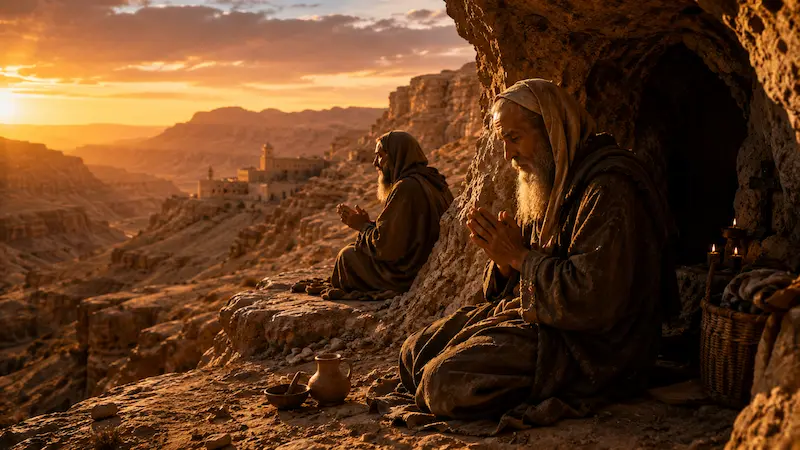
The roots of Christian mysticism can be seen in Scripture and in the lives of early Christians who devoted themselves to prayer, fasting, and solitude. During the third and fourth centuries, men and women withdrew into the deserts of Egypt, Palestine, and Syria. Known as the Desert Fathers and Mothers, they sought freedom from distraction so they could confront temptation, purify the heart, and remain attentive to God.
Their short teachings on silence, humility, watchfulness, and continual prayer became foundational for later monastic and contemplative traditions.
Pseudo-Dionysius and the Mystical Ascent
A Christian writer known as Pseudo-Dionysius the Areopagite had a major influence on medieval mystical theology. His writings described the soul’s movement toward God through purification, illumination, and union. He also emphasized that God surpasses every human concept and description, an approach often called apophatic or “negative” theology.
This does not mean that nothing can be known about God. Rather, it means that the infinite God can never be fully contained by human language or ideas.
Medieval Monastic and Rhineland Mysticism
During the Middle Ages, monasteries became important centers of mystical prayer. Practices such as the Divine Office, silence, fasting, and lectio divina created a disciplined environment for contemplation.
St. Bernard of Clairvaux wrote mystical interpretations of the Song of Songs. St. Hildegard of Bingen recorded symbolic visions and produced works on theology, music, nature, and medicine. St. Catherine of Siena described an intense spiritual union with God while also taking an active role in Church and public life.
German and Flemish writers sometimes called the Rhineland mystics explored themes such as detachment, interior silence, and the soul’s union with God. Meister Eckhart was especially influential, although some propositions associated with his work were later criticized or condemned because they could be interpreted in ways inconsistent with Church teaching.
The Golden Age of Spanish Catholic Mysticism
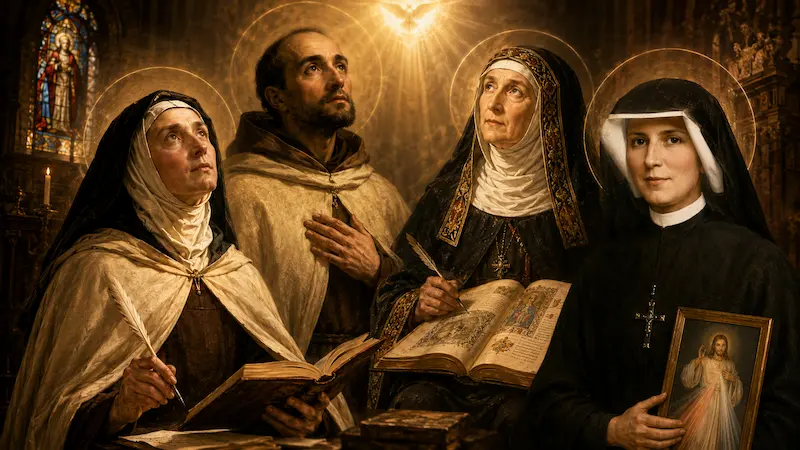
The 16th century is often described as a golden age of Catholic mysticism, especially because of the writings of St. Teresa of Ávila and St. John of the Cross. Both were Carmelite reformers and both became Doctors of the Church.
In The Interior Castle, Teresa described the spiritual life as a journey through a castle with many rooms, leading toward transforming union with God. In Dark Night of the Soul and other works, John explained how attachment, spiritual pride, and dependence on religious consolation must be purified before the soul can love God more freely.
Their writings remain among the most important Catholic guides to contemplative prayer because they combine personal experience, psychological insight, and careful theological discernment.
Modern Catholic Mysticism
Catholic mysticism continued into the modern period. St. Thérèse of Lisieux emphasized the “Little Way,” a path of trust, humility, and love expressed through ordinary actions. Her life showed that deep union with God does not require dramatic visions or severe asceticism.
St. Faustina Kowalska recorded spiritual experiences that contributed to the spread of the Divine Mercy devotion. St. Padre Pio became known for his life of prayer, ministry of confession, and reported stigmata. Other modern contemplatives emphasized silence, Eucharistic devotion, service to the poor, and fidelity in everyday life.
What Is a Mystic in the Catholic Church?
A Catholic mystic is a person whose life of prayer is marked by a profound awareness of God’s presence and a transforming union with Him. This union is understood as the work of grace. It should produce greater charity, humility, patience, faithfulness, and freedom from selfish attachment.
Extraordinary experiences may occur, but they are not the essence of Catholic mysticism. The Church gives more importance to a person’s character and spiritual fruits than to unusual phenomena.
Experiences Associated With Catholic Mystics
Some Catholic mystics have reported experiences such as:
- Infused contemplation: a quiet, receptive awareness of God’s presence that is not created by deliberate mental effort.
- Visions: perceived images of Christ, Mary, saints, angels, or spiritual realities.
- Locutions: words or messages perceived interiorly rather than through ordinary hearing.
- Ecstasy: an intense state of prayer in which awareness of the surrounding environment may be reduced.
- Stigmata: bodily wounds or marks resembling the wounds of Christ’s Passion.
Not every mystic experiences these phenomena, and the presence of such phenomena does not by itself prove holiness or supernatural origin.
How the Catholic Church Discerns Mystical Claims
The Catholic Church approaches alleged visions, apparitions, locutions, and other supernatural phenomena with caution. Under the Vatican’s current norms, the diocesan bishop normally begins the investigation in consultation with the Dicastery for the Doctrine of the Faith.
The discernment may consider the credibility of the people involved, consistency with Catholic faith and morals, the spiritual fruits associated with the devotion, possible risks or manipulation, and whether medical, psychological, fraudulent, or other natural explanations are present.
Current Church norms generally focus on whether a devotion may be pastorally permitted or whether warnings or restrictions are needed. Even a favorable decision does not normally amount to a formal declaration that an event was certainly supernatural.
Signs of Authentic Catholic Mysticism
Catholic spiritual writers commonly emphasize several signs of a healthy mystical life:
- Fidelity to Scripture and Catholic teaching
- Humility rather than spiritual superiority
- Obedience and openness to discernment
- Growth in charity, patience, and service
- Emotional and moral stability
- Freedom from obsession with visions or supernatural powers
Authentic mysticism directs attention toward God, not toward the mystic’s reputation or extraordinary experiences.
Famous Catholic Mystics Throughout History
| Catholic Mystic | Era | Known For |
|---|---|---|
| St. Teresa of Ávila | 16th century | Carmelite reformer and author of The Interior Castle, a guide to the soul’s journey toward union with God. |
| St. John of the Cross | 16th century | Carmelite reformer whose works explain spiritual purification, detachment, and the “dark night.” |
| St. Catherine of Siena | 14th century | Dominican tertiary, Church reformer, and author of The Dialogue. |
| St. Hildegard of Bingen | 12th century | Benedictine abbess, visionary, composer, writer, and Doctor of the Church. |
| St. Bernard of Clairvaux | 12th century | Cistercian abbot known for contemplative writings on divine love and the Song of Songs. |
| St. Thérèse of Lisieux | 19th century | Author of Story of a Soul and teacher of the “Little Way” of trust and ordinary love. |
| St. Faustina Kowalska | 20th century | Polish nun whose diary and reported visions helped spread the Divine Mercy devotion. |
| St. Padre Pio | 20th century | Capuchin friar known for prayer, confession, spiritual direction, and reported stigmata. |
| St. Margaret Mary Alacoque | 17th century | Visitation nun associated with the development of devotion to the Sacred Heart of Jesus. |
Mystical Practices in the Catholic Tradition
Catholic mystical practices are not techniques for producing supernatural experiences. They are disciplines that help a person become more attentive to God, more receptive to grace, and more faithful in daily life.
Contemplative Prayer
Contemplative prayer is a quiet and loving attention to God. The Catechism describes contemplative prayer as a gaze of faith fixed on Jesus, attentiveness to the Word of God, and silent love.
A person may enter contemplative prayer by becoming still, placing themselves in God’s presence, and resting without trying to create special feelings. Distractions are handled gently by returning attention to God.
Lectio Divina
Lectio divina, meaning “divine reading,” is a traditional method of praying with Scripture. It is commonly practiced in four movements:
- Lectio: read a short passage slowly and attentively.
- Meditatio: reflect on a word, image, or message that stands out.
- Oratio: respond to God honestly in prayer.
- Contemplatio: rest silently in God’s presence.
The United States Conference of Catholic Bishops provides a practical explanation of these four movements.
The Eucharist and Sacramental Life
Catholic mysticism remains rooted in the sacramental life of the Church. Participation in Mass, reception of the Eucharist, Reconciliation, Eucharistic adoration, and the liturgical year give Catholic contemplation a distinctly Christ-centered and ecclesial foundation.
Mystical prayer is not meant to replace the sacraments. It deepens a person’s participation in them and should lead to greater love of God and neighbor.
Silence, Fasting, and Interior Detachment
Silence creates space for attention. Fasting can strengthen self-discipline. Interior detachment helps a person become less controlled by possessions, praise, comfort, or emotional consolation.
These practices should be approached with prudence. Catholic tradition does not require extreme physical austerity, and fasting should be adapted to a person’s health, responsibilities, and state of life.
Spiritual Direction and Discernment
Because spiritual experiences can be misunderstood, Catholic mystics have traditionally relied on wise spiritual direction. A trustworthy priest, religious, or trained spiritual director can help distinguish genuine growth in prayer from imagination, emotional intensity, pride, fear, or unhealthy fixation.
The Dark Night of the Soul
The phrase “dark night of the soul” comes from St. John of the Cross. It refers to a spiritual purification in which familiar feelings of consolation disappear and a person is invited to love God with greater faith and freedom.
The dark night is not simply a synonym for sadness, burnout, or clinical depression. Spiritual dryness can occur alongside mental or physical illness, so serious or persistent distress should not be treated only as a spiritual problem.
Can Ordinary Catholics Experience Mysticism Today?
Yes, ordinary Catholics are called to intimate union with God. The Catholic tradition does not teach that contemplation belongs only to monks, nuns, priests, or canonized saints. At the same time, extraordinary experiences such as visions or stigmata are neither necessary nor guaranteed.
For most people, the contemplative life grows quietly through faithful prayer, repentance, participation in the sacraments, service to others, and perseverance during periods when prayer feels dry or ordinary.
Simple Ways to Begin a Contemplative Catholic Life
- Set aside 10 to 15 minutes of silence each day.
- Pray with a short Gospel passage using lectio divina.
- Participate regularly in Mass and the sacraments.
- Read a trusted Catholic mystic, such as St. Teresa of Ávila, St. John of the Cross, or St. Thérèse of Lisieux.
- Practice one small act of hidden charity each day.
- Seek spiritual direction when prayer becomes confusing or unusually intense.
- Avoid chasing visions, messages, or extraordinary sensations.
The goal is not to become fascinated with mystical phenomena. The goal is to become more faithful, loving, and united with God.
Frequently Asked Questions About Catholic Mysticism
Does Catholicism Have Mysticism?
Yes. Mysticism has been part of Catholic spirituality since the earliest centuries of Christianity. It appears in the lives and writings of the Desert Fathers and Mothers, medieval monastics, Carmelite saints, and modern Catholic contemplatives.
What Is the Main Goal of Catholic Mysticism?
The main goal is intimate union with God through grace. Visions, ecstasy, and other extraordinary experiences are secondary and are not required for a genuine mystical life.
Who Are the Most Famous Catholic Mystics?
Well-known Catholic mystics include St. Teresa of Ávila, St. John of the Cross, St. Catherine of Siena, St. Hildegard of Bingen, St. Bernard of Clairvaux, St. Thérèse of Lisieux, St. Faustina Kowalska, St. Padre Pio, and St. Margaret Mary Alacoque.
What Is the Difference Between a Catholic Mystic and a Saint?
A saint is recognized for holiness of life, while a mystic is known for a profound experience of union with God. Some saints were mystics, but not every saint reported mystical experiences, and not every person described as a mystic has been canonized.
Did Jesus Teach Mysticism?
The word “mysticism” developed later, but Catholic mystical spirituality is rooted in the life and teaching of Jesus. The Gospels describe His solitary prayer, His intimate union with the Father, the Transfiguration, and His invitation to “abide” in Him. Catholic mystics interpret these themes as foundations for contemplative union with God.
How Does the Catholic Church Verify a Mystic?
The Church does not formally “certify” every mystic. When a person reports apparitions, visions, messages, or other alleged supernatural phenomena, the local bishop may investigate with the involvement of the Dicastery for the Doctrine of the Faith. The process examines doctrine, credibility, spiritual fruits, possible harm, and natural explanations.
Is Catholic Mysticism the Same as New Age Spirituality?
No. Catholic mysticism is centered on the Triune God, Jesus Christ, Scripture, grace, the sacraments, and the teaching of the Church. It does not treat spiritual experiences as techniques for gaining hidden power, controlling reality, or discovering a divine identity within oneself.
Can Catholics Practice Mysticism Safely?
Catholics can develop a contemplative life through Scripture, silence, the sacraments, traditional prayer, charity, and spiritual direction. The safest approach is to seek God rather than extraordinary experiences and to evaluate spiritual practices by their consistency with Catholic faith and their fruits in daily life.
Conclusion
Catholic mysticism is not primarily about visions, ecstasy, or supernatural spectacle. It is the deepening of Christian life into intimate union with God. Across two thousand years, Catholic mystics have shown that this path involves prayer, purification, humility, charity, discernment, and faithful participation in the life of the Church.
From the Desert Fathers and Mothers to St. Teresa of Ávila, St. John of the Cross, St. Thérèse of Lisieux, and St. Faustina Kowalska, the Catholic mystical tradition offers practical guidance for anyone seeking a deeper relationship with God. For most believers, that journey begins not with extraordinary experiences, but with Scripture, silence, the sacraments, and ordinary acts of love.

About the Author
Dana Whitfield
I write about numerology, astrology, mythology, tarot, and world mystical traditions for Mystivora, drawing on years of independent research across comparative religion and symbolic systems. I approach each topic by cross-checking primary texts and established scholarship rather than repeating popular but unverified claims.
Related Articles
View All Articles → Mysticism