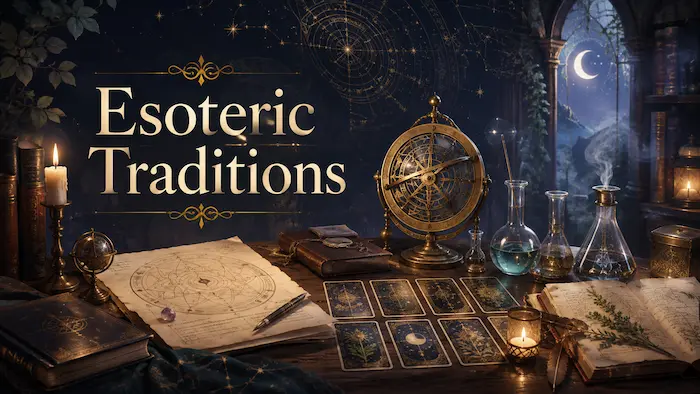
Esoteric traditions are systems of teaching, symbolism, or practice concerned with inner knowledge, spiritual experience, and personal transformation. The term does not point to a single religion or belief system. Instead, it covers a wide range of historical currents, including Hermeticism, Gnosticism, Kabbalah, Rosicrucianism, and Theosophy, each with its own origins, texts, and practices.
This article explains what esoteric traditions are, what esoteric practices involve, what people within these traditions have believed, and how esotericism differs from occultism and mysticism. It also outlines the major Western traditions, offers a brief history, and looks at how these traditions continue today.
What Are Esoteric Traditions?
An esoteric tradition is a system of teachings, symbols, interpretations, or practices intended to communicate inner, advanced, or specialized knowledge, often through initiation, guided study, or symbolic texts rather than plain public instruction.
Esoteric traditions have not all operated in the same way. Some restricted teachings to initiated members, while others published their texts openly but expected readers to study their layered symbolism with guidance. In this context, “esoteric” may describe knowledge that is restricted, advanced, or difficult to interpret rather than completely secret.
What Does “Esoteric” Mean?
The word “esoteric” comes from a Greek root associated with what is inner or directed inward. In general usage, it describes knowledge, teachings, or interests intended for people with the background or training needed to understand them.
Knowledge may be deliberately withheld, or it may simply require a symbolic key, specialist vocabulary, or sustained study. Esoteric texts often use images and allegories to express ideas about the cosmos, the divine, or the self on several interpretive levels.
Esoteric vs. Exoteric Teachings
Exoteric teachings are the public-facing or introductory layer of a religious or philosophical system. Esoteric teachings are its inner, advanced, symbolic, or restricted interpretations. Both can coexist within one tradition: a broad community may receive accessible ethical instruction while a smaller group studies a specialized mystical or philosophical current.
| Aspect | Esoteric | Exoteric |
|---|---|---|
| Audience | Initiates, advanced students, or specialized readers | General public or new members |
| Type of teaching | Inner, symbolic, or advanced interpretation | Public, introductory, or literal instruction |
| Method of transmission | Initiation, mentorship, or restricted texts | Sermons, public texts, or open instruction |
| Role of symbolism | Central, often layered with multiple meanings | Minimal or used mainly for illustration |
| Accessibility | Limited by training, context, or membership | Open to anyone willing to participate |
Key Characteristics of Esoteric Traditions
Although esoteric traditions differ widely, several features recur across many of them:
- Initiation or progressive stages of learning
- Symbolic language and layered interpretation of texts or images
- Emphasis on personal spiritual experience rather than belief alone
- A goal of inner transformation or change in awareness
- The idea of correspondences linking humanity, nature, and the cosmos
- Ritual, meditative, or contemplative practice
- Transmission through teachers, texts, orders, or lineages
Not every tradition contains all these features. They are recurring tendencies rather than a fixed checklist.
Examples of Esoteric Traditions
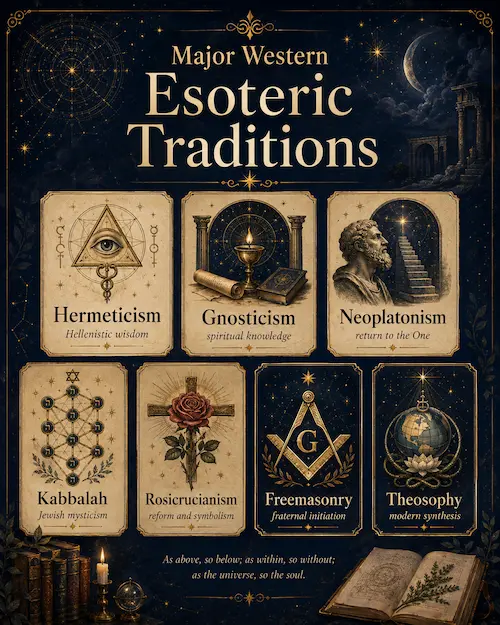
The phrase “esoteric traditions” covers several distinct historical movements rather than one unified school of thought. Some grew from religious reform, others from philosophy, and others from organized fraternal societies. The table below introduces seven major examples before each is discussed in more detail later in the article.
| Tradition | Historical context | Central emphasis | Associated practices or ideas |
|---|---|---|---|
| Hermeticism | Hellenistic Egypt and the wider Mediterranean, later revived in the Renaissance | Divine knowledge of the cosmos, humanity, and the self | Texts attributed to Hermes Trismegistus, astrology, alchemy |
| Gnosticism | Early centuries CE, alongside emerging Christianity | Direct spiritual knowledge, or gnosis, of divine origin | Sacred texts, cosmological myth, spiritual liberation |
| Neoplatonism | Late antique Greek philosophy | The soul’s return to a highest divine principle | Contemplation, philosophical discipline, theurgy |
| Kabbalah | Jewish mysticism, especially from the medieval period onward | Interpretation of divine creation, scripture, and language | Study of sacred texts, symbolic structures such as the Tree of Life |
| Rosicrucianism | Early seventeenth-century Europe | Christian and Hermetic reform of knowledge | Manifestos, alchemical symbolism, initiatory ideals |
| Freemasonry | Modern form emerged in early eighteenth-century Britain, though earlier roots remain debated | Moral instruction through allegory and craft symbolism | Initiation, progressive degrees, fraternal lodges |
| Theosophy | Founded in the late nineteenth century | Synthesis of Western esoteric ideas with interpretations of Asian religions | Study groups, comparative religious teachings |
These traditions differ significantly in origin, theology, organization, and practice. Some are primarily philosophical, others religious or devotional, and others fraternal or initiatory societies. Treating them as interchangeable would misrepresent each one, which is why later sections examine them individually.
What Are Esoteric Practices?
So what are esoteric practices? They are the symbolic, contemplative, interpretive, or ritual methods that people within certain traditions use to pursue spiritual insight, self-knowledge, transformation, or a deeper understanding of a larger cosmic or divine order. Esoteric practices are the tools, while esoteric traditions are the broader systems that give those tools meaning.
It helps to separate the two terms clearly. An esoteric tradition is the overall system, including its history, worldview, texts, and method of transmission. An esoteric practice is a specific activity or discipline carried out within, or sometimes borrowed from, that system, such as meditation, ritual, or symbolic study. A single tradition may include several distinct practices, and a specific practice, such as astrology, may appear across multiple traditions in different forms.
What Is the Purpose of Esoteric Practices?
The purpose of esoteric practices varies considerably from one tradition to another, but several goals appear often:
- Developing self-knowledge
- Supporting spiritual or philosophical development
- Seeking direct spiritual experience rather than relying on secondhand belief
- Interpreting symbols, allegories, or sacred texts
- Encouraging a shift in awareness, identity, or understanding
- Connecting the individual with a larger cosmic or divine order
- Preparing a student for initiation or advancement within a tradition
Because these goals differ between traditions, it is inaccurate to describe esoteric practices as serving one single purpose. A Neoplatonist philosopher pursuing contemplative return to a divine principle and a Renaissance alchemist pursuing symbolic purification were working within very different frameworks, even though both practices are commonly labeled esoteric.
Common Esoteric Practices
There is no single practice used by every esoteric tradition. The practices below appear frequently across Western esoteric history, though their specific form and meaning shift depending on the tradition and period involved.
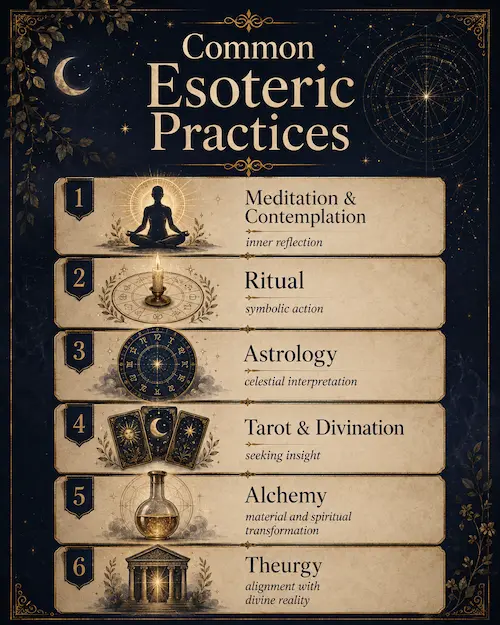
Meditation and Contemplation
Many esoteric traditions value focused attention and inner observation. Practice may involve contemplating a symbol, sacred passage, divine concept, or metaphysical question rather than following one standardized technique. Neoplatonists, for example, treated contemplation as a way of directing the soul toward a higher principle. Comparable practices also appear in distinct Buddhist and Hindu traditions.
Rituals and Ceremonial Practices
A ritual is a structured symbolic action that may involve words, gestures, objects, clothing, timing, music, or sacred space. In esoteric settings, rituals can mark initiation, express devotion, support purification or contemplation, and represent transformation. Not every ritual is magical. Many are primarily devotional, commemorative, or contemplative.
Astrology
Astrology historically interpreted celestial positions and movements as meaningful in relation to earthly life. It influenced Hermetic thought, medieval scholarship, Renaissance philosophy, and later occult movements, often alongside medicine and alchemy. Its historical importance should be distinguished from scientific validation, since modern scientific methods do not support its predictive claims.
Tarot and Divination
Divination uses symbolic methods to seek insight, guidance, or reflection. Forms associated with modern esotericism include tarot, scrying, and numerology. Practitioners may use them for interpretation or structured introspection, but their historical and cultural significance does not establish that they can objectively predict future events.
Alchemy
Historical alchemy combined material experimentation, natural philosophy, medicine, cosmology, and early chemical inquiry. Alchemists studied metals and substances in laboratories while also writing philosophically about matter and transformation.
Spiritual alchemy is a symbolic reading of alchemical transformation in which changes in matter are interpreted alongside the purification or transformation of the practitioner. This approach became especially prominent in later esoteric traditions. Historical alchemy therefore cannot be reduced either to a search for gold or to a purely spiritual metaphor.
Magic and Theurgy
Ceremonial magic generally refers to structured ritual practices involving elements such as invocations, sacred names, and symbolic correspondences. Theurgy, associated especially with late antique Neoplatonism, aims at alignment or communion with divine reality rather than ordinary practical effects. Definitions vary by period and tradition. For a related comparison, see our guide to mysticism vs magic.
Modern Esoteric Practices
Practices now described as esoteric include contemporary witchcraft, astrology, tarot, crystal-related work, manifestation techniques, and energy-oriented approaches. Online communities and courses are major places where people encounter them.
These practices often combine ideas from several historical sources. A modern practice labeled “Hermetic” or “Kabbalistic” may differ substantially from historical Hermeticism or Jewish Kabbalah. Its relationship to older traditions therefore needs to be assessed case by case rather than assumed from the label used today.
Major Western Esoteric Traditions
Western esotericism is an academic category for studying diverse intellectual, religious, and cultural currents shaped within Greco-Roman, Jewish, Christian, and Islamic-influenced settings. It is a field of comparison, not one coherent movement.
Hermeticism
Hermeticism developed in the Hellenistic Mediterranean, especially Roman-era Egypt. The Corpus Hermeticum, attributed to Hermes Trismegistus, explores divine reality, the cosmos, and the destiny of the human soul.
Renaissance translations renewed European interest in these texts and helped connect Hermetic ideas with philosophy, astrology, and alchemy. Hermeticism subsequently became an important reference point for later Western esoteric currents.
Gnosticism
Gnosticism is a broad scholarly category for groups and texts that emphasized gnosis, or direct and revealed spiritual knowledge. Recurring themes include the soul’s divine origin, the condition of the material world, and liberation through spiritual understanding.
It was not a single movement with one authority or doctrine. The surviving sources represent several communities and worldviews that developed in dialogue with early Christianity, and sometimes in conflict with it.
Neoplatonism
Neoplatonism describes philosophical traditions in which reality proceeds from a highest principle, often called the One, and the soul seeks a return toward divine unity. Contemplation was central, while thinkers such as Iamblichus also emphasized theurgy. Neoplatonic ideas influenced later Christian, Islamic, Jewish, and Renaissance philosophy.
Kabbalah
Kabbalah is a Jewish mystical and interpretive tradition concerned with divine creation, sacred language, scripture, and symbolic structures such as the sefirot, often represented as the Tree of Life.
Jewish Kabbalah should be distinguished from Christian Cabala and from Hermetic or occult Qabalah. These later systems adapted Kabbalistic ideas within Christian, ceremonial, and occult frameworks rather than preserving the original tradition unchanged. See our guide to Kabbalah symbols and meanings for a closer comparison.
Rosicrucianism
Rosicrucianism entered public view through anonymous German manifestos published from 1614 to 1616. They described a secret brotherhood and called for reform through Christian, Hermetic, and alchemical ideas. Whether such a brotherhood then existed remains debated, but the texts strongly influenced later initiatory organizations.
Freemasonry
Modern Freemasonry emerged in the early eighteenth century from traditions associated with operative stonemasonry, although its precise institutional origins remain debated. It uses craft imagery, initiation, and progressive degrees for moral instruction. Some Freemasons participated in esoteric currents, but Freemasonry as a whole should not automatically be classified as magical or occult.
Theosophy
The Theosophical Society was founded in New York in 1875, with Helena Petrovna Blavatsky and Henry Steel Olcott among its leading early figures. Theosophy combined Western esoteric currents with nineteenth-century interpretations of Hindu and Buddhist ideas and influenced later occult, artistic, and New Age movements. Those interpretations did not always match Asian traditions in their own cultural settings.
Modern Occultism
Modern occultism includes movements such as Spiritualism, the Hermetic Order of the Golden Dawn, Thelema, Anthroposophy, modern Paganism, and New Age spirituality. These currents combined older Kabbalistic, astrological, magical, philosophical, and religious materials in new organizations and systems, especially from the nineteenth century onward.
A Brief History of Esoteric Traditions
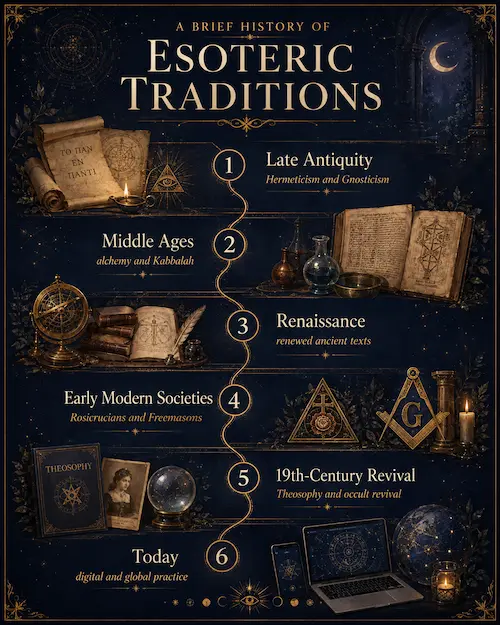
Late Antiquity
Foundational currents developed amid cultural exchange in the Hellenistic Mediterranean. Hermeticism, Gnosticism, Neoplatonism, and theurgy emerged in distinct but sometimes overlapping settings. Ancient mystery religions provide earlier examples of initiation, secrecy, symbolism, and transformative religious experience that scholars sometimes compare with later esoteric currents. See our overview of ancient mystery schools.
The Middle Ages
Astrology, alchemy, Kabbalah, and forms of Christian mysticism developed through the medieval period. Jewish, Christian, and Islamic scholarly networks transmitted philosophical and scientific texts across the Mediterranean rather than leaving medieval Europe culturally isolated.
The Renaissance
Renaissance translations revived classical, Hermetic, and Neoplatonic texts. Renaissance Neoplatonism, Christian Cabala, natural magic, astrology, and alchemy developed as scholars tried to reconcile ancient sources with Christian theology and changing approaches to nature.
Initiatory Societies in Early Modern Europe
Rosicrucianism and Freemasonry helped popularize organized systems of progressive degrees, initiation, and symbolic moral instruction. Their structures later influenced other esoteric societies.
The Nineteenth-Century Occult Revival
The nineteenth century brought Spiritualism, the Theosophical Society, and ceremonial orders such as the Hermetic Order of the Golden Dawn. It also intensified European engagement with Asian religions, although those interpretations were often selective or inaccurate.
Esotericism in the Modern World
The twentieth and twenty-first centuries brought New Age spirituality, modern Paganism, psychological readings of symbolism, and large tarot and astrology communities. Digital platforms widened access, while esotericism also became an established subject of academic research.
Esotericism vs. Occultism vs. Mysticism
These terms overlap, but they are not exact synonyms. Each has a somewhat different emphasis, even though they are often used loosely in everyday conversation.
| Term | Main focus | Typical context |
|---|---|---|
| Esotericism | Inner teachings, symbolic knowledge, and initiatory systems | Broad academic and historical category covering traditions such as Hermeticism, Kabbalah, and Rosicrucianism |
| Occultism | Hidden forces and magical or ritual practice | Especially associated with movements developing from the nineteenth century onward, such as ceremonial magic |
| Mysticism | Direct experience of, or union with, divine or ultimate reality | Found across many religious traditions, both Western and non-Western |
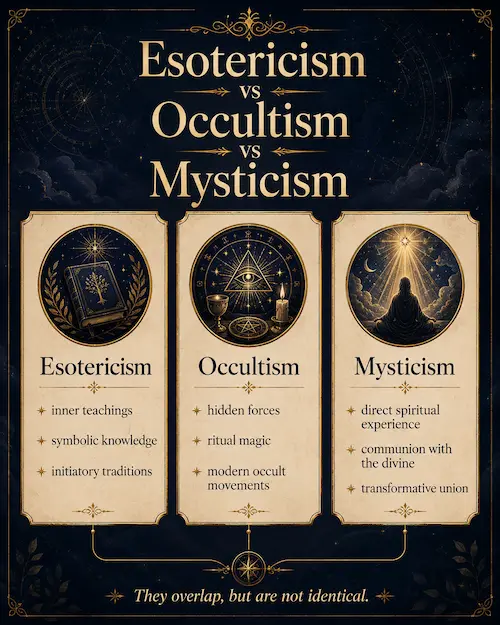
Esotericism is generally the broadest of the three categories, encompassing a wide range of traditions concerned with inner or specialized knowledge. Occultism is often used more narrowly, particularly for movements centered on ritual magic and hidden forces that developed strongly during and after the nineteenth-century occult revival. Mysticism centers most directly on personal spiritual experience, such as a sense of communion or union with the divine, and appears across many traditions that are not necessarily esoteric in structure.
A single tradition can be both esoteric and mystical at once, as with some strands of Kabbalah or Christian contemplative practice. At the same time, not every esoteric tradition involves magic, and not every mystical tradition is esoteric in the sense of relying on restricted or symbolic transmission. For a fuller breakdown of what mysticism itself involves, see our guide on what mysticism means.
Esoteric Traditions Beyond the West
While this article focuses primarily on Western esotericism, distinct esoteric traditions have developed independently in other parts of the world, each with its own history, texts, and institutions. These include Hindu Tantra, a broad family of ritual and philosophical traditions found within Hinduism. They also include Vajrayana Buddhism, sometimes called Tantric Buddhism and prominent in Tibetan Buddhist traditions, and Shingon Buddhism, an esoteric school within Japanese Buddhism. Taoist internal alchemy is a set of contemplative and physical practices aimed at cultivating and refining vital energy within Taoist philosophy, and various currents of Islamic esoteric thought, including strands of Sufism, focus on inner spiritual experience and interpretation.
These traditions share certain general features with Western esotericism, such as initiation, symbolic transmission, mantra or ritual formula, visualization, contemplative practice, and advanced teachings reserved for trained students. However, each developed within its own religious, philosophical, and cultural framework, with distinct aims, texts, and institutional structures. They should not be understood simply as Eastern equivalents of Western occultism, and they should not be collapsed into a single generic category of “Eastern esotericism.”
How Esoteric Traditions Are Practiced Today
Esoteric traditions continue through formal initiatory organizations, religious lineages, study groups, and independent practice. Some Rosicrucian and Masonic bodies retain progressive degrees, while Jewish, Buddhist, and Sufi communities transmit specialized teachings through established teachers and institutions.
Others engage through historical study, primary texts, meditation, ritual, astrology, tarot, and online communities without joining a formal organization.
Some teachings still require initiation, while many texts are public. Because modern practitioners often combine material from several sources, attention to each tradition’s historical and cultural context remains important.
Frequently Asked Questions About Esoteric Traditions
What is an esoteric tradition?
An esoteric tradition is a system of inner, symbolic, advanced, or initiatory teachings concerned with spiritual, religious, or philosophical transformation. It may be transmitted through sacred texts, teachers, rituals, or formal initiation into a group. Esoteric does not always mean completely secret. It can also describe teachings that are publicly available but require guidance or symbolic interpretation to understand fully.
What are some esoteric practices?
Common esoteric practices include meditation, contemplation, ritual, astrology, tarot, other forms of divination, alchemy, and ceremonial magic. The specific practices used depend heavily on the tradition involved. A Neoplatonist philosopher, a Renaissance alchemist, and a modern tarot reader would draw on very different practices, even though all fall under the general label of esoteric practice.
What do esoterics believe in?
There is no single belief shared by all esoteric practitioners, since esotericism is not one religion. Many esoteric traditions place emphasis on inner knowledge, symbolic correspondences between humanity and the cosmos, direct spiritual experience, and personal transformation. However, specific beliefs differ greatly between traditions such as Hermeticism, Kabbalah, Theosophy, and Gnosticism, which hold distinct and sometimes conflicting worldviews.
What are esoteric rituals?
Esoteric rituals are structured symbolic actions used within a spiritual or philosophical tradition, often involving words, gestures, objects, visualization, sacred timing, or a designated ceremonial space. Their purposes can include marking initiation, expressing devotion, supporting contemplation, symbolic purification, or personal transformation. Not every esoteric ritual is intended to perform magic. Many function primarily as structured contemplative or commemorative practice.
What is the difference between esoteric and occult?
Esoteric is the broader term, referring to inner teachings, symbolic interpretation, and specialized spiritual or philosophical knowledge across many historical traditions. Occult is used more narrowly, most often associated with hidden forces and magical practices, particularly within modern occult movements that developed from the nineteenth century onward. The two categories overlap considerably but are not identical.
Conclusion
Esoteric traditions are not one unified belief system, but a diverse collection of teachings and practices concerned with inner knowledge, symbolic interpretation, spiritual experience, and personal transformation. Major Western examples include Hermeticism, Gnosticism, Neoplatonism, Kabbalah, Rosicrucianism, Freemasonry, and Theosophy, each shaped by its own historical and cultural setting. Common esoteric practices, such as meditation, ritual, astrology, divination, and alchemy, take on different meanings depending on the tradition in which they appear. Understanding esoteric traditions requires looking at each one individually, within its own historical context, rather than treating esotericism as a single, interchangeable category.

About the Author
Dana Whitfield
I write about numerology, astrology, mythology, tarot, and world mystical traditions for Mystivora, drawing on years of independent research across comparative religion and symbolic systems. I approach each topic by cross-checking primary texts and established scholarship rather than repeating popular but unverified claims.