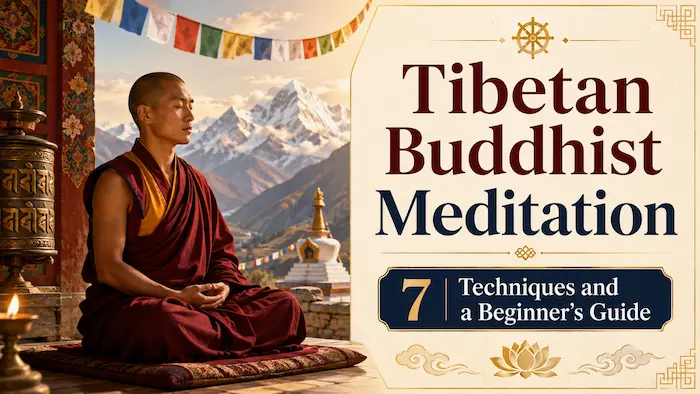
Tibetan Buddhist meditation is a system of contemplative practices used to build concentration, stabilize attention, examine experience clearly, and cultivate compassion within the Tibetan Buddhist tradition. It is not limited to sitting quietly and watching the breath. The tradition also includes analytical reflection, mantra recitation, visualization, and practices aimed specifically at developing compassion, such as Tonglen.
Because Tibetan Buddhism is a Mahayana Buddhist tradition that also includes Vajrayana methods, its meditation practices range from simple, accessible techniques to advanced tantric practices that are traditionally learned directly from a qualified teacher. Beginners are generally encouraged to start with foundational practices, such as breath awareness, calm-abiding meditation, and compassion practice, rather than attempting advanced tantric methods on their own.
This guide explains what Tibetan Buddhist meditation is, how it differs from secular mindfulness, and how to prepare for and practice it. It covers seven core techniques, common breathing methods, a 10-minute guided session for beginners, and an honest look at which advanced practices require direct instruction.
What Is Tibetan Buddhist Meditation?
Tibetan Buddhist meditation is not a single technique but a collection of related contemplative methods practiced within the four major schools of Tibetan Buddhism: Nyingma, Kagyu, Sakya, and Gelug. These methods share common goals but differ in emphasis, sequencing, and specific instructions depending on the lineage and teacher. Bön is a distinct Tibetan religious tradition, although it also contains contemplative practices that developed within the wider Tibetan cultural world.
The Traditional Purpose of Meditation
Within Tibetan Buddhism, meditation is traditionally understood as a method for training and transforming the mind rather than simply relaxing it. The aim is to develop mental stability, clear wisdom, and genuine compassion, while gradually reducing attachment, anger, confusion, and automatic emotional reactions.
Motivation matters a great deal in this framework. Many practices begin by consciously setting an intention, often connected to bodhicitta, the aspiration to reach awakening for the benefit of all beings. This is one reason Tibetan Buddhist meditation is traditionally described as a path rather than a stress-relief technique. The long-term goal in classical texts is described as liberation and awakening, not simply a calmer afternoon.
Relaxation and reduced stress often occur as practitioners meditate, and many people notice these effects early on. However, in the traditional context, relaxation is a byproduct rather than the complete purpose of the practice.
How Tibetan Meditation Differs from Secular Mindfulness
Secular mindfulness and Tibetan Buddhist meditation overlap in practical technique but differ in scope and underlying framework. Secular mindfulness typically isolates present-moment attention as a stand-alone skill, while Tibetan Buddhist meditation situates similar attention skills within a broader system that includes ethics, analytical reflection, and compassion training.
This does not mean secular mindfulness lacks ethical grounding or compassion; many mindfulness programs do incorporate both. The difference lies in how central these elements are to the overall system and how explicitly they connect to a specific philosophical view.
| Aspect | Secular mindfulness | Tibetan Buddhist meditation |
|---|---|---|
| Primary purpose | Present-moment awareness, stress reduction | Mental stability, insight, and progress toward awakening |
| Common objects of attention | Breath, body sensations, sounds | Breath, visual images, mantra, compassion, the mind itself |
| Use of analytical contemplation | Rarely emphasized | Central practice (analytical meditation) |
| Mantra and visualization | Not typically included | Commonly used in many lineages |
| Compassion and bodhicitta | Sometimes included informally | Explicitly cultivated as a core aim |
| Relationship to Buddhist teachings | Usually presented independently of doctrine | Rooted in Buddhist philosophy and lineage instruction |
The Role of Compassion, Wisdom, and Bodhicitta
Compassion in this context refers to the wish for beings, including oneself, to be free from suffering and its causes. Wisdom refers to a clear, direct understanding of experience, rather than intellectual knowledge collected from books alone. Bodhicitta means the aspiration to attain awakening specifically in order to benefit others, and it functions as a guiding motivation across many Tibetan Buddhist practices.
Because motivation shapes the character of a practice, many sessions open with a brief moment of setting intention. A person does not need to accept every element of Buddhist philosophy to benefit from this step; even a simple wish to be more aware and kind can serve a similar function for a beginner.
How to Prepare for Tibetan Buddhist Meditation
Preparing well makes any of the techniques described later easier to practice. Preparation involves posture, choosing an object of attention, and setting a clear motivation.
The Traditional Meditation Posture
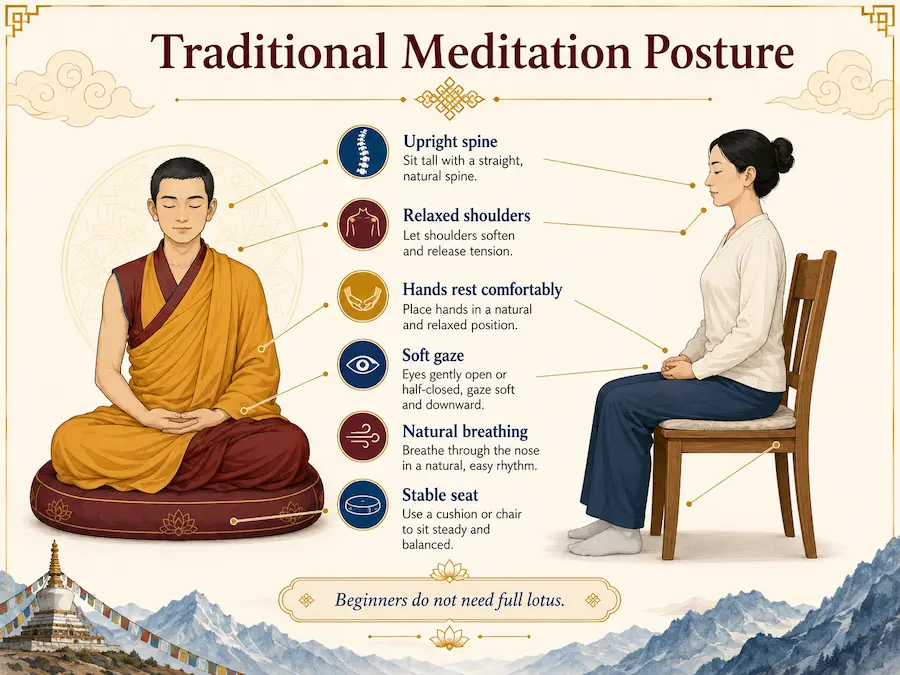
A stable, comfortable posture supports sustained attention without unnecessary strain. Most traditional instructions include the following elements:
- Sit on a cushion on the floor or in a chair, whichever allows a stable base.
- Keep the spine upright but not rigid or stiff.
- Relax the shoulders and unclench the jaw.
- Rest the hands comfortably in the lap or on the knees.
- Let the head balance naturally, with the chin tucked slightly.
- Keep the eyes gently open, half-open, or softly lowered, depending on the specific practice being used.
- Allow the breath to move naturally, without forcing it.
Beginners do not need to sit in a full lotus position. A straight-backed chair works well, and different lineages and teachers offer some variation in specific posture instructions, so no single posture should be treated as mandatory across all of Tibetan Buddhism.
Choosing an Object of Meditation
Most Tibetan Buddhist techniques involve directing attention toward a specific object. Common objects include the natural breath, a visual image such as an image of the Buddha, a mantra, the felt sense of compassion, a specific teaching or contemplative question, or the activity of the mind itself. The object used should match the technique being practiced; breath awareness uses the breath, while analytical meditation uses a topic or question instead.
Setting a Clear Motivation
Before beginning, many practitioners pause briefly to set an intention for the session. A simple example a beginner might use is:
May this practice help me become more aware, patient, and compassionate toward myself and others.
This step reflects the traditional emphasis on motivation shaping the meaning of a practice, but a reader does not need to hold specific religious beliefs to use it. Even a general wish for greater awareness and kindness serves a comparable purpose.
The Two Foundations of Tibetan Buddhist Meditation
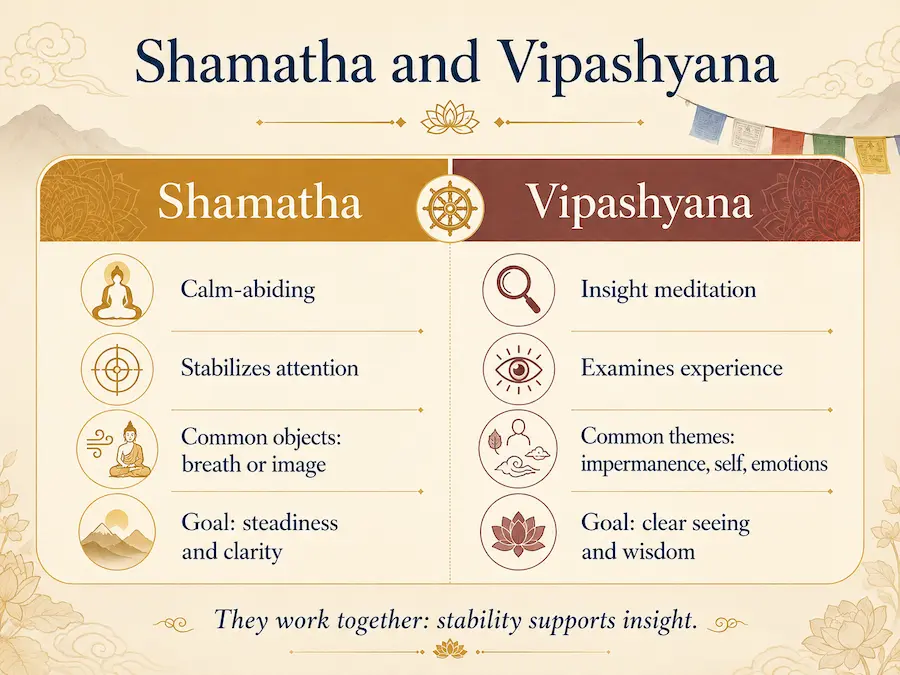
Many Tibetan Buddhist meditation techniques draw on two complementary foundations: calm-abiding meditation and insight meditation. Understanding these two categories makes it easier to see how the seven techniques described later fit together.
Shamatha: Calm-Abiding Meditation
Shamatha is a Sanskrit term usually translated as calm abiding, referring to practices aimed at making attention more stable, clear, and less scattered. In shamatha practice, a practitioner chooses an object, often the breath or a visual image, and repeatedly returns attention to that object whenever it wanders.
Shamatha does not mean forcibly stopping every thought or achieving a completely blank mind. Thoughts continue to arise; the practice involves noticing them without following their content and gently returning to the chosen object. Over time, this repeated return is said to build a steadier and clearer quality of attention, forming a foundation for many Buddhist meditation methods described in later sections.
Vipashyana: Insight Meditation
Vipashyana refers to insight or clear seeing, and it involves examining experience more closely rather than simply resting attention on one object. Common subjects for vipashyana include impermanence, the nature of attachment, the sense of self, emotional patterns, cause and effect, and emptiness.
In Tibetan traditions, vipashyana often includes careful analysis, not only passive observation. This analytical dimension distinguishes it from approaches that treat insight as a purely receptive noticing process. Emptiness, one traditional subject of vipashyana, refers to the absence of a fixed, independent, permanent nature in things, not the claim that nothing exists at all; explaining emptiness fully goes beyond the scope of this beginner-focused guide.
How Shamatha and Vipashyana Work Together
Shamatha stabilizes attention, and vipashyana uses that stability to investigate experience directly. Concentration developed through shamatha without any insight practice can remain limited in its transformative effect, while analysis attempted without a stable foundation of attention can become ordinary intellectual thinking rather than direct insight.
For this reason, Tibetan traditions typically integrate the two rather than treating them as separate paths. A practitioner might first spend several minutes settling the mind through breath awareness, then shift into contemplating impermanence or compassion once attention feels more stable, using the calm developed in the first phase to support clearer reflection in the second.
7 Tibetan Buddhist Meditation Techniques
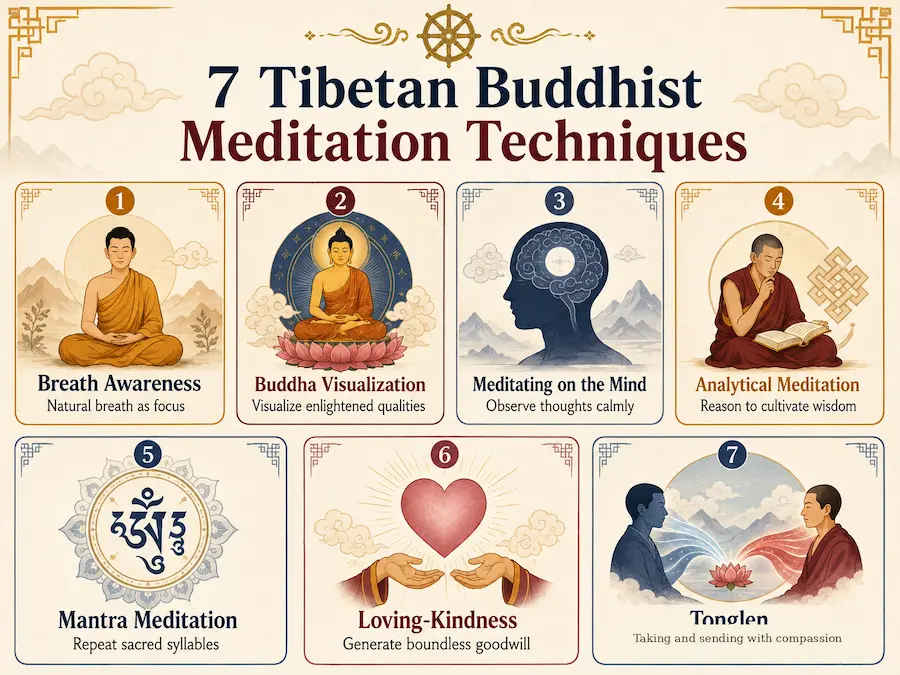
Tibetan monks, nuns, teachers, and lay practitioners do not all follow one identical meditation routine. The specific techniques a person practices depend on their lineage, teacher, level of training, and purpose, so the following seven techniques represent common practices rather than a single fixed program every Tibetan Buddhist follows.
1. Breath Awareness Meditation
Breath awareness involves observing the natural rhythm of breathing without trying to change it. A practitioner typically chooses one clear sensation to focus on, such as the movement of air at the nostrils or the rise and fall of the abdomen, and lets the breath remain unforced throughout the session.
When the mind wanders, which it does regularly, the practice is simply to recognize the distraction and return attention to the breath, without self-criticism. Because it requires no visualization, mantra, or prior study, breath awareness is one of the most accessible entry points into Buddhist meditation practice for beginners, and it also serves as a foundation for several of the other practices described below.
2. Buddha Visualization Meditation
This practice involves visualizing an image of the Buddha in front of the practitioner as a symbol of awakened wisdom and compassion. A practitioner might bring to mind details such as posture, facial expression, and a sense of radiating light, using these details to help sustain attention and evoke a feeling of clarity and warmth.
When the visualization fades or attention wanders, the practitioner gently returns focus to the image. This basic external visualization is distinct from advanced tantric deity practice, which involves generating oneself as a deity and typically requires direct instruction and, in many traditions, formal empowerment. Simple Buddha visualization, by contrast, is generally treated as an accessible practice for beginners and does not involve a claim of literal supernatural communication.
3. Meditating on the Mind Itself
This technique involves becoming directly aware of thoughts, emotions, and the basic knowing quality of experience, rather than focusing on an external object such as the breath or an image. A practitioner observes thoughts as they arise without following their storyline, and may investigate where a thought seems to come from, where it remains while present, and where it goes when it passes.
This is different from suppressing thoughts; the practice involves watching mental activity directly rather than blocking it. Several Tibetan meditation resources describe using the mind itself as an object of meditation, and this approach becomes more subtle and more closely tied to direct guidance as practice deepens, making it a technique where working with an experienced teacher becomes increasingly valuable.
4. Analytical Meditation
Analytical meditation involves selecting a specific teaching or question and examining it deliberately through reasoning, personal experience, and reflection until a clear understanding emerges, at which point attention rests on that understanding rather than continuing to analyze.
Common subjects include impermanence, cause and effect, compassion, the nature of attachment, the value of human life, and the disadvantages of anger. For example, a practitioner examining impermanence might reflect on how their own mood, body, and circumstances have changed over the years, consider specific instances of change they can recall clearly, and then rest attention on the resulting sense of how little in life stays fixed, rather than moving immediately to a new topic.
5. Mantra Meditation
A mantra is a set of syllables recited during meditation, often associated with a particular quality, such as compassion, and used to help focus and steady the mind. Repetition can support stable attention in a way similar to breath awareness while also connecting the practitioner to the specific quality the mantra represents.
Mantras may be recited aloud, in a quiet whisper, or silently in the mind. Om Mani Padme Hum is one of the most widely recognized mantras in Tibetan Buddhism and is commonly associated with Chenrezig, a figure representing compassion. Mantra recitation is sometimes combined with visualization, such as picturing Chenrezig while reciting the syllables. Traditional explanations of a mantra’s precise meaning vary somewhat across teachers and lineages, so this guide does not assign one single definitive translation. There is also no scientific basis for claims that mantras work through specific proven healing frequencies.
6. Loving-Kindness and Compassion Meditation
Loving-kindness meditation and compassion meditation are closely related but distinct: loving-kindness focuses on wishing beings well, while compassion focuses specifically on wishing beings to be free from suffering. Many practitioners use both in the same session.
A common approach begins by directing these wishes toward oneself or toward someone the practitioner already finds easy to care about, such as a close friend or family member. From there, the practice gradually extends outward to neutral people and, eventually, to people the practitioner finds difficult. It is generally recommended not to force a particular emotional intensity; the practice works through repeated, gentle intention rather than manufactured feeling. Traditionally, compassion meditation is also meant to connect with how a person behaves outside of formal practice, not only during seated sessions.
7. Tonglen Meditation
Tonglen is a Tibetan term generally translated as “sending and taking” or “taking and sending,” and it is a compassion practice that uses the rhythm of breathing as its structure. On the in-breath, the practitioner acknowledges a form of suffering, either their own or another person’s; on the out-breath, the practitioner imagines sending relief, courage, kindness, or well-being in its place.
Many teachers recommend that beginners start with a manageable personal difficulty rather than an overwhelming one, gradually expanding the practice toward others’ suffering as it becomes more familiar. It is worth clarifying that practitioners are not literally absorbing another person’s disease, trauma, or physical suffering into their bodies; the breath serves as a symbolic structure for the practice rather than a literal transfer. People experiencing intense emotional distress may find a gentler compassion practice, or guidance from a qualified teacher, more appropriate than pushing through an overwhelming version of Tonglen on their own.
Tibetan Buddhist Breathing Techniques
Breathing plays a supporting role across several Tibetan Buddhist practices, but Buddhist breathing techniques are not the entirety of Tibetan Buddhist meditation. The methods below range from simple beginner approaches to advanced techniques that require direct instruction.
Basic Mindful Breathing
A simple mindful breathing session generally follows these steps:
- Sit in a stable, comfortable position.
- Allow the body to relax without slumping.
- Let the breath move naturally, without controlling its pace or depth.
- Notice the clearest sensation of breathing, such as at the nostrils or abdomen.
- Recognize thoughts and sensations as they arise, without fighting them.
- Gently return attention to the breath.
- Continue for five to ten minutes.
The purpose of this practice is to build awareness and stability, not to force deeper or slower breathing than feels natural.
Counting the Breath
Counting the breath adds a simple structure to basic breath awareness. A practitioner counts each complete breath cycle, moving from one to ten, and then either starts over at one or continues counting depending on personal preference. If attention wanders and the count is lost, the practitioner simply returns to one rather than becoming frustrated. Some practitioners drop the counting altogether once attention feels stable, shifting to open breath awareness instead.
Nine Purification Breaths and Other Advanced Methods
The Nine Purification Breaths are a preparatory practice found in Tibetan contemplative traditions, including Bön and some Buddhist lineages. Instructions vary by tradition and may combine breath, visualization, posture, and preparatory intention, so a single online version should not be treated as universal.
The Nine Purification Breaths are distinct from Tummo, an advanced tantric practice involving inner heat, subtle channels, and specific breath retention methods, which is covered later in this guide. Because these advanced methods use specialized breath-retention and subtle-body instructions, this article does not provide detailed guidance; they are traditionally learned directly from a qualified teacher.
A 10-Minute Tibetan Buddhist Meditation for Beginners
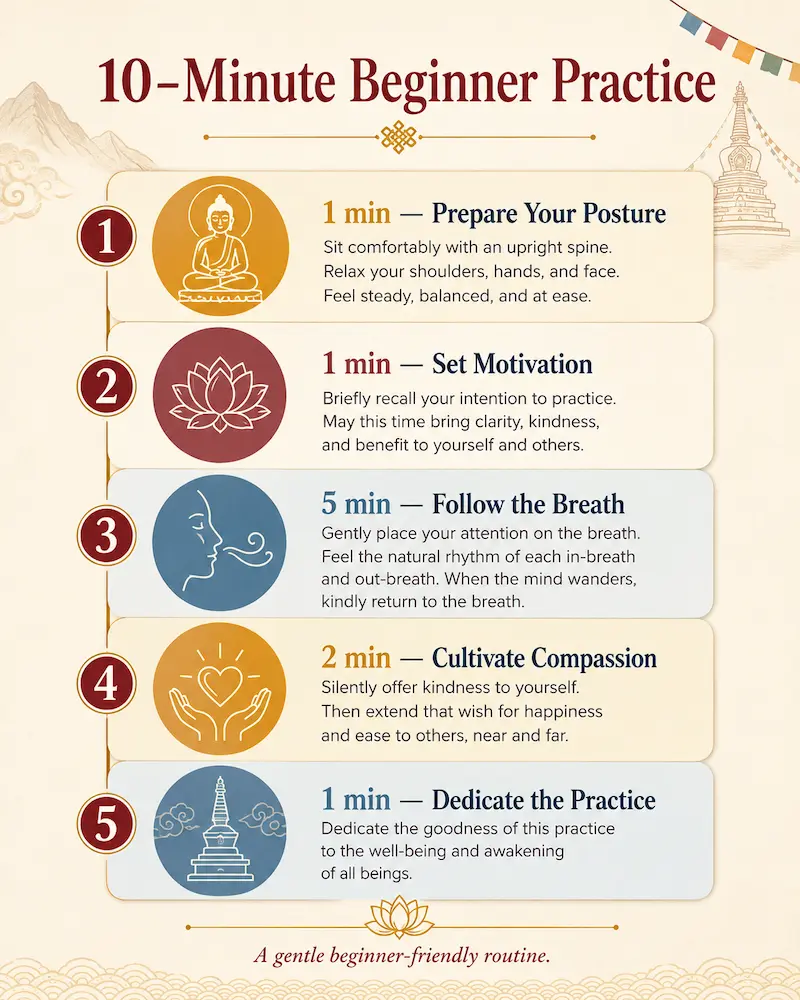
This short guided session draws on the foundational elements described earlier in this guide: posture, motivation, breath awareness, and compassion. It reflects common elements across several lineages rather than the specific practice of any single tradition.
Step 1: Prepare Your Posture
Suggested time: about one minute
Find a stable seat, either on a cushion or in a chair. Let the spine be upright but not stiff, soften the shoulders, and allow the gaze to rest gently, either half-open or lightly closed. Let the breath move naturally.
Step 2: Set a Compassionate Motivation
Suggested time: about one minute
Pause briefly and bring to mind a simple intention for the session, such as a wish to become more aware and more kind toward yourself and others. There is no need to force a particular feeling; a quiet, sincere thought is enough.
Step 3: Rest Attention on the Breath
Suggested time: about five minutes
Bring attention to the natural sensation of breathing, without controlling it. When the mind wanders, which it will, some practitioners find it useful to note “thinking” quietly and then return attention to the breath. Repeat this gently for the remainder of the five minutes.
Step 4: Cultivate Compassion
Suggested time: about two minutes
Bring to mind yourself, or someone you care about, and form a simple wish for their relief from difficulty and for their well-being. Keep this brief and gentle rather than emotionally intense; this beginner routine does not include the fuller Tonglen practice described earlier.
Step 5: Dedicate the Practice
Suggested time: about one minute
Before ending the session, take a moment to recognize any sense of calm or clarity that arose during the practice. Set an intention to carry some of that awareness into ordinary activities, and consider wishing that the practice contribute, in some small way, to the well-being of others.
Advanced Tibetan Buddhist Meditation Practices
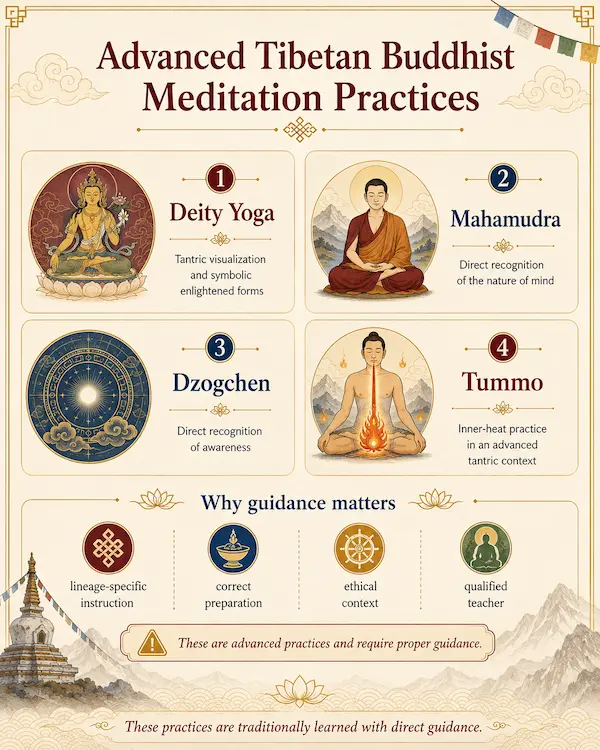
Tibetan Buddhism includes advanced meditation systems that cannot be responsibly reduced to a short internet tutorial. These practices are described here at a general, informational level rather than as instructions to follow independently.
Deity Yoga and Tantric Visualization
Deity yoga is a tantric practice that involves working with symbolic enlightened forms, combining mantra, visualization, a shift in perceived identity, and an understanding of emptiness. Traditional presentations distinguish between visualizing a figure in front of oneself, which is closer to the simple visualization described earlier, and generating oneself as a deity, a more advanced practice.
Deity self-generation traditionally requires empowerment and guidance from a qualified teacher, along with oral transmission and specific instruction, and it may involve ethical commitments the practitioner agrees to uphold. For these reasons, this guide does not provide a self-generation ritual.
Mahamudra
Mahamudra is a set of meditation instructions strongly associated with the Kagyu tradition, though related teachings appear in other lineages as well. Its focus is on directly recognizing the nature of mind. Mahamudra involves specific preparation, a particular view of mind and reality, and direct instruction from a teacher; describing it simply as “doing nothing” misrepresents both its depth and its structured approach.
Dzogchen
Dzogchen holds a central place in the Nyingma school and in the Bön tradition, and its focus is on directly recognizing awareness itself. There is an important difference between a philosophical summary of Dzogchen, such as the one offered here, and actual practice instruction, which is traditionally transmitted directly by a qualified teacher. Presenting Dzogchen as a generic open-awareness exercise available to anyone without guidance does not reflect how the tradition itself approaches this practice.
Tummo and Subtle-Body Practices
Tummo is an advanced tantric practice, often translated as inner heat, that may involve specific breathing methods, visualization, and work with subtle channels and winds described in tantric physiology. It is not simply a technique for warming the body, and it belongs to an advanced tantric context rather than to ordinary breath awareness. Because Tummo uses specialized breath-retention, visualization, and subtle-body instructions, this guide does not provide practice directions; beginners should not attempt it based on an article alone.
Why Advanced Practices Require a Qualified Teacher
Advanced Tibetan Buddhist practices are traditionally learned directly from a qualified teacher for several reasons: correct context and preparation matter, instructions are often lineage-specific, the practices come with ethical commitments, a teacher can adjust guidance for an individual student’s particular difficulties, and direct guidance helps prevent serious misunderstanding of subtle instructions. This does not mean every teacher is infallible; students are traditionally encouraged to use discernment and to evaluate a teacher’s conduct and qualifications over time.
What Are the Benefits of Tibetan Buddhist Meditation?
Tibetan Buddhist meditation is traditionally understood to develop specific spiritual qualities over time, and some practitioners also report benefits in daily life, though these outcomes are not guaranteed and should not be confused with medical treatment.
Traditional Spiritual Benefits
Traditional texts describe sustained practice as developing qualities such as greater stability of attention, more awareness of habitual reactions, reduced attachment and hostility, deeper compassion, a clearer understanding of the mind, and growth in wisdom and bodhicitta. These are described as aims cultivated gradually through consistent practice, not as automatic or guaranteed results of a single session.
Possible Benefits in Everyday Life
Some practitioners find that meditation practice supports everyday life in modest, practical ways. These may include improved awareness of one’s own distraction, a brief pause before reacting to a difficult situation, greater emotional perspective, more intentional behavior, and increased patience and compassion toward others. These outcomes vary from person to person and are not promised by any particular technique.
What Meditation Cannot Guarantee
Meditation does not guarantee permanent calm, and it does not eliminate every thought or difficult emotion. It is not a substitute for medical or mental health care, and it should not be used to dismiss serious emotional distress that may benefit from professional support. Meditation practice also does not automatically make someone more ethical or spiritually advanced; the tradition itself connects meditation with ongoing effort in conduct and understanding, not with practice alone.
Which Tibetan Meditation Techniques Are Suitable for Beginners?
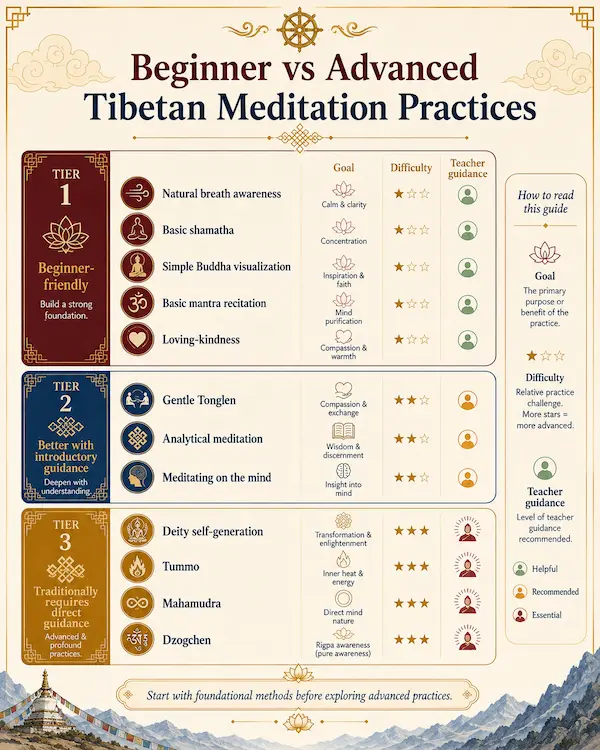
Beginners are generally well-suited to foundational practices such as breath awareness, basic calm-abiding meditation, simple visualization, and compassion practice, while advanced tantric methods traditionally require direct instruction from a qualified teacher.
| Practice | Primary purpose | Difficulty | Beginner-friendly? | Is a teacher needed? |
|---|---|---|---|---|
| Natural breath awareness | Build stable attention | Low | Yes | Not required to begin |
| Basic shamatha | Calm and stabilize the mind | Low to moderate | Yes | Usually not required to begin |
| Simple Buddha visualization | Focus attention, evoke wisdom and compassion | Moderate | Usually | With introductory guidance helpful |
| Basic mantra recitation | Stabilize attention, evoke a quality such as compassion | Low to moderate | Yes | Not required to begin |
| Loving-kindness | Cultivate goodwill toward beings | Low | Yes | Not required to begin |
| Gentle Tonglen | Cultivate compassion using the breath | Moderate | With introductory guidance | With introductory guidance helpful |
| Analytical meditation | Develop insight through reflection | Moderate | Usually | With introductory guidance helpful |
| Meditating on the mind | Directly examine mental activity | Moderate to high | With introductory guidance | Direct instruction traditionally recommended |
| Deity self-generation | Tantric transformation practice | High | Not as a self-taught beginner practice | Empowerment and instruction required in traditional contexts |
| Tummo | Advanced tantric inner-heat practice | High | Not as a self-taught beginner practice | Direct instruction traditionally recommended |
| Mahamudra | Recognize the nature of mind | High | Not as a self-taught beginner practice | Direct instruction traditionally recommended |
| Dzogchen | Directly recognize awareness | High | Not as a self-taught beginner practice | Direct instruction traditionally recommended |
Advanced practices are not inherently forbidden to interested newcomers; they simply require appropriate context, preparation, and guidance that a self-taught approach cannot provide.
Common Beginner Mistakes
Trying to Empty the Mind
Many beginners assume meditation requires stopping all thoughts. In practice, noticing distraction and gently returning attention to the chosen object is a normal and expected part of the process, not a sign of failure.
Forcing the Breath
Basic breath awareness relies on natural, unforced breathing. Deliberately slowing, deepening, or holding the breath during a basic session works against the purpose of simply observing what is already happening.
Switching Methods Too Frequently
Changing techniques every day can prevent a practitioner from developing familiarity with any single method. Practicing one foundational technique consistently over weeks or months is often more useful for building stability than sampling a new method daily.
Starting with Advanced Practices
Tummo, deity self-generation, and other advanced tantric methods are not beginner breathing exercises, despite sometimes being described that way online. Attempting these practices without proper preparation and guidance can lead to physical strain or serious misunderstanding of the instructions.
Chasing Visions or Unusual Sensations
Lights, warmth, tingling, a sense of bliss, or unusual imagery sometimes arise during meditation. These experiences are not reliable indicators of spiritual attainment, and treating them as a goal can distract from the actual purpose of the practice.
Separating Meditation from Daily Conduct
Tibetan Buddhist meditation is traditionally connected to ethics, compassion, patience, and behavior outside the meditation session itself. Treating meditation as an isolated activity disconnected from daily conduct overlooks an important part of how the tradition understands practice.
Frequently Asked Questions
How do Tibetan Buddhists meditate?
Tibetan Buddhists use a range of techniques, including calm-abiding meditation, insight meditation, analytical meditation, mantra recitation, visualization, and compassion practices such as Tonglen. The specific combination and emphasis vary by lineage, teacher, and the practitioner’s level of experience, so there is no single method that represents every Tibetan Buddhist’s practice.
How is Tibetan Buddhism different from other forms of Buddhism?
Tibetan Buddhism is a form of Buddhism, not a separate religion, and it shares foundational teachings with other Buddhist traditions, including the Mahayana emphasis on compassion and the aspiration to benefit all beings. Its distinctive features include Vajrayana methods, elaborate visualization practices, mantra recitation, tantric systems such as deity yoga, close lineage-based teacher-student transmission, and extensive philosophical study. Not every Tibetan Buddhist practices tantra; many focus primarily on foundational practices and study.
What is the most powerful Buddhist meditation?
There is no single meditation method that is universally considered the most powerful. Effectiveness depends on factors such as the practitioner’s specific needs, level of preparation, depth of understanding, consistency of practice, quality of guidance, and how the practice connects to ethical conduct in daily life. For most beginners, foundational practices such as breath awareness and calm-abiding meditation are more appropriate starting points than advanced methods.
How many hours a day do Tibetan monks meditate?
There is no single fixed number of hours that applies to all Tibetan monks. Monastic schedules vary considerably depending on the specific monastery, lineage, a monk’s particular role, ongoing study programs, ritual responsibilities, philosophical debate, work duties, and whether the monk is currently in a dedicated retreat period.
Do you need a teacher to practice Tibetan Buddhist meditation?
Simple practices such as breath awareness, basic calm-abiding meditation, and gentle compassion meditation can often be explored without formal initiation from a teacher, though a trustworthy teacher can improve a practitioner’s understanding at any stage. Advanced practices, including tantric deity self-generation, Tummo, and certain Mahamudra or Dzogchen instructions, traditionally require direct guidance from a qualified teacher and, in many cases, formal empowerment.
Final Thoughts
Tibetan Buddhist meditation is best understood as a family of related practices rather than one single technique. Calm-abiding meditation and insight meditation form the foundation that supports nearly everything else in the system, while breath awareness, simple visualization, mantra recitation, and compassion practices such as loving-kindness and Tonglen offer accessible entry points for newcomers.
Beginners benefit most from practicing consistently with foundational methods rather than rushing toward advanced tantric practices, which traditionally require direct instruction from a qualified teacher. Understood within its own tradition, the purpose of this meditation extends well beyond relaxation, toward the gradual development of wisdom, compassion, and a clearer understanding of the mind.

About the Author
Dana Whitfield
I write about numerology, astrology, mythology, tarot, and world mystical traditions for Mystivora, drawing on years of independent research across comparative religion and symbolic systems. I approach each topic by cross-checking primary texts and established scholarship rather than repeating popular but unverified claims.
Related Articles
View All Articles → Mysticism