Ancient mystery schools were initiatory religious or philosophical traditions that revealed sacred teachings through ritual, symbolism, and personal experience. They were not a single organization, and many were not schools in the modern academic sense.
People joined these traditions voluntarily, and most required a period of preparation before a formal initiation could take place. Some rites centered on the fate of the soul, confronting death, and imagining what (if anything) came after it. The best-documented traditions developed in Greece and later spread through the Roman Empire, with additional threads connecting to religious practice in Egypt.
This guide looks at what mystery schools actually were, why secrecy mattered to them, what they taught, how initiation worked, and which traditions left the clearest historical trace, while keeping a firm line between what is documented, what is scholarly interpretation, and what is modern speculation. Mystery schools are sometimes discussed as part of the wider category of mysticism, though the two terms aren’t interchangeable, as the sections below make clear.
What Were the Ancient Mystery Schools?
“Mystery schools” is a modern umbrella term. It does not refer to one coordinated institution but to a range of independent traditions, each with its own deities, rituals, and goals, from a farming goddess’s rites outside Athens to a soldier’s cult centered on a bull-slaying god imported from the eastern Mediterranean.
What Did “Mystery” Mean in the Ancient World?
The word comes from the Greek mysterion, tied to the idea of initiation and secrecy. It referred to something revealed only to initiates (people who had gone through the required rites) rather than to a puzzle or an unexplained event, which is closer to how English uses “mystery” today.
Were They Actually Schools?
Not usually, at least not in the sense of a curriculum-based institution. The Eleusinian and Mithraic traditions functioned mainly as ritual communities built around a shared initiation experience rather than ongoing instruction. The Pythagorean community is the exception that looks more like a philosophical school, with shared teachings, a common way of life, and an internal hierarchy.
Historians and classicists generally prefer terms like “ancient mysteries,” “mystery religions,” or “mystery cults.” “Mystery school” (sometimes seen as “mystic schools” or “esoteric schools” in popular writing) is common in modern esoteric writing, but it isn’t always the most historically precise label.
Mystery Religions and Public Religion
Public religion in the Greek and Roman world was tied to the city-state: civic festivals, state-sponsored sacrifices, and communal obligations open to citizens by default. Mystery traditions layered something different on top of that: personal participation and initiation that had to be actively sought out.
Joining a mystery cult didn’t require abandoning public religious life, and it wasn’t unusual for a person to be initiated into more than one tradition over a lifetime.
Why Were the Mystery Schools Secret?
Secrecy protected the sacred character of the rites, restricting the experience to those who had gone through the proper preparation. It maintained a clear boundary between initiates and outsiders, and in several traditions, members swore explicit oaths not to describe what they had witnessed.
What was kept secret wasn’t necessarily a body of forbidden knowledge. It was often the specific things an initiate saw, heard, or did during the ceremony itself. The central rites of many mystery traditions were revealed primarily through initiation and were rarely described openly in writing. That is why modern scholars must piece these traditions together from archaeology, inscriptions, and accounts written by outsiders or later commentators rather than from complete explanations by initiates.
What Did Ancient Mystery Schools Teach?
There was no single shared curriculum across all mystery schools. Themes overlapped, but each tradition emphasized its own combination of ideas.
The Soul and the Afterlife
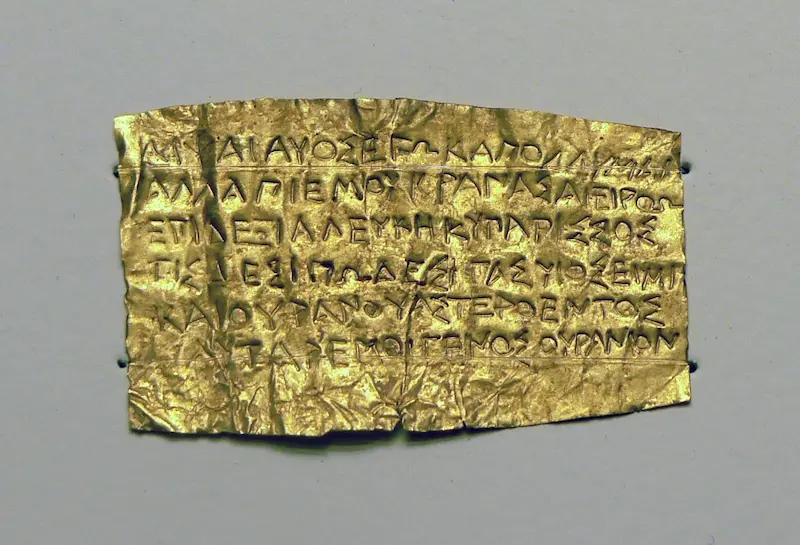
A recurring concern was what happened to the soul after death, along with the hope for a better fate in the afterlife and a sense that the soul could be prepared for what came next. The Orphic gold tablets (small inscribed sheets buried with initiates, found across the Greek world and into southern Italy) are a concrete example of this concern, offering the dead guidance for the journey after death. Not every tradition shared an identical doctrine of the soul. The emphasis and details varied.
Death, Rebirth, and Personal Transformation
Several traditions drew on myths built around descent and return: Persephone’s abduction into the underworld and seasonal return, Osiris’s death and restoration, and Dionysus’s own mythic death and rebirth. Initiation in these traditions often involved symbolic death and renewal, and could reshape how a participant understood mortality and their own place in the world.
Purification, Ethics, and Self-Discipline
Preparation for initiation commonly involved ritual cleansing, fasting or other forms of abstinence, and instruction in expected conduct. Some communities, particularly the Pythagoreans, layered on dietary rules and a broader code of personal discipline that extended well beyond the initiation ceremony itself.
Divine Knowledge and Sacred Order
Many traditions framed initiation as a way of understanding the relationship between mortals and the gods, the cycles of nature, and a broader sacred order, a sense of harmony connecting the individual soul, the community, and the cosmos.
Did They Teach Astrology, Alchemy, and Sacred Geometry?
This deserves a careful answer. Pythagorean tradition has a clearer historical connection to mathematics, music theory, and the idea of cosmic harmony. Some ancient texts and ritual traditions did incorporate astrological or ritual knowledge in various forms. Alchemy, Hermeticism, Kabbalah, and ceremonial magic, however, developed in their own distinct historical contexts, often centuries later or in different regions.
Modern esoteric writing frequently bundles all of these into a single “mystery school curriculum,” but the historical evidence doesn’t support the claim that every ancient mystery school taught astrology, alchemy, or sacred geometry as core subjects.
How Did Initiation Into a Mystery School Work?
Ancient initiation rituals differed by tradition, but several patterns recur across the record.
Preparation and Purification
Candidates typically underwent ritual washing, fasting, prayer, and sometimes sacrifice. Temporary abstinence from certain foods or activities was common, along with instruction in the rules and expected conduct of the rite ahead.
Processions and Sacred Journeys
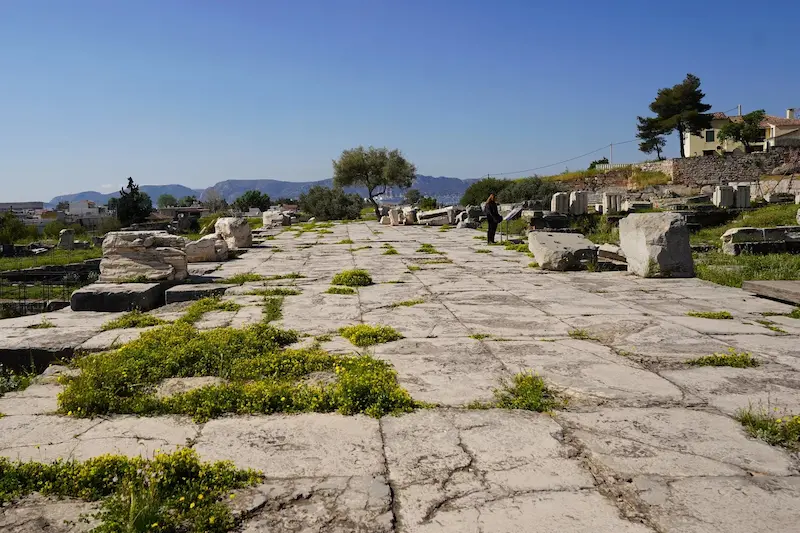
Some rites opened with a public procession, moving participants from an everyday setting toward a sacred site. The Sacred Way, the road connecting Athens to Eleusis, is the clearest surviving example of this kind of ritual journey.
The Secret Ceremony
Accounts and archaeological remains suggest a ceremony could involve darkness followed by sudden light, sacred words, music or ritual sound, dramatic reenactment of myth, sacred objects, and revelation performed by priests. Because these ceremonies were deliberately kept secret, it isn’t possible to fully reconstruct every detail of what took place.
Revelation and Transformation
Initiation wasn’t simply a lesson delivered in words. Participants experienced the rite directly, and understanding was transmitted through seeing, hearing, and taking part rather than through explanation alone. The underlying goal was often a shift in how the initiate understood the gods, the soul, or death itself.
Levels of Initiation
Several traditions built in stages. Eleusis distinguished between the Lesser Mysteries and the Greater Mysteries, while Mithraic initiation involved multiple named grades. There was no single shared system of ranks across all mystery schools. Each tradition structured its stages differently, if it had stages at all.
The Major Ancient Mystery Schools and Traditions
The Eleusinian Mysteries
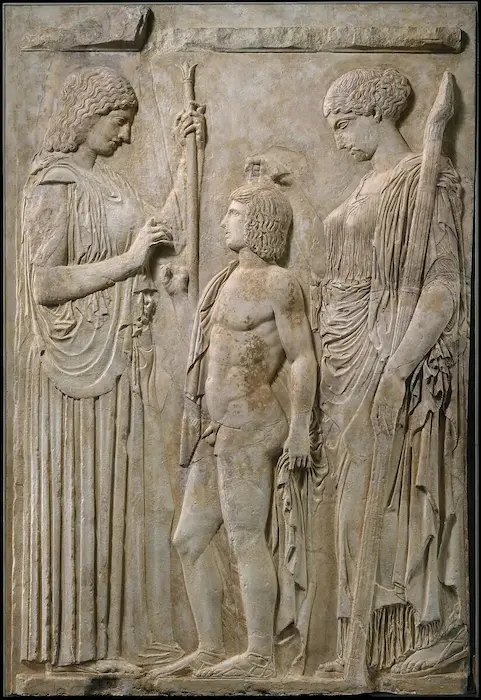
The Eleusinian Mysteries, centered at Eleusis near Athens, are the best-documented and most influential of the ancient mystery traditions. They were built around Demeter, goddess of agriculture, and her daughter Persephone, whose abduction by Hades and eventual return structured the central myth, a story that resonated with the agricultural cycle of loss and renewal, and, by extension, with human death and hope for what follows it.
Initiation unfolded in stages. The Lesser Mysteries, held in spring, served as preparation for the Greater Mysteries, celebrated in early autumn over roughly nine days. The Greater Mysteries opened with a procession along the Sacred Way from Athens to Eleusis, accompanied by ritual purification (including bathing in the sea) and a period of fasting. Participants drank kykeon, a barley-based beverage, breaking their fast in a way that echoed Demeter’s own actions in the myth.
The culminating rites took place inside the Telesterion, a large hall built specifically for the Mysteries at Eleusis, where initiates witnessed the central revelation. What exactly took place inside has never been reconstructed with certainty, since initiates were bound to secrecy and no surviving source describes it in full. What ancient sources do suggest is that participants came away with some kind of promise or hope concerning their fate after death.
Participation was notably open by ancient standards: citizens, non-citizens, and, according to ancient sources, enslaved people could be initiated, provided they met the ritual requirements, spoke Greek, and had not committed murder. This was broader access than many people assume today.
Was Kykeon a Psychedelic Drink?
One long-standing hypothesis holds that kykeon contained a substance capable of altering consciousness, sometimes linked to ergot, a fungus that grows on grain and contains compounds related to LSD, or to other psychoactive ingredients. This remains a hypothesis, not a settled fact. No direct evidence confirms that kykeon contained a psychoactive ingredient, and the surviving traditional recipe does not settle the debate. A powerful subjective experience at Eleusis does not, on its own, prove psychedelic use.
The Orphic Mysteries
Orphism took its name from Orpheus, the legendary poet and musician credited as its founding figure, and existed less as a single organized cult than as a loose network of texts, hymns, and practicing communities across the Greek world. Orphic teaching held that the soul had a divine origin or nature in at least some versions of the tradition, and framed ritual purification and disciplined living (including dietary restrictions in some communities) as a way of working toward the soul’s release from a cycle of repeated mortal existence.
The Orphic gold tablets, small inscribed sheets buried with initiates, offer some of the clearest surviving evidence: short texts meant to guide the soul through the afterlife, sometimes phrased as instructions for what to say and where to go. Orphism should not be understood as a single centralized organization. It’s better described as a shared body of myth, text, and practice that took different local forms.
The Dionysian Mysteries
Dionysian mystery rites centered on Dionysus, god of wine, ecstasy, and altered states of consciousness, and involved music, dance, wine, and communal ritual aimed at a kind of liberation from ordinary social and psychological boundaries. Myths of Dionysus’s own death and rebirth gave the tradition its own version of the descent-and-return motif found elsewhere in Greek religion.
It’s worth distinguishing between the public worship of Dionysus (civic festivals such as the Athenian Dionysia, which centered on theater and public celebration) and the private, initiatory rites associated with his mystery cult. Not all Dionysian worship should be characterized as chaotic or uncontrolled. Much of it, including the public festivals, was highly structured.
The Mysteries of Samothrace
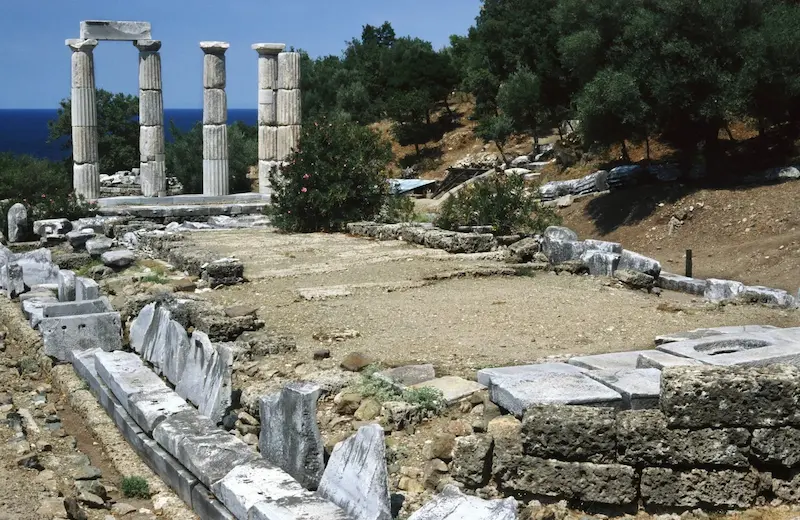
The sanctuary on the island of Samothrace hosted initiation rites dedicated to a group known as the Great Gods, whose precise identities remain debated by scholars. The cult was known for offering protection at sea and safe travel to initiates, and it drew participants from across the Greek and later Roman worlds, without the same restrictions on background found in some other traditions. Much about the exact content of Samothracian initiation remains unclear, since, as with Eleusis, the central rites were kept secret.
The Mysteries of Isis and Osiris
This tradition drew on the Egyptian myth of Osiris’s death and restoration by Isis, who was worshipped in the Greco-Roman mysteries as a healer, protector, and restorer figure offering initiates hope of renewal beyond death. Isis worship spread widely through the Greco-Roman world in the Hellenistic and Roman periods, well beyond Egypt’s borders.
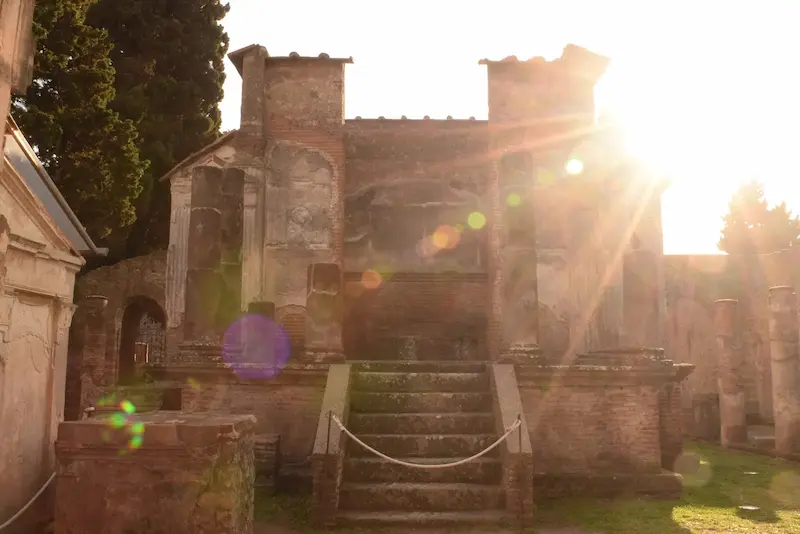
The most detailed surviving account of an initiation into the mysteries of Isis comes from the novel The Golden Ass by the Roman writer Apuleius, which describes the fictional character Lucius undergoing initiation. This is a valuable source, but it’s a literary work, not a ritual manual, and shouldn’t be treated as a complete or verbatim record of what every Isis initiation involved. It’s also worth distinguishing between ancient Egyptian religious practice surrounding Osiris and Isis and the later Greco-Roman mystery cult that grew up around them, related but not identical.
The Mithraic Mysteries
The cult of Mithras was a Roman-era mystery tradition, primarily restricted to men, that found particular popularity among soldiers, officials, and merchants across the empire. Its rites took place in mithraea (underground or enclosed sanctuaries built to resemble caves) decorated with the tauroctony, an image of Mithras slaying a bull, found at sites throughout the Roman world.
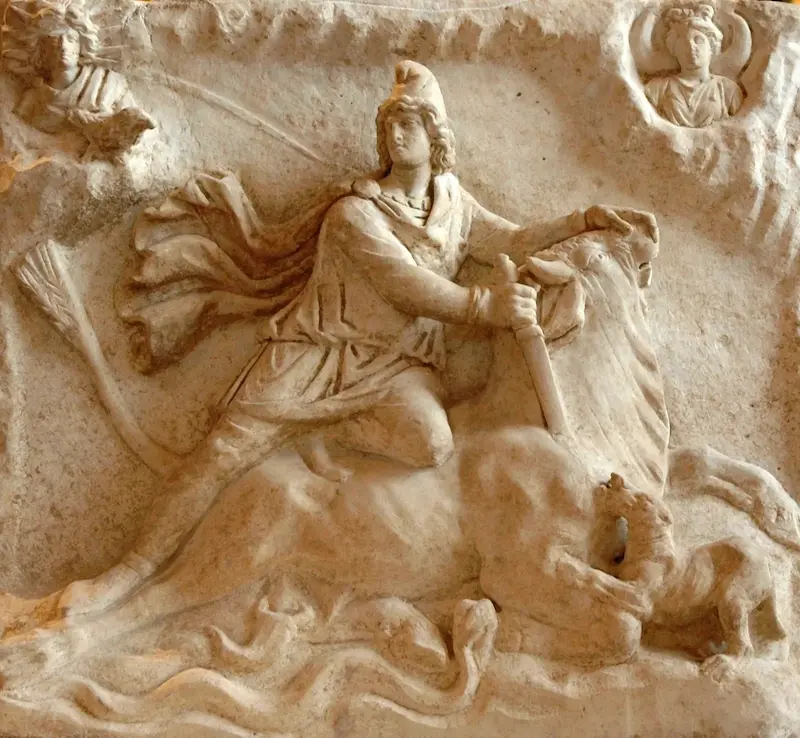
Initiation involved a graded structure, commonly cited as seven ranks, along with ritual meals shared among members. No Mithraic scripture survives to explain the cult’s full belief system in its own words, which leaves much of its theology to be inferred from imagery and inscriptions rather than stated directly. Despite some structural similarities to early Christianity (shared meals, a hierarchy of initiation, moral expectations), the evidence does not support the claim that either tradition directly copied the other.
The Pythagorean School
Founded around the philosopher and mathematician Pythagoras, this community combined mathematics and the study of number, music and the idea of cosmic harmony, belief in the transmigration of the soul, and a disciplined communal way of life that included dietary rules and secrecy around certain teachings.
The Pythagorean community is best understood as a philosophical-religious community with initiatory features of its own, rather than a mystery cult in the same mold as Eleusis or the Mithraic mysteries. Its influence on later Greek philosophy, particularly Platonism, was substantial.
The Mysteries of Cybele and Attis
Originating in Anatolia and later spreading into the Roman world, this cult centered on Cybele, worshipped as the Great Mother, and her consort Attis, whose myth carried its own themes of loss, death, and renewal. Rites involved music, procession, and intense ritual performance, and the cult eventually received official recognition in Rome.
Other Lesser-Known Mystery Traditions
A number of smaller or more regionally confined mystery traditions round out the picture. The Cabiri, or Kabeiroi, were the focus of mystery rites on the island of Lemnos and elsewhere, with a character distinct from the Samothracian mysteries, though the two are sometimes confused. The Andanian Mysteries, centered in Messenia in the Peloponnese, are known partly through a surviving inscription detailing ritual regulations. Sabazios, a Phrygian and Thracian deity later associated with Dionysus and sometimes with Zeus, had his own initiatory following in parts of the Greek and Roman world. Various local Thracian and Anatolian rites left traces in inscriptions and archaeology, though rarely enough to reconstruct in detail.
Did Ancient Egypt Have Mystery Schools?
Not every Egyptian temple should be described as a mystery school, and the term needs careful handling here.
Egyptian Temples as Centers of Sacred Knowledge
Egyptian temples housed priests, scribes, and ritual specialists, and served as repositories of religious, medical, astronomical, and administrative knowledge. Some texts and rites were restricted to people holding the appropriate priestly office. Much of what’s known about this comes from the broader record of ancient Egyptian ritual practice (daily temple worship, restricted sanctuary access, and the priestly use of heka), which creates a genuine point of comparison with esoteric schools elsewhere, but it doesn’t establish that ancient Egypt had a unified “mystery school” system in the sense the modern term implies.
The Houses of Life
The Egyptian institution known as the Per Ankh, or “House of Life,” was connected to temples and scribal activity, involved in copying, preserving, and composing texts, with possible links to medicine, ritual knowledge, and education. These should not be characterized as occult academies in the modern sense. They functioned as scribal and religious institutions embedded in temple administration.
Were Greek Philosophers Initiated in Egypt?
Ancient and later traditions claim that figures such as Pythagoras or Plato studied in Egypt. Genuine intellectual exchange between Greek and Egyptian cultures did take place. However, many of the specific details about lengthy study periods and initiation in Egypt come from later sources, sometimes written centuries after the fact. These stories are best presented as traditions or claims rather than established fact.
History Versus Modern Legend
It helps to separate what’s historically supported from what isn’t.
Historically supported: temple rituals, priestly knowledge restricted by office, the Houses of Life, funerary texts, the Isis and Osiris traditions, and religious roles limited to qualified personnel.
Not historically established: a single worldwide Egyptian Mystery School system, Atlantis as its source, a universal curriculum encompassing chakras, tarot, and modern energy healing, or an unbroken secret lineage running continuously into modern organizations.
What Evidence Do We Have for the Mystery Schools?
Archaeology and Inscriptions
The physical record includes sanctuaries, the Telesterion at Eleusis, mithraea scattered across the former Roman Empire, statues and relief carvings, ritual objects, inscriptions naming initiates, and the Orphic gold tablets recovered from burials.
Ancient Written Sources
Useful, if imperfect, written evidence comes from authors including Plato, Cicero, Plutarch, Pausanias, and Apuleius, along with early Christian critics who wrote about these cults from an adversarial standpoint. These sources have real limits: some writers were not themselves initiates, some wrote well after a tradition’s height, polemical authors had reason to describe rival cults unfavorably, and initiates who did participate generally kept their oaths of secrecy rather than describing the central rites outright.
What Remains Unknown?
Despite this evidence, a great deal stays out of reach: the exact words spoken during initiation, the full meaning of the sacred objects displayed, what initiates actually saw at the central moment of revelation, whether psychoactive substances played a role in any of these rites, and how consistent practices were across different times and locations.
How Did the Mystery Traditions Differ?
| Tradition | Main figure or deity | Main theme | Known feature |
|---|---|---|---|
| Eleusinian | Demeter and Persephone | Death, return, and the afterlife | Procession and secret revelation |
| Orphic | Orpheus and Dionysus | Purification and rebirth | Sacred texts and funerary guidance |
| Dionysian | Dionysus | Ecstasy and liberation | Music, dance, and altered states |
| Samothracian | The Great Gods | Protection and safe travel | Sanctuary initiation |
| Isis | Isis and Osiris | Death and restoration | Ritual revelation |
| Mithraic | Mithras | Brotherhood and cosmic order | Grades and ritual meals |
| Pythagorean | Pythagoras | Harmony and purification | Disciplined communal life |
Taken together, these traditions don’t add up to a single, universal mystery-school doctrine. Secrecy, initiation, and personal transformation are the threads that run through most of them, but each tradition’s specific goals, myths, and rituals developed on their own terms.
Why Did the Ancient Mystery Schools Disappear?
Their decline tracked broader political and social changes across the late Roman Empire: the gradual weakening of traditional temple institutions, the growth of Christianity as the empire’s dominant religion, and imperial restrictions on pagan sacrifice and worship that followed. Sanctuaries were closed, abandoned, or in some cases destroyed. The Eleusinian rites are generally understood to have ended near the close of the fourth century CE, amid this broader shift. Because these traditions depended heavily on oral secrecy passed among living initiates, once their communities dispersed, much of what they knew was difficult, often impossible, to preserve. No single event or figure accounts for the disappearance of the mystery traditions as a whole. It was a gradual process spanning generations.
Did Mystery School Teachings Survive?
Neoplatonism and Hermeticism
Ideas about the soul’s ascent, divine knowledge, and spiritual transformation continued developing in later philosophical and religious movements, including Neoplatonism and the Hermetic writings. These traditions shared much of the same intellectual and religious environment as the earlier mysteries, but similar ideas appearing in later texts don’t by themselves prove a direct institutional continuity between them.
Gnosticism
Gnostic groups, active in the early centuries CE, emphasized saving knowledge, the divine origin of the soul, and in some cases their own initiatory or ritual elements. Gnosticism isn’t simply a direct continuation of Eleusinian or Orphic tradition. It drew on a wider mix of Jewish, Christian, and philosophical sources.
Rosicrucianism, Freemasonry, and the Golden Dawn
Later esoteric organizations (including Rosicrucian movements, Freemasonry, and the Hermetic Order of the Golden Dawn) adopted graded initiation, oaths, symbolic ritual, and a stated goal of moral and spiritual transformation, often drawing on ancient imagery for symbolic weight. These organizations emerged many centuries after the ancient mysteries and combined ideas from a wide range of sources, not a single inherited tradition.
Direct Lineage or Later Inspiration?
In some documented cases, later movements deliberately revived or symbolically referenced ancient mystery imagery. That kind of influence and conscious revival can be shown. What generally can’t be confirmed is an unbroken organizational lineage running continuously from the ancient mysteries to modern esoteric orders. Lineage claims made by present-day organizations shouldn’t be repeated as established historical fact without independent evidence.
Do Mystery Schools Still Exist Today?
Many present-day organizations describe themselves as a mystery school, esoteric school, or initiatory order, and their curricula can include meditation, Hermeticism, astrology, ritual magic, or general personal development. Using a name associated with the ancient mysteries doesn’t, on its own, establish a direct historical connection to Eleusis, the Isis mysteries, or Mithraism.
A few practical questions are worth asking when evaluating any organization that makes these claims: Is it transparent about its founders and actual history? Are its lineage claims supported by sources independent of the organization itself? Are membership requirements and costs clearly stated up front? Does it promise healing, supernatural abilities, or historical claims that don’t hold up? Does it pressure members to keep secrets from, or isolate themselves from, people outside the group?
Why the Ancient Mysteries Still Fascinate Us
The core rituals of these traditions were never fully written down, and what survives (archaeology, fragmentary texts, outside commentary) only reveals part of the picture. Themes of death, rebirth, and hidden knowledge remain broadly resonant regardless of era, and modern esotericism continues to borrow the symbolism and language of initiation from these ancient sources. That persistent gap in the evidence leaves room for both serious scholarship and considerable speculation to fill it. That’s part of why interest in these traditions hasn’t faded.
Frequently Asked Questions
What Is an Ancient Mystery School?
An ancient mystery school was an initiatory religious or philosophical tradition that revealed sacred teachings through ritual, symbolism, and personal experience rather than open instruction. The term covers many independent traditions, including the Eleusinian, Orphic, and Mithraic mysteries, rather than one organization. Most were not schools in the modern academic sense.
What Are the Oldest Mystery Schools?
The Eleusinian Mysteries were among the oldest and longest-lasting well-documented mystery traditions in the Greek world. Egyptian temple institutions and the Houses of Life were older, but they were not mystery schools in the same initiatory sense. Because the surviving evidence is uneven, it is safer to speak of the oldest well-documented traditions than to name one unquestioned first mystery school.
What Were the Seven Mystery Schools?
There is no single ancient list of seven mystery schools. The idea comes from modern esoteric writing, and different authors include different traditions. Some modern lists group well-known traditions such as the Eleusinian, Orphic, Dionysian, Samothracian, Isis, Mithraic, and Pythagorean traditions, but no ancient source established that set as a canonical seven.
Do Mystery Schools Exist Today?
Yes. Various modern organizations describe themselves as mystery schools, esoteric schools, or initiatory orders and teach subjects ranging from meditation to ceremonial magic. The name alone does not establish a direct historical connection to Eleusis, the Isis mysteries, or Mithraism. Claims of an unbroken lineage generally cannot be verified without independent evidence.
What Was the Most Famous Ancient Mystery School?
The Eleusinian Mysteries, centered near Athens and built around Demeter and Persephone, are generally considered the most famous and best-documented ancient mystery tradition. They stood out for their long history, broad participation, and surviving archaeological and literary evidence. The rites continued for well over a millennium before ending near the close of the fourth century CE.
Conclusion
Ancient mystery schools weren’t one movement but a range of distinct initiatory traditions, each with its own myths, rituals, and understanding of the divine, and they never formed a single global secret system. The Eleusinian, Orphic, Dionysian, Isis, and Mithraic traditions remain the clearest examples of this broader phenomenon, held together less by shared doctrine than by common threads of secrecy, ritual, and personal transformation. Their influence can still be traced through the history of Western esotericism, but that influence is not the same thing as an unbroken lineage. In many ways, what remains unknown about these traditions is as much a part of their lasting appeal as what has actually been documented.

About the Author
Dana Whitfield
I write about numerology, astrology, mythology, tarot, and world mystical traditions for Mystivora, drawing on years of independent research across comparative religion and symbolic systems. I approach each topic by cross-checking primary texts and established scholarship rather than repeating popular but unverified claims.
Related Articles
View All Articles → Mysticism