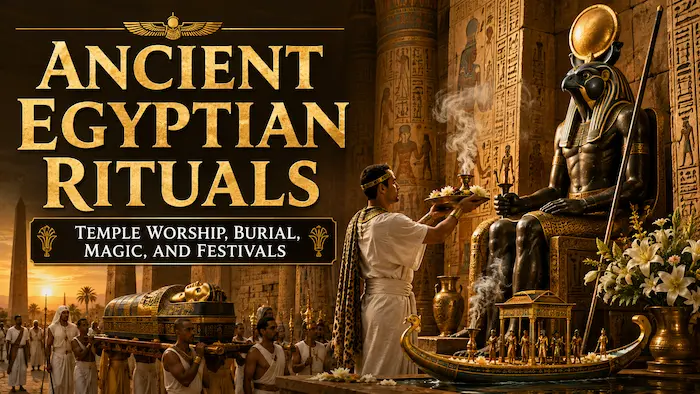
Ancient Egyptian rituals were structured religious actions (combinations of speech, gesture, offering, and sacred objects) used to honor and sustain the gods, preserve Ma’at (order, truth, and balance), protect individuals and communities, heal illness, legitimize royal authority, and prepare the dead for continued existence. Far from being centered only on death, Egyptian ritual life filled daily temple service, royal ceremony, public festival, household devotion, and healing practice. This guide surveys temple worship, offerings, funerary rites, festivals, royal ceremonies, protective and healing magic, and the evidence historians use to reconstruct all of it.
What Were Ancient Egyptian Rituals?
A ritual, in the Egyptian context, was a repeated or prescribed sequence of actions: spoken formulas, offerings, gestures, images, and sacred objects combined in a set order to produce a religiously meaningful effect. Rituals were not confined to one setting. They took place inside the enclosed sanctuaries of major temples, at royal ceremonies tied to kingship, in tombs and cemeteries, during large public festivals, at small household shrines, and in contexts aimed at healing or protection from danger.
Rituals as Communication With the Gods
Egyptians approached divine powers through several overlapping channels:
- Prayers and hymns, recited or inscribed
- Offerings of food, drink, and other goods
- Incense and purification rites that prepared a person or space to approach the sacred
- Images and statues that served as points of contact with a deity
- Processions that carried divine presence beyond the temple walls
- Spoken formulas believed to carry real effect when correctly performed
Temple statues were not treated as simple decoration. In Egyptian temple theology, a properly consecrated and cared-for cult image could serve as a vessel through which a deity’s presence became accessible to priests performing the daily rites. The statue itself was not worshipped as the totality of the god, but understood as a channel for divine manifestation.
Ma’at and the Purpose of Ritual
Ma’at was not simply the name of a goddess, though it was personified as one. More broadly, Ma’at was the guiding principle of truth, justice, order, and cosmic balance that the Egyptians believed underpinned a functioning world. Ritual activity was one of the primary tools through which this order was thought to be maintained: it sustained the relationship between gods and humans, helped protect Egypt from chaos and disorder, reinforced the legitimacy of the reigning king, and supported continuity between generations of the living and the dead.
Egyptians do not appear to have believed that any single ritual act permanently secured Ma’at once and for all. Order required ongoing maintenance. Daily temple service, seasonal festivals, and royal ceremony were all part of a continuous effort rather than one-time interventions.
Heka as Sacred Power
Heka referred to a power the Egyptians believed existed within creation itself and could be activated through correctly spoken words, prepared images, specific materials, and prescribed actions. Religion, magic, and medicine were not treated as fully separate categories in ancient Egyptian thought. A single healing or protective rite might combine what a modern reader would classify as prayer, pharmacology, and spell.
Calling heka “magic” is a useful shorthand but an imperfect one, since modern audiences often associate the word “magic” with entertainment, illusion, or fiction. For the Egyptians, heka was understood as a genuine and effective force woven into the structure of the cosmos, not a theatrical trick.
Who Performed Rituals in Ancient Egypt?
Ritual participation depended heavily on setting, social status, historical period, and geographic location. Access to the most sacred spaces and the most elaborate ceremonies was never evenly distributed across Egyptian society.
The Pharaoh
In official ideology, the king was the sole legitimate intermediary between humanity and the gods, and temple relief decoration consistently shows the pharaoh personally making offerings, censing statues, or performing other ritual acts before a deity. This was a matter of theological representation as much as daily practice: the king could not physically attend every temple across Egypt on a given day, so priests carried out the daily rites in his name and on his behalf. Upholding Ma’at remained the king’s fundamental religious responsibility, and ritual imagery repeatedly reinforced this role even when priests, not the monarch, performed the physical actions.
Priests and Temple Personnel
Temple ritual required a range of specialized personnel, including high priests who oversaw major cults, lector priests who recited the sacred texts and formulas, purification priests responsible for ritual cleanliness, musicians and singers who performed during ceremonies, and administrators who managed temple estates and resources.
Priests underwent purification procedures, wore clean linen rather than wool, and their access to the innermost parts of a temple was restricted according to rank. Service was often organized in rotations rather than as a full-time, permanently resident occupation, and priests in many periods maintained households and family lives outside their temple duties. The idea that all Egyptian priests lived as a permanently celibate class is not supported by the evidence.
Families and Ordinary Egyptians
Most Egyptians never entered a temple’s innermost sanctuary, which was reserved for a small number of ritually purified specialists. Ordinary people instead engaged with religious life through public festivals, household shrines, votive offerings left at accessible temple courts or shrines, protective amulets, personal prayers, occasional pilgrimage to important cult centers, burial and ancestor rituals for their own family dead, and questions submitted to oracles during festival processions.
This distinction between the official, restricted temple religion conducted by priests on the state’s behalf and the personal religious practice of ordinary families is essential to understanding Egyptian ritual life as a whole.
The Daily Temple Ritual
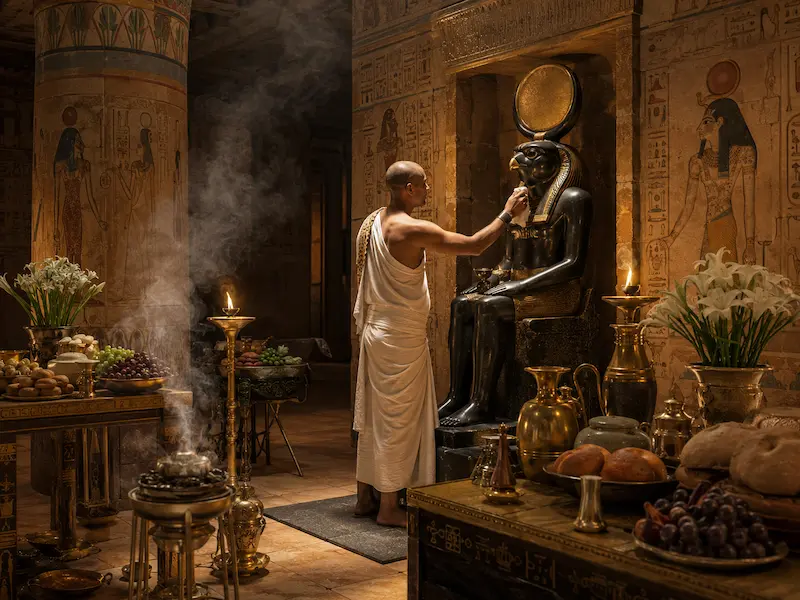
The daily cult ritual performed for a temple’s principal deity was one of the most important recurring rituals in Egyptian state religion. Exact procedures differed between periods and individual temples, but surviving inscriptions, particularly from sites such as Karnak and Abydos, preserve a broadly recognizable sequence.
Purification Before Entering the Sanctuary
Before approaching the sanctuary, officiating priests underwent purification that included washing with water, use of natron (a naturally occurring salt with cleansing and desiccating properties), donning clean linen clothing, and in some priestly contexts shaving or other grooming requirements. Ritual tools and the sanctuary space itself were also purified before use. This ritual purity was understood as a religious condition necessary for approaching the divine, not simply a matter of ordinary hygiene.
Opening the Shrine
The officiating priest entered the inner sanctuary, opened the doors of the shrine housing the cult statue (sometimes described as breaking a clay seal applied after the previous day’s ritual) and lit the space before approaching the image. Hymns, gestures, and spoken formulas accompanied this approach.
Awakening and Greeting the Deity
Temple texts describe a symbolic greeting or awakening of the deity as the shrine was opened. This should not be read as a literal Egyptian belief that the god had been asleep in the human sense. Rather, it was a ritual convention marking the renewal of divine presence at the start of the ceremony.
Washing, Anointing, and Dressing the Statue
The cult statue then received a sequence of care: previous garments were removed, the image was cleaned, oils or ointments were applied, and it was dressed in fresh linen with ornaments or regalia added as appropriate to the deity. These acts were understood both to renew the divine presence within the statue and to mirror the kind of attentive care one might give to an honored living being.
Food, Drink, and Incense Offerings
Offerings placed before the statue could include bread, beer, wine, meat, fruit, vegetables, water, flowers, oils, and incense. Egyptian ritual theology held that the divine essence or nourishment of an offering could be received by the deity while the physical food itself remained available afterward, commonly redistributed to temple staff or used in further ritual contexts. Not every temple followed an identical offering list. The specific menu varied by cult, period, and available resources.
Closing and Resealing the Sanctuary
After the offerings and rites were complete, the priest closed and resealed the shrine, retreating from the sanctuary in a manner meant to restore its undisturbed sacred order (in some descriptions, even sweeping away footprints on departure). This was not a rare or occasional ceremony. The daily ritual was meant to be repeated, in principle, every day.
Offerings and Sacred Objects
Why Egyptians Made Offerings
Offerings served several overlapping purposes: honoring a deity, sustaining ongoing cult activity, requesting protection or favor, expressing thanks, supporting the deceased in the afterlife, and maintaining a reciprocal relationship between humans and the divine or the dead. They are better understood as part of an ongoing relationship of care and exchange than as simple bribes intended to purchase favor.
Common Types of Offerings
Beyond food and drink, offerings could include flowers, incense, oils, clothing, jewelry, statues, and other symbolic objects. When physical provisions were not available, a representation of an offering, carved or painted in a tomb or temple, or named in an inscription, could function ritually as a substitute, since word and image carried real efficacy in Egyptian religious thought.
Offering Tables
Offering tables were placed in both temples and tombs as focal points for presenting goods to a deity or the deceased. Many were carved with channels for liquid offerings or with images of bread, meat, and other foods, sometimes accompanied by inscriptions naming the offerings even when the objects themselves were symbolic rather than physically present.
False Doors and Points of Contact
In tomb chapels, the false door represented a symbolic threshold through which the deceased’s spirit could pass to receive offerings left by the living. It was not believed that the physical body walked through this architectural feature. Rather, it functioned as a conceptual point of contact between the world of the living and the realm of the dead.
Votive Objects
Votive statues, stelae, figurines, animal images, and inscribed objects were given by individuals in fulfillment of a vow or in connection with a specific request to a deity. The precise meaning of any votive object depended on its inscription, placement, and the context in which it was deposited.
Ancient Egyptian Funerary Rituals
Funerary ritual in ancient Egypt was a process extending over weeks and, for some individuals, months, not a single ceremony. Practices differed significantly according to the deceased’s status, wealth, historical period, and region, ranging from simple desert burials to the elaborate royal funerary complexes exemplified by the Pyramids of Giza.
Preparing the Body Through Mummification
Mummification aimed to preserve bodily integrity in keeping with Egyptian beliefs about continued existence after death. In broad, non-graphic terms, the process could involve purification of the body, treatment or removal of certain internal organs, drying with natron, anointing with oils and resins, wrapping in linen, placement of protective amulets within the wrappings, and enclosure in one or more coffins. Not every Egyptian received an elaborate elite mummification procedure. The level of preservation and ritual attention varied enormously according to what a family could afford, and simpler burials, sometimes relying on natural desiccation in dry sand rather than artificial treatment, were far more common than the elaborate royal or elite examples that receive the most attention today.
The Funeral Procession
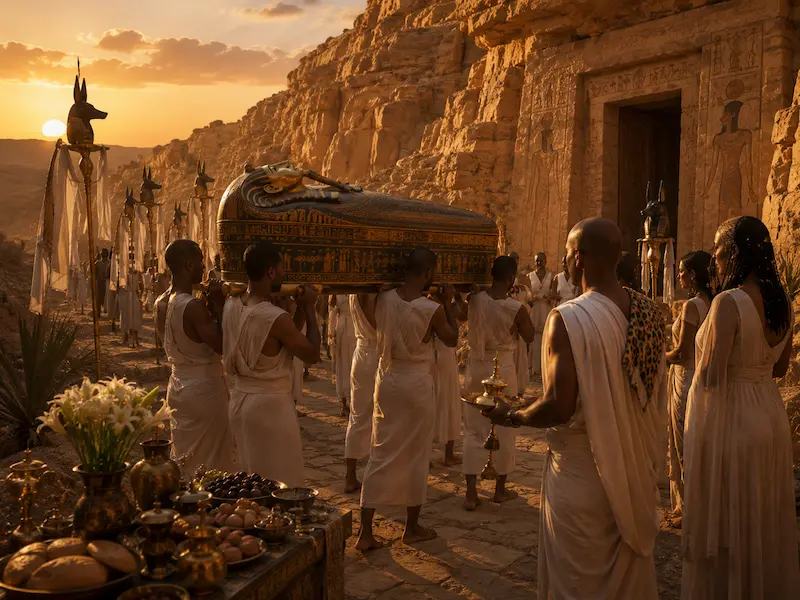
The funeral involved a procession from the place of preparation toward the tomb, with transportation of the coffin, participation by family members, accompanying priests, hired or professional mourners, and the movement of burial equipment and goods. Crossing from the world of the living into the cemetery landscape, often located across the Nile or on the desert edge, carried social and religious significance beyond simple logistics.
Ritual Mourning
Lamentation, physical gestures of grief, and the presence of professional mourners were established parts of Egyptian funerary practice. Female mourners were symbolically associated with the goddesses Isis and Nephthys grieving for their brother Osiris, linking a family’s personal loss to a central myth of death and restoration. This ritual mourning should not be understood as insincere performance. It operated as a recognized and meaningful expression of grief within a shared symbolic framework.
The Opening of the Mouth Ceremony
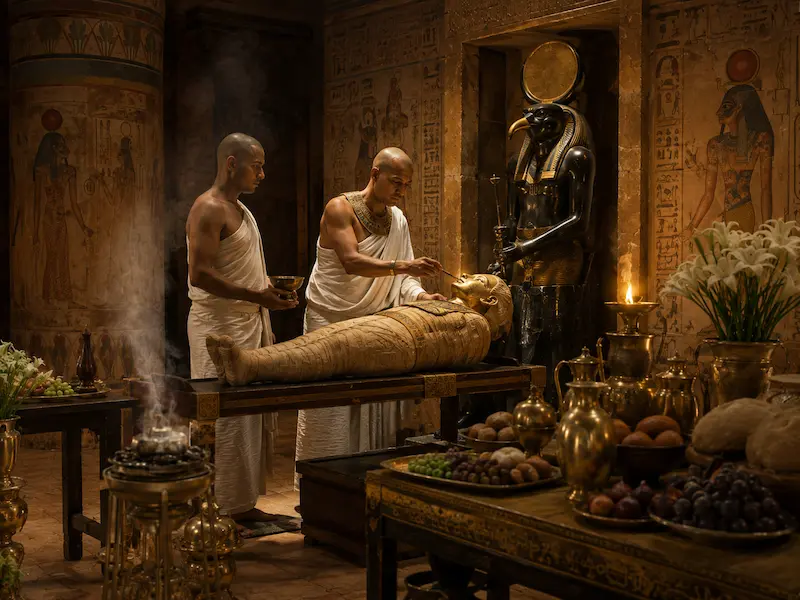
The Opening of the Mouth was one of the most significant rites within Egyptian funerary practice. It could be performed on a mummy, a statue of the deceased, or occasionally other representations, and involved priests using specialized tools and prescribed gestures to symbolically touch the mouth, eyes, and other features of the image or body. This act was understood to restore the senses to the deceased, enabling them to breathe, speak, see, and receive nourishment in the afterlife. Surviving depictions of the ceremony vary in detail across tombs and periods, and not every image should be assumed to record an identical procedure.
Coffins, Amulets, and Burial Goods
Burial equipment could include:
- Coffins and, for elite individuals, stone sarcophagi
- Heart scarabs placed over the chest and inscribed with a spell intended to prevent the heart from testifying against its owner during judgment
- Eye of Horus amulets associated with protection and wholeness
- Shabti figures meant to perform labor on behalf of the deceased in the afterlife
- Food and drink
- Clothing and personal possessions
- Other protective images
These objects served practical, symbolic, and ritual functions simultaneously.
Funerary Texts
Funerary literature developed and changed considerably over Egyptian history. The Pyramid Texts, inscribed in royal pyramids of the Old Kingdom, were followed by the Coffin Texts of the Middle Kingdom, painted or written on coffins for a somewhat broader range of individuals, and later by the collection of spells modern scholars call the Book of the Dead, along with underworld compositions such as the Amduat in relevant contexts. These were collections of spells and religious compositions assembled and adapted over time, not a single standardized text used identically by everyone.
Rituals After Burial
Care for the dead did not end at burial. Ongoing mortuary practice included continued food offerings, recitation of the deceased’s name (considered essential to their continued existence), visits to the tomb by family members, memorial festivals, and services carried out by family members or paid mortuary priests. Remembrance itself, keeping a person’s name and image alive, was treated as vital to their survival in the afterlife.
Rituals for the Journey to the Afterlife
The Body, Ka, Ba, and Akh
Egyptian understanding of the human person did not map neatly onto a simple “body and soul” model. The ka was a kind of vital life force or double, sustained through offerings after death. The ba represented an individual’s distinct personality or mobility, often depicted as a bird with a human head, capable of moving between the tomb and the world of the living. The akh referred to an effective, transfigured spirit, a state the deceased ideally attained after successfully passing through the necessary rites and judgments. Because these elements were each considered necessary for continued existence, preservation of the body, provision of offerings, and preservation of the deceased’s name and image were all treated as complementary requirements rather than redundant precautions.
The Weighing of the Heart
Funerary texts and tomb paintings depict a judgment scene in which the deceased’s heart was weighed against the feather of Ma’at, with Anubis overseeing the weighing, Thoth recording the result, Osiris presiding as judge, and the composite creature Ammit ready to consume the heart of anyone found wanting. This scene should be understood primarily as a funerary image and theological statement about moral judgment after death, rather than as evidence that a specific ceremony was physically reenacted at every individual’s funeral.
Spells and Knowledge of the Underworld
Funerary spells placed emphasis on knowing the correct names of gates, guardians, and pathways within the underworld, since this knowledge was believed to help the deceased navigate the dangers and transformations of the journey toward a favorable afterlife. This body of ritual knowledge functioned alongside, rather than as a replacement for, expectations about moral conduct during life. Possessing the right spells was not presented as a way to make ethical behavior irrelevant.
Festivals and Public Rituals
Festivals temporarily brought divine images out of their restricted inner sanctuaries and into public view, creating opportunities for participation that the ordinary daily temple ritual did not allow.
Sacred Processions and Divine Barques
Cult statues were carried out of the temple in portable shrines mounted on ceremonial boats known as barques, accompanied by music, incense, crowds of onlookers, and officiating priests. These barques could be carried by priests on land or transported along the Nile or temple canals, stopping at designated points along the route.
The Opet Festival
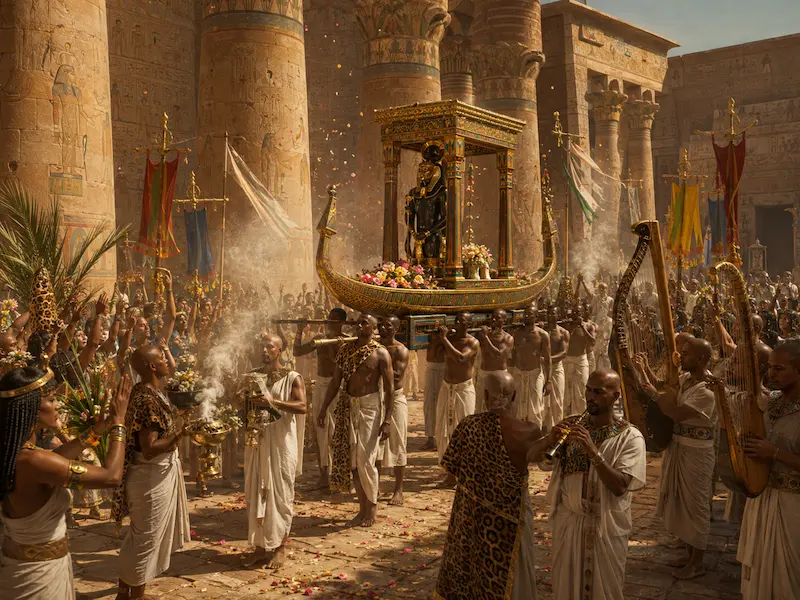
The Opet Festival centered on the Theban triad of Amun, Mut, and Khonsu, and involved a procession connecting the temple of Karnak with the temple of Luxor. The reigning king played an important role in the festival, which was closely tied to themes of royal renewal and the reaffirmation of legitimate kingship. The specific route and scale of the procession changed over time, so a description drawn from one period should not be treated as valid for every dynasty.
The Beautiful Festival of the Valley
This festival involved a procession of Amun’s image from Karnak toward the necropolis of western Thebes, linking the great state temples with the tombs and mortuary chapels of the dead. Families used the occasion to visit the tombs of relatives, share food, and engage in acts of remembrance, blending large-scale state religion with personal family devotion.
The Khoiak Festival of Osiris
Rituals during the month of Khoiak were connected to the mythology of Osiris’s death and regeneration. Some rites involved ritual images formed from earth, grain, or other plant material, associated with themes of fertility, renewal, and the agricultural cycle tied to the Nile. Because much of the detailed evidence for these practices comes from later periods and specific temple contexts, reconstructions of the festival’s exact procedures should be treated as informed rather than universally certain.
Wepet-Renpet and New Year Rituals
Wepet-Renpet, meaning “opening of the year,” marked a point of seasonal renewal connected with the Nile’s cycle and the Egyptian calendar. Because Egyptian calendrical systems and local traditions were complex and changed over time, the specific timing and practices associated with New Year rites varied rather than following one fixed pattern throughout Egyptian history.
Music, Dance, and Celebration
Festivals regularly included sistra (a type of ritual rattle), drums, harps, singing, dancing, feasting, and the distribution of offerings to participants. Sacred celebration and communal enjoyment coexisted rather than standing in opposition to one another in Egyptian festival life.
Royal Rituals and Ceremonies
Coronation and Royal Legitimacy
A new king’s coronation ritually connected him with divine order, with his royal predecessors, and with rulership over the “Two Lands” of Upper and Lower Egypt. Depending on period, coronation rites could involve the presentation of crowns, the formal adoption of royal names and titles, enthronement ceremonies, and symbolic presentation of the king to the gods.
The Sed Festival
The Sed Festival was a royal renewal ceremony traditionally associated with celebrating roughly thirty years of a king’s rule, though the evidence shows that some kings celebrated it earlier than this traditional interval. It could include ceremonial movement or displays of the king’s continued vitality and fitness to rule, along with rites reaffirming his kingship. Surviving evidence does not indicate a single unchanged format followed by every ruler across Egyptian history.
Smiting the Enemy
Egyptian art frequently depicts the pharaoh raising a weapon, often a ceremonial mace, over one or more defeated enemies, a recurring image found on temple walls, palettes, and other royal monuments. This should be interpreted primarily as an ideological and ritual statement about the king’s role in overcoming chaos and disorder, rather than as a documentary record of a specific historical execution in each instance.
Temple Foundation Rituals
Establishing a new temple involved its own set of rites, including selecting an appropriate sacred site, a ceremony known as “Stretching the Cord” used to orient and lay out the building’s foundations, digging the foundation trenches, depositing ritual objects (foundation deposits) within them, and presenting the completed structure to the resident deity. The king was symbolically credited with performing these acts even when specialist builders and priests carried out the physical construction work.
Magical and Protective Rituals
This section describes historical Egyptian practice. It is not a guide to performing any of these rites today.
Execration Rituals
Execration rituals involved writing the names or fashioning images of perceived enemies, whether foreign groups, individuals, or hostile forces, onto objects such as clay figures, bowls, pots, or inscribed tablets. Symbolic actions such as binding, breaking, burning, or burying these objects were then performed. The underlying purpose was to neutralize a perceived threat and restore order, functioning as a ritual expression of state or personal protection rather than a set of instructions to be described here in procedural detail.
Protective Amulets
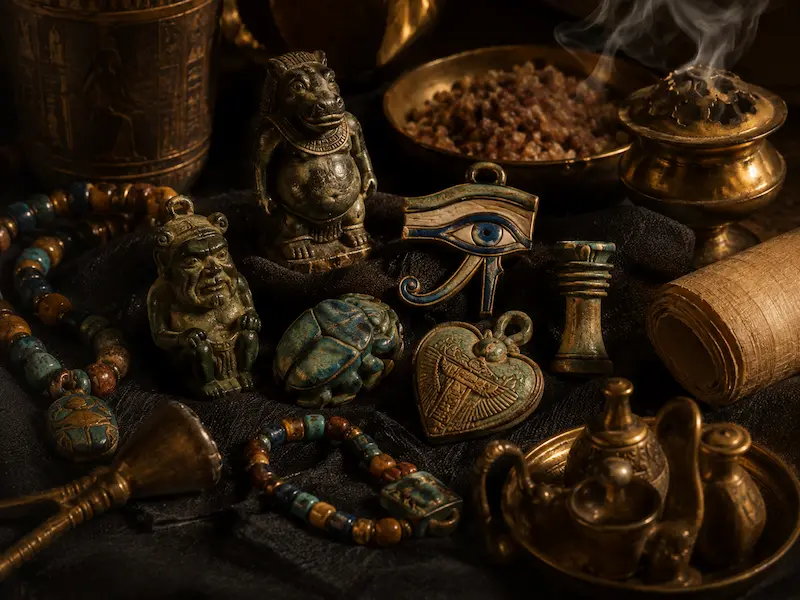
Widely used protective amulets included:
- The Eye of Horus, one of the best-known ancient Egyptian symbols of power and protection, was associated with healing and restoration.
- The scarab, linked to transformation and the rising sun
- The djed pillar, associated with stability and connected to Osiris
- The tyet knot, sometimes called the “Isis knot,” associated with protection
- Images of the household deity Bes
- Imagery of the goddess Taweret
- The heart scarab used in funerary contexts
An amulet’s meaning depended on its specific form, any inscription it carried, the material it was made from, where it was worn or placed, and the ritual context in which it was used.
Spoken Spells and Performative Words
Egyptian ritual placed heavy emphasis on the power of correctly spoken words. Central elements included knowledge of correct divine or personal names, precise recitation, deliberate repetition, reference to mythological precedent (invoking a past event from myth as a model for the desired outcome), accompanying ritual gestures, and specific material substances used alongside the spoken formula. Speech and physical action were understood to work together rather than as separate components.
Protection Against Snakes, Scorpions, and Other Dangers
Objects known as cippi of Horus, stelae showing the child god Horus standing on crocodiles and grasping dangerous animals, were inscribed with protective texts related to healing from bites and stings. In some contexts, water poured over such an inscribed object was collected afterward and used within a healing or protective ritual, on the belief that it had absorbed the text’s protective power. This discussion remains descriptive of historical practice rather than a set of instructions for present-day use.
Healing Rituals
Medicine, Prayer, and Heka
Egyptian healing practice could combine several approaches within a single treatment: direct observation of symptoms, plant- or mineral-based remedies, bandaging, surgical or wound care techniques, spoken formulas, and invocation of relevant deities. Not every Egyptian medical treatment involved a magical or religious component, and not every documented remedy would have been medically effective by modern standards. Surviving medical papyri show a mixture of practical technique and ritual formula rather than a uniformly “magical” approach to all illness.
Deities Associated With Healing
Deities connected with healing included:
- Sekhmet, a powerful lioness goddess associated with both disease and its cure
- Isis, invoked in numerous protective and healing spells, particularly those connected to her son Horus
- Horus himself, especially in contexts related to childhood dangers
- Thoth, associated with knowledge and healing magic
- In later periods, the deified historical figure Imhotep, who came to be worshipped as a god of medicine and healing
These divine associations were not static and changed across Egyptian history.
Ritual Healing Objects
Amulets, healing stelae such as the cippi described above, inscribed statues, ritual vessels used to prepare or dispense treated water, and medical or magico-medical papyri all formed part of the material culture of Egyptian healing practice. None of the remedies described in these historical sources should be understood as recommendations for modern medical use.
Birth, Childhood, and Family Protection
Rituals Surrounding Childbirth
Pregnancy and childbirth were considered dangerous transitions in ancient Egypt, carrying real risk to both mother and child. Households responded with protective measures including amulets, spoken protective formulas, and protective imagery placed in spaces associated with birth.
Bes and Taweret
The dwarf god Bes and the hippopotamus goddess Taweret appeared frequently in domestic and childbirth-related contexts, valued for their protective rather than threatening character despite their unusual appearance. They are more accurately described as protective divine beings associated with the home, fertility, and safe childbirth than as “demon gods,” a label that misrepresents their benevolent role in Egyptian religion.
Magical Birth Wands
Curved ivory or hippopotamus-tusk objects, often called “birth wands” or “apotropaic wands,” date primarily to the Middle Kingdom and are decorated with protective figures including images of Bes, Taweret, and various animals. Scholars continue to debate the exact way these objects were used in ritual practice, and confident claims about their precise function should be treated with appropriate caution.
Protecting Infants and Children
Surviving evidence points to the use of amulets, protective names, and household prayers connected to the wellbeing of infants and children, though documentation of childhood ritual practice is less extensive than for adult funerary or temple contexts. Gaps in the evidence should not be filled with modern assumptions about what “must” have occurred.
Household Religion and Personal Devotion
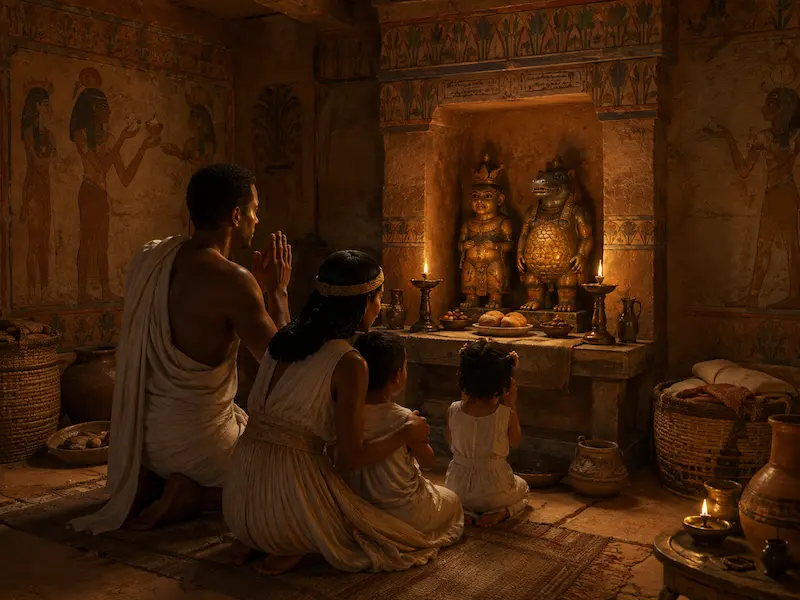
Household Shrines
Many Egyptian homes contained small shrines where residents could worship particular deities or venerate ancestors, typically consisting of small statues, stelae, wall niches, or a designated offering area within the home rather than a dedicated building.
Personal Prayers and Votive Stelae
Individuals left prayers and votive stelae requesting health, justice, fertility, protection, or forgiveness for a wrongdoing. A number of surviving texts reveal strikingly personal relationships between individuals and particular deities, suggesting that formal state religion and intimate personal devotion coexisted within the same religious system.
Ancestor Veneration
Families maintained ongoing remembrance of deceased relatives through offerings and forms of communication addressed to the dead, sometimes including letters left at tombs. Ancestors were generally treated as distinct from the gods, though a small number of exceptional individuals, certain deified kings or officials, could receive their own cults over time.
Oracles
During festival processions, the movements of a divine barque, interpreted by priests as signals from the god carried within it, could be used to answer questions put to the deity, covering matters such as property disputes, appointment to office, or personal decisions. The precise mechanics of how such oracular movements were produced and interpreted are not fully understood, and different explanations remain under scholarly discussion.
Dreams and Dream Interpretation
Surviving texts sometimes called “dream books” catalog dream images and their proposed meanings, and dreams could be understood as possible divine messages or omens. Because most surviving sources of this kind derive from a literate elite context, they do not necessarily reflect how every Egyptian experienced or interpreted their own dreams.
Ritual Purity and Sacred Space
Water, Natron, and Incense
Water served both symbolic and practical purification roles, closely connected with concepts of renewal and preparation for entering sacred space. Natron and incense were likewise used both to physically cleanse and to spiritually prepare people, objects, and spaces for ritual use.
Clothing and Bodily Preparation
Clean linen clothing and personal grooming were expected of officiating priests, though the precise requirements are not safely generalized to every priest in every temple across all periods. Practice varied by cult, rank, and era.
Temple Access
Egyptian temples were structured with a clear progression from more open outer courts toward increasingly restricted inner spaces, culminating in the sanctuary that housed the cult statue and that only a small number of purified priests could enter. Temples functioned primarily as residences for the divine and as ritual institutions serving the state cult, rather than as congregational worship spaces in the modern sense of a building where a general public gathered regularly for communal services.
Sacred Time and Ritual Calendars
Rituals were structured around multiple overlapping cycles of time: the daily rhythm of temple service, lunar phases, seasonal changes tied to the Nile’s flooding cycle, anniversaries connected to the reigning king, and the calendar of local festivals specific to individual cult centers.
How Do We Know About Ancient Egyptian Rituals?
Temple and Tomb Images
Reliefs and paintings in temples and tombs are a major source for reconstructing Egyptian ritual practice, but they come with real limitations. Such images may present idealized rather than literal actions, several distinct ritual moments can sometimes appear compressed into a single scene, and many images were designed to express theological order and the correct performance of a rite rather than to serve as a documentary record of an actual event as it happened.
Religious and Ritual Texts
Temple inscriptions, papyri, funerary texts, hymns, and administrative records all contribute to modern understanding of Egyptian ritual. A significant proportion of these written sources originated within temple institutions or among the literate elite, which shapes and sometimes limits what they can tell us about the religious life of the broader population.
Archaeological Evidence
Physical evidence includes mummified remains, tomb contents, remnants of offerings, amulets, ritual deposits, animal remains connected to sacrifice or votive practice, incense burners, chemical residue found in vessels, and the remains of domestic shrines within excavated houses.
Experimental and Scientific Analysis
Modern scientific methods, including medical imaging, chemical residue analysis, and bioarchaeological study of human and animal remains, continue to add new evidence about Egyptian ritual practice, refining or sometimes correcting earlier interpretations. Individual new discoveries should be weighed against the broader body of evidence rather than treated as overturning established understanding on their own.
Limits of the Evidence
Several factors limit what can be known with certainty: organic materials used in many rituals have often decayed and left no trace, ancient tomb robbery frequently disturbed the original context of burial goods, elite and royal sources are heavily overrepresented compared to evidence for ordinary people, the meaning of specific terms and practices shifted across several millennia of Egyptian history, and scholars often disagree in their interpretation of the same evidence.
Did Egyptian Rituals Remain the Same?
Ancient Egyptian civilization spanned more than three thousand years, and ritual practice changed considerably across this span. Broad differences existed between the Early Dynastic Period, the Old Kingdom, the Middle Kingdom, the New Kingdom, the Late Period, and the Ptolemaic and Roman eras that followed, each of which brought shifts in theology, temple architecture, and ceremonial detail. Considerable regional variation also existed between major cult centers such as Memphis, Thebes, Abydos, and Heliopolis, each with its own local deities, traditions, and priestly institutions. Many modern general summaries of Egyptian ritual necessarily draw material from different centuries for the sake of accessibility. Readers should keep in mind that a composite picture of this kind does not represent any single moment in Egyptian history exactly.
Common Misconceptions About Ancient Egyptian Rituals
“All Egyptian Rituals Were About Death”
Funerary practice was one important strand among many. Temple worship, royal ceremony, healing rites, household devotion, and public festivals occupied a far larger share of Egyptian religious life than mortuary ritual alone.
“Every Egyptian Was Mummified Like a Pharaoh”
Elaborate mummification was expensive and largely reserved for royalty and the wealthy elite. Most Egyptians received simpler burial treatment, and the quality of preservation depended heavily on wealth, period, and access to skilled embalmers.
“Egyptian Priests Practiced Secret Black Magic”
This idea largely reflects modern projection onto the concept of heka, which Egyptians understood as a legitimate and effective sacred power woven into official religion, not a hidden or malevolent practice.
“The Book of the Dead Was One Standard Book”
“Book of the Dead” is a modern title applied to a variable collection of funerary spells that individuals or their families selected from and had copied, rather than a single fixed scripture used identically by everyone.
“Temple Statues Were Simply Idols”
Egyptian theology treated cult statues as potential vessels for genuine divine manifestation when properly prepared and ritually maintained, a more complex concept than the dismissive term “idol” suggests.
“Every Ritual Was Performed the Same Way for Thousands of Years”
As noted above, both chronological change over three millennia and regional variation between cult centers mean that ritual practice was never static or fully uniform across Egyptian history.
Did Ancient Egyptians Practice Human Sacrifice?
Evidence from the Early Dynastic Period, particularly at royal cemeteries such as Abydos, includes what are often called subsidiary or retainer burials, burials of servants or attendants alongside a king or high-status individual. Scholars continue to debate whether all such cases should be described as “sacrifice” in a strict sense, and this practice appears limited to a relatively narrow chronological window early in Egyptian history rather than continuing as a common feature throughout the civilization’s long history. In later periods, human retainers in the tomb were replaced by symbolic figures such as shabtis, intended to perform labor for the deceased in the afterlife without the loss of human life. There is no solid archaeological consensus supporting widespread or routine human sacrifice as a normal feature of Egyptian religious practice across its history, and claims to the contrary should be treated with caution.
Are Ancient Egyptian Rituals Practiced Today?
Ancient Egyptian ritual traditions did not survive as an unbroken, continuous practice into the present day.
Modern Kemetic Reconstruction
Some modern practitioners, often grouped under the term Kemetic reconstruction, attempt to rebuild elements of ancient Egyptian religious practice based on historical and archaeological evidence, adapting what is known to a contemporary religious framework.
Contemporary Spiritual Adaptations
Other modern practices draw on Egyptian imagery and concepts while being shaped primarily by New Age spirituality, Western occultism, or individual personal interpretation, often departing significantly from what the historical evidence indicates about ancient practice.
Historical Accuracy and Continuity
These modern practices can hold genuine meaning for the people who engage in them, but they should not automatically be described as identical to or unbroken continuations of ancient Egyptian ritual. Historical description and contemporary religious practice are best treated as related but distinct subjects, discussed with respectful, nonjudgmental language toward modern practitioners.
Frequently Asked Questions
What were the rituals of ancient Egypt?
Ancient Egyptian ritual life included daily temple rites performed for a resident deity, offerings made in temples, tombs, and homes, funerary ceremonies for the dead, large public festivals involving processions of divine images, royal ceremonies tied to kingship, protective and healing rites drawing on heka, and household devotion practiced by ordinary families. These categories overlapped, and a single occasion, a festival, for instance, could combine elements of several at once.
What rituals were performed at an Egyptian funeral?
A funeral typically involved preparation of the body through mummification appropriate to the family’s means, a procession to the tomb accompanied by mourners and priests, ritual mourning, the Opening of the Mouth ceremony to restore the deceased’s senses, burial with appropriate grave goods, recitation of funerary texts, and continuing offerings made at the tomb after burial.
What are the 7 steps of mummification?
Popular summaries often condense mummification into seven simplified steps, typically some version of purification, removal of certain internal organs, drying the body with natron, cleansing the body cavity, anointing with oils and resins, wrapping in linen with amulets placed among the layers, and final preparation for burial in a coffin. This sequence is a useful teaching simplification rather than a fixed ritual formula attested uniformly in ancient sources. Surviving evidence shows the process varied by period, embalmers’ workshop, and what a family could afford, so no single seven-step procedure was followed identically across all of Egyptian history.
Did ordinary Egyptians participate in rituals?
Yes, though generally not within a temple’s restricted inner sanctuary. Ordinary Egyptians took part through public festival processions, worship at household shrines, votive offerings, protective amulets, personal prayers, and burial and ancestor rituals conducted for their own family members.
Did ancient Egyptian rituals involve magic?
Egyptian rituals frequently drew on heka, a sacred power the Egyptians believed could be activated through correct words, images, materials, and actions. Because religion, medicine, and what modern readers call “magic” were not sharply separated categories in Egyptian thought, the modern distinction between religious ritual and magical practice does not map neatly onto how the Egyptians themselves understood these activities.
Final Thoughts
Ancient Egyptian rituals formed an interconnected system linking the gods, kingship, community life, health, the natural world, the dead, and the wider cosmic order the Egyptians called Ma’at. Burial and mummification were important within this system, but they represented only one part of a much broader ritual life that also encompassed daily temple worship, royal ceremony, public festival, household devotion, and healing practice. Across all of these contexts, ritual transformed ordinary materials, including water, bread, linen, incense, images, and spoken words, into tools for maintaining the relationship between the visible world and the divine.

About the Author
Dana Whitfield
I write about numerology, astrology, mythology, tarot, and world mystical traditions for Mystivora, drawing on years of independent research across comparative religion and symbolic systems. I approach each topic by cross-checking primary texts and established scholarship rather than repeating popular but unverified claims.