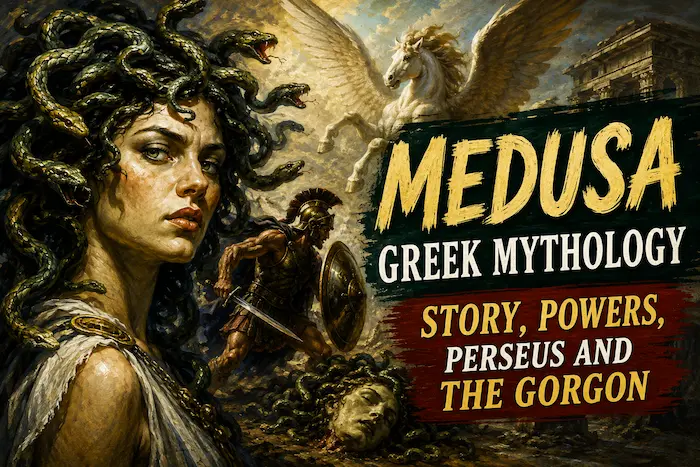
Medusa Greek mythology centers on the most famous monster in the ancient Greek imagination, one of the three sisters known as the Gorgons. Her sisters, Stheno and Euryale, were immortal. Medusa alone was mortal, and that single detail is what makes the rest of her story possible, because a creature who cannot die cannot be beheaded by a hero. She is remembered above all for two things: the snakes associated with her hair, and a gaze that turned living people into stone.
The version most readers know today is not the only one. Ancient writers separated by centuries, by language, and by culture told her story in different ways, and the famous account of a beautiful woman transformed into a monster comes from a much later source than the earliest Greek poetry. This guide keeps those traditions apart rather than blending them into one.
Who Is Medusa in Greek Mythology?
Medusa is one of the three Gorgons, a group of monstrous sisters in Greek mythology whose faces were so terrible that anyone who looked at them was turned to stone. Stheno and Euryale were her sisters, and both were deathless. Medusa was not, which sets her apart from almost every other major monster in the tradition.
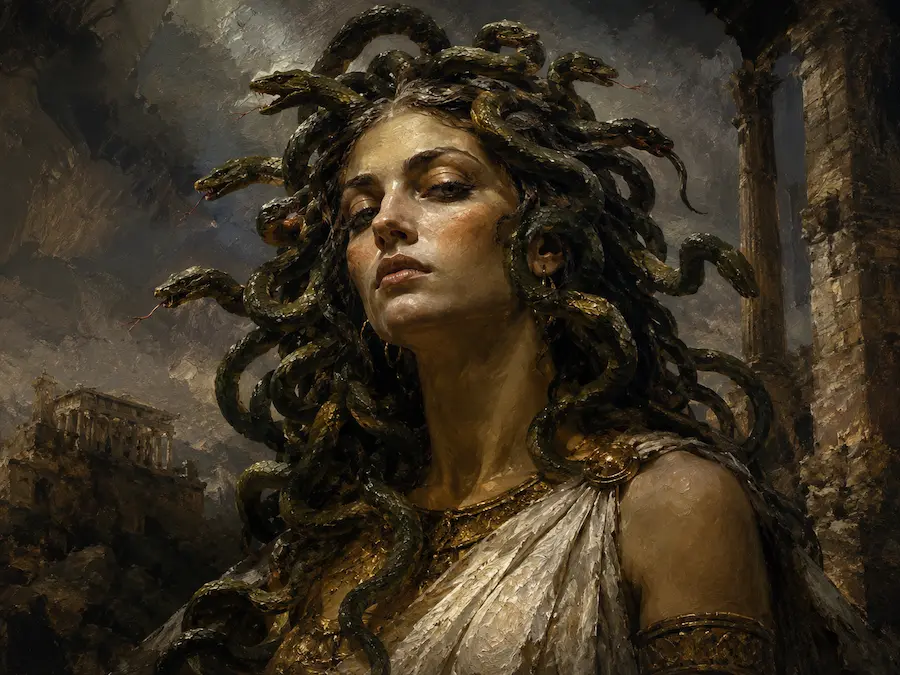
She belongs to the oldest layer of Greek monsters, the ones descended from primordial sea powers rather than bred later by Typhon and Echidna. Among the creatures of Greek mythology, she is unusual because her danger is entirely passive. She does not hunt, guard a treasure, or block a road. She simply exists, and looking at her is fatal.
Her importance comes from the myth of Perseus. The hero was sent to bring back her head, an errand meant to kill him, and the whole story of how he survived it turns on the specific nature of what Medusa could do.
Medusa’s Origins and Family
Parents and Sisters
In the earliest surviving Greek account, Hesiod names the parents of the Gorgons as Phorcys and Ceto, two ancient sea deities associated with the hidden dangers of the deep and with sea monsters. Their children in that tradition are a set of alarming figures rather than a family of gods.
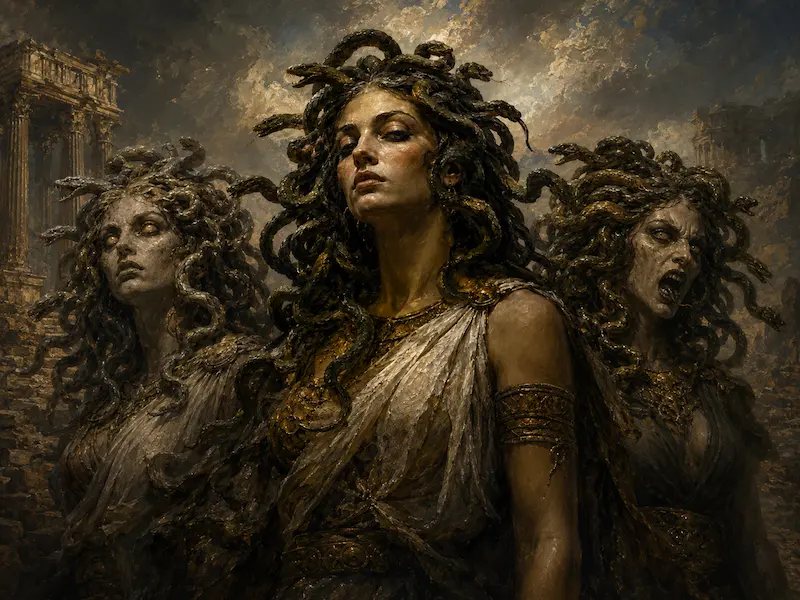
The three daughters called the Gorgons are Stheno, Euryale, and Medusa. Hesiod places them at the edge of the world, beyond the stream of Ocean, near the Hesperides. He also makes the point that later storytellers depend on completely: two of the sisters were immortal and ageless, and Medusa was not.
Details of this kind vary between authors, since Greek genealogy was never standardized, and different regions and periods preserved different parentage for the same figures. The line from Phorcys and Ceto is the one that appears most consistently.
Medusa’s Children
Medusa had two sons, Pegasus, the winged horse, and Chrysaor, whose name refers to a golden blade. Poseidon is named as their father.
Their birth is one of the strangest events in Greek myth. They did not arrive in any ordinary way. Both emerged from Medusa at the moment Perseus cut off her head, which means her children entered the world at the instant she left it. That episode is covered in full further down.
What Did Medusa Look Like?
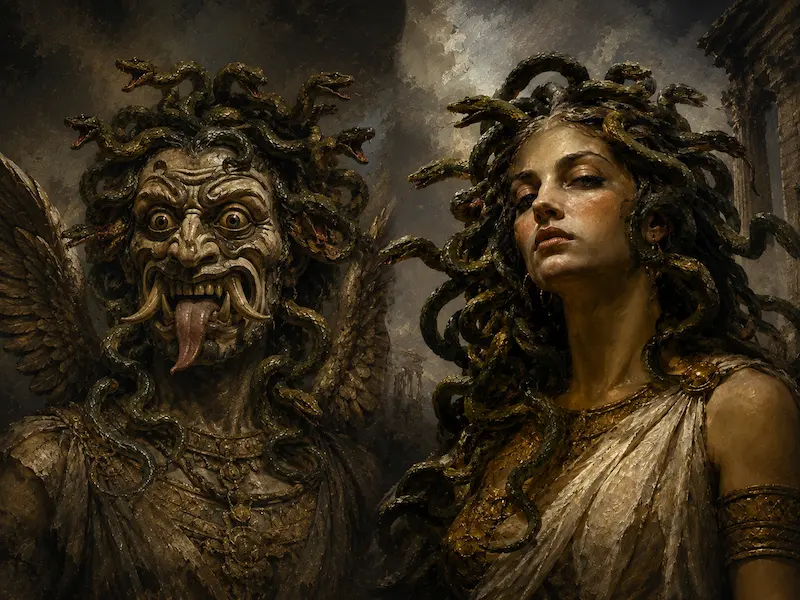
Ancient Greeks did not picture Medusa the way modern film and illustration do. In archaic art, from roughly the seventh century BCE onward, the Gorgon face is deliberately hideous: a wide round head, staring eyes, a grinning mouth stretched open, tusks or boar-like fangs, and a protruding tongue. Some depictions add a beard. Wings appear frequently, either on the shoulders or on the head, and snakes are worked into the hair or knotted at the waist and neck.
The result is not a frightening woman. It is closer to a mask, and that is essentially how it functioned in Greek art, as a face designed to stop a viewer in place.
Snake hair, at least, is early. Greek poets from Pindar and Aeschylus onward describe the Gorgons as snake-haired, so that feature does not depend on later Roman retelling. What changed over time was everything around it.
From the fifth century BCE, and increasingly in Hellenistic and Roman work, artists began softening the face. The tusks disappear, the grin closes, and the Gorgon becomes a beautiful woman with an expression of pain or calm, still framed by serpents. The famous image of an attractive woman with snakes for hair is therefore a late development within ancient art, not the standard picture the Greeks always held.
Medusa’s Powers
Medusa Greek mythology assigns her a narrow set of abilities, and the two that matter both concern her head. She has no weapons, no shapeshifting, and no command over other creatures. The tradition is remarkably disciplined about this, which is part of why the myth holds together so well.
The Petrifying Gaze
Medusa’s defining power is petrification. Anyone who looked directly at her face was turned to stone, and ancient accounts treat this as automatic rather than as something she chose to do.
That is what made approaching her nearly impossible. An attacker cannot fight what he cannot look at, and the ground around the Gorgons is sometimes described as scattered with the stone shapes of men and animals who came too close. Every practical detail of the Perseus story, from the equipment he carried to the way he held his weapon, exists because of this one power.
Medusa’s Head Retained Its Power
Death did not neutralize her. The severed head kept its petrifying effect, which is why it became an object worth carrying rather than a trophy to be discarded.
Perseus used it deliberately as a weapon in the later stages of his journey, turning enemies to stone by uncovering the face at the right moment. A dead Gorgon, in other words, remained roughly as dangerous as a living one, provided someone was willing to handle her.
Was Medusa Always a Monster?
This is the question where popular accounts of Medusa Greek mythology most often go wrong, usually by merging two traditions written centuries apart into a single story. The honest answer is that it depends entirely on which source you are reading.
Medusa in Early Greek Mythology
In the earliest Greek material, Medusa is a Gorgon. She is born a Gorgon, along with her two sisters, to Phorcys and Ceto. Hesiod’s Theogony, the oldest surviving systematic account of Greek divine genealogy, describes her as one of three monstrous sisters and calls her fate a sad one because she alone was mortal. There is no transformation in it, no temple, and no punishment. The text is available in translation at the Theoi Classical Texts Library.
Homer refers to the Gorgon as a terrifying face rather than as a character with a backstory. Early Greek art works the same way, showing the Gorgon head as an object of terror without any suggestion that it once belonged to a human being.
So Medusa should not be described flatly as a woman who was turned into a monster. In the tradition Greek audiences knew first, that is not what she was.
Ovid’s Version of Medusa
The transformation story that dominates modern retellings comes from the Roman poet Ovid, writing in the Metamorphoses around 8 CE, roughly seven hundred years after Hesiod.
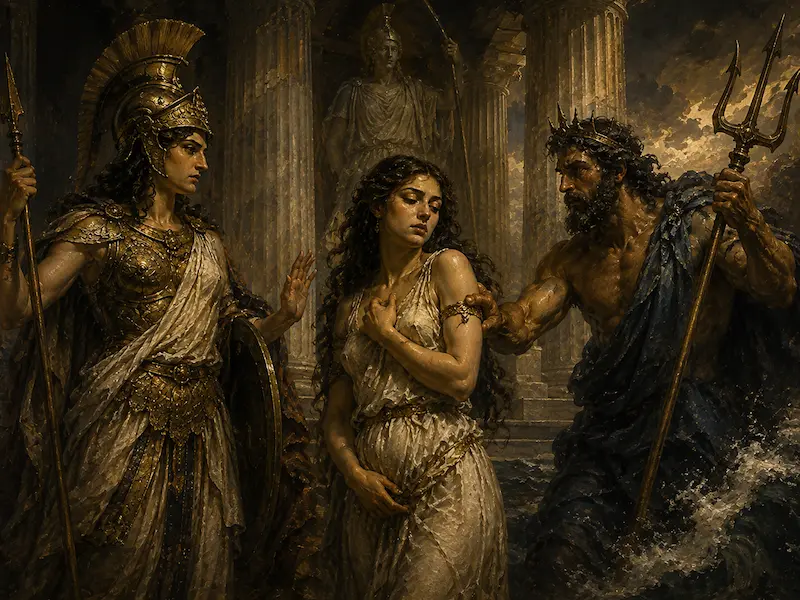
In Ovid’s version, told by Perseus at a banquet, Medusa was once famous for her beauty and pursued by many suitors, and her hair was the most admired thing about her. Ovid then reports that Neptune, the Roman counterpart of Poseidon, had her in the temple of Minerva, the Roman counterpart of Athena. The goddess turned her face away and covered her eyes, and she punished the violation of her temple by changing the Gorgon’s hair into snakes. Ovid’s account can be read in translation at the Theoi Classical Texts Library.
The exact nature of that encounter is worth handling carefully. Ovid’s Latin is compressed, and English translations render it very differently, from euphemistic phrasing about winning her love to explicit language about violation. Most modern translators and classicists read it as rape, but the wording readers meet depends heavily on which edition they pick up, which is one reason retellings of this episode vary so much in tone.
One detail that circulates constantly is not in Ovid at all. He never calls Medusa a priestess of Athena. That element belongs to later retelling and to modern popular versions, so the sentence Medusa was originally a beautiful priestess of Athena should be treated as a later interpretation rather than as a fact recorded in the ancient sources.
Athena, Poseidon and Medusa
Three figures sit at the center of the story, and their relationships are easier to follow once the two traditions are separated.
Poseidon connects to Medusa in both traditions, though for different reasons. Hesiod records only that the god lay with one of the Gorgons in a meadow, with no transformation attached, and names him as the father of Pegasus and Chrysaor. Ovid moves the same relationship into a temple and makes it the cause of everything that follows.
Athena appears in the early tradition as the divine helper of Perseus rather than as the author of Medusa’s condition. Her role as the goddess who transforms Medusa belongs specifically to Ovid’s account, where the offense is committed in her sanctuary and the punishment falls on Medusa rather than on the god responsible.
That imbalance is why modern retellings so often describe Athena’s action as a curse. The word is a modern framing rather than an ancient technical term, and it reflects how uncomfortable the outcome looks to readers who arrive at Ovid expecting justice. Within Roman religious logic, the desecration of a temple demanded a response, and Ovid supplies one without commenting on whether it was fair.
Why Are There Different Versions of Medusa’s Story?
Greek mythology had no canon. There was no scripture, no central religious authority, and no editorial body reconciling contradictory accounts, so stories changed as they moved between writers, cities, and centuries.
Hesiod belongs to the early Greek tradition, composing in the eighth or seventh century BCE. Ovid was a Roman poet writing in Latin under Augustus, working with Greek material for a sophisticated literary audience that already knew the outlines and expected something new. Their goals were not the same, and neither were their results.
Both traditions shaped the Medusa most people recognize today. The Gorgon comes from Greek myth and Greek art, and the tragic transformation comes from Ovid. The mistake is to treat the second as the original.
Perseus and Medusa
Among Medusa Greek mythology stories, the expedition of Perseus is the one that everything else hangs on. It explains how she died, where her children came from, and how her head ended up on the aegis of a goddess.
Why Did Perseus Have to Kill Medusa?
Perseus was the son of Danae and of Zeus, born after his grandfather Acrisius shut Danae away because of a prophecy that her son would kill him. Mother and child were sealed in a chest and set adrift, and they washed up on the island of Seriphos.
The king of Seriphos, Polydectes, wanted Danae and found her grown son inconvenient. He arranged a banquet at which every guest was expected to contribute a gift, commonly described as horses, and maneuvered Perseus into promising something more extravagant instead. Perseus committed himself to bringing back the head of Medusa.
The task was designed as a death sentence. Nobody knew where the Gorgons lived, no ordinary weapon helped against a creature who could not be looked at, and two immortal sisters would be waiting beside her. Polydectes expected the problem to solve itself.
How Did the Gods Help Perseus?
Perseus succeeded because he was equipped rather than because he was strong, and the tradition is consistent on the items even when it disagrees about who supplied them.
- Divine guidance. Athena directs the mission in most accounts, and Hermes accompanies him. In several versions the two send him first to the Graeae, the grey sisters who shared one eye between them, to learn where the Gorgons could be found.
- A reflective surface. The solution to the gaze is a polished shield, usually credited to Athena, that let Perseus watch his target without meeting her eyes.
- The blade. A curved sword or sickle, the harpe, most often given by Hermes and in some accounts made of adamant.
- Winged sandals. These allow him to reach the Gorgons and to escape afterward. Apollodorus credits them to a group of nymphs rather than directly to an Olympian.
- The kibisis. A special bag or pouch made to hold the head safely, since carrying it uncovered would have been suicidal.
- A cap of invisibility. The cap of Hades, which conceals him from the surviving sisters during the escape.
Sources differ about the supplier of each object. Apollodorus routes the sandals, the kibisis, and the cap through nymphs whose location the Graeae reveal, while other retellings simplify the chain and hand everything directly to Perseus from Athena and Hermes. The equipment list is stable, but the credit is not, and any version that presents one distribution as the definitive one is smoothing over a real disagreement.
How Did Perseus Kill Medusa?
Perseus reached the Gorgons at the far edge of the world and found the three sisters asleep. In the commonly told version, that timing matters as much as any of his equipment, since a waking Medusa would have had every advantage.
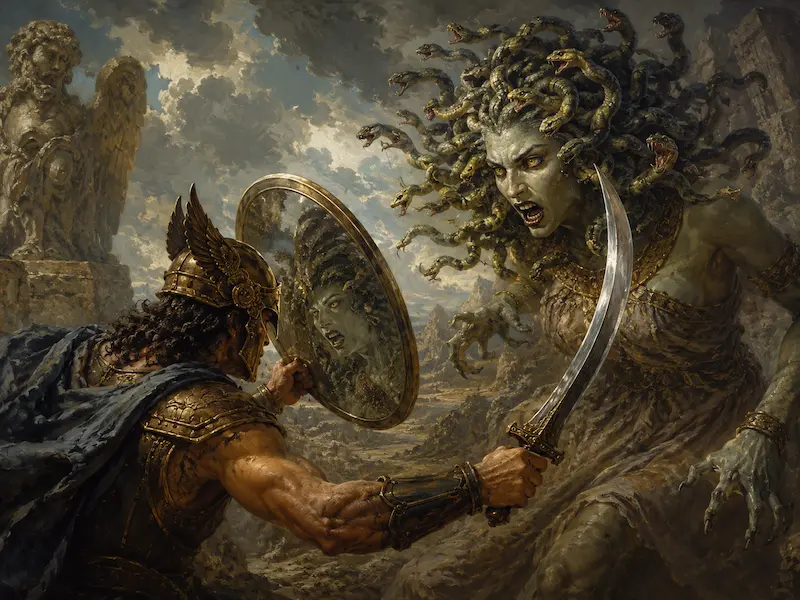
He approached without looking at her. Watching her reflection in the polished shield, he tracked the position of her head while keeping his own eyes turned away, then struck with the curved blade and cut through her neck in a single blow. Some accounts have Athena steady his hand at the moment of the strike.
What happened next is the part no one expects. Pegasus and Chrysaor came out of her body as it fell, fully formed, and the winged horse rose into the air.
Perseus had no time for any of it. He swept the head into the kibisis without looking at it, and the noise woke Stheno and Euryale, who came after him at once. They were immortal and he could not fight them, so the escape depended entirely on the cap of Hades and the winged sandals. Invisible and airborne, he outran them and carried the head away.
The Birth of Pegasus and Chrysaor
Hesiod gives the earliest surviving version of the event. When Perseus cut off Medusa’s head, Chrysaor and the horse Pegasus sprang forth from her, and Poseidon is named as their father in the same passage.
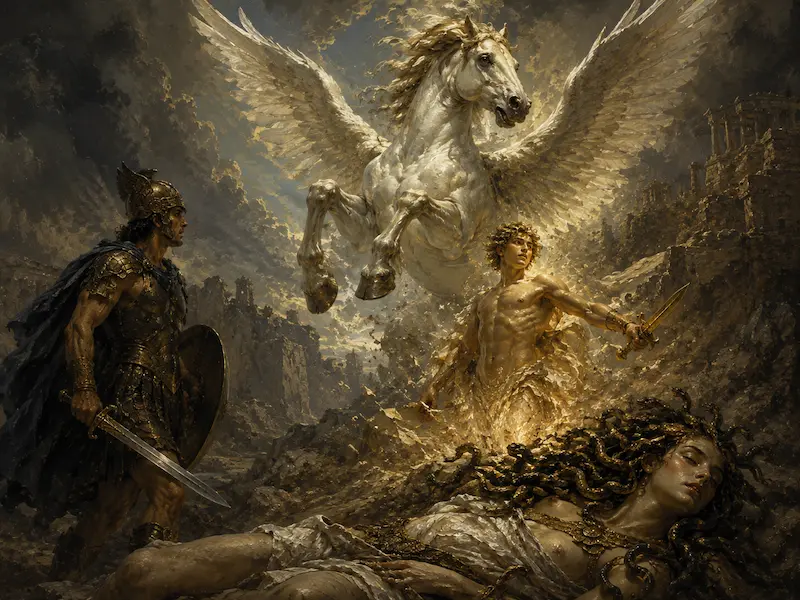
The circumstances are unlike any other birth in Greek myth. There is no pregnancy in the ordinary sense and no delivery. The children were latent inside Medusa and released by the sword stroke that killed her, which is a mythological logic rather than a biological one, and Greek audiences do not appear to have found it a problem.
Pegasus is the famous one, the winged horse who flew away to the gods and who later carried Bellerophon against the Chimera. Chrysaor is far less developed as a character. His name points to a golden blade, and later tradition makes him the father of the three-bodied giant Geryon, but he barely appears in narrative myth compared with his brother.
What Happened to Medusa’s Head?
Perseus Used Medusa’s Head as a Weapon
The head kept working after death, and Perseus treated it as equipment for the rest of his journey. He carried it sealed in the kibisis, uncovering it only when he intended someone to be turned to stone.
Two uses are best known. In Ovid, Perseus shows the head to the Titan Atlas, who becomes the mountain range that carries his name. Back on Seriphos, he uses it on Polydectes and the king’s supporters, ending the threat to his mother in a single moment and completing the errand the king had set in the worst possible way for the king.
Athena and the Gorgoneion
When the mission was over, Perseus gave the head to Athena, and she set it on her aegis, the fringed goatskin or shield that is her most distinctive attribute. Greek art shows the Gorgon face at its center constantly, and the association became permanent.
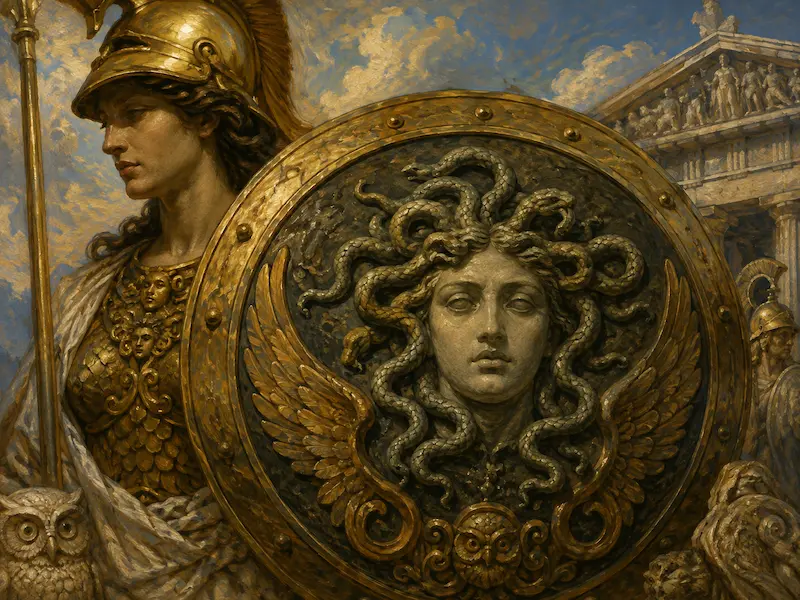
The image itself has a name. A Gorgoneion is a representation of the Gorgon’s head, used on its own, detached from any narrative scene. It appears on the aegis of Athena, but also far beyond it.
Its function was protective. The Greeks used the Gorgoneion as an apotropaic device, meaning an image intended to turn away harm by frightening off whatever might cause it. The face that petrified enemies in myth was expected to repel danger in practice, which is why a monster’s head ended up on objects meant to keep people safe.
Medusa’s Symbols and Meaning in Ancient Greece
Medusa Greek mythology leaves behind one image more than any other, and it is not a scene from the story. It is the snake-covered head on its own, which circulated widely as an image in its own right. Gorgoneia appear on shields and armor, on temple pediments and roof tiles, on coins, on drinking cups, on door fittings, and on ovens and household objects, always doing the same job of warding something off.
The logic is straightforward once the function is clear. A face too terrible to look at is useful precisely because it is terrible. Placed on a shield, it confronts an enemy. Placed on a temple, it guards a threshold. The famous Gorgon pediment from the temple of Artemis at Corfu, made in the early sixth century BCE, shows the type at its most aggressive, and the terracotta antefixes on many Greek roofs repeat it in miniature.
The shift in appearance described earlier applies here too. As Greek and later Roman artists moved toward the beautiful Gorgon type, the Gorgoneion followed, and Roman versions on armor and mosaic can be striking rather than grotesque while still serving as protection. The meaning stayed constant even as the face changed.
Frequently Asked Questions About Medusa
What is the real story behind Medusa?
There is no single real version. In early Greek tradition, recorded by Hesiod, Medusa is born as one of three Gorgon sisters to the sea deities Phorcys and Ceto, and she is a monster from the start, distinguished only by being mortal. The story of a beautiful woman transformed as punishment comes from the Roman poet Ovid, writing centuries later. Both are ancient, but they are not the same tradition, and Ovid’s account is not the original Greek myth.
Was Medusa evil or a victim?
The two traditions point in different directions. Early Greek sources present Medusa as a dangerous Gorgon rather than as a character with motives, and neither Hesiod nor early Greek art gives her a backstory that would invite sympathy. Ovid changed that by supplying a cause for her appearance, and his version is the reason later readers have understood her as a tragic figure punished for something done to her. Calling her simply evil or simply a victim requires ignoring one of the two traditions.
Which god fell in love with Medusa?
Poseidon is the god connected with Medusa, and he is named as the father of Pegasus and Chrysaor. Describing this as falling in love oversimplifies what the sources actually say. Hesiod records only that the god lay with her in a meadow, with no emotional framing at all. Ovid places the encounter in the temple of Minerva, and most modern translators read his Latin as describing rape rather than romance.
Did Medusa get pregnant by Poseidon?
Poseidon fathered Pegasus and Chrysaor with Medusa, and both emerged from her when Perseus decapitated her. The myth does not describe a pregnancy or a birth in any ordinary sense. The children simply spring forth at the moment of her death, which is how Hesiod tells it. Applying modern biological reasoning to the sequence produces questions the ancient sources were never trying to answer.
Why did Athena curse Medusa?
The transformation belongs mainly to Ovid’s Roman account. In it, Neptune has Medusa in the temple of Minerva, and the goddess responds to the desecration of her sanctuary by turning Medusa’s celebrated hair into snakes. Earlier Greek traditions contain nothing of the kind. Hesiod already describes Medusa as one of three Gorgon sisters born that way, so there is no curse to explain in the older material.
Medusa remains one of the most recognizable figures in Greek mythology because her story combines ancient monster traditions, heroic myth, and later literary reinterpretation. Early Greek sources present her as the only mortal Gorgon, while Ovid’s Roman retelling introduced the famous story of a beautiful Medusa transformed after her encounter with Poseidon. Her death at the hands of Perseus led to the birth of Pegasus and Chrysaor, and even after death her severed head retained its deadly power. Through the Gorgoneion, Medusa also became more than a monster, serving as a powerful protective image throughout the ancient Greek world.

About the Author
Dana Whitfield
I write about numerology, astrology, mythology, tarot, and world mystical traditions for Mystivora, drawing on years of independent research across comparative religion and symbolic systems. I approach each topic by cross-checking primary texts and established scholarship rather than repeating popular but unverified claims.
Related Articles
View All Articles → Mythology