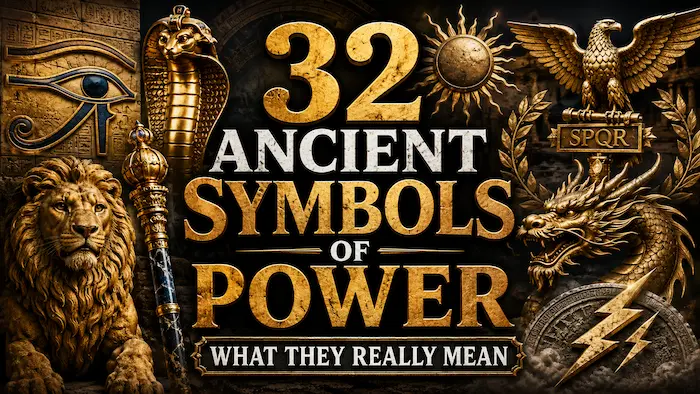
Long before modern states relied on constitutions, flags, and official seals, ancient societies used visual symbols to communicate who ruled, who protected the community, and whose authority was believed to come from the gods. Some represented physical strength. Others expressed royal legitimacy, military command, divine protection, cosmic order, or the power to preserve life.
This guide explores 32 ancient symbols of power from Egypt, Mesopotamia, Greece, Rome, India, China, and the Americas. The symbols are organized by cultural setting and type of authority. Where a popular modern interpretation goes beyond the historical evidence, that distinction is made clear. A separate comparison section also examines two Akan Adinkra symbols, which add a valuable non-military view of power but are not counted as ancient examples.
Ancient Symbols of Power at a Glance
| Symbol | Civilization or Culture | Approximate Period | Type of Power |
|---|---|---|---|
| Was Scepter | Ancient Egypt | Early Dynastic Period onward | Divine and royal dominion |
| Uraeus | Ancient Egypt | Early Dynastic Period onward | Royal authority and protection |
| Eye of Ra | Ancient Egypt | Old Kingdom texts onward | Solar and destructive divine power |
| Eye of Horus | Ancient Egypt | Old Kingdom onward | Protection, restoration, legitimacy |
| Ankh | Ancient Egypt | Early Dynastic Period onward | Life-giving divine power |
| Crook and Flail | Ancient Egypt | Early Dynastic/Old Kingdom onward | Kingship and royal duty |
| Double Crown | Ancient Egypt | Early Dynastic Period onward | Sovereignty over a unified kingdom |
| Sekhem Scepter | Ancient Egypt | Old Kingdom onward | Power, rank, ritual authority |
| Shen Ring and Cartouche | Ancient Egypt | Old Kingdom onward | Eternity, protection, royal identity |
| Zeus’s Thunderbolt | Ancient Greece | Archaic Period onward | Supreme divine authority |
| Labrys | Minoan Crete | Second millennium BCE | Ritual and palace authority |
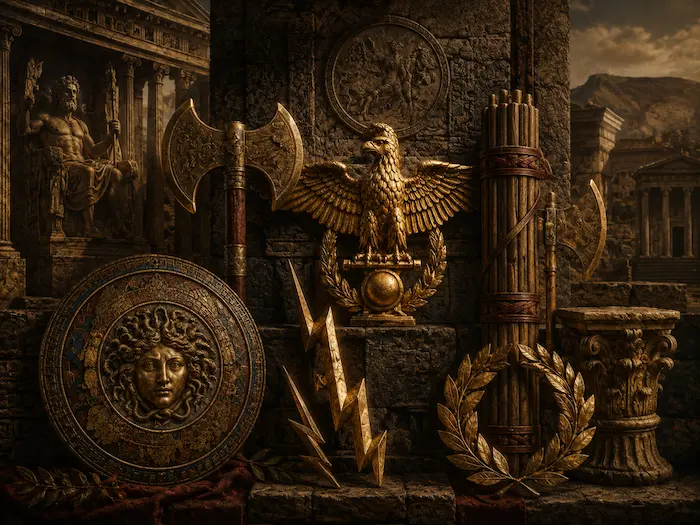
| Roman Aquila | Ancient Rome | Late Republic onward | Military command and state power |
| Aegis | Ancient Greece | Archaic literature/art onward | Divine protection, terrifying authority |
| Fasces | Ancient Rome | Roman Republic onward | Magisterial and state authority |
| Laurel Wreath | Greece and Rome | Classical Period onward | Victory, achievement, sanctioned status |
| Lion | Egypt, Mesopotamia, Persia, Greece, India | Third millennium BCE onward | Royal strength and dominance |
| Bull | Mesopotamia, Anatolia, Minoan Crete | Fourth millennium BCE onward | Strength, fertility, kingship |
| Griffin | Egypt, Near East, Greece, Persia | Third millennium BCE onward | Royal guardianship and authority |
| Lamassu | Ancient Assyria | 9th–7th centuries BCE | Imperial protection |
| Phoenix | Egypt and Greece | 1st millennium BCE textual traditions | Renewal, solar endurance, rebirth |
| Ram | Egypt, Greece, ancient Near East | Third millennium BCE onward | Virility, divine force, leadership |
| Boar | Ancient Europe and Mediterranean | 1st millennium BCE onward | Ferocity, courage, warrior strength |
| Oak Tree | Greece, Rome, Europe | Ancient religious traditions | Endurance, sacred strength, stability |
| Arrow | Worldwide | Prehistoric and ancient use | Military reach, speed, focused force |
| Chinese Imperial Dragon | Imperial China | Ancient origins; imperial use over centuries | Cosmic and royal authority |
| Lion Capital of Ashoka | Maurya Empire, India | 3rd century BCE | Royal and moral authority |
| Sudarshana Chakra | Ancient India | Early Hindu traditions onward | Divine force and cosmic order |
| Aztec Eagle Warrior Regalia | Mexica Empire | 14th–early 16th centuries CE | Military and sacred status |
| Maya Jaguar Throne Imagery | Classic Maya | c. 250–900 CE | Royal and supernatural authority |
| Mesopotamian Horned Crown | Ancient Mesopotamia | Third millennium BCE onward | Divinity and supernatural rank |
| Ceremonial Mace and Macehead | Egypt and Mesopotamia | Fourth millennium BCE onward | Royal conquest and executive power |
| Winged Sun Disk | Egypt and ancient Near East | 2nd millennium BCE onward | Divine protection and royal legitimacy |
Important distinction: not every old-looking emblem is truly ancient. Mjölnir pendants belong mainly to the Viking Age, the double-headed eagle became an imperial emblem in the medieval period, the Star of David’s political meaning solidified centuries later than its shape, and the raised fist is entirely modern. Those symbols are discussed later, but they are not counted among the 32 ancient examples above.
Power, Strength, Authority, and Protection Are Not the Same
Searches for ancient power symbols often mix several related ideas. Ancient cultures did the same, but the distinctions still matter. A lion can represent strength without granting legal authority. A crown can express authority even when its wearer is not physically strong. An amulet may protect its owner without functioning as a royal emblem.
| Concept | What It Means | Typical Ancient Examples |
|---|---|---|
| Power | The capacity to command, control, create, destroy, or influence events. | Was Scepter, thunderbolt, chakra |
| Strength | Physical force, endurance, courage, or resistance. | Lion, bull, ram, boar, oak |
| Authority | A recognized or legitimate right to rule and issue commands. | Double Crown, Uraeus, Fasces, throne |
| Divine authority | Power believed to come from a god or the cosmic order. | Eye of Ra, winged sun disk, aegis |
| Protection | The ability to guard a person, place, ruler, or community. | Eye of Horus, Lamassu, Griffin |
The strongest historical examples usually have evidence showing how the symbol was actually used: on royal clothing, temple reliefs, military standards, official seals, coins, thrones, amulets, or monumental gateways. A modern tattoo meaning can be meaningful today, but it should not automatically be presented as the original ancient interpretation.
Divine and Royal Power in Ancient Egypt
Ancient Egypt developed one of the richest visual systems of royal and divine authority in the ancient world. Egyptian kingship was not treated as ordinary political leadership. The pharaoh was expected to preserve maat — order, balance, truth, and justice — while maintaining the relationship between the gods and humanity.
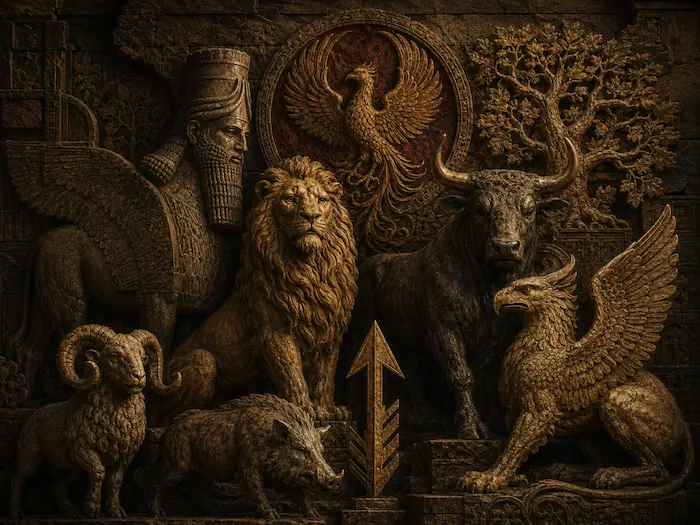
Royal clothing, crowns, scepters, animal emblems, and hieroglyphic signs therefore carried political and religious meaning at the same time. The Metropolitan Museum of Art’s educational guide identifies the Was Scepter as meaning “power,” the Wedjat eye as a protective emblem, and the ankh as the sign for life. It also describes the crook, flail, crowns, and uraeus as elements of Egyptian royal regalia. The Met’s guide to ancient Egyptian art provides a useful scholarly overview of these symbols.
1. The Was Scepter
The Was Scepter is one of the clearest ancient symbols of power because its Egyptian name was directly connected with dominion or authority. It appears as a long staff with a forked base and a stylized animal head at the top. Gods commonly hold it in temple reliefs, while kings and high officials may appear with related scepters that mark their status.
The animal represented by the head is not identified with complete certainty. It is sometimes associated with Set, the powerful and dangerous god of the desert, storms, and disorder. Whatever its precise zoological identity, the scepter’s function is clearer: it communicates the ability to control forces that could otherwise threaten the ordered world.
2. The Uraeus
The Uraeus was the upright rearing cobra worn on the crowns and headdresses of Egyptian rulers. It represented the goddess Wadjet and became one of the clearest visual signs of legitimate pharaonic rule.
Its raised posture communicates readiness to strike. Egyptian tradition imagined the royal cobra defending gods and kings with fire, turning the emblem into a visual warning to enemies. A ruler wearing the Uraeus displayed both legitimate kingship and divine protection.
3. The Eye of Ra
The Eye of Ra represents the active force of the sun god Ra. It is often confused with the Eye of Horus because Egyptian myths could describe divine eyes in overlapping ways, and artists did not always use one modern standardized design for each concept.
In mythology, the Eye of Ra could act independently as a goddess or destructive power sent against the enemies of divine order. Texts associate this force with goddesses such as Hathor, Sekhmet, Bastet, and Wadjet in different contexts. The famous story often called the “Destruction of Mankind” presents the solar eye as a dangerous instrument of punishment.
4. The Eye of Horus
The Eye of Horus, also called the Wedjat eye, carries a different emphasis. According to the myth, Horus’s eye was damaged or torn out during his struggle with Set for the kingship of Egypt. The god Thoth restored it, turning the healed eye into a symbol of wholeness, recovery, and protection.
Egyptians used Wedjat-eye amulets for both the living and the dead. The symbol could protect the body, restore health, and support rebirth in the afterlife. Because Horus was also closely associated with living kingship, the restored eye could imply the survival and renewal of legitimate rule.
5. The Ankh
The Ankh is a cross-shaped sign with a loop at the top. Its basic meaning is “life,” and Egyptian deities are often shown holding it or offering it toward a king’s face. These scenes visually connect life itself with divine favor.
The Ankh did not primarily represent military power or physical strength. Its power was more fundamental: the ability to sustain life in this world and continue existence in the next. When a god extends an Ankh to a pharaoh, the image suggests that royal life and authority depend on divine support.
6. The Crook and Flail
The crook and flail are among the most important Egyptian symbols of royalty. Kings are frequently depicted holding them crossed over the chest, and Osiris carries them as ruler of the underworld. A Metropolitan Museum object description identifies them directly as insignia associated with Egyptian kingship. The Met’s statuette of Osiris shows the god holding both emblems while wearing a royal Uraeus.
The crook is commonly connected with the shepherd’s staff and can be interpreted as the ruler’s duty to guide and protect. The origin and exact meaning of the flail are less certain. It has been linked with agricultural tools, livestock, fertility, and royal discipline, but no single explanation should be treated as conclusively proven.
7. The Double Crown
The Double Crown, often called the Pschent in later terminology, combined the White Crown of Upper Egypt with the Red Crown of Lower Egypt. It expressed sovereignty over the two lands and the political ideal of a unified kingdom.
Egyptian rulers used several crowns depending on the ritual or artistic context, but the combined crown made a particularly direct claim. Its wearer did not govern only one region; he or she embodied authority over the entire Egyptian state.
8. The Sekhem Scepter
The Sekhem Scepter was another Egyptian emblem of power, rank, and ritual authority. Its upper section was broader and flatter than the animal-headed Was Scepter, giving it a form sometimes compared to a ceremonial paddle or fan.
The Egyptian word sekhem was associated with power or might. It appears in royal and divine names, including Sekhmet, whose name is commonly translated as “the Powerful One.” Kings, deities, high officials, and ritual specialists could be shown with related scepters, connecting the object with both formal office and sacred force.
The Sekhem Scepter is especially valuable for this topic because it shows that Egyptian power symbolism was not limited to one staff. The Was emphasized dominion and control, while the Sekhem more directly communicated potency, status, and the capacity to act with authority.
9. The Shen Ring and Cartouche
The Shen Ring is a circular loop of rope whose form expressed enclosure, eternity, and protection. Deities and protective birds could be shown holding the ring, visually surrounding what lay within its protection.
The royal cartouche developed as an elongated name ring enclosing a pharaoh’s throne name or birth name. By setting the king’s name apart, it transformed written identity into a protected royal emblem. The cartouche did not simply identify the ruler; it preserved the ruler’s name within a symbolic boundary.
A Metropolitan Museum foundation plaque takes the form of a Shen Ring and encloses a royal cartouche, clearly showing the relationship between eternity, protection, and kingship. The Met’s foundation plaque of Psusennes I is a useful material example.
Power Symbols of Ancient Greece and Rome
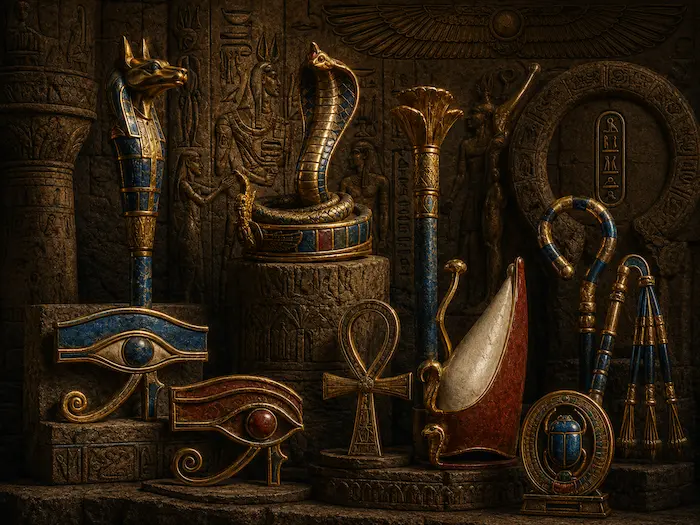
10. Zeus’s Thunderbolt
The thunderbolt of Zeus represented the supreme authority of the ruler of the Olympian gods. Greek myth describes the Cyclopes forging the weapon and giving it to Zeus during the conflict against the Titans.
Unlike an ordinary spear or sword, lightning comes from the sky, strikes without warning, and cannot be controlled by human beings. The thunderbolt therefore made an ideal symbol for a god whose judgments were meant to be irresistible.
11. The Labrys
The Labrys is a symmetrical double axe strongly associated with Bronze Age Minoan Crete. Archaeologists have found double-axe imagery in palace and ritual settings, including at Knossos. Some examples are too delicate or elaborate to have functioned as ordinary weapons.
The precise meaning of the Labrys in Minoan religion remains debated because the Minoan scripts have not yielded a complete explanation of the civilization’s beliefs. It is safer to describe the axe as a prominent ritual and elite emblem than to assign it one universal meaning.
Minoan palaces concentrated political, economic, and ceremonial activity. The Metropolitan Museum notes that these palace centers gathered political and economic power as well as artistic production, supplying historical context for the ceremonial world in which the Labrys appeared.
12. The Roman Aquila
The Aquila was the eagle standard of a Roman legion. Under the late Republic and Empire, each legion guarded its eagle as a physical embodiment of military honor, unity, and loyalty to Rome.
Roman leaders made the recovery of lost standards a political priority. Augustus famously celebrated the diplomatic return of standards taken by the Parthians, turning their recovery into a public statement of restored Roman prestige. A historical overview of Roman military standards explains why the Aquila became the best-known emblem of the legions.
13. The Aegis
The Aegis belongs to Zeus and Athena in Greek myth. Ancient descriptions do not present one perfectly consistent object: it can resemble a hide, breastplate, cloak, or shield-like divine attribute. In later art it is frequently shown with the head of the Gorgon at its center.
Its meaning combines protection with intimidation. The Aegis does not merely block an attack. It projects the terrifying presence of a deity, causing enemies to panic or lose the will to resist. This is authority expressed as an atmosphere of overwhelming supernatural force.
The modern phrase “under the aegis of” preserves the protective side of the symbol. Historically, however, the Aegis was not a gentle shelter. It represented protection backed by the power of Zeus or the strategic, warlike authority of Athena.
14. The Fasces
The Roman Fasces consisted of bundled rods, sometimes surrounding an axe. Lictors carried them before senior magistrates, making the emblem a visible sign that the official possessed the authority of the Roman state.
The rods referred to the power to punish, while the axe could represent the power of execution. The exact display varied according to place, office, and political circumstance. The symbol therefore communicated jurisdiction rather than personal physical strength.
The British Museum describes the Fasces as a graphic representation of the Roman state’s power and authority over its people. The British Museum’s introduction to ancient Rome provides concise historical context. Modern political appropriation, especially by Fascism, is much later and should not replace the symbol’s Roman meaning.
15. The Laurel Wreath
The Laurel Wreath represented victory, achievement, honor, and publicly recognized status in the Greek and Roman worlds. Laurel was sacred to Apollo, and wreaths or crowns made from leaves became prizes and ceremonial markers.
A wreath differs from a hereditary crown. Its authority was awarded because of an accomplishment: athletic success, poetic distinction, military victory, or imperial triumph. In Rome, victorious commanders and emperors used laurel imagery to present success as sanctioned and worthy of remembrance.
The laurel therefore represents power gained through achievement and recognition rather than power inherited by blood. Its later use for academic honors and the word “laureate” preserves this association with publicly confirmed excellence.
Animal and Hybrid Symbols of Strength and Authority
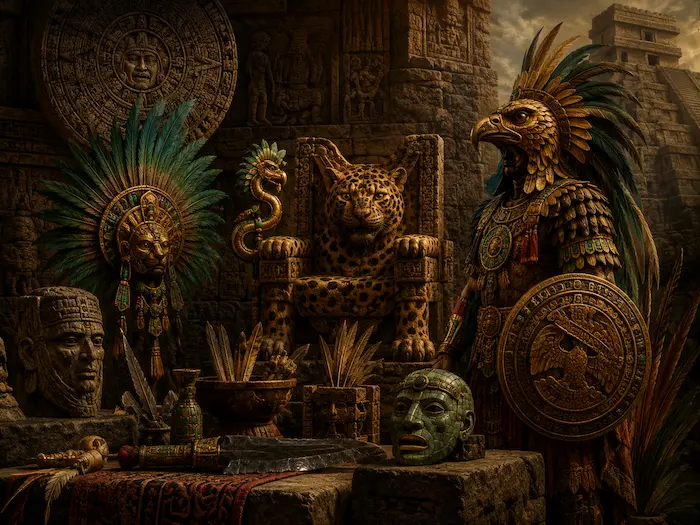
16. The Lion
The lion was used as a symbol of strength, kingship, courage, and divine protection across Egypt, Mesopotamia, Anatolia, Persia, Greece, and India. Its importance did not come from one shared mythology. Different cultures independently recognized the authority communicated by a large predator.
In Egypt, lion and lioness imagery could express the destructive heat of the sun and the force of deities such as Sekhmet. In India, lions became associated with royal leadership and, in Buddhist contexts, the authority of the Buddha’s teaching. The lion is therefore one of the broadest old symbols of power, but its exact meaning always depends on context.
17. The Bull
The bull represented physical force, fertility, virility, agricultural wealth, and royal power in many ancient cultures. Bull imagery appears prominently in Mesopotamia, Anatolia, the Levant, Egypt, Minoan Crete, and the Greek world.
In Mesopotamian art, powerful gods and supernatural beings could be associated with bull horns. Horned crowns marked divine status, while winged bulls protected Assyrian palaces. In Minoan culture, bulls appeared in ritual imagery, including the famous bull-leaping scenes.
Calling the bull a universal symbol of masculinity would oversimplify its history. Its meanings included fertility, cosmic force, sacrifice, divine rank, and the economic power of livestock. What remains consistent is the animal’s association with energy that humans sought to control or claim.
18. The Griffin
The Griffin combines the body and strength of a lion with the head, wings, and commanding vision of an eagle. By joining two dominant animals, ancient artists created a guardian capable of representing power on both land and in the sky.
Griffin imagery has a long history in Egypt and the ancient Near East before becoming prominent in Greek, Persian, and later Mediterranean art. Griffins guarded valuable objects, sacred places, rulers, and the dead. Their role was often protective, but that protection communicated status: only something important required such a formidable guardian.
The Metropolitan Museum describes the griffin as a symbol of power and authority that functioned as a sign of royalty and as a guardian figure.
19. The Lamassu
The colossal Assyrian guardian commonly called a Lamassu combines a human head, the body of a bull or lion, bird wings, and a horned divine crown. Pairs of these figures stood at monumental palace gateways, where visitors encountered them before entering the royal space.
Assyrian sculptors sometimes gave the figure five legs. From the front, it appears to stand firmly; from the side, it strides forward. The effect makes the guardian both stable and active. The Metropolitan Museum explains that such figures protected and supported important palace doorways, while the horned cap signaled divinity and the belt signified power. The Met’s Assyrian winged lion is a strong surviving example.
20. The Phoenix
The Phoenix is an ancient bird associated with exceptional longevity, the sun, renewal, and rebirth. Early Greek accounts describe a rare sacred bird connected with Egypt, while later Roman writers developed more elaborate versions of its death and return.
The familiar image of a bird bursting into flames and immediately rising from its ashes is not equally clear in the earliest sources. The myth changed over time. What remained consistent was the idea that the Phoenix survived ordinary limits and renewed itself after an immense cycle.
For that reason, the Phoenix is better classified as a symbol of regenerative power and endurance than as an emblem of political authority. It fits the broader “strength” search intent, but it should not be described as a royal insignia comparable to the Uraeus or Fasces.
21. The Ram
The Ram represented force, virility, fertility, leadership, and divine energy in several ancient societies. Its horns offered a natural visual language of impact and forward-driving power.
In Egypt, ram imagery was associated with gods including Khnum and Amun. Amun’s growing religious importance connected the ram with creation, kingship, and the hidden power of a major state deity. Ram-headed sphinxes could line ceremonial approaches, placing divine protection around sacred and royal spaces.
In Greek tradition, the ram also appears in heroic myth and sacrificial practice. Because the animal’s meanings varied, “strength” is a useful summary but not a complete definition. Its power might be reproductive, royal, creative, sacrificial, or martial depending on the context.
22. The Boar
The Boar was admired and feared for its aggression, courage, endurance, and refusal to retreat. Ancient hunters regarded it as a dangerous opponent, so defeating one could demonstrate skill and bravery.
Boars appear in Greek heroic myths, Celtic and Iron Age art, Germanic traditions, helmets, shields, coins, and military imagery. The National Museum of Ireland notes that the animal’s courage and aggression made it both a worthy opponent and a military emblem.
Unlike the lion, which often represents kingship and controlled dominance, the boar expresses power as ferocity and unstoppable resistance. It is especially suited to warrior identity rather than formal legal authority.
Natural and Martial Symbols of Strength
23. The Oak Tree
The Oak Tree became a symbol of endurance because of its size, long life, dense wood, and resistance to storms. Its strength was both physical and sacred: an old oak could appear to bridge generations and stand as a permanent feature of the landscape.
In ancient Greece, the oak was sacred to Zeus. The oracle at Dodona interpreted signs connected with Zeus’s sacred oak, linking the tree with divine counsel as well as thunder and kingship.
Across later European traditions, the oak remained associated with thunder gods, stability, and strength. Claims about one universal “Celtic oak symbol” should be treated carefully, but the broader connection between oak, sacred endurance, and divine power is historically well established.
24. The Arrow
The Arrow represents focused force delivered across distance. As both a hunting tool and weapon, it gave ancient societies the power to strike an animal or enemy before close contact.
In visual symbolism, a single arrow can imply direction, speed, precision, penetration, and purposeful action. Bundled arrows add a different meaning: coordinated strength, since multiple shafts held together are harder to break and suggest collective military power.
Because arrows were used by cultures across the world, their meaning cannot be assigned to one civilization. They appear as attributes of gods and heroes, as signs of warfare, and as metaphors for sudden divine punishment, desire, or fate. Their strongest connection to power is practical: the arrow converts human intention into force at a distance.
Imperial and Divine Power in Asia
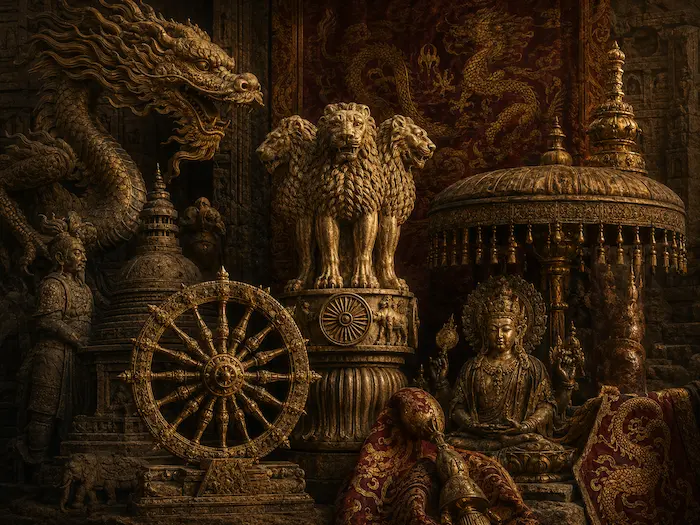
25. The Chinese Imperial Dragon
The Chinese dragon was associated with rain, water, fertility, auspicious energy, cosmic order, and imperial majesty. Unlike the destructive dragons common in later European stories, it was often presented as a life-giving and regulating force.
Dragon imagery existed long before a single claw-count system defined rank. Over centuries, imperial courts regulated the designs, colors, and creatures permitted on formal dress. Five-clawed dragons became especially connected with the emperor and the highest members of the imperial family, although rules varied by dynasty, garment, and rank.
It is therefore inaccurate to claim that every unauthorized use automatically resulted in execution. A better conclusion is that dragon imagery formed part of a detailed visual hierarchy. Smithsonian material on Qing court dress explains that five-clawed dragons indicated a high-level member of the imperial family and that clothing design depended on rank.
26. The Lion Capital of Ashoka
The Lion Capital of Ashoka was created in the third century BCE for a pillar at Sarnath, a site connected with the Buddha’s first sermon. Four lions sit back to back above a circular abacus decorated with animals and wheels.
The capital therefore represents a different kind of power from the weapon of Zeus or the Roman eagle. It joins royal authority with dharma, suggesting that a ruler’s strength should be directed by moral responsibility. Smarthistory’s analysis notes that the lion signifies royalty and leadership and may also represent Ashoka himself — one of the clearest ancient examples of authority expressed through ethical rule.
27. The Sudarshana Chakra
The Sudarshana Chakra is the spinning discus associated with Vishnu and his avatars, including Krishna. It appears as both a weapon and a divine attribute, representing a force capable of defeating disorder and protecting the cosmic structure.
In Hindu iconography, Vishnu commonly carries the chakra along with the conch, mace, and lotus. The discus is martial, but its meaning is not limited to violence. Vishnu’s larger role is the preservation of the universe, so the weapon acts in defense of dharma and rightful order.
Power Symbols of the Ancient Americas
28. Aztec Eagle Warrior Regalia
Eagle Warrior regalia identified members of elite military traditions in central Mexico. Eagle imagery connected warfare with the sky and sun, while specialized clothing made a warrior’s rank visible during ceremonies and battle.
The regalia could include a helmet or head covering shaped like an eagle’s open beak, feathered garments, shields, and ornaments. Its imagery linked the warrior to the sun and to the martial prestige of the Mexica state, making military achievement visible rather than merely symbolic.
Surviving artworks and colonial-era pictorial manuscripts show warriors wearing animal-associated costumes and ornaments. The Metropolitan Museum describes eagle-headed gold jewelry as military regalia likely reserved for elite warriors, emphasizing the eagle’s ferocity.
29. Maya Jaguar Throne Imagery
The jaguar held a special place in ancient Mesoamerican ideas of power. As a dominant nocturnal predator able to move through forest, darkness, and water, it became associated with warfare, the night sun, the underworld, and supernatural transformation.
Maya kings used jaguar pelts, jaguar-patterned cushions, throne imagery, and feline attributes to present themselves as rulers with access to forces beyond the ordinary human world. The animal’s skin and body were therefore part of a carefully staged language of courtly and sacred authority.
A Maya stela in the Metropolitan Museum shows a ruler seated on a throne covered with jaguar pelt while supernatural imagery surrounds the court. The museum explains that the combination of historical and mythical elements communicated the ruler’s influence over human and superhuman realms.
Divine Rank and Royal Force in Mesopotamia and Early Egypt
30. The Mesopotamian Horned Crown
The horned crown was one of the clearest visual markers of divinity in ancient Mesopotamian art. Gods and supernatural beings were shown wearing caps or crowns built from one or more pairs of horns, allowing viewers to recognize divine status immediately.
The number and arrangement of horns could vary by period and image, but the basic message remained consistent: the wearer belonged to the supernatural realm. The crown did not represent physical strength alone. It marked a rank of being whose authority exceeded that of ordinary humans and earthly rulers.
The Metropolitan Museum of Art describes the horned crown as an indicator of divinity on Neo-Assyrian supernatural figures. The Met’s Neo-Assyrian relief panel provides a clear surviving example of this ancient convention.
31. The Ceremonial Mace and Macehead
The mace began as a practical striking weapon, but in early Egypt and Mesopotamia it also became a symbol of royal force, victory, and the ruler’s capacity to punish enemies. Stone maceheads could be made on a scale or with decoration that made them more suitable for ritual display than ordinary combat.
Ancient Egyptian royal imagery repeatedly shows the king raising a mace over a defeated enemy. The pose communicates more than one historical battle: it presents the ruler as the force that defeats disorder and restores the political and cosmic order of the state.
The Metropolitan Museum of Art notes that Predynastic maces became symbols of power and prestige even after their practical military role declined. The Met’s Predynastic disc-shaped macehead explains how the weapon developed into a lasting emblem of royal authority.
Cross-Cultural Symbols of Celestial Power
32. The Winged Sun Disk
The winged sun disk appeared in Egypt and across parts of the ancient Near East. Its design typically places a solar disk between extended wings, sometimes accompanied by cobras, crowns, or other divine elements.
The symbol also traveled and changed across cultures, appearing in Near Eastern royal and religious art with locally specific meanings. It should not be reduced to one universal definition. In general, however, it combined celestial power, protective presence, and legitimate rule. A British Museum temple relief places a winged sun disk with Uraei and Ankh signs above an Egyptian king, showing how several power symbols could reinforce one another.
How to Tell Whether an Ancient Power Symbol Is Historically Reliable
A symbol is more securely documented when archaeologists can connect its image with objects, inscriptions, ritual settings, royal titles, or repeated uses across a known period. The Was Scepter, Roman Aquila, Fasces, Uraeus, and Double Crown meet this standard because their functions are supported by art, texts, and material evidence.
Be more cautious when a claim relies on a modern tattoo chart, an unattributed Pinterest graphic, or a statement that one sign had exactly the same meaning across every culture. Symbols change. The lion could be a royal guardian, solar force, divine animal, defeated enemy, or emblem of courage depending on where and how it appeared.
It is also important to separate an ancient image from a later interpretation. A geometric form may be thousands of years old while its familiar religious or political meaning is medieval or modern. Good historical writing dates both the shape and the interpretation instead of assuming they began together.
Symbols Often Called Ancient That Are Actually Later
Mjölnir
Thor’s hammer is one of the best-known symbols of strength and protection, but most surviving hammer pendants belong to the Viking Age, roughly the eighth through eleventh centuries CE. That places them in the early medieval period rather than classical antiquity. Mjölnir remains relevant to the broader topic, especially because pendants may have served protective and religious functions, but it should be dated honestly.
The Double-Headed Eagle
Two-headed eagle imagery has older precedents, but the familiar emblem of imperial dominion over East and West is primarily associated with medieval Byzantine and later European heraldry. Treating the complete Byzantine political meaning as an ancient symbol projects a later interpretation backward.
The Star of David
The hexagram shape itself is far older and appears independently across several unrelated cultures as decoration, but its specific meaning as a Jewish symbol — the “Shield of David,” linked to legends about King Solomon’s seal — is largely a medieval and early modern development. It became widely adopted as the central emblem of Jewish identity mainly from the 17th century onward, and was formalized as a national symbol only with the 19th–20th century Zionist movement and the 1948 flag of Israel. The shape predates that meaning by thousands of years; the meaning itself does not.
The Raised Fist
The raised fist is not ancient at all. Its first prominent documented use as a political symbol dates to 1917, when labor organizer “Big Bill” Haywood displayed it to a crowd during a labor dispute in the United States. It was later adopted by civil rights, feminist, and anti-authoritarian movements throughout the 20th century. It’s worth mentioning here for one reason: it proves the underlying pattern — a simple, repeatable image standing in for collective strength — is not unique to antiquity. Societies still generate new power symbols using the same logic Egypt and Rome used thousands of years earlier.
Traditional Power Symbols That Add a Different Perspective
The strongest way to preserve the Adinkra angle is not to label it ancient, but to present it as a later traditional comparison. Surviving documentation of Adinkra cloth belongs mainly to the precolonial and early modern Akan world rather than deep antiquity. The tradition may preserve older ideas, but the available evidence does not justify counting Tabono or Sankofa among the 32 ancient symbols above.
This distinction makes the comparison more useful, not less. Most ancient power lists focus on kings, weapons, predators, and divine punishment. Adinkra adds a different model in which persistence, memory, responsibility, and accumulated wisdom can also function as power.
Adinkra: Tabono
Shaped like four joined oars, the Tabono represents strength defined as persistence, willpower, and hard work rather than physical dominance. The image suggests that a boat moves forward only through sustained and coordinated effort.
Tabono offers a useful counterpoint to symbols such as the mace, lion, thunderbolt, and Fasces. Instead of expressing the ability to defeat or command others, it presents strength as the discipline required to continue moving toward a goal.
Adinkra: Sankofa
Often shown as a bird reaching backward to retrieve an egg from its back, Sankofa represents the principle that progress requires recovering knowledge from the past. Its power lies in memory, learning, and the willingness to correct what has been forgotten.
Sankofa remains widely used in Ghanaian and African diaspora contexts as a symbol of cultural recovery and inherited wisdom. It stands apart from most entries in this article because it places authority in knowledge rather than force, divine rank, or bloodline.
The Metropolitan Museum of Art discusses early documented Akan imagery on Adinkra cloth collected before 1826, illustrating why these symbols should be treated as historically important traditional forms rather than automatically described as ancient. The Met’s study of heraldic imagery in Akan art provides useful chronological context.
What Ancient Power Symbols Have in Common
Power Was Closely Connected to the Sacred
Ancient political authority rarely stood completely apart from religion. Pharaohs preserved divine order, Roman standards received ceremonial devotion, Maya rulers appeared with gods, and Ashoka’s pillars joined royal command with moral teaching. Power was more persuasive when presented as part of the structure of the universe.
Protection and Destruction Were Two Sides of Power
The Uraeus protects the king by threatening enemies. The Eye of Ra defends order through destructive force. The Lamassu guards a palace because it looks capable of crushing an intruder. Ancient protection symbols were not always gentle; many worked by displaying the consequences of crossing a boundary.
Animals Made Invisible Authority Visible
Leadership, divine favor, and cosmic order are abstract ideas. Lions, bulls, eagles, cobras, and jaguars gave those ideas recognizable bodies. The animal did not have to mean the same thing everywhere. Its physical characteristics supplied a visual vocabulary that each culture adapted to its own beliefs.
Power Was Worn, Carried, and Displayed
Many symbols of authority were physical objects rather than abstract designs. Crowns marked divine or royal rank, scepters and maces made command visible, standards represented organized armies, and throne imagery defined the ruler’s place within a political and sacred hierarchy.
Because these objects appeared in ceremonies, temples, courts, and battles, they allowed power to be recognized instantly. Their materials, scale, and restricted use often mattered as much as their shapes.
Not All Power Depended on Force
The later Adinkra examples sharpen a pattern that is easy to miss in an article dominated by weapons, predators, crowns, and thrones. Power can also be imagined as endurance, memory, coordination, and the capacity to learn from earlier generations.
They are not evidence for the same ancient political systems represented by the Aquila or Double Crown. Their value is comparative: they reveal that cultures can construct equally serious ideas of strength without making conquest or domination the central image.
Royal Symbols Outlived Individual Rulers
Crowns, scepters, standards, and throne imagery helped separate the institution of rulership from the person temporarily holding it. A king died, but the Uraeus, Double Crown, Aquila, or dragon robe could pass to a successor. Symbols allowed authority to appear continuous even when dynasties and governments changed.
Frequently Asked Questions
What symbols symbolize power?
Common symbols of power include the scepter and crown for royal authority, the lion and bull for physical or political strength, the eagle for military command and connection with the sky, and the dragon for cosmic or imperial power. Their meanings are not universal. The culture, time period, object, and setting determine what kind of power a symbol communicates.
What is the powerful ancient symbol?
There is no single ancient symbol that every culture or historian would rank as the most powerful. The Egyptian Was Scepter is one of the strongest candidates because its meaning was directly tied to power and dominion. The Uraeus and Double Crown are clearer symbols of royalty, while the Roman Aquila represents organized military and state authority.
What are the ancient symbols of strength?
The animals most associated with ancient symbols of strength are the lion (linked especially to the Egyptian goddess Sekhmet), the ram (linked to Khnum and Amun), the bull (widespread across the ancient Near East and Minoan Crete), and the boar (Celtic and Germanic warrior traditions).
What is the oldest magic symbol?
No single symbol can be proven to be humanity’s first magical sign. The Ankh and Eye of Horus are among the oldest well-documented Egyptian symbols with life-giving, protective, and amuletic associations. Both appear in ancient Egyptian religious art and were used in contexts intended to preserve life, restore wholeness, or protect the living and the dead.
What is the Egyptian symbol for power?
The Was Scepter is the most direct Egyptian symbol for power or dominion. The Uraeus represents royal authority and protection; the crook and flail represent kingship; and the Double Crown represents sovereignty over Upper and Lower Egypt.
What is the Egyptian symbol for strength?
Lion imagery, especially through the goddess Sekhmet, was Egypt’s primary symbol of ferocious, destructive strength. The ram, associated with the gods Khnum and Amun, represented a more generative, virile form of strength, while bull imagery — including the sacred Apis bull and the royal epithet “Strong Bull of His Mother” — represented physical and royal power.
Which ancient symbol represents divine authority?
The Was Scepter, Zeus’s thunderbolt, the Sudarshana Chakra, and the winged sun disk all represent forms of divine authority. The Was Scepter expresses dominion, the thunderbolt enforces the rule of Zeus, the chakra preserves cosmic order, and the winged sun disk joins celestial force with protection and kingship.
What are the best-known Egyptian protection symbols?
The Eye of Horus is associated with healing, restoration, and protection. The Uraeus protects kings and gods, while the Eye of Ra represents a more aggressive defensive force. Ankh, scarab, Shen-ring, and winged imagery also appear in protective or life-preserving contexts, although each has its own primary meaning.
Are ancient power symbols still used today?
Yes. The Lion Capital of Ashoka is India’s national emblem, the ankh remains common in jewelry and spiritual practice, and the double-headed eagle (a medieval rather than strictly ancient symbol) still appears on the flags of Albania and Serbia.
What is the oldest known symbol of power?
No single object can be proven to be humanity’s first power symbol. Early crowns, maces, animal standards, monumental architecture, and royal images appeared in different regions during the development of complex societies. In Egypt, the Was Scepter, royal crowns, and Uraeus belong among the oldest clearly documented symbols whose meanings relate directly to rule and divine authority.
What is the difference between a symbol of power and a symbol of authority?
A symbol of power communicates the ability to act, control, protect, or destroy. A symbol of authority communicates a recognized right to rule. Zeus’s thunderbolt is primarily power; the Roman Fasces are primarily authority. The Uraeus and Was Scepter combine both because they present divine force as support for legitimate kingship.
What symbol represents royalty?
The crown is the broadest symbol of royalty, but specific cultures used more precise signs. Ancient Egypt used the Uraeus, Double Crown, crook and flail, royal cartouche, and throne names. Imperial China used regulated dragon imagery and court dress. Lions, thrones, scepters, and royal standards also communicated sovereignty in many ancient states.
What is the difference between the Eye of Ra and the Eye of Horus?
The Eye of Ra emphasizes the fierce, active power of the sun god and can function as an instrument of punishment or aggressive protection. The Eye of Horus emphasizes healing, restoration, wholeness, and protection after the damaged eye is restored. Their imagery and mythology can overlap, so they should not be treated as two rigidly standardized modern logos.
Final Thoughts
The most important ancient symbols of power did more than decorate crowns, temples, weapons, and palaces. They made authority visible. A scepter could turn dominion into an object that a god or king could hold. A cobra could show that royal protection was ready to strike. A legionary eagle could transform thousands of soldiers into one organized body, a jaguar throne placed a Maya ruler at the meeting point of politics and the supernatural.

About the Author
Dana Whitfield
I write about numerology, astrology, mythology, tarot, and world mystical traditions for Mystivora, drawing on years of independent research across comparative religion and symbolic systems. I approach each topic by cross-checking primary texts and established scholarship rather than repeating popular but unverified claims.