The evil eye meaning is best understood as two related ideas that happen to share one name. Traditionally, the evil eye is a look, a gaze given out of envy or ill will that is believed to bring misfortune to whoever it falls on. The evil eye symbol 🧿, the blue and white eye seen on bracelets, wall hangings, and social media captions, is the reverse of that. It is an amulet used to guard against the gaze.
Nearly all the confusion around this symbol comes from mixing the two up. Someone wearing an evil eye necklace is not wishing harm on anyone. They are carrying a protective charm.
This guide covers what the evil eye means, what the 🧿 symbol represents, where the belief came from, how it appears in Turkish, Greek, Middle Eastern, and Italian traditions, what the different colors are said to signify, and why so many people wear it today.
What Is the Evil Eye?
The evil eye is a folk belief that a person’s gaze can cause harm. In its most common form, the harm comes from envy. Someone sees another person’s health, beauty, children, wealth, or good luck, feels a flash of resentment or covetousness, and that feeling is believed to travel through the look itself and settle on the person being admired.
The misfortune that follows is usually described in ordinary terms rather than dramatic ones. Traditional accounts mention bad luck, illness, headaches, exhaustion, crops failing, animals sickening, or a run of things simply going wrong. Babies and small children are often considered the most vulnerable, which is why so many protective customs are aimed at them.
One detail surprises people who are new to the idea: the gaze is not always thought to be deliberate. In many traditions the person casting it does not intend anything and may not even know they have done it. A compliment given a little too warmly is enough. That is why some cultures pair praise with a protective phrase, so admiration is not mistaken for envy. Belief in the evil eye is ancient and widespread, appearing in ancient Greece and Rome, in Jewish, Islamic, Buddhist, and Hindu traditions, and in folk societies around the world, and it has survived into the present day.
Here is the distinction that shapes the entire evil eye meaning. The evil eye is the harmful gaze. The eye-shaped amulet is the defense against it. Both are called the evil eye in everyday English, and that single overlap is responsible for most of the misunderstanding around the symbol.
What Does the Evil Eye Mean?
In its original and strictest sense, the evil eye meaning is envy made dangerous. The associations attached to it are consistently negative:
- Envy directed at someone else’s good fortune
- Jealousy, particularly toward what a person has rather than who they are
- Harmful intent, in the cases where the gaze is thought to be deliberate
- Misfortune as the result, from small setbacks to serious illness
- Negative influence that arrives unseen and without warning
Read that way, the phrase is a warning, not a blessing. To say someone gave you the evil eye is to say they looked at you with something unpleasant behind their eyes.
So why does the eye-shaped charm carry the opposite evil eye meaning? Because protective objects in this tradition work by imitation. The amulet is an eye that looks back. It meets the harmful gaze on its own terms and returns it, absorbs it, or breaks it before it lands. The logic is old and appears in many cultures: to stop a threatening image, you display a version of that image yourself.
That is the reason a symbol named after something harmful ended up standing for safety. The charm is not the curse. It is the answer to it.
Spiritual Meaning of the Evil Eye
In spiritual contexts, the evil eye meaning shifts firmly toward defense. The amulet is understood as a form of protection rather than a source of power. People who wear it commonly describe it as guarding against envy, deflecting bad intentions, and creating a boundary between themselves and unwanted influence.
Modern spiritual interpretations often use the language of energy, describing the symbol as something that keeps negative energy away or returns it to its source. Older folk traditions framed the same idea in terms of luck, harm, and the evil eye itself rather than energy.
These are traditional and symbolic interpretations. They describe what a community believes an object represents, not a mechanism that has been demonstrated.
What Does the Evil Eye Symbolize?
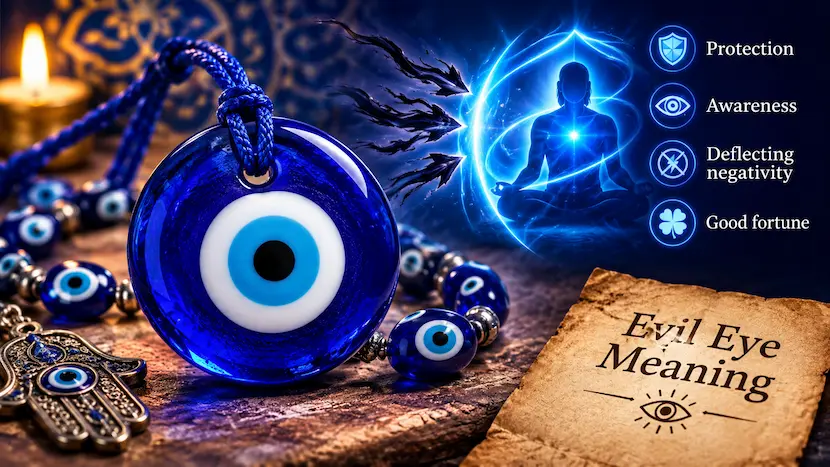
The 🧿 symbol, most often a set of concentric blue and white circles arranged as an eye, carries meanings that are almost entirely positive. Across the cultures where it is common, and in the wider modern usage that has grown up around it, the eye amulet symbolizes:
- Protection, above everything else
- Awareness, an eye that watches for trouble rather than causing it
- Guarding against jealousy, whether it comes from a stranger or from someone close
- Deflecting negativity before it reaches the wearer
- Safety for a person, a home, a child, or a vehicle
- Good fortune, an association that has become common in modern use
This is the half of the evil eye meaning that most people actually encounter, and it is worth stating plainly, because the name misleads constantly. Wearing the 🧿 symbol is not a hostile gesture. It does not mean the wearer is casting the evil eye, cursing anyone, or wishing anyone harm. In practically every context where it appears, the amulet represents the wish to be left alone by bad luck.
The same applies to the emoji. When people add 🧿 to a photo of something they are proud of, they are doing the digital version of hanging a charm over a doorway.
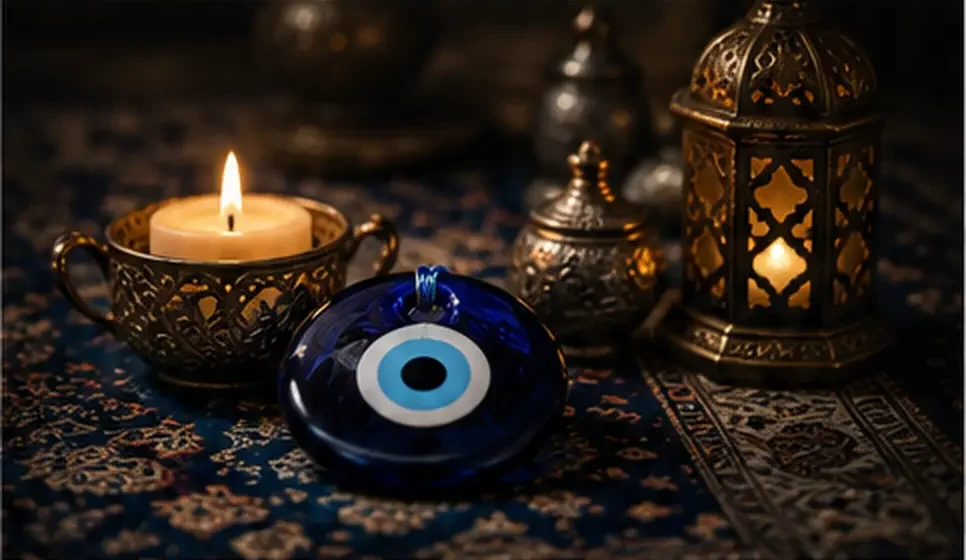
Origin and History of the Evil Eye
The belief is old enough that no culture can claim to have invented it. Ideas about the harmful gaze appear independently in societies that had little or no contact with one another, which is one reason anthropologists have found the subject so interesting.
References to a destructive or envious eye appear in ancient Mesopotamian texts, and eye-shaped amulets and idols survive from the same broad period in the ancient Near East. The belief is well documented in the classical world. The Greeks discussed it under the name baskania, and Plutarch offered an explanation involving rays emitted from the eyes of an envious person. Roman writers, including Pliny the Elder, recorded accounts of harmful gazes and the charms used against them. The Latin term for that bewitching stare, fascinatio, is where the English word fascinate comes from. Britannica’s overview of the evil eye in folklore is a useful starting point for readers who want the anthropological framing.
Ancient Greece also shows how normal apotropaic imagery was in the Mediterranean world. Apotropaic simply means intended to turn harm away. The Gorgoneion, the head of Medusa in Greek mythology, was placed on shields, temple roofs, coins, and household objects for exactly that reason, and it worked on the same principle as an eye amulet: confront the danger with an image of it.
The belief spread through the Mediterranean, the Middle East, North Africa, and South Asia, and later travelled with migration into Europe, Latin America, and beyond. That history is why the modern evil eye meaning still points back to those regions. The specific charm changed from region to region even when the underlying fear stayed the same.
The blue glass eye bead most people picture today is strongly associated with Anatolia and the wider Ottoman world, where a long glassmaking tradition produced the form now known as the nazar boncuğu. That bead is the direct ancestor of the modern 🧿 emoji and of most evil eye jewelry sold internationally.
Precise dates and origin claims about the evil eye circulate widely online and are often stated far more confidently than the evidence supports. What can be said reliably is that the belief is thousands of years old, that it is attested across several ancient civilizations, and that the eye-shaped countermeasure has been part of it for a very long time.
Evil Eye Meaning Across Cultures
The evil eye meaning stays remarkably stable as the belief travels. What changes between cultures is the name, the preferred charm, and the customs built around it. The core idea, that envy can do damage and that something visible should stand in its way, stays recognizable everywhere.
Turkish Nazar
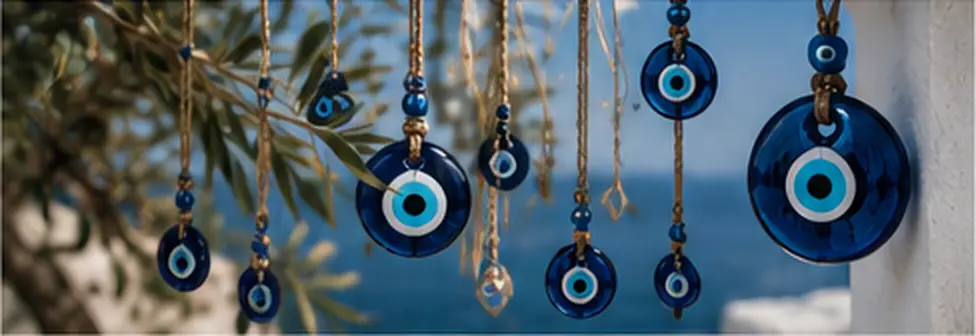
Nazar is the Turkish and Persian word for the look or gaze, and nazar boncuğu is the blue glass bead made to counter it. This is the most recognizable evil eye amulet in the world and the design that the 🧿 emoji is based on.
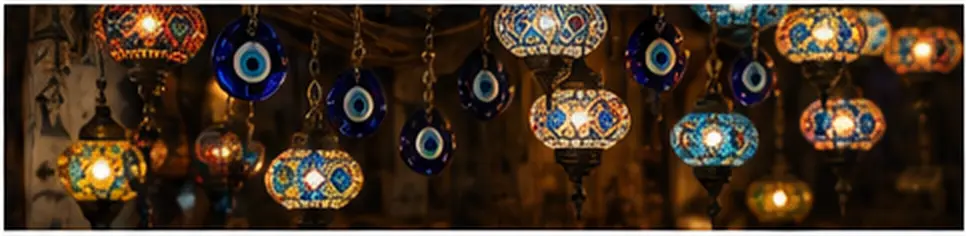
In Turkey the bead is genuinely part of daily life rather than a specialty item. It is hung inside homes and shops, pinned to babies’ clothing, fixed above doorways, hung from rearview mirrors, worked into jewelry, and set into everything from keychains to building facades. Its presence is so routine that it functions as much as a cultural marker as a spiritual one.
Greek Mati
In Greece the concept is called mati, meaning eye, and the belief is often referred to as vaskania. Envy sits at the center of it. Being complimented, praised, or openly admired is traditionally seen as the moment of risk, and the symptoms attributed to it are usually mundane, most commonly a persistent headache or a sudden heaviness and fatigue.
Blue and white eye charms are used widely, on jewelry, in homes, and on boats. Greek families also preserve spoken customs and household remedies passed down within families, which are treated as folk practice rather than formal religion.
Middle Eastern Traditions
Across the Arabic-speaking world the belief is known as al-ayn, and it is one of the most persistent folk concerns in the region. In Hebrew the equivalent term is ayin hara. A common protective habit is verbal rather than material: adding a phrase such as mashallah when praising something is understood as separating genuine admiration from envy.
Practice varies enormously, and it would be a mistake to treat the region as a single tradition. Some communities use amulets freely, while other Muslims avoid charms of any kind on the grounds that protection belongs to God alone. Both positions are held sincerely. As the American Academy of Ophthalmology notes in its overview of the cultural context of the evil eye, the belief appears across many religious and cultural traditions without being universal or consistent inside any one of them. That is worth keeping in mind before generalizing about any community.
Italian Malocchio
Malocchio translates literally as bad eye, and it names the same belief in Italian tradition, particularly in the south. Envy is understood as the trigger, and excessive praise, especially of a child or a newborn, is the classic danger point.
Italian folk practice tends to favor charms other than the eye itself. The cornicello, a small twisted horn worn as a pendant, is the best known, and certain hand gestures serve the same protective purpose. Italian American communities carried these customs abroad, which is why malocchio is a familiar word well outside Italy.
Evil Eye Colors and Their Meanings
Blue is the traditional color and by a wide margin the most recognizable. It is the color of the Turkish nazar bead, the standard for evil eye jewelry, and the color of the emoji.
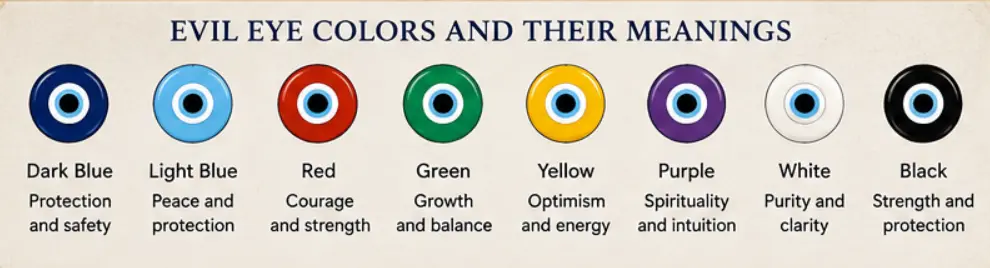
The broader color chart, on the other hand, is largely a modern layer added to the evil eye meaning. It grew up alongside contemporary jewelry making and spiritual retail rather than descending from any single ancient system. These are the associations most commonly given today.
| Evil Eye Color | Common Modern Meaning |
|---|---|
| Dark Blue | Protection and general spiritual safety |
| Light Blue | Peace and broad protection |
| Red | Courage, strength, and confidence |
| Green | Growth, balance, and well-being |
| Yellow | Optimism and positive energy |
| Purple | Imagination and spirituality |
| White | Purity and clarity |
| Black | Strength and protection |
Treat this table as a guide to current usage, not as ancient doctrine. The meanings above are widely repeated but not standardized, and they vary between sellers, communities, and individual traditions. Blue is the only color with a genuinely deep historical claim. If a particular color matters to you, it is worth asking where the interpretation you are following actually comes from.
Why Is the Evil Eye Blue?
The short answer is that the dominant form of the amulet came out of a region where blue glass was the material of choice. The nazar boncuğu of Anatolia established blue and white concentric circles as the standard design, and that design spread outward with trade, migration, and tourism until it became the default worldwide.
Two explanations are commonly offered for the color itself. One connects blue to the sky and to water, both associated with clarity and purity. The other notes that in the Mediterranean and the Middle East, light-colored eyes were relatively uncommon historically, so a blue gaze stood out and became linked with the idea in folk explanation. These are traditional accounts rather than settled history.
In practice, the blue evil eye is now simply the generic version. When someone buys an evil eye charm without thinking about color, they are buying a blue one, and it is understood to mean general protection.
How Does the Evil Eye Protect You?
Within the traditions that use it, the amulet is believed to work by intercepting the gaze before it reaches its target. It is placed where it will be seen, because a protective sign that nobody notices is doing nothing.
According to these traditions, the charm is understood to:
- Ward off envy directed at the wearer or their household
- Deflect harmful intentions back away from the person
- Protect against bad luck and general misfortune
- Guard the wearer from negative influence they cannot see coming
There is a related folk idea that the bead absorbs what is sent at it, which is why a nazar bead that cracks or breaks is often said to have done its job and to need replacing. Interpretations of that custom differ from place to place.
All of this is cultural and spiritual symbolism. It describes how a belief is understood by the people who hold it, not a process that has been established as fact. Wearing an amulet is not a substitute for medical care, financial planning, or any other practical response to a real problem.
Why Do People Wear the Evil Eye?
People wear it for very different reasons, and the evil eye meaning attached to any given bracelet depends on who is wearing it. Assuming a single motive is usually wrong. The most common ones are:
- Personal protection, the traditional purpose
- Cultural tradition, especially for people with Turkish, Greek, Middle Eastern, North African, South Asian, or Mediterranean heritage
- Spiritual symbolism, as part of a broader personal practice
- Good luck, in the loose modern sense
- A reminder, to stay clear of envy and ill will in their own outlook
- Jewelry and fashion, because the design is striking and pairs with almost anything
Most wearers fall into more than one of these at once. A person may have been given a nazar by a grandmother, keep wearing it because it looks good, and still feel something protective about it without holding any strong belief. That combination is completely ordinary, and it is the reason the symbol has spread so far beyond its regions of origin.
Evil Eye Bracelet Meaning
An evil eye bracelet carries the standard protective symbolism: guarding against envy, deflecting ill will, and marking a positive intention for the wearer. Bracelets are the most common format because the charm stays visible, which fits the older idea that protection works by being seen.
Bracelets are also the format most often given as a gift, particularly for a new baby, a new home, or a new job. In that context the object doubles as a good wish.
Rules about which wrist a bracelet must be worn on circulate widely online but do not come from any single established tradition, and different sources contradict one another. Wear it on whichever wrist you prefer unless you are following a specific practice that says otherwise.
Evil Eye Necklace Meaning
An evil eye necklace carries the same meaning as a bracelet. Protection, guarding against envy, and cultural or spiritual connection apply equally, and there is no separate tradition assigning necklaces a different purpose.
The one practical difference is placement. A necklace sits near the chest or throat, which some wearers describe as keeping the symbol close to the body, and it is easy to wear under clothing when a visible charm is not appropriate. Pendant designs also tend to be larger, which is why necklaces are often chosen when the symbol is meant to be noticed.
How Is the Evil Eye Used?
The symbol adapts to almost any object, which is a large part of why it has stayed in circulation. Common formats include:
- Bracelets, including beaded and charm styles
- Necklaces and pendants
- Rings
- Earrings
- Keychains and bag charms
- Wall decorations and framed pieces
- Home decor such as bowls, tiles, and ornaments
- Hanging nazar charms for doorways, mirrors, and vehicles
The pattern behind all of them is the same. The charm goes where it will be seen and where protection is felt to be wanted, whether that is on a wrist, above a front door, or on a rearview mirror.
What the object means depends on who placed it there. For some people it is an active protective practice, for others a link to family or heritage, and for others a design they like. All of these are normal uses of the symbol.
Is the Evil Eye Good or Bad?
Both answers are correct, because the evil eye meaning splits in two and the phrase covers both halves.
The evil eye itself is negative. As a traditional belief, it refers to a harmful or envious gaze that is thought to bring misfortune. There is nothing positive in that meaning. Receiving the evil eye is bad news in every tradition that recognizes it.
The evil eye symbol 🧿 is protective. The amulet exists specifically to counter the gaze described above. Wearing one signals a wish for safety, not a wish for anyone else’s harm, and in modern usage it is frequently treated as a good luck charm as well.
Both go by the same name in English, which is where the confusion begins. The word for the problem and the word for the solution became the same word. If someone tells you they are wearing an evil eye, they mean the charm, and they mean protection.
Frequently Asked Questions
What does 🧿 mean?
The 🧿 emoji represents the nazar amulet, the blue and white glass eye bead used as protection against the evil eye. Its meaning is protective rather than threatening. People use it to guard against envy, harmful intentions, and general bad luck, often adding it to posts about good news, achievements, or family. The design is based on the Turkish nazar boncuğu, which is why the emoji is officially named nazar amulet.
What does 🧿 🪬 mean?
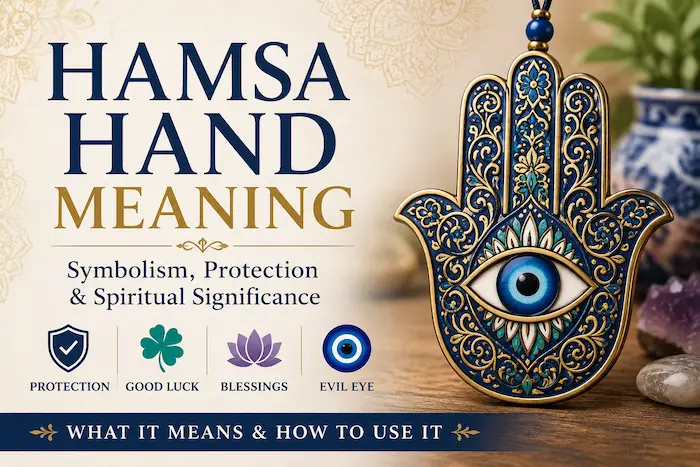
They are two different protective symbols that are frequently used together. 🧿 is the nazar amulet, the eye-shaped charm associated with Turkey and the wider Mediterranean, used specifically against the evil eye. 🪬 is the hamsa hand, an open five-fingered palm associated with Middle Eastern and North African traditions, including Jewish and Islamic ones. Both are linked to protection, but they have separate histories and are not interchangeable.
What does an evil eye mean?
The phrase carries two meanings. The traditional one is a harmful or envious gaze believed to bring misfortune to the person it falls on, usually driven by jealousy rather than deliberate malice. The second refers to the eye-shaped amulet worn to defend against that gaze. Since both are called the evil eye in English, context decides which is meant. Anyone wearing or hanging an evil eye is referring to the protective charm.
Why do people wear 🧿?
Reasons vary from person to person. Some wear it for protection in the traditional sense, some as part of a cultural or family heritage from Turkey, Greece, the Middle East, North Africa, or South Asia, and some as part of a personal spiritual practice. Others wear it as a general good luck charm or simply because they like the design. Plenty of wearers combine several of these, and no single belief is shared by everyone.
Is the evil eye good luck or bad luck?
It depends on which one you mean. The evil eye as a harmful gaze is bad luck by definition, since the whole belief is about misfortune caused by envy. The 🧿 amulet is the opposite. It is protective, and in modern usage it is often treated as a good luck charm as well. The curse is the bad part. The charm is the good part.
Final Thoughts
The evil eye meaning comes down to one distinction. The evil eye itself is a harmful or envious gaze, a folk belief thousands of years old holding that resentment can travel through a look and bring misfortune with it. The 🧿 symbol is what people use against it, an eye that watches back and turns the harm away.
The customs built around that idea differ considerably. A nazar bead in Turkey, a mati charm in Greece, a cornicello in southern Italy, and a spoken blessing in an Arabic-speaking household all address the same concern in their own way, and none of them is the definitive version.
Whether the symbol is worn for protection, heritage, or simply because it looks good, it is a cultural tradition rather than a proven mechanism. That is worth remembering, and it takes nothing away from how much the symbol has meant to people for as long as it has been around.

About the Author
Dana Whitfield
I write about numerology, astrology, mythology, tarot, and world mystical traditions for Mystivora, drawing on years of independent research across comparative religion and symbolic systems. I approach each topic by cross-checking primary texts and established scholarship rather than repeating popular but unverified claims.