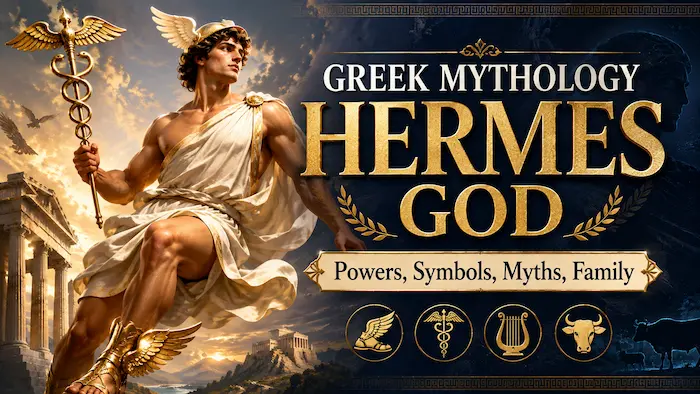
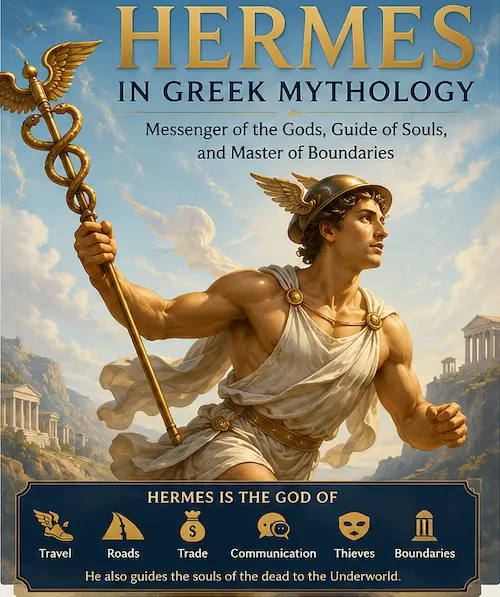
Greek mythology Hermes god: Hermes is one of the Twelve Olympian gods and the divine messenger of Zeus. In Greek mythology, he is the god of travel, roads, trade, merchants, communication, thieves, trickery, and boundaries. The son of Zeus and the Pleiad Maia, Hermes also guides the souls of the dead to the Underworld, making him one of the most distinctive gods of the Greek pantheon.
Who Is Hermes in Greek Mythology?
Hermes is the Olympian god of movement and exchange. He was born in a cave on Mount Cyllene in Arcadia to Zeus and Maia, eldest of the seven Pleiades, and he became the herald and personal agent of Zeus. Ancient writers describe him as the quickest, most inventive, and most persuasive of the gods, and as the only Olympian who could pass freely between the world of the gods, the world of the living, and the world of the dead.
That freedom of passage is the key to understanding him. Where Zeus rules by authority and Apollo by prophecy, Hermes works by speed, negotiation, and access. He is the god other gods send when something needs carrying, opening, or crossing.
| Attribute | Hermes |
|---|---|
| Greek name | Hermes (Ἑρμῆς) |
| Roman equivalent | Mercury (Mercurius) |
| Parents | Zeus and Maia |
| Birthplace | A cave on Mount Cyllene, Arcadia |
| Home | Mount Olympus |
| Main role | Messenger and herald of the gods |
| Key domains | Travel, roads, trade, communication, thieves, boundaries |
| Famous symbols | Caduceus, winged sandals, petasos, lyre |
| Major epithets | Argeiphontes (Argus-slayer), Psychopompos (guide of souls), Dolios (the crafty) |
| Main ancient source | Homeric Hymn 4 (to Hermes) |
What Is Hermes the God of in Greek Mythology?
Hermes is the Greek god of travel, roads, trade, merchants, communication, messengers, thieves, cunning, and boundaries. He also serves as the divine messenger of Zeus and guides the souls of the dead to the Underworld.
That list looks scattered at first, but it holds together around a single idea. Every one of these domains involves crossing a line. A messenger crosses between speakers, a merchant crosses between owners, a traveller crosses between places, a thief crosses between what is his and what is not, and a psychopomp crosses between the living and the dead. Hermes governs the moment of transition itself, which is why his responsibilities look so unusually broad compared with other Olympians.
Messenger of the Gods
Hermes is the herald of Zeus, and this is the role that made him famous. In the Odyssey he carries Zeus’s order to the nymph Calypso that Odysseus must be released. In the Iliad he is sent to escort King Priam through the Greek camp. In Hesiod’s account of Pandora, Hermes is the god who delivers her to Epimetheus.
Two qualities made him the natural choice for this work. The first is speed. The second is diplomacy, because a herald in the ancient Greek world was not simply a runner. Heralds were protected persons who moved between hostile parties, negotiated terms, and spoke on behalf of someone more powerful. Hermes was the divine version of that office, which is why he became the patron of real ambassadors, orators, and interpreters.
God of Travelers and Roads
Travel in ancient Greece was slow, expensive, and genuinely dangerous. Roads ran through territory nobody controlled, and a traveller far from home had no legal protection and no one to appeal to. Hermes was the god who covered that gap.
His protection extended to roads, journeys, crossroads, doorways, and the boundary stones that separated one community’s land from another’s. Small stone heaps called hermai were piled at roadsides and at property lines, and travellers added a stone as they passed. Under the epithet Hermes Hodios, meaning Hermes of the Road, he was the god you addressed when you were between places and belonged to neither.
God of Trade and Merchants
Commerce was the practical extension of travel. Merchants moved goods along the same dangerous roads and sea routes, negotiated with strangers whose language they might not share, and depended on being trusted enough to strike a deal and quick enough to get a good one.
Hermes covered all of it. As Hermes Agoraios, Hermes of the Marketplace, he presided over the agora where buying and selling happened. The Greeks did not separate the shrewdness of a good trader from the shrewdness of a good trickster, and they saw no contradiction in a god who protected both. Profitable trade and clever theft required exactly the same skills: reading people, moving fast, and knowing when to speak.
God of Thieves and Trickery
Hermes became the god of thieves because he committed the first theft in Greek myth. On the day he was born he left his cradle, stole Apollo’s cattle, and then lied about it to Apollo and to Zeus. That story is told in full below.
It is worth being precise about how the Greeks read this. They did not treat Hermes as a criminal deity to be feared, and the myth is not told as a warning. It is told as a demonstration of intelligence. Hermes drove the cattle backwards so the tracks pointed the wrong way, and he covered his own feet so they left no useful trail. The point of the story is the quality of the plan, not the wrongness of the act. Cunning, called metis in Greek, was an admired virtue, and Hermes was its patron alongside more respectable heroes like Odysseus, who happened to be his own great-grandson.
Guide of Souls to the Underworld
Hermes carries the epithet Psychopompos, which means guide or conductor of souls. In this role he meets the dead and escorts them down to the realm of Hades. The opening of Book 24 of the Odyssey shows him at work, using his golden staff to rouse the souls of the dead suitors and lead them along to their destination.
This is the single point most often misunderstood, so it is worth stating directly. Hermes does not rule the Underworld and has no authority over the dead. Hades rules the Underworld. Hermes is the guide who conducts souls to its border and hands them over, and he is the only Olympian who can make that journey and return. In the Homeric Hymn to Demeter it is Hermes whom Zeus sends down to bring Persephone back up to her mother, which shows the same principle from the opposite direction: he can enter, but he enters as a messenger, not as an owner.
What Powers Did Hermes Have?
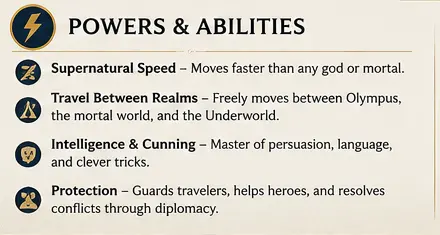
Ancient sources do not present Hermes as a warrior god, and his abilities are not framed as combat strengths. They are framed almost entirely around access, motion, and persuasion.
Supernatural Speed
Hermes is the fastest of the gods. Homer describes him crossing sea and land without effort, and his winged sandals became the standard visual shorthand for that speed in Greek and Roman art. Speed was not a decorative trait for him. It was the qualification for his job, because a message that arrives late is worthless.
Traveling Between Realms
Hermes could move between Olympus, the mortal world, and the Underworld at will. No other Olympian is described as having this freedom. Other gods could be barred, delayed, or bound by oath, and the Underworld in particular was a place from which return was famously difficult.
This one ability underwrites almost everything else about him. It is what makes him usable as a messenger, since a herald who cannot reach the recipient is no herald at all. It is also exactly what qualifies him as psychopomp, since guiding souls requires a god who can come back afterwards.
Intelligence, Cunning, and Persuasion
Hermes is repeatedly described as the most eloquent and most inventive of the gods. He talks his way out of the cattle theft in front of Zeus himself. He negotiates with Apollo from a position of total weakness, as a newborn caught red-handed, and walks away with a permanent alliance instead of a punishment.
The Greeks connected him directly to language. An interpreter was called a hermeneus, and the modern word hermeneutics, the study of interpretation, descends from the same root. Some traditions credit him with inventing speech, writing, or numbers, though these attributions vary by source and are late additions rather than part of the earliest material.
Protection and Assistance
Hermes intervenes on behalf of gods and mortals more often than almost any other Olympian, and he is unusual in Greek myth for holding no long-running grudge against any mortal. He supplies Perseus with what he needs for the hunt for Medusa, he gives Odysseus the means to resist Circe, and he escorts Priam safely through an enemy camp. Each of these is covered in more detail below.
Symbols of Hermes and What They Mean
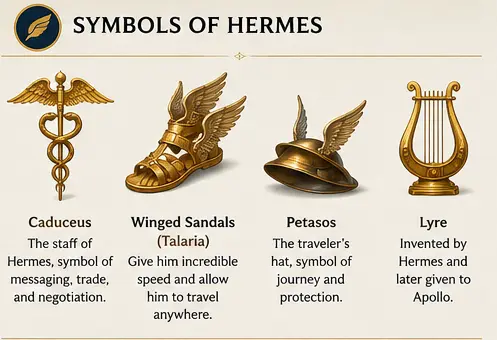
| Symbol | Greek name | What it represents |
|---|---|---|
| Caduceus | Kerykeion | Herald’s authority, messenger role, safe passage |
| Winged sandals | Talaria | Speed and travel |
| Winged traveller’s hat | Petasos | Journeys, the road, life outdoors |
| Lyre | Lyra | Invention, music, the settlement with Apollo |
| Purse or money bag | Marsupium (Latin) | Trade and profit, especially in Roman art |
| Tortoise | Chelys | The shell he made the first lyre from |
| Ram | Krios | Flocks and herds, seen in Hermes Kriophoros statues |
Caduceus
The caduceus, known in Greek as the kerykeion, is the herald’s staff and the emblem of Hermes’s office. Later depictions show it as a winged rod with two snakes twined around it. In the Homeric Hymn to Hermes it is a golden staff given to him by Apollo as part of their settlement, and in Homer it has the power to bring sleep upon people or wake them from it.
One correction is worth making here. The caduceus is frequently used today as a medical symbol, but that use is a mix-up. The genuine medical emblem is the Rod of Asclepius, a plain staff with a single snake and no wings, belonging to the god of healing. The caduceus belongs to commerce, heraldry, and negotiation.
Winged Sandals
The talaria are the golden sandals that carry Hermes over sea and land. Homer describes them as immortal and golden but does not actually say they have wings. The wings were added by artists, who needed a visible way to show speed in a static image, and the addition worked so well that it became the single most recognisable feature of the god. Hermes also lends them out, most famously to Perseus.
Petasos or Winged Hat
The petasos is a broad-brimmed hat, and it is not a divine invention. It was ordinary practical gear worn by real Greek travellers and herdsmen for shade and rain. Its presence in images of Hermes marks him as a figure of the road rather than of the palace, and later art gave it wings to match the sandals.
Lyre
Hermes invented the lyre on the day he was born, using the shell of a tortoise as a sounding box and strings of sheep gut stretched across it. He then handed it to Apollo, and it became one of Apollo’s defining attributes rather than his own. The lyre therefore functions as a symbol of two things at once: Hermes as inventor, and the moment his conflict with Apollo turned into an alliance.
Hermes’ Family
Who Were Hermes’ Parents?
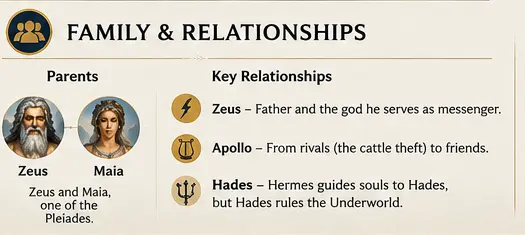
Hermes is the son of Zeus and Maia. Maia was a mountain nymph, the eldest of the seven Pleiades and a daughter of the Titan Atlas. She lived apart from the other gods in a cave on Mount Cyllene in Arcadia, and it was there, according to the Homeric Hymn to Hermes, that Hermes was born at dawn.
His birth outside Olympus matters to his story. Hermes is not born into the centre of divine power. He starts on a mountainside in a rural region, and the cattle theft is the manoeuvre by which he forces the Olympians to recognise him. In many traditions he is counted as the second youngest of the Twelve Olympians, older only than Dionysus.
Did Hermes Have Children?
Hermes had several children in Greek myth, though he is never described as married and the ancient traditions disagree with each other about parentage. Different regions and different poets attached different lineages to the same figures, so any list of his children is a summary of competing accounts rather than a settled family tree.
- Pan. The rustic god of shepherds, flocks, and wild places, usually named as Hermes’s son. The Homeric Hymn to Pan gives his mother as a daughter of Dryops, though other sources name different mothers.
- Hermaphroditus. A child of Hermes and Aphrodite, best known from Ovid’s account of a body combining male and female form. The English word hermaphrodite descends from this name.
- Autolycus. A master thief who inherited his father’s talent for deception. He is the maternal grandfather of Odysseus, which is how Greek tradition explains where Odysseus got his famous cunning.
- Myrtilus. The charioteer of King Oenomaus, central to the myth of Pelops and the curse on the house of Atreus.
The Birth of Hermes and Apollo’s Cattle
This is the defining Hermes myth, and it is told at length in the Homeric Hymn to Hermes, one of the longest and liveliest of the Homeric Hymns. The whole thing happens within roughly a single day.
- Dawn. Hermes is born in the cave on Mount Cyllene.
- Morning. He climbs out of his cradle, finds a tortoise outside the cave, and turns its shell into the first lyre, stringing it with sheep gut. He plays it and sings about his own birth.
- Evening. He travels to Pieria and takes fifty head of cattle from the herds belonging to Apollo.
- Night. He drives the cattle backwards so their hoofprints point away from where they are actually going, and he binds makeshift coverings to his own feet so his trail is unreadable. He hides the cattle, sacrifices two of them, and then returns to the cave and tucks himself back into his cradle as though nothing has happened.
- Next morning. Apollo works out who is responsible and confronts the infant, who denies everything with complete confidence. Apollo brings the case before Zeus.
- The verdict. Hermes argues his innocence in front of the king of the gods. Zeus is not fooled for a moment, but he is entertained rather than angry, and he orders the two brothers to settle it between themselves.
- The settlement. Hermes plays the lyre. Apollo, the god of music, has never heard anything like it and wants it. Hermes hands it over, Apollo gives him the cattle in exchange, and the two become permanent allies. In the hymn, Apollo also gives Hermes a golden staff, the origin of his herald’s wand.
Almost everything Hermes is known for appears in this one story in compressed form. He invents something (the lyre), he steals something (the cattle), he lies persuasively to the highest authority there is (Zeus), and then he converts a losing position into a permanent gain through negotiation. He begins the day as an unrecognised newborn in a rural cave and ends it as an acknowledged Olympian with an alliance to Apollo and a staff of office.
Famous Myths About Hermes
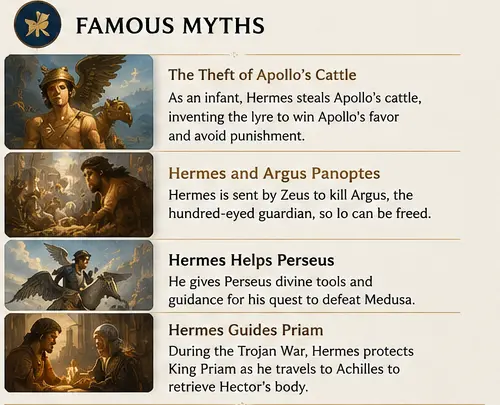
Hermes and Argus Panoptes
Zeus took an interest in Io, a priestess of Hera, and transformed her into a heifer to hide the affair. Hera was not deceived. She claimed the heifer for herself and set Argus Panoptes to guard her, a giant whose name means all-seeing and who had a hundred eyes covering his body. Because only some of his eyes slept at a time, he could never be caught off guard.
Zeus sent Hermes to solve the problem. Hermes did not fight him. He approached in disguise, talked to him, played music, and told him stories until every one of the hundred eyes had finally closed, and then he killed him. Hera afterwards set the eyes into the tail of the peacock.
The kill gave Hermes his most common epithet in Homer, Argeiphontes, usually translated as Argus-slayer. It also demonstrates the pattern that runs through his myths, since Hermes wins by making an unbeatable opponent stop paying attention rather than by overpowering him.
Hermes Helps Perseus
When Perseus was sent to bring back the head of Medusa, an impossible task designed to kill him, Hermes and Athena intervened on his behalf. Accounts differ on exactly what Hermes supplied. In Apollodorus he guides Perseus to the Graeae, the three sisters who share one eye between them, so that Perseus can force them to reveal where the equipment he needs is kept. Other versions have Hermes lend his own winged sandals directly, or provide the adamantine blade used to make the kill.
The variation itself is worth noting, because it shows how Greek myth actually worked. There was no single authorised version, and different poets and regions preserved different details. What stays constant across all of them is the role: Hermes is the god who makes a hero’s impossible journey survivable.
Hermes Helps Odysseus Against Circe
In Book 10 of the Odyssey, Odysseus and his crew land on the island of Aeaea. The witch Circe drugs half the crew and turns them into pigs. As Odysseus walks up to her house to confront her, Hermes meets him on the path in the form of a young man and gives him a herb called moly, described as having a black root and a milk-white flower, which makes him immune to her drugs.
Hermes does more than hand over an antidote. He also tells Odysseus exactly what will happen next and exactly how to respond, including the oath he must make Circe swear before he trusts her. This episode is one of the clearest illustrations of Hermes as a god of information rather than force. He does not fight Circe or break her magic. He simply gives Odysseus what he needs to know.
Hermes Guides Priam to Achilles
Book 24 of the Iliad contains the most sombre of the Hermes myths. Achilles has killed Hector and refuses to release the body. Hector’s father, King Priam of Troy, decides to travel alone at night into the Greek camp to beg for his son back, which is close to suicide.
Zeus sends Hermes to see him through. Hermes appears as a young Greek soldier, puts the camp guards to sleep, and leads Priam past every checkpoint to Achilles’s shelter without a single man raising an alarm. He then withdraws so that the two men can meet alone, and returns later to bring Priam safely home with Hector’s body before dawn.
This episode shows a side of Hermes that the trickster stories can obscure. He is a protector of the vulnerable traveller, and here the traveller is an old man walking into an enemy camp with nothing but a ransom. It is also the closest the Iliad comes to putting his psychopomp role into human terms, since Hermes is guiding a father through the darkness on an errand about the dead.
Hermes and the Other Greek Gods
Hermes and Zeus
Zeus is his father, and Hermes is the child Zeus relies on most in practical matters. Their relationship is not one of equals, and Hermes never challenges his father’s authority. What he offers instead is execution. Zeus decides, and Hermes carries it out.
The pattern shows up repeatedly. Hermes carries Zeus’s order to Calypso, escorts Priam on Zeus’s instruction, and kills Argus to free Io on his father’s behalf. Notably, Zeus never punishes him, not even for stealing Apollo’s cattle and then lying about it to his face.
Hermes and Apollo
Their relationship starts as a theft and turns into one of the more durable alliances in Greek myth. Apollo is the injured party in the cattle story, and he has every right to demand punishment. What he gets instead is the lyre, and the exchange leaves both of them better off than before.
The result is a lasting division of territory. Apollo keeps music, prophecy, and the formal, elevated side of divine communication. Hermes keeps speed, trade, roads, and the practical, everyday side of it. They are half-brothers whose domains complement rather than compete, which is unusual among Olympians.
Hermes and Hades
This relationship is the one most often described incorrectly, so it deserves a plain statement. Hades is the ruler of the Underworld. Hermes is not.
What Hermes has is access. He can enter the Underworld and leave it again, which no other Olympian can do, and his job is to conduct souls to its threshold. He does not judge the dead, he does not decide anyone’s fate after death, and he holds no territory there. Under the epithet Hermes Chthonios, meaning Hermes of the earth below, he was invoked in funeral rites and at graves, but as an escort and intermediary rather than as a lord of the dead. Confusing the two roles turns a guide into a ruler and misses the entire point of the character.
Hermes vs. Mercury
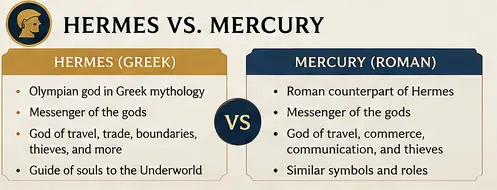
Hermes is Greek and Mercury is Roman. The Romans identified the two closely, and by the classical period almost every myth told about Mercury is a Greek story about Hermes with the names changed. They share the messenger role, the commerce role, the travel role, and the trickster reputation, along with the winged sandals, the petasos, and the caduceus.
The two traditions are not identical in origin, though. Mercury does not appear among Rome’s oldest deities. His name most likely derives from the Latin merx, meaning merchandise, which points to a commercial function from the start. His temple was dedicated in 495 BCE near the Circus Maximus at the foot of the Aventine Hill, at a moment when Rome was struggling with its grain supply, and the same act established a guild of merchants under his protection. That is a specific piece of Roman civic history with no Greek equivalent.
Other differences follow from that commercial emphasis. Roman art regularly puts a money bag in Mercury’s hand, an attribute Greek art does not give Hermes. Roman traders held an annual festival for him in May involving water from a spring near the Porta Capena, sprinkled over their goods and themselves. Later, through the Roman practice of identifying foreign gods with their own, Mercury was mapped onto local deities across the empire, and in Gaul he acquired a consort named Rosmerta who has no counterpart in Greek myth at all.
The practical takeaway is this. Treating Hermes and Mercury as the same figure is reasonable when you are discussing mythology, since the narrative material really is shared. Treating them as identical becomes misleading when you are discussing religion, because Mercury’s cult had Roman commercial roots that Hermes never had, and Hermes had Arcadian pastoral roots that Mercury never had.
Why Was Hermes Important to the Ancient Greeks?
Hermes mattered to ordinary Greeks in a way that the more dramatic gods did not, because his domains were the ones people dealt with constantly.
Travel was risky and unavoidable. Trade was how communities that grew different things stayed fed. Negotiation was how city-states that were frequently at war managed to talk to each other at all, and heralds depended on being treated as untouchable. Boundaries were a daily reality in a landscape of small territories, contested farmland, and property lines that had to be visibly marked and mutually respected.
The clearest evidence of this is the herm. Herms were plain rectangular stone pillars topped with a carved head of Hermes, and they stood at crossroads, boundaries, gateways, and doorways all over the Greek world. They were not temple sculpture. They were street furniture with a religious function, positioned exactly where one space ended and another began. Hermes had relatively few grand temples compared with other Olympians, but his image was on more street corners than any other god’s.
How seriously the Athenians took them is on record. In 415 BCE, on the eve of the fleet’s departure for Sicily, the herms across Athens were vandalised in a single night. The city treated it as a religious catastrophe and a political emergency, launched investigations, and the resulting scandal helped bring down the commander of the expedition. Damaging the boundary markers of the god of boundaries was, to an Athenian, an omen worth panicking over.
Frequently Asked Questions About Hermes
What exactly is Hermes the god of?
Hermes is the Greek god of travel, roads, trade, merchants, messengers, communication, thieves, trickery, and boundaries. He is also the herald of Zeus and the guide who escorts souls of the dead to the Underworld. The common thread across all of these is crossing from one place, state, or owner to another.
What powers does Hermes have in Greek mythology?
His defining abilities are extraordinary speed and the freedom to travel between Olympus, the mortal world, and the Underworld, which no other Olympian shares. He is also credited with exceptional intelligence, eloquence, and persuasion, and with the power to induce or lift sleep using his staff. He uses these abilities to guide and protect travellers and heroes rather than to fight.
What are the symbols of Hermes?
His four main symbols are the caduceus (his herald’s staff, entwined with two snakes), the talaria (winged sandals), the petasos (a broad-brimmed traveller’s hat, often winged), and the lyre he invented and gave to Apollo. A purse, a tortoise, and a ram also appear as attributes in ancient art.
Who are Hermes’ parents in Greek mythology?
Hermes is the son of Zeus and Maia. Maia was one of the seven Pleiades and a daughter of the Titan Atlas, and she gave birth to Hermes in a cave on Mount Cyllene in Arcadia.
Who did Hermes fall in love with?
There is no single great love of Hermes in Greek mythology, and any source that names one is choosing between competing traditions. He is never described as married, and different ancient authors connect him with different figures, including Aphrodite (named as mother of Hermaphroditus), the mortal Chione (named as mother of Autolycus), and various nymphs associated with the birth of Pan. These accounts come from different periods and regions and do not add up to one consistent story. Unlike gods whose myths centre on a particular relationship, Hermes is defined by his roles rather than by any romance.
Is Hermes stronger than Zeus?
No. Zeus is the king of the Olympian gods and holds both supreme authority and by far the greater destructive power. Hermes is his son and his agent, and he acts on Zeus’s instructions rather than against them.
Hermes is genuinely powerful, but his strengths lie elsewhere: speed, access to realms closed to other gods, intelligence, and persuasion. The cattle myth shows the actual balance between them clearly. Hermes can lie to Zeus’s face and get away with it, which no other god manages, but he gets away with it because Zeus chooses to be amused rather than because Hermes could resist him.
Conclusion
Hermes is considerably more than the messenger god that popular summaries make him. His domains cover travel, roads, trade, communication, cunning, boundaries, and the passage from life to death, and they hold together as a single idea rather than a scattered collection: he is the god of crossing over.
The major myths all show the same character from different angles. He outwits Argus rather than overpowering him, he turns a theft into an alliance with Apollo, he arms Odysseus with information rather than weapons, and he walks an old king through an enemy camp in the dark. His winged sandals, broad-brimmed hat, and snake-twined staff made him one of the most instantly recognisable figures in Greek art, and the plain stone herms at Greek crossroads made him one of the most present in everyday life.

About the Author
Dana Whitfield
I write about numerology, astrology, mythology, tarot, and world mystical traditions for Mystivora, drawing on years of independent research across comparative religion and symbolic systems. I approach each topic by cross-checking primary texts and established scholarship rather than repeating popular but unverified claims.