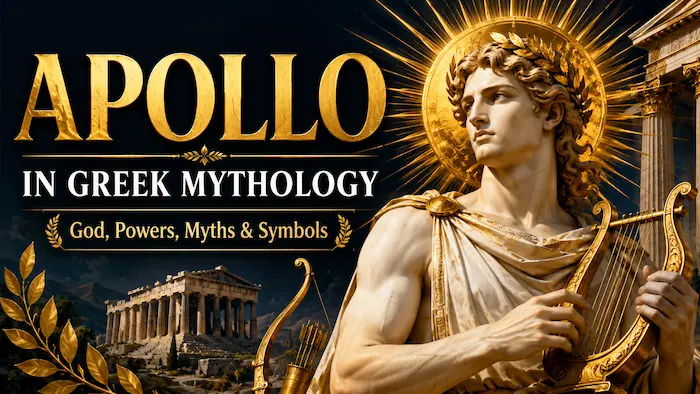
Apollo and Greek mythology are almost inseparable, since Apollo ranks among the most important gods in the Olympian pantheon, linked with prophecy, music, poetry, healing, disease, archery, and light. He was the son of Zeus and Leto and the twin brother of Artemis. Apollo was believed to speak through the Oracle of Delphi, and his best-known myths include killing the serpent Python, pursuing the nymph Daphne, and sending a plague against the Greek army in the Iliad. He was later associated with the sun, but the traditional Greek personification of the sun was Helios.
Who Is Apollo in Greek Mythology?
Apollo is a major Olympian god in Greek mythology, the son of Zeus and the Titaness Leto and the twin brother of Artemis. He was worshiped as the god of prophecy, music, poetry, healing, plague, and archery. He was also the god most closely tied to the Oracle of Delphi, where the Greeks believed he delivered divine knowledge to human beings.
As one of the Twelve Olympians, Apollo held a permanent place among the gods who lived on Mount Olympus under Zeus. Unlike some deities whose worship stayed local, Apollo was honored across the Greek world. His two most famous sanctuaries were Delphi, the center of Greek prophecy, and Delos, the island where he was said to have been born.
Apollo also had a double-sided character that ancient Greeks understood clearly. He represented order, clarity, music, and healing, but he could also send sudden illness and death with his arrows. Both sides belonged to the same god, and Greek worshipers approached him with that in mind.
What Is Apollo the God Of?
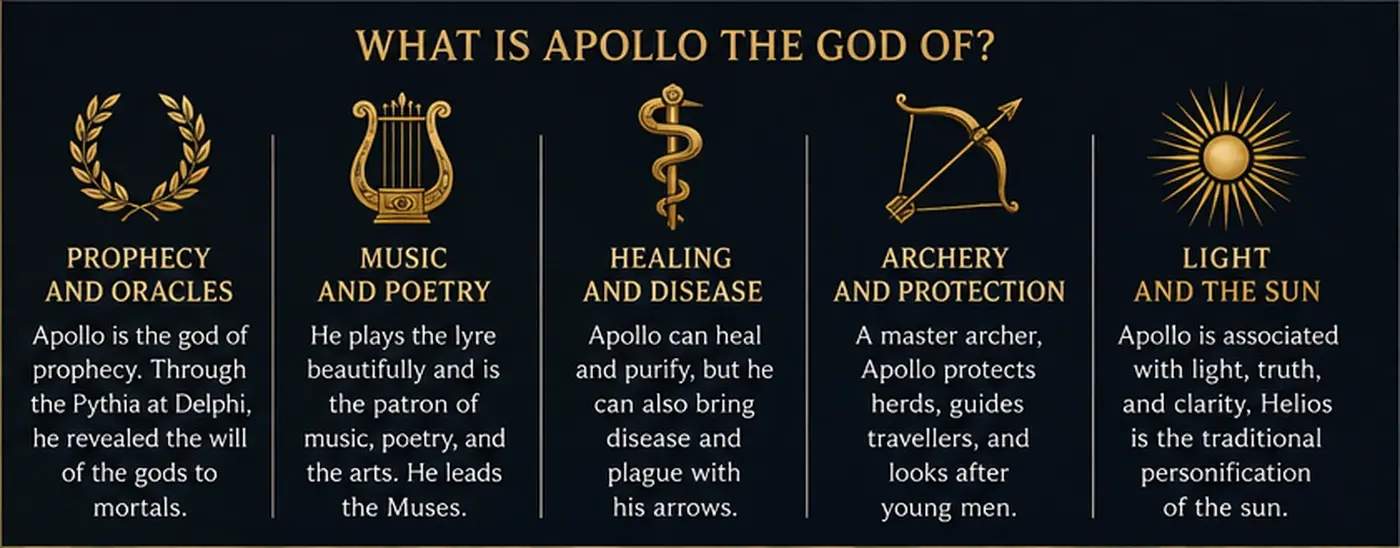
Apollo was the god of prophecy, music and poetry, healing and disease, archery, and light. These domains were not separate compartments. They connected through ideas the Greeks associated with him: knowledge, harmony, purification, and the power to strike from a distance.
Prophecy and Oracles
Apollo was the primary Greek god of prophecy. The Greeks believed that Zeus knew the future and that Apollo revealed portions of it to humans through oracles and seers.
His most famous oracle operated at Delphi, where a priestess called the Pythia gave responses to questions brought by individuals, generals, and entire city-states. Apollo also granted prophetic ability to certain mortals, sometimes with painful results. Cassandra of Troy, for example, received true foresight from Apollo but was cursed so that no one would believe her.
Music and Poetry
Apollo was the god of music, poetry, and artistic inspiration, and his signature instrument was the lyre. In one well-known tradition, the infant Hermes built the first lyre from a tortoise shell and gave it to Apollo to settle a dispute over stolen cattle.
Apollo was frequently associated with the Muses, the goddesses who inspired poetry, song, and the arts, and he carried the title Musagetes, meaning leader of the Muses. Greek music was tied to proportion and mathematical ratio, which fits Apollo’s broader association with order and measure.
Healing and Disease
Apollo could both cure and cause illness. He was invoked as a healer and as a god of purification, and he was also believed to send plague when angered.
That combination appears clearly in the Iliad, where Apollo’s arrows spread disease through the Greek camp before he is persuaded to stop it. His healing role also passed to the next generation. Asclepius, his son, became the central Greek god of medicine, and Greek healing sanctuaries often honored both father and son together.
Archery and Protection
Apollo was an archer god, and his bow represented divine punishment delivered from a distance. Ancient Greeks explained sudden death, especially of men, as the result of Apollo’s arrows, while sudden death of women was often attributed to the arrows of his sister Artemis.
Apollo also had a protective role. He guarded flocks and herds, he was associated with the founding of new colonies, and he was closely connected to young men moving into adulthood. Greek statues typically show him as a beardless youth, which reflects that association.
Light and the Sun
Apollo was connected with light, clarity, and purity from an early period, and one of his most common names, Phoebus, means bright or radiant. That is not the same as being the sun itself.
In traditional Greek mythology, Helios was the personification of the sun, a Titan who drove a chariot across the sky each day and saw everything below. Greek writers began identifying Apollo with Helios during the Classical period, and that identification became far more common in later Greek and Roman literature, where poets routinely describe Apollo in solar terms. In short, Apollo acquired a solar identity over time rather than starting with one.
Apollo’s Birth and Family
Zeus and Leto
Apollo was the son of Zeus, king of the Olympian gods, and Leto, a Titaness and daughter of Coeus and Phoebe. This parentage placed Apollo among the most powerful second-generation Olympians and gave him direct standing in Zeus’s household despite being born outside Zeus’s marriage to Hera.
Apollo and Artemis
Artemis, goddess of the hunt and of wild animals, was Apollo’s twin sister. Both were children of Zeus and Leto, and both were archers, which is why they so often appear together in myth and art.
According to the tradition preserved in the Homeric Hymn to Apollo, Hera’s anger at Leto drove her from place to place while pregnant, since no land wanted to risk Hera’s hostility by sheltering her. The small, rocky island of Delos finally accepted Leto, and she gave birth to the twins there. Delos became one of Apollo’s most sacred sites as a result. Some later accounts add that Artemis was born first and helped with her brother’s birth, though ancient sources do not agree on that detail.
Apollo’s Children
Apollo’s most significant child was Asclepius, the god of medicine, whose mother was Coronis. Asclepius became so skilled at healing that he was said to have brought the dead back to life, which led Zeus to strike him down with a thunderbolt.
Ancient writers name other children as well, including Aristaeus, associated with beekeeping and rural crafts, and Ion, treated as an ancestor of the Ionian Greeks. Some traditions also make Apollo the father of the poet Orpheus, though other sources give Orpheus a mortal father. Genealogies differ considerably between authors, so no single list is authoritative.
What Did Apollo Do in Greek Mythology?
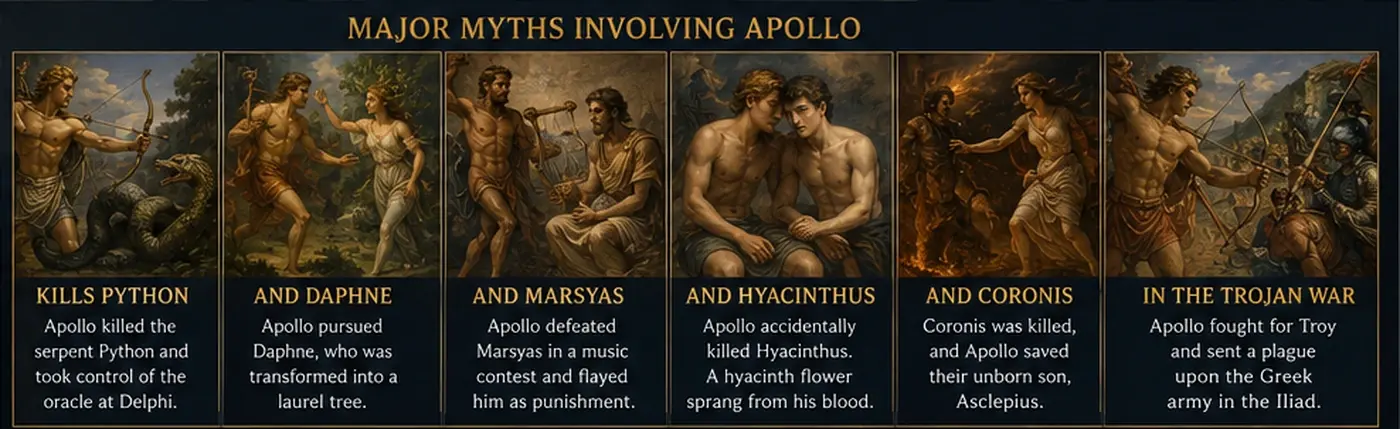
In Greek mythology, Apollo killed the serpent Python and took control of the oracle at Delphi, pursued Daphne until she was transformed into a laurel tree, defeated the satyr Marsyas in a music contest, accidentally killed his companion Hyacinthus, fathered Asclepius with Coronis, and fought on the Trojan side in the Trojan War. These stories define his character across ancient literature.
Apollo Kills Python
Apollo’s defeat of Python established his authority at Delphi. Python was a great serpent or dragon that guarded the site, and in several accounts it belonged to Gaia, the earth goddess, who was said to have controlled the oracle before Apollo arrived.
After killing the creature, Apollo claimed the sanctuary and became the voice behind its prophecies. Ancient writers connected this myth to the name Pytho, an older name for Delphi, and to the title Pythia, used for Apollo’s priestess. Some traditions add that Apollo had to undergo purification after the killing, a detail that reinforced his association with cleansing rituals.
Apollo and Daphne
The story of Apollo and Daphne explains why the laurel became Apollo’s sacred plant. In the best-known version, told by the Roman poet Ovid, Eros retaliated against Apollo’s mockery by shooting him with a golden arrow that caused desire, then shooting the nymph Daphne with a lead arrow that caused rejection.
Apollo pursued Daphne, who wanted nothing to do with him and fled. As he closed in, she called for help and was transformed into a laurel tree. Apollo then took the laurel as his own emblem. The myth is not a love story. It is an account of unwanted pursuit that ends with Daphne losing her human form, and Greek and Roman sources vary in how they explain the transformation and who caused it.
Apollo and Marsyas
Marsyas was a satyr who found the aulos, a double reed pipe that Athena had discarded, and became skilled enough to challenge Apollo to a musical contest. The agreement was that the winner could do as he liked with the loser.
Apollo won, and in one popular version he secured victory by playing his lyre upside down while singing, something impossible on a wind instrument. He then had Marsyas flayed. The myth carries a clear message about Apollo and music: he represents the stringed instrument, restraint, and divine authority over art, and mortals who challenge that authority are not treated gently.
Apollo and Hyacinthus
Hyacinthus was a beautiful young Spartan man loved by Apollo, and their relationship is one of the best-documented same-sex pairings in Greek myth. While the two were throwing the discus, Apollo’s throw struck Hyacinthus and killed him.
From the young man’s blood, Apollo caused the hyacinth flower to grow as a memorial. A widely repeated variant holds that Zephyrus, the west wind, was also in love with Hyacinthus and jealously blew the discus off course. Hyacinthus was honored in Sparta at the festival of the Hyacinthia, held at Amyclae.
Apollo and Coronis
Coronis was a Thessalian princess who was pregnant with Apollo’s child when she became involved with a mortal man. Apollo learned of it, and in the traditional account Coronis was killed, with Pindar attributing the killing to Artemis.
As her body burned on the funeral pyre, Apollo removed the unborn child, who became Asclepius. He gave the boy to the centaur Chiron, who raised him and taught him medicine. The story matters mainly because it links Apollo directly to the origins of Greek healing. A later version, best known from Ovid, adds that the bird who reported Coronis’s betrayal was a raven whose white feathers Apollo turned black.
Apollo in the Trojan War
Apollo supported Troy against the Greeks. The Iliad opens with his anger: Agamemnon refuses to return Chryseis to her father Chryses, a priest of Apollo, and Chryses prays for revenge. Apollo answers by shooting arrows into the Greek camp, spreading a plague that lasts nine days until Agamemnon gives the girl back.
Apollo remains active throughout the poem. He protects Hector, rescues Aeneas from danger, and plays a decisive part in the death of Patroclus by stunning him and stripping away his armor before mortal fighters finish him.
Achilles’s death is not narrated in the Iliad, although the poem points toward it. That event belongs to later epic material, including the lost Aethiopis and works by later poets, in which Apollo guides the arrow shot by Paris or kills Achilles directly. The versions differ, so it is worth separating what Homer actually describes from what came afterward.
Apollo and the Oracle of Delphi
Delphi was the most important oracular sanctuary in the Greek world, and Apollo was the god believed to speak through it. The connection came from the myth of Python, which explained how Apollo claimed the site and its prophetic power for himself.
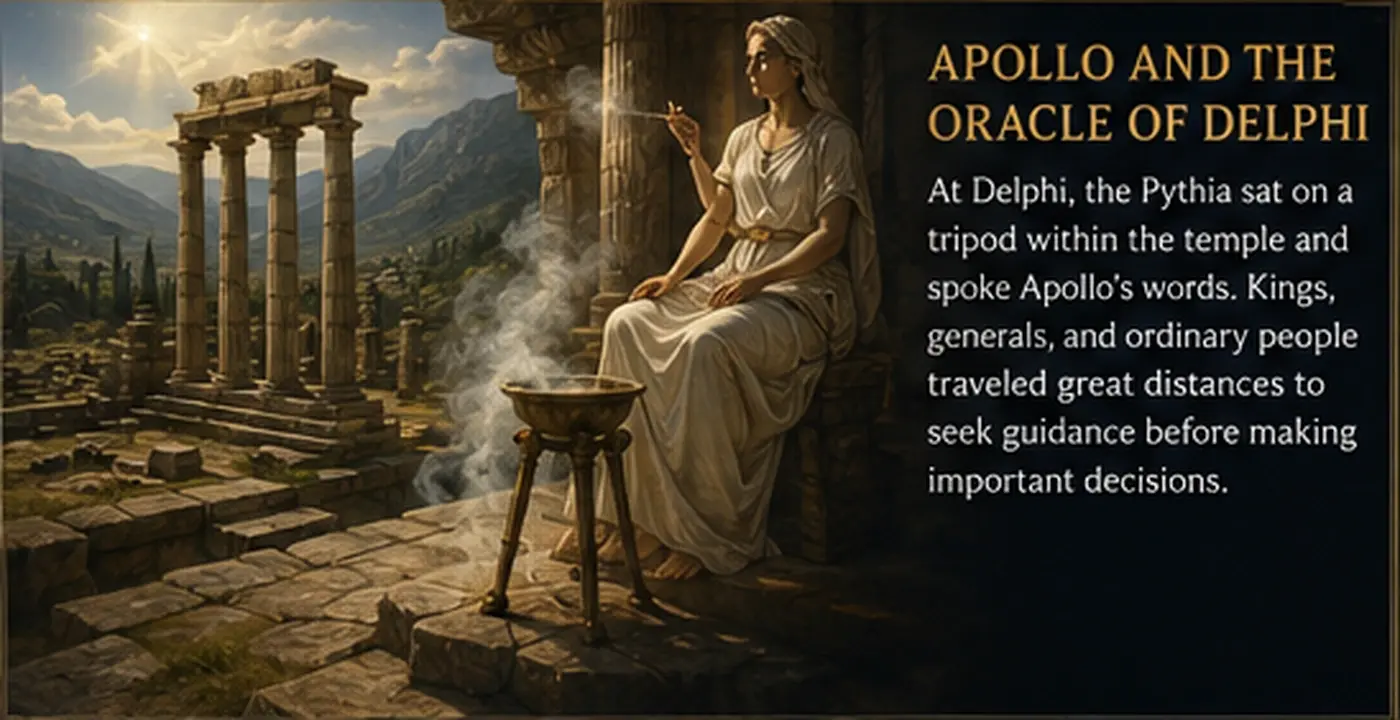
Prophecies were delivered by the Pythia, a priestess who sat on a tripod inside the temple and gave responses that the Greeks understood as Apollo’s own words. Temple personnel then relayed or interpreted those responses for the person asking. The answers had a reputation for being ambiguous, which is why famous stories about Delphi so often turn on a questioner misreading what he was told.
Delphi’s importance went well beyond religion. City-states consulted the oracle before founding colonies, going to war, or changing laws, and rival communities filled the sanctuary with treasuries and monuments. The site was regarded as the omphalos, the navel of the world, and it hosted the Pythian Games, one of the four great Panhellenic athletic festivals. Any serious discussion of Apollo and Greek mythology comes back to Delphi at some point.
Apollo’s Symbols and Sacred Animals
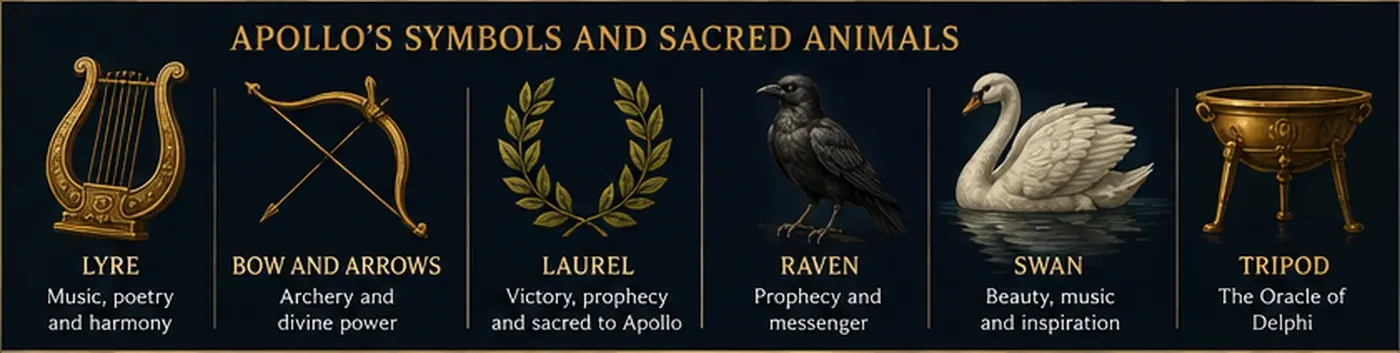
Apollo’s symbols map directly onto his domains. Each one comes from a specific myth or a specific area of worship, which is why ancient artists could identify him by an object alone.
| Symbol | Meaning or Connection to Apollo |
|---|---|
| Lyre | Represents Apollo’s rule over music, poetry, and harmony. In one tradition, Hermes made the first lyre and gave it to Apollo. |
| Bow and arrows | Stand for archery, distant striking power, divine punishment, and the plague Apollo could send or withdraw. |
| Laurel | Comes from the myth of Daphne. Laurel wreaths were tied to Apollo’s worship and awarded at the Pythian Games at Delphi. |
| Raven | Associated with prophecy and messages. In the Coronis story, a raven reports news to Apollo, and a later version explains its black feathers. |
| Swan | A bird sacred to Apollo, linked to music and to Delos, and often shown accompanying him in ancient art. |
| Tripod | The seat used by the Pythia at Delphi, and a standing emblem of Apollo’s oracular authority. |
Who Is Phoebus Apollo?
Phoebus Apollo is the god Apollo referred to by his most common epithet. Phoebus comes from the Greek Phoibos, meaning bright, radiant, or pure, and it appears attached to Apollo’s name as early as Homer.
The name reflects Apollo’s association with brightness, clarity, and ritual purity rather than with the physical sun. Ancient writers sometimes explained it as an inheritance from his grandmother Phoebe, the Titaness whose name shares the same root.
The reason Phoebus Apollo in Greek mythology became such a familiar phrase is largely literary. Poets favored the double name for its sound and its associations, and Roman writers used it constantly. As Apollo’s solar identification grew in later traditions, the epithet was increasingly read as a reference to sunlight, which is how many modern readers first encounter it.
Apollo in Greek and Roman Mythology
Apollo is unusual among the major gods because the Romans kept his Greek name instead of matching him to an existing Italic deity. There is no Roman equivalent of Apollo in the way that Jupiter corresponds to Zeus or Venus to Aphrodite.
His main attributes carried over intact. Roman Apollo remained a god of prophecy, music, healing, and archery, and Roman authors retold the Greek myths of Python, Daphne, Marsyas, and Hyacinthus, often adding detail. Ovid’s Metamorphoses preserves the versions of several of these stories that are best known today.
Apollo’s healing side arrived in Rome early. His first temple in the city was dedicated in the fifth century BCE in connection with plague, and he was worshiped there as Apollo Medicus. Centuries later, Augustus adopted Apollo as a personal patron and built a temple to him on the Palatine Hill, which raised the god’s political profile considerably.
The solar identification also became far more pronounced in this period. Roman poetry regularly treats Apollo and the sun as interchangeable, blending him with Sol in a way that classical Greek writers generally had not.
Frequently Asked Questions About Apollo in Greek Mythology
Who is Apollo in Greek mythology?
Apollo is an Olympian god in Greek mythology, the son of Zeus and Leto and the twin brother of Artemis. He was worshiped as the god of prophecy, music and poetry, healing and disease, archery, and light. His most famous sanctuary was Delphi, where the Greeks believed he answered questions through the priestess known as the Pythia.
What did Apollo do in Greek mythology?
Apollo killed the serpent Python and claimed the oracle at Delphi, which made him the leading god of prophecy. He defeated Marsyas in a music contest, pursued Daphne, who became a laurel tree, and fathered Asclepius, the god of medicine. In the Trojan War he fought for Troy and struck the Greek army with plague.
Is Apollo the Greek god of the sun?
Not originally. In traditional Greek mythology, Helios was the personification of the sun and drove the solar chariot across the sky. Apollo was a god of light, clarity, and prophecy, which is a related but different idea. Greek writers began merging the two figures during the Classical period, and Apollo’s solar identity became standard in later Greek and Roman traditions.
Who did Apollo marry?
Apollo has no permanent wife in the main Greek mythological tradition. Unlike Zeus with Hera or Hades with Persephone, he is not paired with a recognized consort. Ancient sources instead describe many relationships, several of which ended badly. Well-known examples include Coronis, the mother of Asclepius, the nymph Daphne, who fled from him, and the Spartan youth Hyacinthus.
Why is Apollo called Phoebus?
Phoebus is an epithet meaning bright, radiant, or pure, from the Greek word Phoibos. It reflects Apollo’s association with light, clarity, and ritual purity, and it appears alongside his name from Homer onward. Some ancient writers linked it to his grandmother Phoebe. Later readers connected it more directly to the sun as Apollo’s solar identity developed.
Conclusion
Apollo makes more sense when his domains are read as one idea rather than a list. Prophecy, music, healing, and archery all depend on knowing something exactly, whether that is what will happen, the interval between two notes, the cause of an illness, or the position of a target. The same precision explains why his punishments in myth arrive so suddenly.
Two points are worth carrying away. His stories survive in competing versions, and the disagreements between Homer, Pindar, and Ovid are part of the material rather than a problem to be fixed. His identity as a sun god was assembled over centuries, so it describes later tradition rather than the god the earliest Greeks worshiped.

About the Author
Dana Whitfield
I write about numerology, astrology, mythology, tarot, and world mystical traditions for Mystivora, drawing on years of independent research across comparative religion and symbolic systems. I approach each topic by cross-checking primary texts and established scholarship rather than repeating popular but unverified claims.