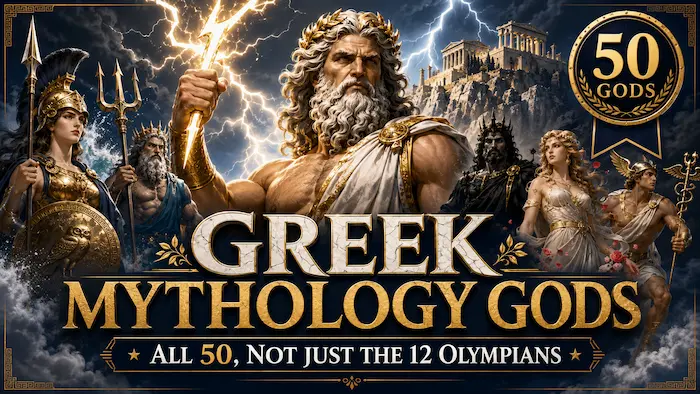
Greek mythology gods number far more than the famous twelve. The Twelve Olympians are only the best-known group inside a much larger pantheon that grew over centuries of ancient Greek religion, poetry, and local worship. Alongside Zeus and his family, the Greeks recognized primordial deities who represented the earliest forces of the cosmos, an older generation of Titans, rulers of the Underworld, sea gods, nature spirits, and personifications of ideas such as victory, sleep, and retribution.
This guide covers the gods and goddesses that matter most for understanding Greek mythology as a system: who they were, what they governed, which symbols identified them, and how they relate to one another. It does not attempt to list every obscure local divinity, because no ancient source ever did that either.
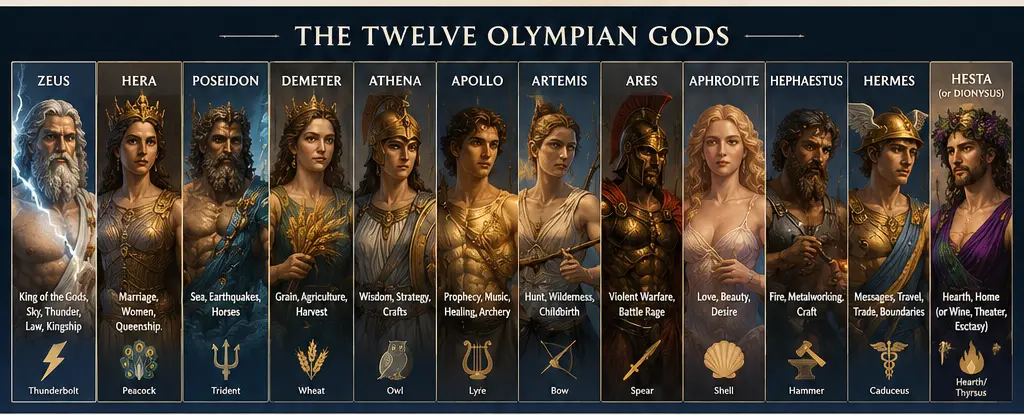
Quick answer: There is no fixed number of gods in Greek mythology. The Twelve Olympians (Zeus, Hera, Poseidon, Demeter, Athena, Apollo, Artemis, Ares, Aphrodite, Hephaestus, Hermes, and either Hestia or Dionysus) are the ruling generation on Mount Olympus, but the wider pantheon also includes primordial gods, Titans, Underworld deities, sea gods, nature gods, and dozens of personified concepts.
Greek Mythology Gods and Goddesses at a Glance
This table covers the Olympians plus the major non-Olympian deities readers usually expect to find in a Greek gods list.
| Greek Deity | God or Goddess Of | Key Symbols | Roman Equivalent |
|---|---|---|---|
| Zeus | Sky, thunder, law, kingship | Thunderbolt, eagle, oak | Jupiter |
| Hera | Marriage, women, queenship | Peacock, cow, crown | Juno |
| Poseidon | Sea, earthquakes, horses | Trident, horse, dolphin | Neptune |
| Demeter | Grain, agriculture, harvest | Wheat, torch, cornucopia | Ceres |
| Athena | Wisdom, strategy, crafts | Owl, olive tree, aegis | Minerva |
| Apollo | Prophecy, music, healing, archery | Lyre, laurel, bow | Apollo |
| Artemis | Hunt, wilderness, childbirth | Bow, deer, hunting dogs | Diana |
| Ares | Violent warfare, battle rage | Spear, helmet, shield | Mars |
| Aphrodite | Love, beauty, desire | Dove, rose, myrtle, shell | Venus |
| Hephaestus | Fire, metalworking, craft | Hammer, anvil, forge | Vulcan |
| Hermes | Messages, travel, trade, boundaries | Caduceus, winged sandals | Mercury |
| Dionysus | Wine, theater, ecstasy | Grapevine, ivy, thyrsus | Bacchus |
| Hestia | Hearth, home, domestic order | Hearth, sacred flame | Vesta |
| Hades | Underworld, the dead, hidden wealth | Helm of invisibility, Cerberus | Pluto |
| Persephone | Underworld queenship, spring growth | Pomegranate, torch, grain | Proserpina |
| Hecate | Magic, crossroads, night | Twin torches, keys, dogs | Hecate (Trivia) |
| Gaia | Earth itself, primordial mother | The earth, fruits, grain | Terra |
| Cronus | Titan rule before the Olympians | Sickle or curved blade | Saturn |
| Rhea | Motherhood, Titan queenship | Lion, throne, drum | Ops |
Why both Dionysus and Hestia appear in lists of the Twelve: ancient sources did not agree on one fixed roster. Hestia is the elder sister of Zeus and the goddess of the hearth, while Dionysus was a hugely popular god whose worship spread widely. Later tradition often gives Dionysus the twelfth seat in Hestia’s place, but there is no single canonical ancient list that settles the question.
Who Were the Twelve Olympian Gods?
The Olympians were the ruling generation of Greek gods, associated with Mount Olympus and led by Zeus, who took power after the defeat of the Titans. They were not the oldest gods, and they were not the only gods. They were the governing family whose quarrels, marriages, and judgments drive most surviving Greek myth.
Two points are worth fixing before the list. First, ancient traditions did not always use exactly the same twelve names, and different cities honored slightly different groupings. Second, Hades belongs to the same divine generation as Zeus and Poseidon but is normally left out of the Twelve, because his realm was the Underworld rather than Olympus. A useful overview of how the ancient sources grouped these deities is available at Theoi Greek Mythology.
Zeus
Zeus was king of the gods and the god of the sky, thunder, law, oaths, hospitality, and kingship. He was the youngest son of the Titans Cronus and Rhea, brother of Poseidon and Hades, and husband of Hera. After overthrowing Cronus and defeating the Titans, he established the Olympian order and divided the cosmos with his brothers, taking the sky for himself.
His symbols are the thunderbolt, the eagle, and the oak tree. His Roman equivalent is Jupiter. Zeus is the enforcer of divine and human law in Greek myth, which is why oaths, guest-friendship, and the punishment of arrogance so often fall under his authority.
Hera
Hera was queen of the gods and the goddess of marriage, married women, family, and queenship. She was both the sister and the wife of Zeus, which reflects an older pattern in which the ruling divine couple came from the same generation of Cronus and Rhea’s children.
She appears frequently in myths punishing Zeus’s lovers and their children, and that reputation has overshadowed her actual religious role. In practice Hera was one of the most widely worshipped goddesses in the Greek world, with major sanctuaries at Argos and Samos. Her symbols are the peacock, the cow, and the crown. Her Roman equivalent is Juno.
Poseidon
Poseidon ruled the sea, and also governed earthquakes and horses. He was the brother of Zeus and Hades, and received the sea when the three brothers divided the cosmos. Greek sailors treated him as a god who could grant safe passage or destroy a fleet, and his epithet as the earth-shaker connects him to seismic activity as well as water.
He famously competed with Athena for patronage of Athens, offering a salt spring while Athena offered the olive tree. The Athenians chose Athena, but Poseidon retained major cult worship in the city and across the Greek coast. His symbols are the trident, the horse, and the dolphin. His Roman equivalent is Neptune.
Demeter
Demeter was the goddess of grain, agriculture, fertility of the soil, and the harvest. She was a daughter of Cronus and Rhea and the mother of Persephone. Her most important myth is the abduction of Persephone by Hades, after which Demeter’s grief caused the earth to stop producing crops until an agreement returned her daughter for part of each year.
That story became the Greek explanation of the agricultural cycle and the foundation of the Eleusinian Mysteries, one of the most significant religious institutions of the ancient Greek world. Her symbols are wheat, the torch, and the cornucopia. Her Roman equivalent is Ceres.
Athena
Athena was the goddess of wisdom, strategy, skilled crafts, and defensive or disciplined warfare. She was born from the head of Zeus, fully armed, in the best-known version of her birth, and she became the patron goddess of Athens, where the Parthenon was built for her.
The contrast with Ares matters. Athena represents warfare as planning, tactics, and the protection of a city, while Ares represents the raw violence and slaughter of the battlefield. Athena also patronized weaving, pottery, and craftsmanship, which is why her domain is better described as skilled intelligence than simply wisdom. Her symbols are the owl, the olive tree, and the aegis. Her Roman equivalent is Minerva.
Apollo
Apollo governed prophecy, music, poetry, healing, plague, archery, and light. He was the son of Zeus and the Titaness Leto, and the twin brother of Artemis. He spoke through the Oracle at Delphi, which made him one of the most consulted gods in the Greek world, and he was also invoked both to send and to end disease. A fuller account of his myths and cult appears in this guide to Apollo and Greek mythology.
One correction is worth making. Apollo is often called the sun god, but the traditional personification of the Sun in Greek religion was the Titan Helios. Apollo acquired strong solar associations later, especially in the Hellenistic and Roman periods, and the two were increasingly identified with each other. Calling Apollo the original Greek sun god flattens that history. His symbols are the lyre, the laurel wreath, and the bow. His Roman name is also Apollo.
Artemis
Artemis was the goddess of the hunt, wild animals, uncultivated land, young women, and childbirth. She was the twin sister of Apollo and, like him, a child of Zeus and Leto. Greek communities associated her with the transition of girls into adulthood, and her sanctuaries often stood outside the settled center of a city, matching her connection to the wilderness.
Artemis is frequently described as a moon goddess, but that association developed alongside her identification with Selene, who was the actual Titan personification of the Moon. The two remain distinct figures in earlier Greek tradition. Her symbols are the bow, the deer, and hunting dogs. Her Roman equivalent is Diana.
Ares
Ares was the god of war in its most violent and destructive form: bloodshed, battle frenzy, and the chaos of combat. He was the son of Zeus and Hera, and Greek literature treats him with noticeably less affection than most Olympians. In the Iliad, Zeus tells him plainly that he is the most hateful of the gods.
Where Athena wins battles through strategy, Ares embodies the part of war that no city celebrates. He was still worshipped, particularly in Sparta and Thrace, and his role in the pantheon is best understood as an honest acknowledgment that violence is a real force in the world. His symbols are the spear, helmet, and shield. His Roman equivalent is Mars, who held a considerably higher and more respected position in Roman religion.
Aphrodite
Aphrodite was the goddess of love, beauty, sexual desire, and attraction. Greek sources give two competing accounts of her origin. In Hesiod she is born from the sea foam that gathered around the severed genitals of Uranus, which makes her older than the Olympians. In Homer she is simply the daughter of Zeus and the Titaness Dione.
She was married to Hephaestus but is repeatedly linked with Ares in myth. Her judgment by Paris, in which she promised him the most beautiful mortal woman in the world, is the event that sets the Trojan War in motion. Her symbols are the dove, the rose, the myrtle, and the scallop shell. Her Roman equivalent is Venus.
Hephaestus
Hephaestus was the god of fire, metalworking, blacksmiths, and craftsmanship, and the only Olympian consistently described as physically impaired. He was cast out of Olympus in one version of his myth, and he returned as the divine smith who forged the weapons and armor of the gods, including Achilles’s shield and Zeus’s own thunderbolts.
He is married to Aphrodite, an unequal pairing that Greek storytellers used for comic and moral effect. His importance is easy to underestimate: in a world where metal tools, weapons, and temple decoration determined a city’s strength, the divine craftsman held real religious weight. His symbols are the hammer, the anvil, and the forge. His Roman equivalent is Vulcan.
Hermes
Hermes was the messenger of the gods and the god of travel, roads, trade, merchants, communication, boundaries, thieves, and trickery. He was the son of Zeus and the Pleiad Maia, and he acted as the divine intermediary who crossed between worlds. A detailed treatment of his powers, family, and myths is available in this guide to the Greek mythology Hermes god.
His most distinctive role is as psychopomp, the guide who leads the souls of the dead down to the Underworld. That function follows directly from his broader domain, since he is the god who moves across boundaries that no one else can cross. His symbols are the caduceus, winged sandals, and a winged travelling hat. His Roman equivalent is Mercury.
Dionysus
Dionysus was the god of wine, the vine, theater, ritual madness, ecstasy, and festivity. He was the son of Zeus and the mortal woman Semele, which makes him unusual among the Olympians, and his myths repeatedly involve the collapse of ordinary social order under divine influence.
Greek drama itself developed within his festivals in Athens, so his cultural footprint extends far beyond drinking. He is the deity who most often takes the twelfth Olympian position in place of Hestia in later traditions. His symbols are the grapevine, ivy, and the thyrsus, a pine-cone-tipped staff. His Roman equivalent is Bacchus.
Hestia
Hestia was the goddess of the hearth, the household, and domestic and civic order. She was the eldest child of Cronus and Rhea, and she barely appears in narrative myth, which has caused modern readers to underrate her. In actual Greek practice she was constantly present: every household fire and every civic hearth belonged to her, and offerings often began with her.
She vowed to remain unmarried, which kept her outside the tangled family conflicts that occupy most Olympian stories. Some ancient lists count her among the Twelve while others give that seat to Dionysus. Her symbols are the hearth and the sacred flame. Her Roman equivalent is Vesta.
Major Goddesses in Greek Mythology
Greek religion gave goddesses authority over political power, warfare, marriage, fertility, hunting, magic, the Underworld, victory, memory, and the natural world. They were not confined to domestic roles, and several outrank male gods in cult importance in specific cities.
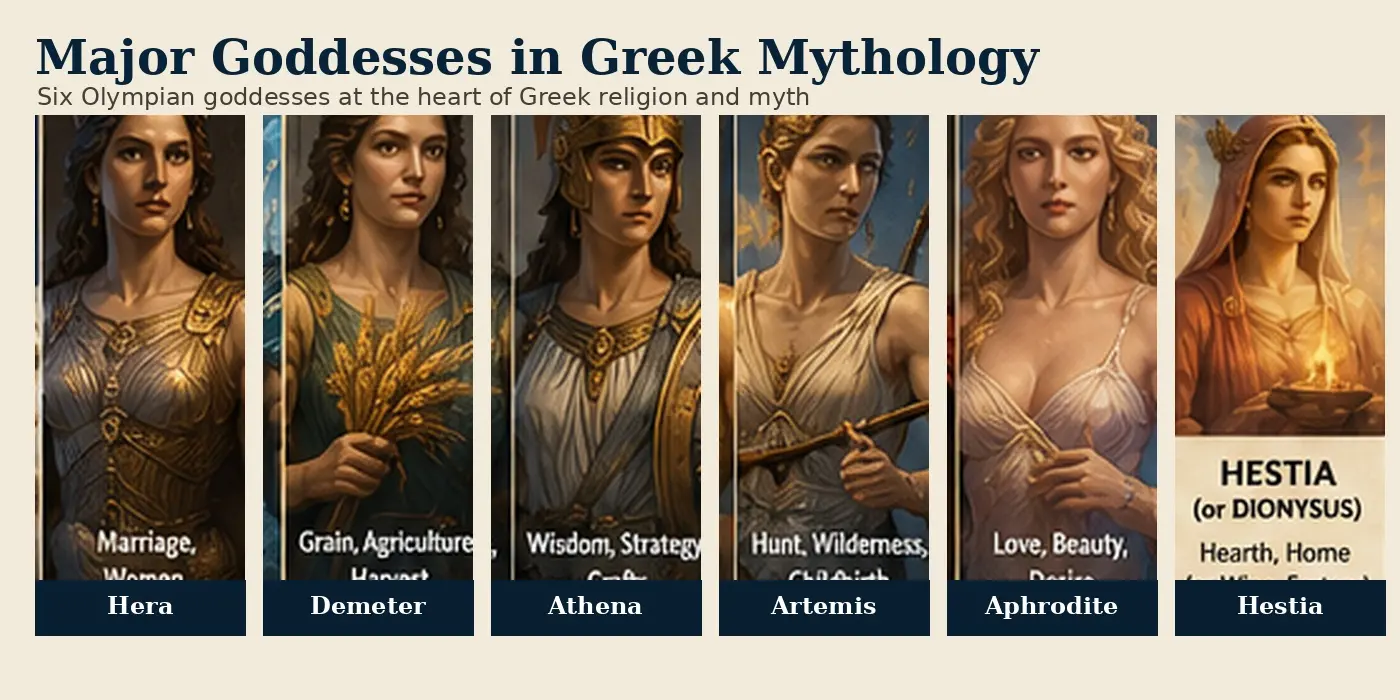
| Goddess | Domain | Group |
|---|---|---|
| Hera | Marriage, women, queenship | Olympian |
| Athena | Wisdom, strategy, crafts | Olympian |
| Aphrodite | Love, beauty, desire | Olympian |
| Artemis | Hunt, wilderness, childbirth | Olympian |
| Demeter | Grain, harvest, fertility of the soil | Olympian |
| Hestia | Hearth, home, civic order | Olympian |
| Persephone | Underworld queenship, returning growth | Underworld |
| Hecate | Magic, crossroads, night, thresholds | Pre-Olympian |
| Gaia | The Earth itself | Primordial |
| Rhea | Motherhood, Titan queenship | Titan |
| Nike | Victory | Personification |
| Selene | The Moon | Titan generation |
The six Olympian goddesses are covered above. The sections below give more context to the important goddesses who sit outside the Olympian group.
Persephone
Persephone was queen of the Underworld and the daughter of Demeter and Zeus. Hades took her to his realm to be his wife, and the negotiated settlement required her to spend part of each year below and part above. Because she had eaten pomegranate seeds in the Underworld, she could not be released permanently.
Her seasonal movement became the Greek explanation for why the growing year has a fertile half and a barren half. She is a genuinely dual figure: goddess of returning growth in the upper world, and a feared sovereign in the world below. Her Roman equivalent is Proserpina.
Hecate
Hecate was associated with magic, crossroads, thresholds, night, ghosts, and the boundaries between states of being. She belongs to the Titan generation by descent, but Hesiod presents her as honored by Zeus and retaining authority across earth, sea, and sky, which is unusual for a pre-Olympian figure.
She is often depicted holding twin torches, and later art gives her a triple form facing three directions, matching her connection to places where roads meet. Greek households placed shrines to her at doorways as a protective presence. Roman tradition generally kept her name, though she is also identified with Trivia.
Gaia
Gaia is the primordial personification of the Earth and one of the first beings to emerge in Hesiod’s creation account. She is not a goddess who rules the earth from outside. She is the earth, treated as a conscious being.
She produced Uranus, the sky, and then bore the Titans, the Cyclopes, and the hundred-handed Hecatoncheires with him. When Uranus imprisoned her children, Gaia armed Cronus to overthrow him, and she later played a role against Cronus as well. Almost every major divine generation traces back to her.
Rhea
Rhea was a Titan goddess, daughter of Uranus and Gaia, and the wife of her brother Cronus. She was the mother of Hestia, Demeter, Hera, Hades, Poseidon, and Zeus.
Cronus swallowed each child at birth because of a prophecy that one of them would overthrow him. When Zeus was born, Rhea hid the infant and gave Cronus a stone wrapped in cloth instead. That act of concealment is what makes the Olympian order possible, so Rhea occupies a decisive position in the succession of divine generations. Her Roman equivalent is Ops.
Nike
Nike was the goddess and personification of victory, in athletic competition as well as war. She is usually shown winged and in motion, often carrying a wreath or palm branch.
She appears as a companion figure to Zeus and to Athena rather than as an independent ruler with her own mythology. Statues of Athena in Athens were shown holding a small Nike, and the sanctuary of Athena Nike stood on the Acropolis. Her Roman equivalent is Victoria.
Selene
Selene was the goddess and personification of the Moon, and the actual lunar deity of earlier Greek tradition. She was the daughter of the Titans Hyperion and Theia, and the sister of Helios (the Sun) and Eos (the Dawn).
Her best-known myth concerns her love for the mortal Endymion, who was placed in eternal sleep. Selene should not be treated as a variant name for Artemis. The two were separate deities who were later merged in poetry and Roman-era art, but earlier Greek sources keep them apart.
Other Important Gods in Greek Mythology
The Olympians are one layer of the Greek pantheon, not the whole of it. Understanding the rest of the structure makes the mythology far easier to follow, because most confusion comes from treating every Greek god as a member of the same family group.
The main divisions are the primordial gods who came first, the Titans who ruled before Zeus, the deities of the Underworld, the gods of the sea, the gods of wild and rural places, and the personified concepts that the Greeks also treated as divine.
Primordial Gods
The primordial deities, sometimes called the protogenoi, represent the earliest cosmic forces in Greek creation traditions. They are less characters than components of the universe, and their myths are correspondingly thin.
| Deity | Represents |
|---|---|
| Chaos | The first state of existence, a primordial gap or void rather than disorder |
| Gaia | The Earth, ancestor of the Titans and most later divine generations |
| Uranus | The Sky, born from Gaia and later her consort and the father of the Titans |
| Tartarus | The deep abyss beneath the earth, used as a prison for defeated powers |
| Nyx | Night, described as a powerful figure whom even Zeus avoided offending |
| Erebus | Darkness, particularly the darkness of the underground regions |
| Eros | The generative force of attraction that allows creation to continue |
A note on Chaos: the modern English word suggests disorder or confusion, but the Greek term points toward a gap, chasm, or empty space. Hesiod describes Chaos as what existed first, not as a god of randomness. Reading the modern meaning back into the ancient word produces a common misunderstanding of the Greek creation account.
The Titans
The Titans were the divine generation between the primordial beings and the Olympians. They were the twelve children of Gaia and Uranus, and Cronus, the youngest of them, ruled the cosmos before Zeus. The war between the Titans and the Olympians, known as the Titanomachy, ended with the defeat of most Titans and the imprisonment of many in Tartarus.
The original twelve Titans were:
- Cronus: the ruling Titan, overthrown by his son Zeus
- Rhea: his sister and wife, mother of the first Olympians
- Oceanus: the great freshwater river believed to encircle the world
- Tethys: his sister and wife, mother of rivers and ocean nymphs
- Hyperion: a Titan of heavenly light, father of Sun, Moon, and Dawn
- Theia: his sister and wife, associated with sight and radiance
- Coeus: a Titan connected with intelligence and the celestial axis
- Phoebe: his sister and wife, linked with prophecy and grandmother of Apollo and Artemis
- Crius: a Titan of the southern sky, less prominent in surviving myth
- Iapetus: father of Atlas and Prometheus, often linked with mortality
- Themis: divine law, custom, and right order
- Mnemosyne: memory, and mother of the nine Muses by Zeus
Several famous figures are Titans by descent but belong to the second generation rather than the original twelve:
- Atlas: son of Iapetus, condemned to hold up the sky after the Titanomachy
- Prometheus: son of Iapetus, who gave fire to humanity and was punished for it
- Epimetheus: brother of Prometheus, associated with acting before thinking
- Helios: son of Hyperion and Theia, the personification of the Sun
- Selene: his sister, the personification of the Moon
- Eos: his sister, the personification of the Dawn
- Leto: daughter of Coeus and Phoebe, mother of Apollo and Artemis
Not every Titan opposed Zeus. Prometheus sided with the Olympians during the war, and Themis and Mnemosyne were integrated into the Olympian order rather than punished.
Hades and the Gods of the Underworld
The Greek Underworld had its own set of deities, and readers looking for a Greek gods list almost always expect to find its ruler near the top.
Hades
Hades was the god and ruler of the Underworld, brother of Zeus and Poseidon, and husband of Persephone. When the three brothers divided the cosmos after defeating the Titans, Hades received the realm of the dead. His name came to refer to the realm itself as well as to the god.
He is normally not counted among the Twelve Olympians, because he did not reside on Mount Olympus. That exclusion is about location and jurisdiction, not about rank or weakness. Hades belongs to the same generation and the same level of power as Zeus.
He also should not be described as a Greek equivalent of Satan or as an evil god. Greek sources present him as stern, inflexible, and unwelcoming, but not as a tempter or an enemy of the other gods. He is also associated with the wealth found beneath the ground, which is why his Roman name, Pluto, connects to the Greek word for riches. His attributes are the helm of invisibility and the guard dog Cerberus.
Other significant Underworld figures include:
- Persephone: queen of the Underworld and co-ruler alongside Hades
- Hecate: goddess of magic and thresholds, closely connected to the world of the dead
- Thanatos: the personification of death itself, a son of Nyx
- Hypnos: the personification of sleep and the twin brother of Thanatos
- Charon: the ferryman who carried souls across the underworld river, a functionary rather than a major god
- The Erinyes (Furies): avenging spirits who pursued those guilty of serious crimes, especially against family
- The judges of the dead: Minos, Rhadamanthus, and Aeacus, former mortals appointed to assess arriving souls
Greek Sea Gods
Poseidon was the most powerful sea deity, but Greek tradition filled the water with older and more localized divine figures, many of them predating Olympian rule.
- Poseidon: Olympian ruler of the sea, earthquakes, and horses
- Oceanus: the Titan of the world-encircling river, an older conception of the waters
- Nereus: the truthful and prophetic Old Man of the Sea, father of the Nereids
- Triton: son of Poseidon and Amphitrite, who calmed or raised the waves with a conch shell
- Proteus: a shape-shifting sea god who would answer questions only if held fast
- Amphitrite: a Nereid who became the wife of Poseidon and queen of the sea
- Thetis: a Nereid of considerable influence among the gods and the mother of Achilles
- The Nereids: the fifty sea nymph daughters of Nereus, helpers of sailors
Nature and Rustic Gods
Greek religion also populated forests, mountains, springs, and rivers with divine beings. These figures mattered enormously in everyday rural worship even though they rarely appear at the center of famous myths.
Nymphs were female nature spirits tied to specific places: naiads to springs and rivers, dryads to trees, oreads to mountains. River gods were treated as genuine deities with their own cults, and a Greek city often traced its origins to a local river or spring. Satyrs, by contrast, were wild male nature spirits in the following of Dionysus rather than gods in their own right.
Pan
Pan was the god of shepherds, flocks, wild and rural places, and rustic music. He was associated above all with Arcadia, the mountainous inland region of the Peloponnese, and he is depicted with the legs, horns, and ears of a goat.
He invented the panpipes, the reed instrument that carries his name. Greek tradition also credited him with the sudden irrational fear that can seize people in lonely places, which is the origin of the English word panic. Pan is a good illustration of how Greek divinity extended well beyond the ordered world of Olympus.
Gods and Personifications of Everyday Life
The Greeks routinely treated abstract forces, emotions, and experiences as divine beings. These personifications received poetry, art, and in some cases genuine worship, which is a major reason why the Greek pantheon cannot be reduced to a fixed headcount.
| Deity | Personifies |
|---|---|
| Nike | Victory |
| Nemesis | Retribution and the correction of excess |
| Tyche | Fortune, chance, and the luck of a city |
| Eros | Love and desire |
| Thanatos | Death |
| Hypnos | Sleep |
| Eris | Strife and discord |
| Hebe | Youth, cupbearer of the gods |
| Iris | The rainbow, and a messenger of the gods |
| Aergia | Idleness and sloth, known mainly from later Greek and Roman sources |
| Morpheus | Dreams, in later literary tradition rather than early Greek myth |
Morpheus deserves a caution. He is best known from Ovid, a Roman poet, and he does not have the same standing in early Greek sources as figures like Thanatos or Nike.
Greek Gods List: 50 Major Deities
Readers often look for a round list of fifty Greek gods. No ancient source produced such a list, and the exact fifty is always an editorial choice. The grouping below covers every major layer of the pantheon and accounts for almost all of the names a reader is likely to meet in Greek myth.
| Group | Deities |
|---|---|
| Olympians (13) | Zeus, Hera, Poseidon, Demeter, Athena, Apollo, Artemis, Ares, Aphrodite, Hephaestus, Hermes, Dionysus, Hestia |
| Primordial gods (7) | Chaos, Gaia, Uranus, Tartarus, Nyx, Erebus, Eros |
| Original Titans (12) | Cronus, Rhea, Oceanus, Tethys, Hyperion, Theia, Coeus, Phoebe, Crius, Iapetus, Themis, Mnemosyne |
| Later Titan generation (5) | Atlas, Prometheus, Helios, Selene, Eos |
| Underworld gods (5) | Hades, Persephone, Hecate, Thanatos, Hypnos |
| Sea gods (4) | Nereus, Triton, Amphitrite, Proteus |
| Nature and personifications (4) | Pan, Nike, Nemesis, Tyche |
Extending the list to a hundred names would be equally possible, since Hesiod alone names roughly three hundred divine beings. The point of a fixed number is convenience for the reader, not fidelity to any ancient roster.
Greek Gods Family Tree Explained
The full genealogy is enormous, but the backbone is simple. Greek divine history moves through a sequence of generations, each replacing the one before it.
- Chaos and the first primordial beings come into existence, including Gaia, Tartarus, and Eros
- Gaia produces Uranus, and together they become the parents of the Titans, the Cyclopes, and the Hecatoncheires
- The Titans take power after Cronus overthrows Uranus
- Cronus and Rhea become the parents of the first Olympian generation
- Zeus, Hera, Poseidon, Hades, Demeter, and Hestia overthrow the Titans and establish Olympian rule
- The younger Olympians follow: Athena, Apollo, Artemis, Ares, Aphrodite, Hephaestus, Hermes, and Dionysus
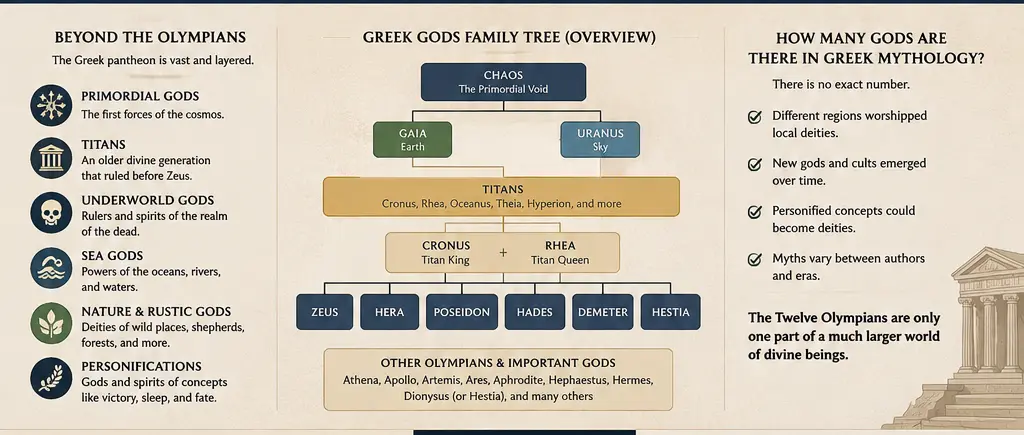
One caution applies to every Greek family tree. Ancient sources do not agree with each other. Hesiod’s Theogony is the most influential account, but Homer, the Homeric Hymns, later mythographers, and local traditions all preserve variations. Aphrodite’s parentage is the clearest example, and there are many others. A family tree diagram is a useful simplification, not a record that every ancient Greek would have recognized.
How Many Gods Are There in Greek Mythology?
There is no universally agreed number of gods in Greek mythology. The Twelve Olympians are one group within a far larger pantheon that also includes primordial deities, Titans, Underworld gods, sea gods, river gods, nature spirits, personified concepts, and many local divinities worshipped in single cities or regions. Hesiod’s Theogony alone names roughly three hundred divine beings, and later authors added more.
Several factors make an exact count impossible:
- Myths varied by place and period. Greek religion had no central authority, no single scripture, and no fixed canon
- Ancient authors preserved different genealogies. Two sources can give a deity different parents or different domains
- Local cults worshipped additional deities. Many gods were significant in one city and unknown elsewhere
- Personified concepts could receive divine status. Victory, retribution, and fortune were all treated as divine at various points
- The categories blur. Gods, daimones, nymphs, river gods, heroes, and semi-divine beings do not sort cleanly into a modern list
Any specific total you encounter is a modern editorial choice about where to draw the line, not a figure inherited from antiquity.
Who Was the Most Powerful Greek God?
Zeus. He was king of the Olympians, controlled thunder and the sky, led the coalition that defeated the Titans, and held authority over both gods and mortals. Greek myth consistently presents his will as the settlement that other gods can resist temporarily but not overturn.
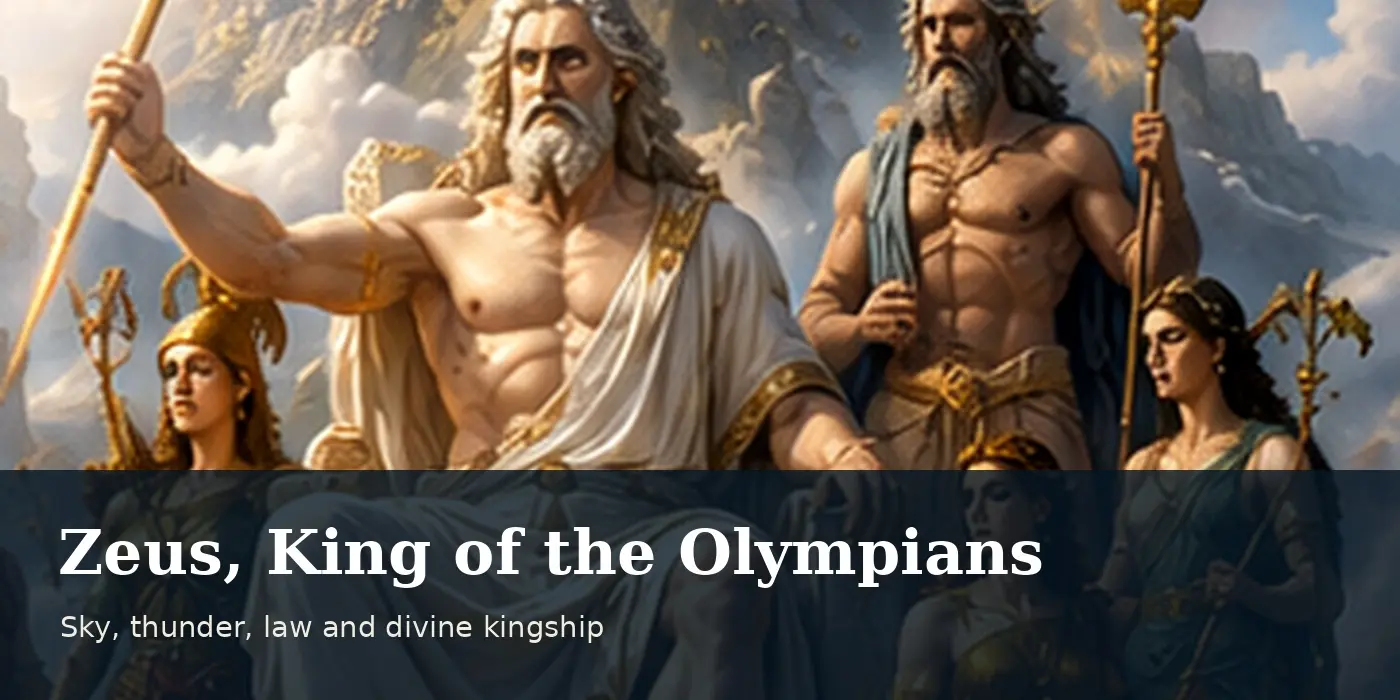
There is a nuance worth keeping. Zeus was supreme within the Olympian order, but Greek tradition also acknowledged older cosmic powers that were not simply his subordinates. Hesiod describes Zeus as reluctant to displease Nyx, and Fate is often portrayed as a limit even on the king of the gods. Zeus is the ruler of the divine world, not the origin of it.
Who Was the Oldest Greek God?
The answer depends on what counts as a god. In Hesiod’s Theogony, the earliest surviving systematic Greek creation account, Chaos comes into being first, followed by Gaia, Tartarus, and Eros. On that basis, Chaos is usually described as the first primordial being.
Among figures with developed personalities and worship, Gaia is the strongest candidate, since she is the ancestor of nearly every later divine generation. What is certainly incorrect is naming Zeus. He belongs to the third divine generation and is one of the younger major gods in the sequence.
Greek Gods and Their Roman Equivalents
| Greek | Roman |
|---|---|
| Zeus | Jupiter |
| Hera | Juno |
| Poseidon | Neptune |
| Hades | Pluto |
| Athena | Minerva |
| Apollo | Apollo |
| Artemis | Diana |
| Ares | Mars |
| Aphrodite | Venus |
| Hephaestus | Vulcan |
| Hermes | Mercury |
| Demeter | Ceres |
| Dionysus | Bacchus |
| Hestia | Vesta |
| Persephone | Proserpina |
| Cronus | Saturn |
These pairings are not identities. Roman religion had its own deities before extensive Greek influence, and the process of matching them to Greek gods altered both sides. Mars was an important Roman god connected with agriculture and the protection of the state, which gives him a status Ares never held in Greece. Reading the Roman column as a simple translation of the Greek column loses most of what made each tradition distinct.
Most Important Symbols of the Greek Gods
Greek art identified deities through consistent attributes, which is how ancient viewers recognized a figure on a vase or in a temple without a caption. Several of these emblems also appear among the most widely recognized ancient symbols of power, particularly the thunderbolt of Zeus and the aegis of Athena.
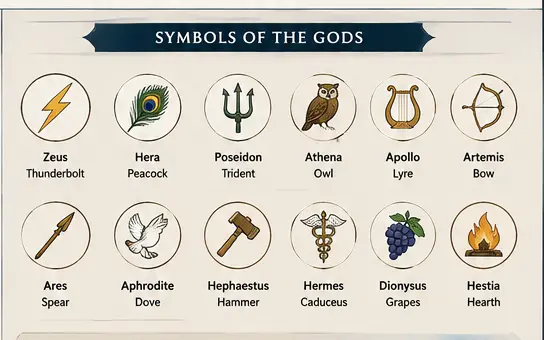
| Deity | Principal Symbols |
|---|---|
| Zeus | Thunderbolt, eagle, oak |
| Hera | Peacock, crown, cow |
| Poseidon | Trident, horse, dolphin |
| Athena | Owl, olive tree, aegis |
| Apollo | Lyre, laurel, bow |
| Artemis | Bow, deer, crescent |
| Ares | Spear, helmet, vulture |
| Aphrodite | Dove, rose, shell |
| Hermes | Caduceus, winged sandals |
| Hephaestus | Hammer, anvil, tongs |
| Demeter | Wheat, torch, cornucopia |
| Dionysus | Grapevine, thyrsus, ivy |
| Hestia | Hearth, sacred flame |
| Hades | Helm of invisibility, Cerberus, key |
Frequently Asked Questions
Who are the 12 main Greek gods?
The Twelve Olympians are Zeus, Hera, Poseidon, Demeter, Athena, Apollo, Artemis, Ares, Aphrodite, Hephaestus, Hermes, and either Hestia or Dionysus. Ancient sources did not use one fixed roster, and Hestia and Dionysus alternate in the twelfth position depending on the tradition. Hades is excluded because he ruled the Underworld rather than living on Mount Olympus.
What are 50 Greek gods?
A workable fifty covers the 13 Olympians, the 7 primordial gods (Chaos, Gaia, Uranus, Tartarus, Nyx, Erebus, Eros), the 12 original Titans, five of the later Titan generation (Atlas, Prometheus, Helios, Selene, Eos), five Underworld deities (Hades, Persephone, Hecate, Thanatos, Hypnos), four sea gods (Nereus, Triton, Amphitrite, Proteus), and Pan, Nike, Nemesis, and Tyche. No ancient source fixed the number at fifty.
Who is the 13th god?
Dionysus is the figure most often called the thirteenth Olympian. Because both Hestia and Dionysus appear in lists of the Twelve depending on the source, counting all of them together produces thirteen names rather than twelve. Hades is sometimes given the label instead, since he shares the generation and rank of Zeus but was not counted among the gods of Mount Olympus.
Who was Zeus’s favorite child?
Athena is usually described as the favorite. She was born from his own head, he grants her requests that he refuses to others, and she is the only deity permitted to handle his aegis and thunderbolt in some accounts. Heracles is occasionally named as the favorite son, but the evidence for Athena is considerably stronger across Homer and later tradition.
Is there a lazy Greek god?
Aergia is the personification of idleness and sloth, and comes closest to the description. She is known mainly from later Greek and Roman sources, where she is placed near the house of Sleep, and she never received significant worship. Hypnos, the god of sleep, is a much older and better-attested figure, but sleep and laziness were not the same idea in Greek thought.
Final Thoughts
The Twelve Olympians are the most famous Greek mythology gods, but they are one layer of a much deeper structure. Behind them stand the Titans who ruled before Zeus, and behind those the primordial beings who represent the earliest state of the cosmos. Alongside them are the gods of the Underworld, the sea, the wilderness, and the everyday forces the Greeks also treated as divine.
Reading the pantheon by generation and domain, rather than as one long list of names, is what makes the whole system coherent.

About the Author
Dana Whitfield
I write about numerology, astrology, mythology, tarot, and world mystical traditions for Mystivora, drawing on years of independent research across comparative religion and symbolic systems. I approach each topic by cross-checking primary texts and established scholarship rather than repeating popular but unverified claims.