The Greek mythology family tree runs through three main generations: the Primordial Gods, the Titans, and the Olympians. It begins with Chaos, the first thing that existed in Hesiod’s account, moves through Gaia and Uranus, who became the parents of the Titans, and reaches Cronus and Rhea, whose six children include Zeus. Zeus then sits at the center of the branch most readers are actually looking for, because so many familiar gods descend from him.
One thing is worth knowing before you start. Greek genealogy was never standardized. Different ancient writers and different regions preserved different parents for the same god, so no single chart can claim to be the official version. The tree below follows the relationships that appear most consistently across the major sources.
Greek Mythology Family Tree
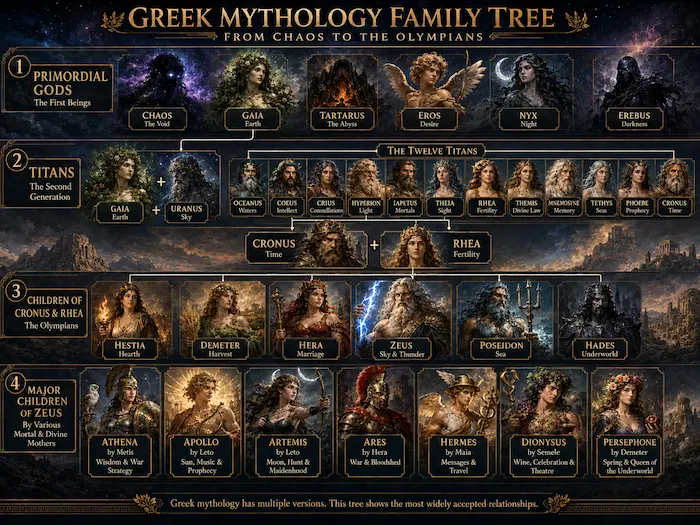
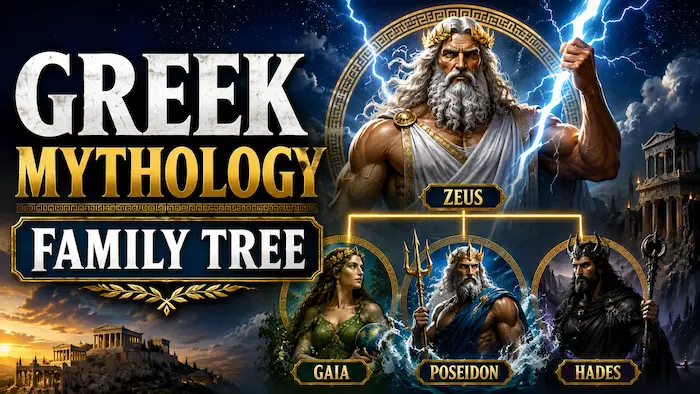
The family tree is easiest to understand as three connected generations. Gaia and Uranus lead to the Titans, Cronus and Rhea lead to Zeus and his siblings, and Zeus connects that older generation to many of the best-known younger Olympian gods.
The image here focuses on the main divine line rather than every minor god, spirit, nymph, hero, or regional variation. That keeps the relationships between the major figures readable.
The sections below explain the same family relationships in text, including the Primordial Gods, the Titans, the children of Cronus and Rhea, and the major descendants of Zeus.
The Primordial Gods
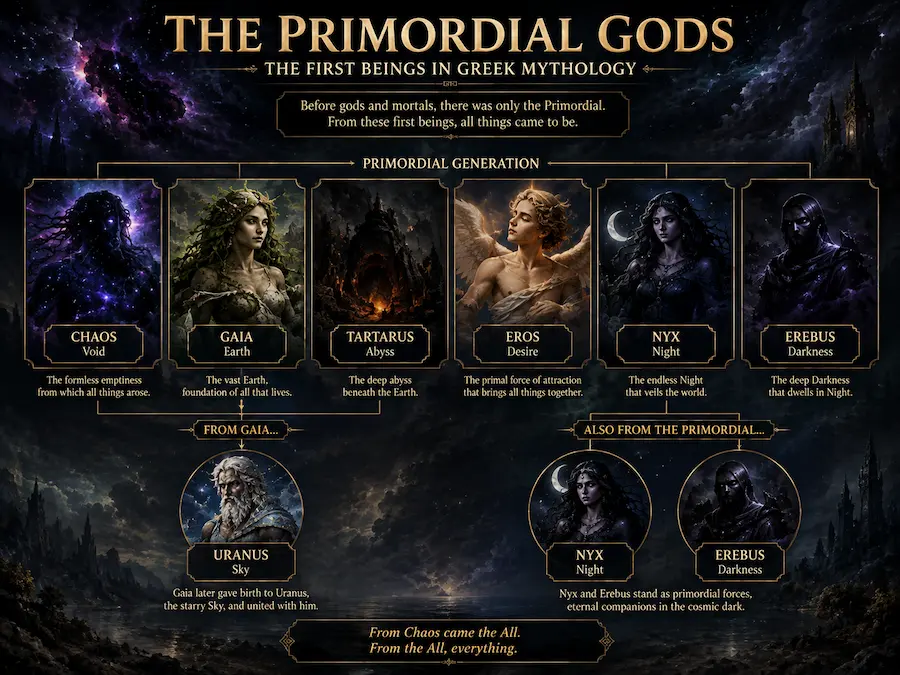
The primordial gods, sometimes called the protogenoi, are the first generation in the tree. They function less as characters with stories and more as the raw components of the universe given a name and a face.
Chaos
In Hesiod’s Theogony, Chaos is the first thing that came into being, which is why most Greek gods family trees place it at the very top. The Greek word points to a gap or open space rather than to disorder, so the modern English sense of the word is misleading here. Chaos has almost no mythology of its own. Its role in the genealogy is simply to mark where the line begins.
Gaia
Gaia is the personification of the Earth, and she is the single most important figure in the early part of the tree. She came into being near the beginning alongside Chaos, then produced Uranus, the sky, without a partner. Gaia and Uranus went on to become the parents of the Titans, which makes Gaia the ancestor of nearly every later divine generation, including the Olympians.
Uranus
Uranus is the personification of the sky. He is both the son of Gaia and her consort, and together they fathered the twelve Titans. His position in the family tree effectively ends there, because Cronus removed him from power and the line continues through the Titan generation.
A few other primordial beings appear near the top of most charts. Nyx (Night), Erebus (Darkness), Tartarus (the abyss beneath the earth), and Eros (the force of attraction) all belong to this earliest layer. They matter for understanding how the Greeks described the beginning of things, but they sit outside the main line of descent that leads to the Olympians, so charts usually show them as a side branch.
Gaia and Uranus: Parents of the Titans
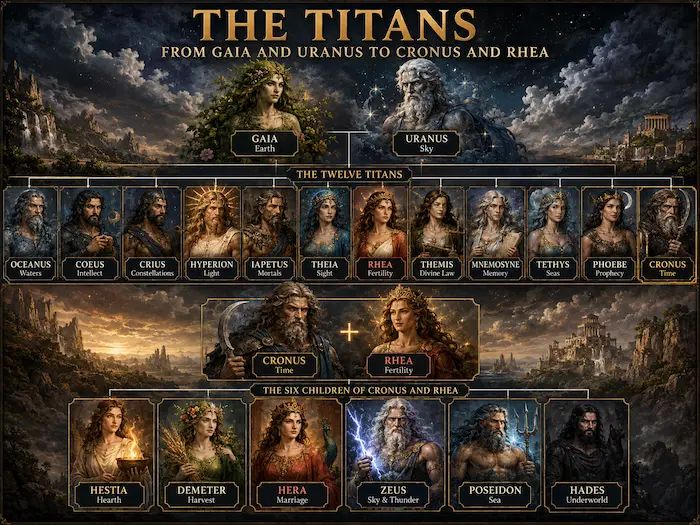
Gaia and Uranus produced twelve Titans, along with the three Cyclopes and the three hundred-handed Hecatoncheires. The twelve Titans became the second divine generation and the rulers of the cosmos after Cronus, the youngest of them, overthrew his father.
For the purposes of the family tree, only one Titan couple really matters. Cronus and Rhea are the parents of the six gods who form the core Olympian sibling group, so almost every line that leads to a familiar Greek god passes through them. This is the point where the chart narrows from a broad primordial layer to a single decisive branch.
The Titans
The Titans occupy the middle of the tree, between the primordial beings and the Olympians. There were twelve in the standard list, all children of Gaia and Uranus, and several of them reappear further down the chart as parents of major figures. Leto, the mother of Apollo and Artemis, belongs to the second Titan generation as the daughter of Coeus and Phoebe. Metis, the mother of Athena, is usually counted among the Oceanids, the daughters of the Titan Oceanus.
Only one Titan pairing carries the main line forward.
Cronus and Rhea
Cronus and Rhea were both children of Gaia and Uranus, which makes them brother and sister as well as husband and wife. Cronus ruled the cosmos during the Titan period, and Rhea bore him six major children who form the senior sibling generation associated with the rise of the Olympian order.
| Child | Parents | Family level |
|---|---|---|
| Hestia | Cronus and Rhea | Children of Cronus and Rhea |
| Demeter | Cronus and Rhea | Children of Cronus and Rhea |
| Hera | Cronus and Rhea | Children of Cronus and Rhea |
| Hades | Cronus and Rhea | Children of Cronus and Rhea |
| Poseidon | Cronus and Rhea | Children of Cronus and Rhea |
| Zeus | Cronus and Rhea | Children of Cronus and Rhea |
All six share the same two parents, so every relationship inside this group is a sibling relationship. That single fact resolves a large share of the confusion readers bring to Greek genealogy, because Zeus, Hera, Poseidon, Hades, Demeter, and Hestia are constantly described in different roles across different myths.
The Olympian Gods Family Tree
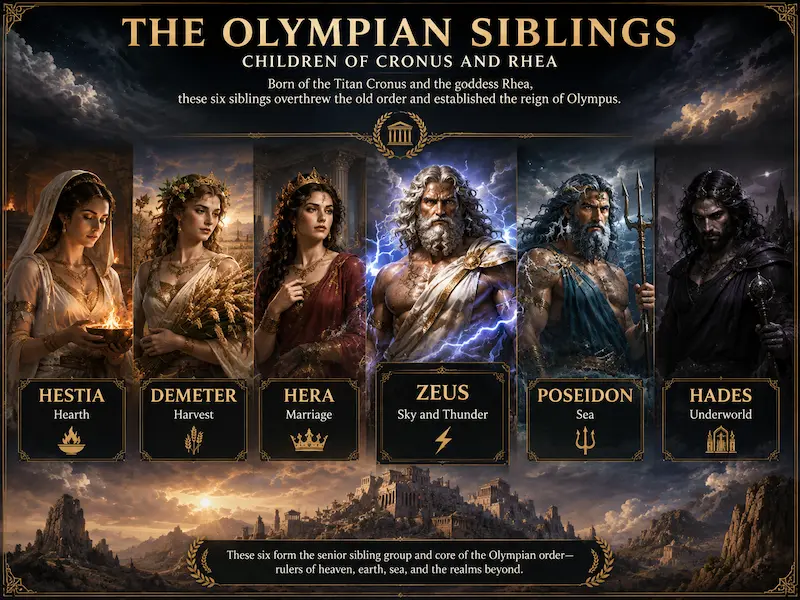
Zeus, Poseidon, Hades, Hera, Demeter, and Hestia all belong to one sibling generation, the children of Cronus and Rhea. Hades belongs to the same generation but rules the Underworld rather than Mount Olympus. Most of the younger Olympian branches shown here descend through Zeus.
The branches below are the ones readers usually need in order to make sense of a chart.
Zeus and Hera
Zeus and Hera are brother and sister, and they are also husband and wife. Both are children of Cronus and Rhea, so their marriage joins two members of the same sibling group rather than linking two separate lines.
The children most commonly attributed to Zeus and Hera together are Ares, Hebe, and Eileithyia. Hephaestus needs to be handled more carefully. Some ancient sources make him the son of Zeus and Hera, while others, including Hesiod, present Hera as producing him alone without a father. Charts differ on this point for that reason, and neither placement is a mistake.
Zeus and His Major Children
Zeus is the busiest node in the entire tree. His children come from several different mothers, which is why a Greek gods family tree tends to widen sharply at this level.
| Child | Mother | Relationship |
|---|---|---|
| Athena | Metis | Daughter of Zeus |
| Apollo | Leto | Son of Zeus |
| Artemis | Leto | Daughter of Zeus |
| Ares | Hera | Son of Zeus |
| Hermes | Maia | Son of Zeus |
| Dionysus | Semele | Son of Zeus |
| Persephone | Demeter | Daughter of Zeus in common genealogies |
Apollo and Artemis are twins, both children of Zeus and the Titaness Leto. Athena’s mother is Metis, although the best-known version of her birth has Athena emerging from the head of Zeus rather than being born in the ordinary way. Hermes is the son of Zeus and Maia, one of the Pleiades. Dionysus is the son of Zeus and the mortal woman Semele, which makes him the only major Olympian with a human parent.
Poseidon
Poseidon is a son of Cronus and Rhea and therefore a brother of Zeus, Hades, Hera, Demeter, and Hestia. In the tree he sits on the same level as Zeus rather than below him, a detail that is easy to get wrong because Zeus is so often shown at the top of simplified charts.
Poseidon has a large number of descendants across Greek myth, but very few of them are needed to read the main family tree, so most charts leave that branch closed.
Demeter and Persephone
Demeter is a sister of Zeus and one of the six children of Cronus and Rhea. Persephone is her daughter, and in the most widely repeated genealogy her father is Zeus.
That places Persephone one generation below the sibling group, with a mother and a father who are themselves brother and sister. She then connects across to the Underworld branch through her marriage to Hades.
Hades
Hades is a son of Cronus and Rhea and a brother of Zeus and Poseidon. He is the husband of Persephone, which makes him both her uncle and her spouse in the standard genealogy.
In terms of the family tree, Hades is straightforward. He belongs to the sibling generation and does not extend the line further, since he and Persephone have no children in the mainstream tradition.
Zeus’s Family Tree
Zeus connects the Titan generation to most of the best-known Olympian gods, which is exactly why his section of the chart is the hardest to read. The table below reorganizes the same information by partner instead of by child, which is usually the faster way to scan it.
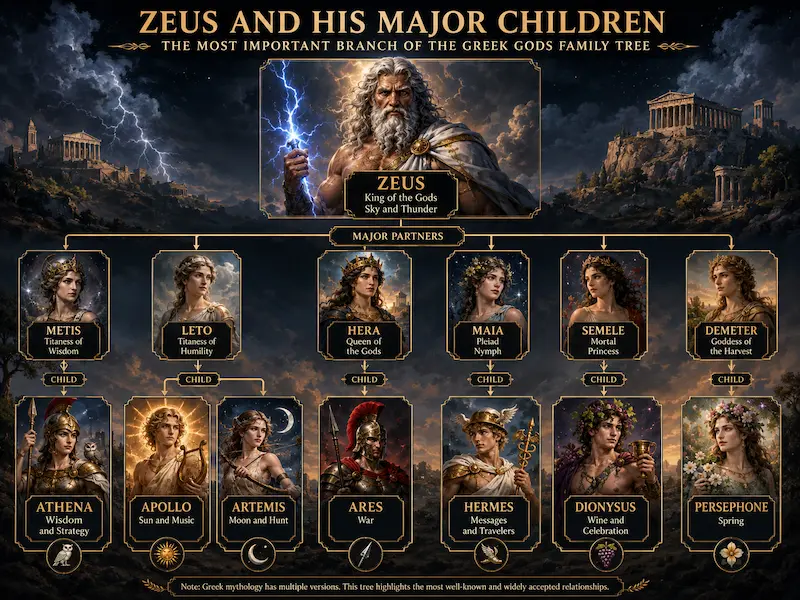
| Partner of Zeus | Who she is | Children in the main tree |
|---|---|---|
| Hera | Sister and wife of Zeus | Ares, Hebe, Eileithyia |
| Metis | An Oceanid, daughter of Oceanus | Athena |
| Leto | Titaness, daughter of Coeus and Phoebe | Apollo, Artemis |
| Maia | One of the Pleiades | Hermes |
| Semele | Mortal princess of Thebes | Dionysus |
| Demeter | Sister of Zeus | Persephone |
Ancient tradition credits Zeus with far more partners and children than these six lines, including many heroes and local founding figures. The purpose of a family tree is not to capture all of them. It is to show how the main Greek gods connect to one another, and these branches do that.
Quick Guide to the Main Greek Gods and Their Parents
This table is the fastest lookup for the question most people arrive with. For domains, symbols, and Roman equivalents rather than parentage, see the wider guide to Greek mythology gods.
| God | Father | Mother |
|---|---|---|
| Zeus | Cronus | Rhea |
| Hera | Cronus | Rhea |
| Poseidon | Cronus | Rhea |
| Hades | Cronus | Rhea |
| Demeter | Cronus | Rhea |
| Hestia | Cronus | Rhea |
| Athena | Zeus | Metis |
| Apollo | Zeus | Leto |
| Artemis | Zeus | Leto |
| Ares | Zeus | Hera |
| Hermes | Zeus | Maia |
| Dionysus | Zeus | Semele |
| Persephone | Zeus | Demeter |
Why Greek Mythology Family Trees Can Differ
If you compare two charts and find they disagree, neither one is necessarily wrong. Greek mythology has no single canonical genealogy. There was no central religious authority, no fixed scripture, and no editorial process that reconciled competing accounts, which is one reason Greek mythology is better understood as a living tradition than as a closed canon.
Ancient writers and local cults preserved different parentage for the same figures, often because a city wanted a particular god attached to its own founding story. Hesiod’s Theogony is the most influential single source for divine genealogy and the backbone of many modern charts, but Homer, the Homeric Hymns, later mythographers, and regional traditions all record variations. Once those variants are included, the family tree expands very quickly.
Hephaestus is the clearest example. Depending on the source he is the son of Zeus and Hera, or the son of Hera alone. Aphrodite is another: Hesiod has her born from the sea after the overthrow of Uranus, which makes her older than the Olympians, while Homer simply calls her the daughter of Zeus and Dione. This guide uses the relationships that are most widely attested and most useful for reading a chart.
Greek Mythology Family Tree FAQs
Who is at the top of the Greek mythology family tree?
Chaos is normally placed at the very top, following Hesiod’s Theogony, where it is the first thing to come into being. Gaia, the Earth, appears immediately below and is the figure the rest of the tree actually descends from. Other primordial beings such as Nyx, Erebus, and Tartarus belong to the same earliest layer but sit on side branches.
Who are Zeus’s parents?
Zeus is the son of the Titans Cronus and Rhea. Cronus swallowed each of his children at birth to prevent a prophesied overthrow, so Rhea hid the newborn Zeus and gave Cronus a stone instead. Zeus later forced his father to release the others, who became his fellow Olympians.
Are Zeus, Poseidon, and Hades brothers?
Yes. All three are sons of Cronus and Rhea, which also makes them brothers of Hera, Demeter, and Hestia. After defeating the Titans they divided the cosmos between them, with Zeus taking the sky, Poseidon the sea, and Hades the Underworld. They belong to the same level of the family tree, not to different generations.
Who are the main children of Zeus?
The children of Zeus most often shown on a family tree are Athena, Apollo, Artemis, Ares, Hermes, and Dionysus, with Persephone and Hebe also appearing on fuller charts. Ancient tradition credits Zeus with many more descendants, including heroes such as Heracles and Perseus, and the exact list varies between sources.
Why are there different Greek gods family trees?
Because different ancient sources preserved different genealogies. Greek religion had no fixed canon, and local traditions frequently assigned different parents to the same deity. Hesiod is the most influential authority, but Homer and later writers often disagree with him, so any chart is a reasonable summary rather than an official record.
Conclusion
The Greek mythology family tree becomes manageable once you read it as three generations rather than one long list of names. The Primordial Gods come first, the Titans follow, and the Olympians take over from there.
Three nodes carry almost all the weight. Gaia links the primordial layer to the Titans, Cronus and Rhea produce the six senior Olympians, and Zeus connects that sibling group to the younger gods most people recognize.

About the Author
Dana Whitfield
I write about numerology, astrology, mythology, tarot, and world mystical traditions for Mystivora, drawing on years of independent research across comparative religion and symbolic systems. I approach each topic by cross-checking primary texts and established scholarship rather than repeating popular but unverified claims.