Kabbalah symbols are the diagrams, Hebrew letters, numbers, Divine Names, and symbolic images that Jewish mysticism uses to express ideas about God, creation, the human soul, and spiritual growth — concepts considered too vast to describe through plain, literal statements.
The best-known of these is the Tree of Life, a diagram of ten interconnected circles that has become almost synonymous with Kabbalah in popular culture. But the Tree of Life is only one part of a much larger symbolic system that includes Hebrew letters, sacred numbers, Divine Names, and concepts like the Four Worlds and the Shekhinah (divine presence).
Many lists found online blend authentic Jewish Kabbalah with general Jewish symbols, ceremonial magic, Hermetic Qabalah, and New Age sacred geometry, often without distinguishing between them. This article explains the major Kabbalah symbols and meanings — what each one represents, and just as importantly, where it actually comes from.
What Are Kabbalah Symbols?
Kabbalah symbols are not simply decorative images chosen for their appearance. They function as tools for expressing ideas that resist direct description. Depending on context, a Kabbalah symbol might be:
- A visual diagram, such as the Tree of Life.
- A Hebrew letter, valued for its shape, sound, and numerical worth.
- A Divine Name, treated with particular reverence.
- A number or numerical relationship.
- A scriptural image, such as Ezekiel’s vision of a chariot.
- A symbolic structure describing how the divine “emanates” into the created world.
Within Kabbalistic thought, symbols serve several overlapping purposes. They represent concepts, such as the infinite nature of God, that cannot be described in ordinary literal language. They map the relationship between an infinite divine source and a finite, created world. They support study, interpretation, prayer, and meditation. And they help explore parallels that some Kabbalists draw between the structure of the universe and the structure of the human soul.
Why Kabbalah Uses Symbolic Language
Kabbalistic literature often begins from the premise that Ein Sof, the infinite divine reality, is beyond complete human comprehension. If God cannot be fully described, Kabbalists reasoned, then divine attributes and processes can only be approached indirectly, through symbol, metaphor, and structured diagram.
This is part of why a single symbol in Kabbalah rarely has just one fixed meaning. A Sefirah (a term explained in detail below), a Hebrew letter, or a number may be read on several levels at once, depending on the text, the school of thought, and the context in which it appears. Readers new to the subject should expect layered interpretation rather than a single dictionary-style definition for each symbol.
Kabbalah, Cabala, and Qabalah Are Not Identical
The words “Kabbalah,” “Cabala,” and “Qabalah” are sometimes used interchangeably online, but they refer to related yet distinct traditions:
- Jewish Kabbalah refers to the Jewish mystical and interpretive traditions that developed primarily from the medieval period onward, building on earlier Jewish mystical currents.
- Christian Cabala refers to Christian adaptations of Kabbalistic ideas, developed mainly during the Renaissance, which reinterpreted Jewish concepts through a Christian theological lens.
- Hermetic Qabalah is a Western esoteric system that combines the Tree of Life with astrology, tarot, alchemy, and ceremonial magic, largely developed from the nineteenth century onward by groups such as the Hermetic Order of the Golden Dawn.
- Modern or New Age Kabbalah describes simplified or syncretic interpretations, often popularized through books, workshops, or celebrity interest, that may differ significantly from traditional Jewish sources.
This article focuses mainly on the first category while noting, where relevant, how later traditions reinterpreted the same symbols.
Kabbalah Symbols at a Glance
The table below offers a quick summary of major Kabbalah symbols and related Jewish symbols, along with how each is generally classified.
| Symbol or Concept | Hebrew or Traditional Name | Primary Meaning | Classification |
|---|---|---|---|
| Tree of Life | Etz Chaim | Diagram of divine emanation and creation | Core Jewish Kabbalah |
| Sefirot | Sefirot (singular: Sefirah) | Ten divine attributes or channels of creative activity | Core Jewish Kabbalah |
| Hebrew Letters | Otiyot | Building blocks of creation and language | Core Jewish Kabbalah |
| Tetragrammaton | YHVH | The four-letter Divine Name | Core Jewish Kabbalah |
| 72 Names of God | Shem HaMephorash | 72 three-letter Divine Name combinations | Core Jewish Kabbalah |
| Ein Sof | Ein Sof | The infinite, boundless divine reality | Core Jewish Kabbalah |
| Shekhinah | Shechinah | Indwelling divine presence | Core Jewish Kabbalah |
| Adam Kadmon | Adam Kadmon | Primordial human, an early configuration of emanation | Core Jewish Kabbalah |
| Four Worlds | Atzilut, Beriah, Yetzirah, Assiah | Symbolic levels of existence | Core Jewish Kabbalah |
| Merkabah | Merkabah | Divine chariot; early mystical ascent tradition | Pre-Kabbalistic Jewish mysticism |
| Star of David | Magen David | Jewish identity symbol; some Kabbalistic readings | Jewish symbol with Kabbalistic interpretations |
| Hamsa | Hamsa | Hand-shaped protective symbol | Jewish symbol with Kabbalistic interpretations (shared across cultures) |
| Chai | Chai | “Life”; numerical value of 18 | Jewish symbol with Kabbalistic interpretations |
| Menorah | Menorah | Seven-branched Temple lampstand | Jewish symbol with Kabbalistic interpretations |
| Mezuzah | Mezuzah | Parchment scroll on the doorway | Jewish symbol with Kabbalistic interpretations |
| Red String | Chut Hashani | Folk protection from the “evil eye” | Later or modern association |
The Tree of Life: The Central Symbol of Kabbalah
If someone asks what the main symbol of Kabbalah is, the Tree of Life is the most widely recognized answer. Because of its centrality, it deserves closer attention than any other single symbol covered here.
What the Tree of Life Represents
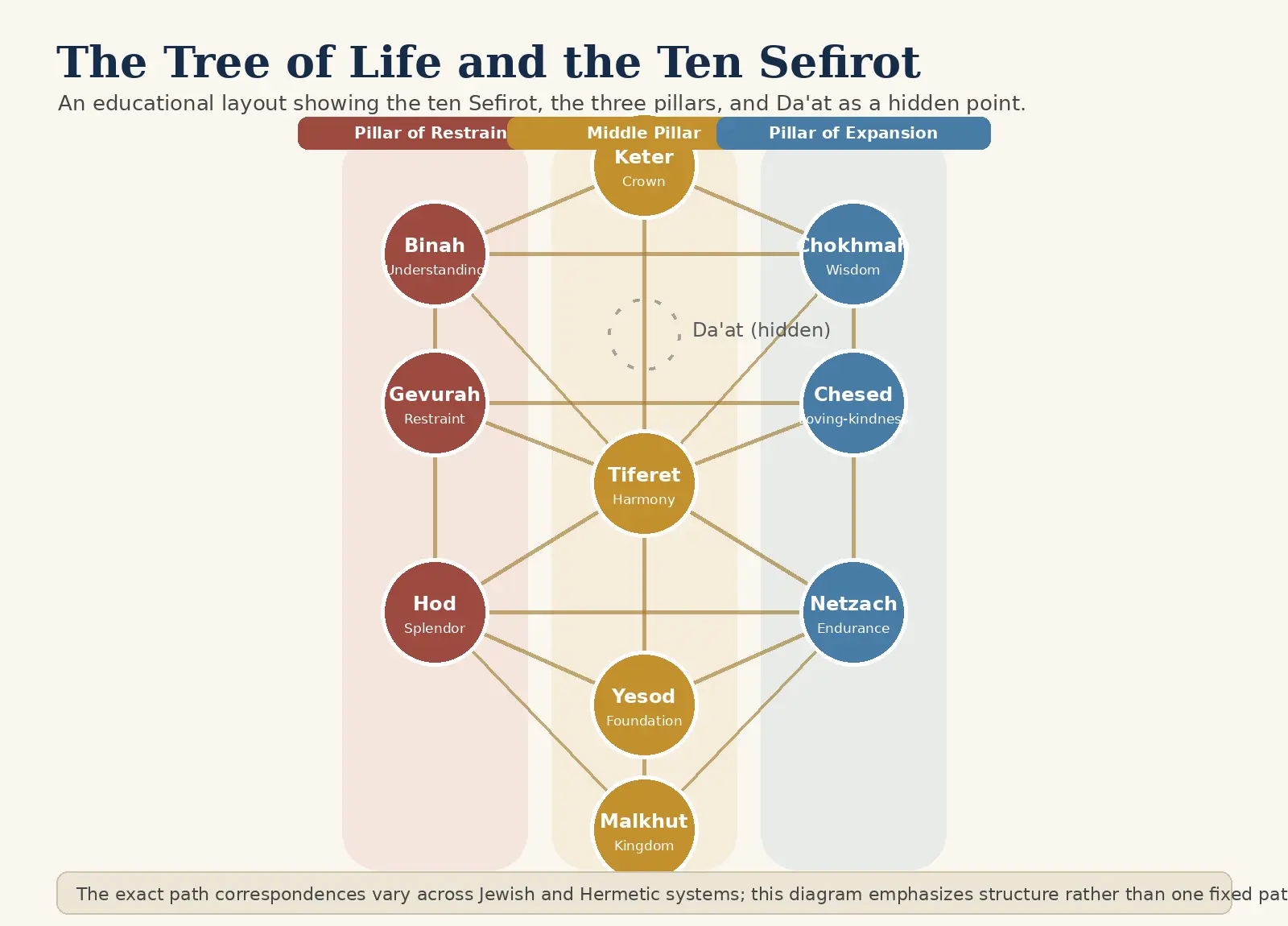
The Tree of Life, often called Etz Chaim in Hebrew, is not a picture of a literal botanical tree. It is a structured diagram, usually shown as ten circles connected by lines, that Kabbalists use to represent several related ideas at once:
- A symbolic map of how the divine “emanates” or unfolds from an infinite, unknowable source into a structured, knowable system.
- A model of creation, describing how the universe came into being in stages.
- A structure representing aspects of the human soul and human character.
- A framework for spiritual and ethical development, since a person can be understood as needing to balance the qualities represented on the Tree.
- A way of examining how unity becomes multiplicity, tracing the movement from the singular divine source toward the diversity of the created world.
Different Kabbalistic schools and different eras have emphasized different aspects of the Tree of Life, and there is no single universally agreed-upon interpretation accepted by every Kabbalist or Jewish community.
The Ten Sefirot and Their Meanings
The ten circles on the Tree of Life are called the Sefirot (singular: Sefirah). They are commonly understood as ten attributes, channels, qualities, or modes through which divine creative activity becomes expressed in progressively more defined and tangible form. They are not simply personality types or “energy centers” in the way some modern self-help interpretations suggest; in traditional sources they are treated as a serious theological and philosophical structure.
| # | Sefirah | Literal Translation | Main Symbolic Meaning | General Role in the Tree |
|---|---|---|---|---|
| 1 | Keter | Crown | The first, most concealed point of divine will, closest to Ein Sof | Sits at the top of the Tree, representing the origin of the emanation process |
| 2 | Chokhmah | Wisdom | Raw, undifferentiated creative insight or flash of idea | Begins the right pillar; associated with the initial spark of an idea before it takes form |
| 3 | Binah | Understanding | The capacity to analyze, structure, and give form to an idea | Begins the left pillar; often described as giving “shape” to the wisdom of Chokhmah |
| 4 | Chesed | Loving-kindness | Expansive giving, generosity, and unconditional love | Continues the right pillar; associated with outward, unrestrained giving |
| 5 | Gevurah | Strength, restraint, or judgment | The capacity to limit, discipline, and evaluate | Continues the left pillar; balances Chesed by introducing boundaries |
| 6 | Tiferet | Beauty, harmony, or compassion | The integration of giving and restraint into balanced beauty | Sits on the central pillar, often seen as harmonizing the qualities above it |
| 7 | Netzach | Endurance or victory | Persistence, ambition, and the drive to carry ideas forward | Continues the right pillar in the lower half of the Tree |
| 8 | Hod | Splendor or acknowledgment | Humility, communication, and structured expression | Continues the left pillar in the lower half of the Tree |
| 9 | Yesod | Foundation | The gathering point that channels higher qualities toward manifestation | Sits on the central pillar, just above the final Sefirah |
| 10 | Malkhut | Kingdom or sovereignty | The tangible, manifest world; the point of reception | Sits at the base of the Tree, representing the created world itself |
Traditional sources generally caution against treating this table as a complete or final account. Different Kabbalistic texts describe the relationships between the Sefirot with varying emphasis, and some communities focus more on ethical or psychological readings while others emphasize cosmological or linguistic ones.
What Is Da’at?
Da’at means “knowledge” in Hebrew. It appears in some, but not all, versions of the Tree of Life diagram, usually placed in the empty space between Chokhmah, Binah, and Tiferet.
Da’at is not normally counted as an eleventh permanent Sefirah in the way that the ten listed above are counted. Instead, it is often described as representing the point where Chokhmah and Binah combine into applied knowledge, or as a kind of “hidden” Sefirah that becomes visible only under certain conditions. Its treatment varies considerably between Kabbalistic systems, which is why readers may encounter Tree of Life diagrams showing either ten or eleven visible circles.
The Three Pillars of the Tree of Life
The ten Sefirot are traditionally arranged into three vertical columns, or pillars:
- The right pillar, containing Chokhmah, Chesed, and Netzach, is commonly associated with expansion, mercy, or giving.
- The left pillar, containing Binah, Gevurah, and Hod, is commonly associated with restraint, severity, or judgment.
- The central pillar, containing Keter, Tiferet, Yesod, and Malkhut, represents balance, integration, or harmony between the other two.
It is a common misreading to treat the right pillar as simply “good” and the left pillar as simply “bad.” In most traditional interpretations, both giving and restraint are considered necessary and valuable; the goal represented by the Tree is balance between them, not the elimination of one side.
The 22 Paths and Hebrew Letters
Later Tree of Life diagrams often display 22 connecting paths, corresponding broadly to the 22 letters of the Hebrew alphabet. Sefer Yetzirah describes 32 Paths of Wisdom as the ten Sefirot together with the 22 foundational letters, although the placement of individual letters on specific connecting paths varies among later Jewish and Hermetic systems.
The exact correspondences between specific paths and specific Hebrew letters differ between traditional Jewish sources and later Hermetic Qabalah, particularly in how the letters are matched to tarot cards, a practice associated with Western esotericism rather than historical Jewish Kabbalah.
Reading the Tree of Life in Two Directions
The Tree of Life is often described as being readable in two directions:
- Downward movement, from Keter toward Malkhut, is generally used to symbolize emanation, creation, or the process by which the divine becomes progressively more manifest and tangible.
- Upward movement, from Malkhut toward Keter, is generally used to symbolize contemplation, ethical refinement, or a process of spiritual “return” toward the source.
These directions are best understood as interpretive frameworks describing conceptual or spiritual processes, rather than as descriptions of literal physical movement.
Core Kabbalistic Symbols and Concepts
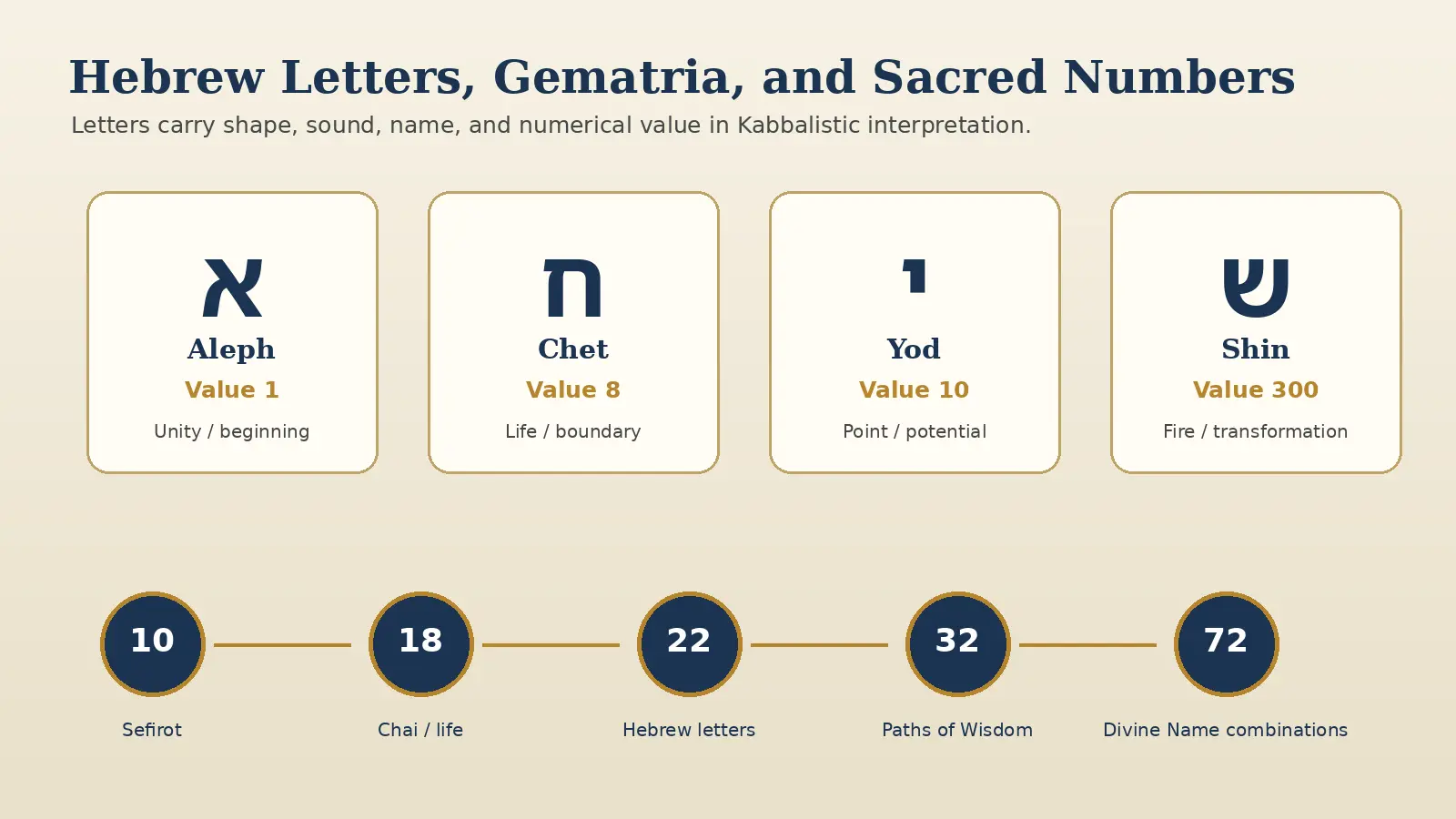
Hebrew Letters
In Kabbalistic thought, Hebrew letters are treated as more than ordinary written characters used to record language. Each letter is associated with a sound, a specific shape, a name, and a numerical value (a system discussed further under Gematria below).
The early mystical text Sefer Yetzirah associates the Hebrew letters directly with the process of creation, describing the universe as having been formed, in part, through combinations of letters. For example, the letter Aleph is often treated as representing unity or the number one; Yod, the smallest letter, is sometimes associated with a concentrated point of potential; and Shin is often connected with fire or transformation in certain interpretive traditions.
It is worth being cautious here: traditional sources treat these letters as objects of serious study, contemplation, and, in some practices, meditation. They are not generally presented as symbols that produce automatic supernatural effects simply by being viewed or written.
The Tetragrammaton
The Tetragrammaton is the four-letter Divine Name written with the Hebrew letters Yod, He, Vav, and He (YHVH). It is treated as the most sacred of the Divine Names in Jewish tradition, and out of reverence, many Jewish communities do not pronounce it aloud, using substitute terms instead.
In Kabbalistic interpretation, the four letters of the Tetragrammaton are sometimes connected symbolically with the Four Worlds (discussed below) or with different stages or attributes of divine manifestation. Given its sacred status, the Tetragrammaton should not be treated casually as a decorative motif or as a formula for ritual invocation; traditional sources generally surround its use with significant reverence and restriction.
The 72 Names of God
The phrase “72 Names of God” commonly refers, in Kabbalistic interpretation, to 72 three-letter combinations derived from three verses in Exodus 14:19–21. This is not simply a list of 72 ordinary personal names for God in the way the phrase might initially suggest to a general reader.
These letter combinations have been used historically in prayer, meditation, and amulet-making within some Kabbalistic and folk-religious contexts, though practices and interpretations vary considerably between communities and eras. Some modern commercial sources present the 72 Names as a guaranteed system for protection, healing, or manifestation. Traditional and scholarly sources are considerably more cautious, treating them as contemplative and symbolic tools rather than as a mechanism with proven supernatural effects.
Ein Sof
Ein Sof translates roughly as “without end” or “the infinite.” It refers to the boundless divine reality that, according to Kabbalistic thought, exists prior to and beyond any specific attributes, description, or form.
Ein Sof is sometimes depicted in diagrams as a boundary or field surrounding or preceding the Tree of Life, but it is more accurately understood as a theological concept than as a standalone graphic symbol in its own right. Its central role is to explain why the emanation of the Sefirot is necessary in the first place: a fully unknowable, infinite source requires an intermediary structure through which it can be symbolically approached.
Shekhinah
Shekhinah refers to the indwelling or manifest presence of the divine within the world, as distinct from the transcendent, unknowable aspect represented by Ein Sof. Some Kabbalistic interpretations associate the Shekhinah with the Sefirah of Malkhut, the final and most tangible point on the Tree of Life.
The Shekhinah is sometimes described using feminine imagery or grammatical gender in Hebrew and Kabbalistic literature. It should not, however, be understood as a literal separate goddess or a second deity; within Jewish theology, the Shekhinah is generally treated as an aspect or expression of the one God rather than an independent divine being.
Adam Kadmon
Adam Kadmon means “primordial” or “archetypal human.” In Lurianic Kabbalah, a system associated with the 16th-century teacher Isaac Luria, Adam Kadmon represents one of the earliest configurations of divine emanation, prior to the full development of the Sefirot as commonly diagrammed.
Adam Kadmon should not be confused directly with the biblical Adam described as an individual historical person in the Book of Genesis. Instead, the concept relates to the idea, found in various Kabbalistic sources, that the human form can be understood as reflecting or corresponding to a larger cosmic structure of divine emanation.
The Four Worlds
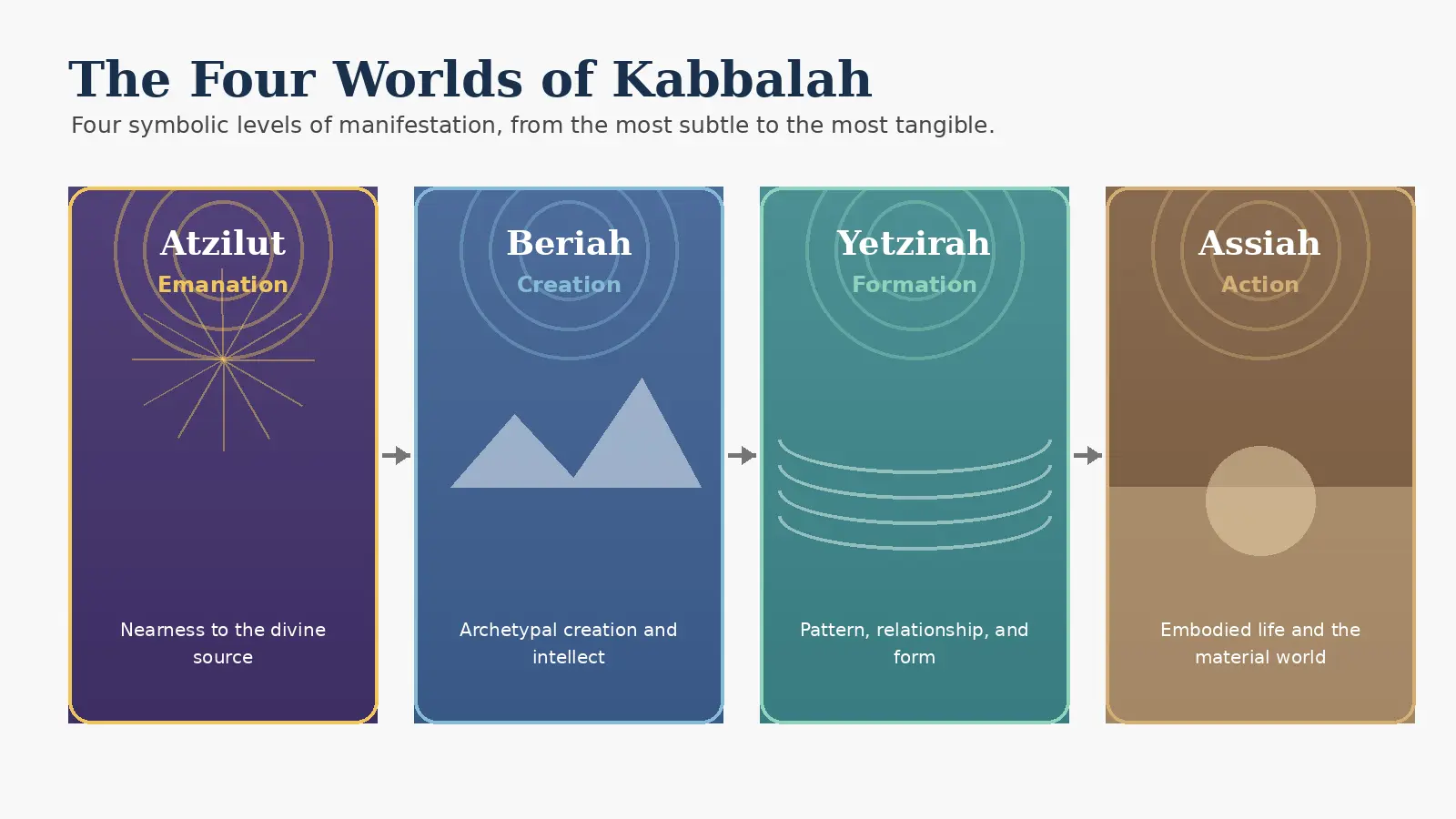
Kabbalistic literature, particularly from the Lurianic period onward, commonly describes existence as unfolding across four symbolic “worlds”:
- Atzilut — Emanation.
- Beriah — Creation.
- Yetzirah — Formation.
- Assiah — Action.
These are best understood as symbolic levels or modes of existence, moving from the most subtle and divine to the most tangible and physical, rather than as four separate physical locations. Different Kabbalistic sources describe the relationships between the Four Worlds somewhat differently, and some traditions connect each world with one of the four letters of the Tetragrammaton.
Merkabah
Merkabah means “chariot.” The term originates from the vision described in the Book of Ezekiel, in which the prophet describes a chariot-like divine throne accompanied by extraordinary celestial imagery. This vision became the foundation for an early stream of Jewish mysticism, generally referred to as Merkabah mysticism, that predates the medieval Kabbalistic tradition centered on the Tree of Life.
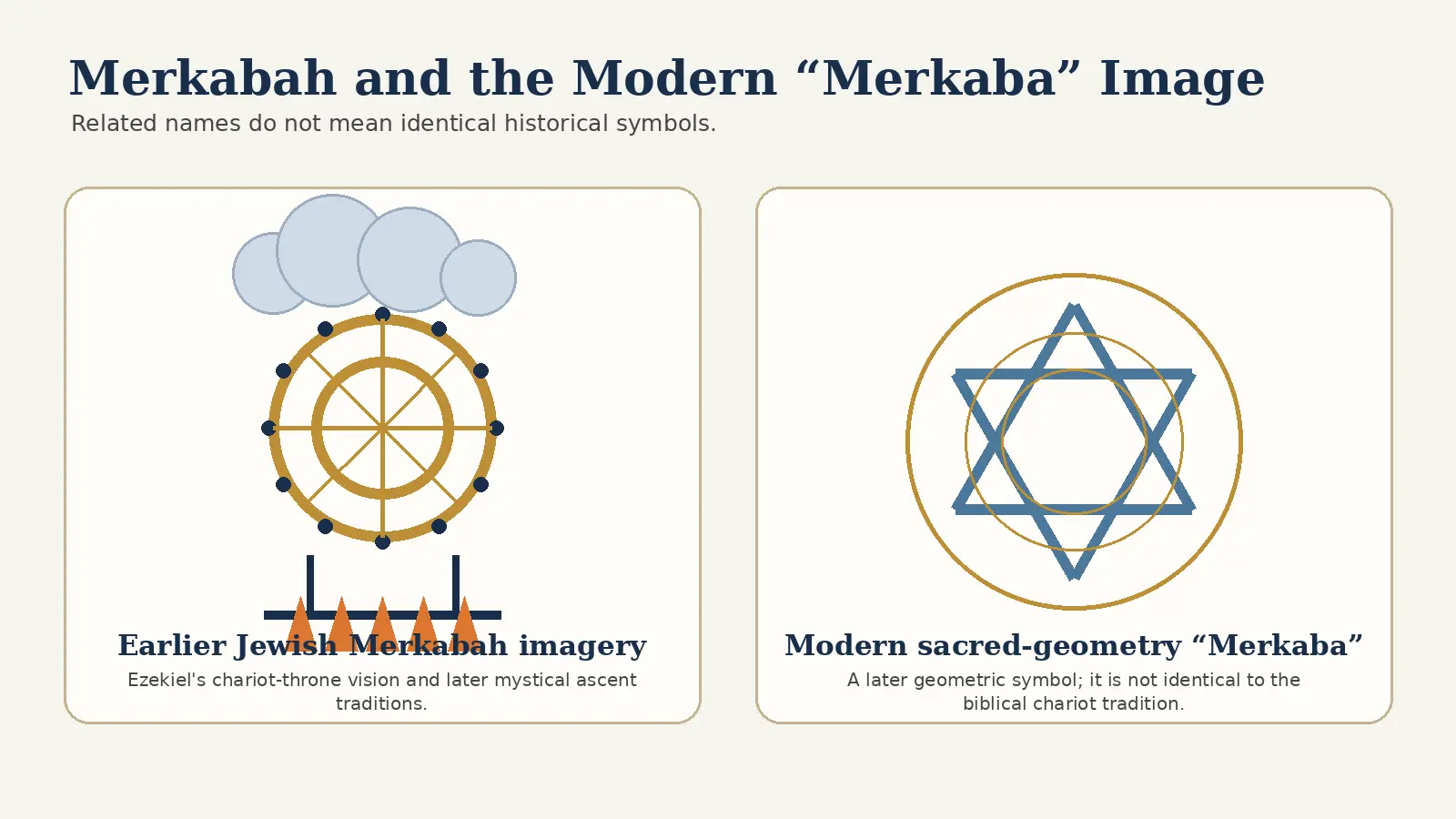
It is worth distinguishing this traditional concept clearly from a modern image, often spelled “Merkaba,” depicting two interlocking tetrahedrons forming a star shape. This geometric figure is a product of modern sacred-geometry and New Age traditions, and it is not identical to, nor does it have a direct historical connection with, the biblical or early Jewish Merkabah concept described above.
Jewish Symbols with Kabbalistic Meanings
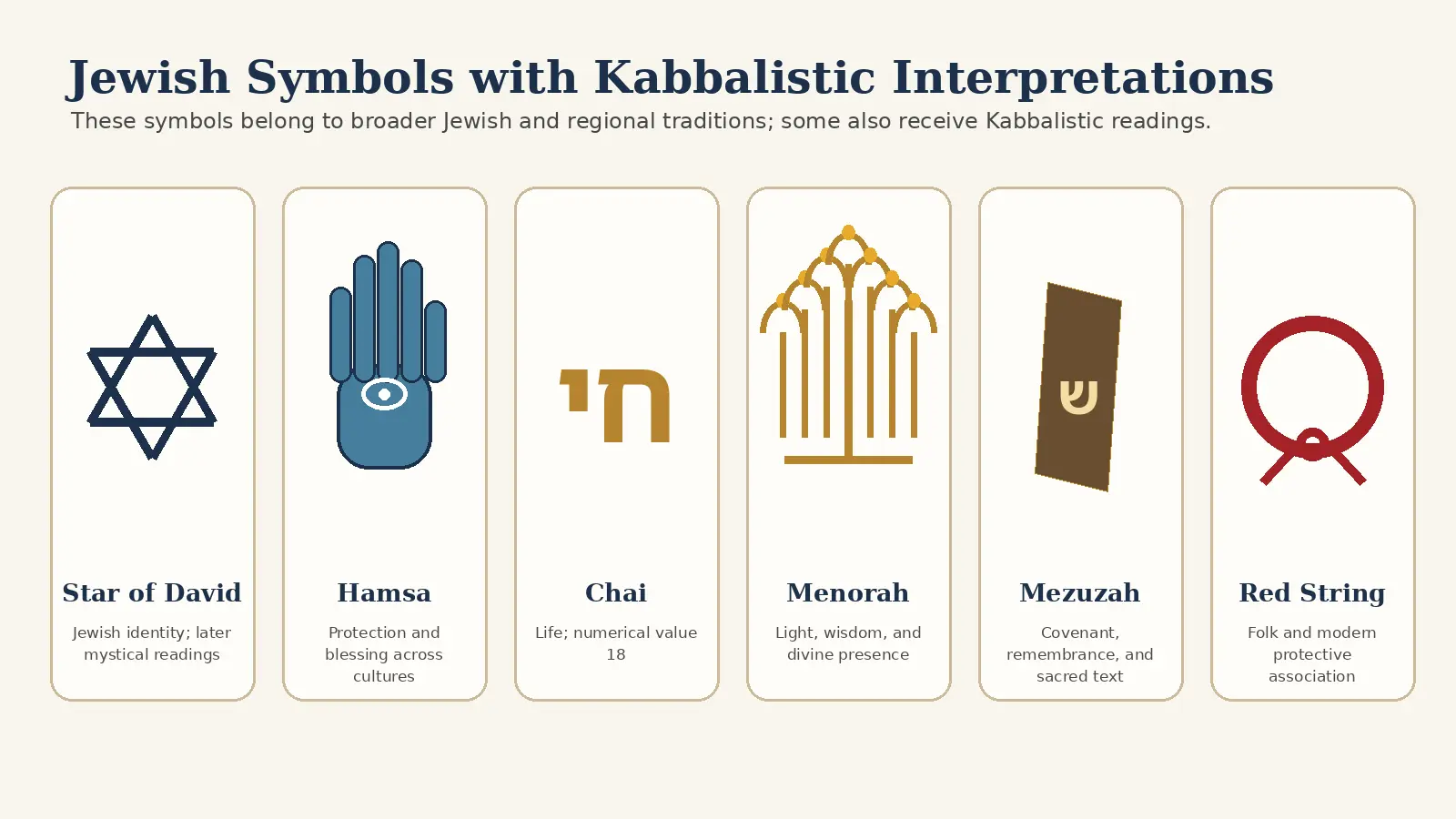
The symbols in this section are important within Judaism more broadly, across many communities and historical periods. Some of them have acquired Kabbalistic interpretations over time, but they should not be described as symbols that originated specifically within Kabbalah.
Star of David — Magen David
The Star of David, or Magen David, consists of two overlapping triangles forming a six-pointed star. Its use as a widely recognized symbol of Jewish identity developed gradually over history and became especially prominent from the modern era onward, including its adoption on the flag of the State of Israel.
In some Kabbalistic interpretations, the two triangles are read as representing the union of heaven and earth, spiritual and material reality, or the interplay of expansion and restraint discussed earlier in relation to the Tree of Life’s pillars. Others connect the six points with the six directions surrounding a central point. These are Kabbalistic readings applied to an existing symbol rather than the symbol’s sole or original historical meaning, and not every traditional explanation of the Star of David is specifically Kabbalistic in origin.
Hamsa Hand
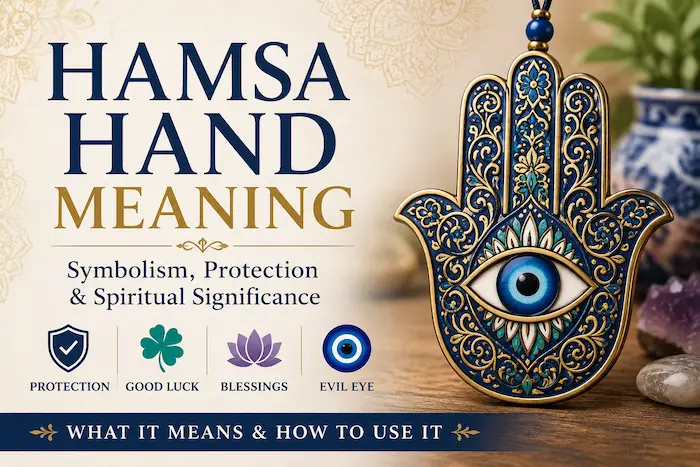
The Hamsa is a hand-shaped symbol, generally shown with the palm facing outward and often with an eye at its center. It appears across Jewish, Islamic, and broader Middle Eastern and North African cultures, and its use predates and extends well beyond Kabbalistic circles specifically.
In some Jewish interpretations, the five fingers of the Hamsa are connected symbolically with the five books of the Torah. The symbol is widely associated with blessing and with protection from the “evil eye,” a folk concept referring to harm believed to result from envious or malicious looks. Because the Hamsa is shared across multiple cultures and religious traditions, it should not be presented as an exclusively Kabbalistic or exclusively Jewish symbol.
Chai Symbol
Chai is a Hebrew word, written with the letters Chet and Yod, meaning “life” or “living.” Its numerical value, following the Hebrew system in which letters double as numbers, is 18.
This numerical association is part of why gifts and charitable donations in some Jewish communities are traditionally given in multiples of 18, as a way of symbolically wishing someone a long life. Chai functions as a broad Jewish symbol of life and vitality, with mystical or numerical layers of interpretation that some Kabbalistic sources have engaged with, rather than as a symbol invented by Kabbalah itself.
Menorah
The seven-branched Menorah, historically used in the ancient Temple in Jerusalem, is associated in Jewish tradition with light, wisdom, creation, and divine presence. Some Kabbalistic interpretations connect its seven branches with particular spiritual qualities or structures.
It is important to distinguish the seven-branched Temple Menorah from the nine-branched lamp used during the festival of Hanukkah, which is sometimes also called a menorah in casual speech but is more precisely referred to as a Hanukkiah. The two objects have different numbers of branches and different ritual functions.
Mezuzah
A Mezuzah is a small parchment scroll, inscribed with specific passages from the Torah, placed inside a case and affixed to the doorway of a Jewish home. The sacred element of a Mezuzah is the handwritten parchment itself, containing the required biblical text, rather than the decorative case that holds it.
The Mezuzah is generally understood as a symbol of covenant, remembrance, and ongoing commitment to Jewish religious commandments. Some Kabbalistic texts additionally discuss protective dimensions associated with the Mezuzah, but traditional sources generally do not present it merely as a decorative good-luck charm; its primary significance is religious and legal rather than superstitious.
The Red String Bracelet
Red string bracelets are associated, in some Jewish folk practices and in modern popular Kabbalah movements, with protection from the “evil eye.” Modern versions of the practice are sometimes connected with Rachel’s Tomb, a traditional Jewish pilgrimage site.
This practice is not considered a central or universally accepted requirement of Jewish Kabbalah, and many traditional Jewish authorities and communities do not treat it as part of mainstream religious practice. As with other protective symbols discussed in this article, there is no scientific basis for treating a red string as providing guaranteed supernatural protection; its significance is best understood as cultural and folk-religious rather than empirically demonstrated.
Gematria and the Symbolism of Numbers
How Gematria Works
Gematria is a method of interpretation based on the fact that Hebrew letters carry numerical values in addition to their use in writing words. Under this system, words or phrases that share the same total numerical value can be compared or connected symbolically.
Kabbalists have used these numerical relationships as one interpretive tool among several, drawing connections between words that share a numeric total as a way of suggesting a conceptual link between them. It is worth being clear that a shared numerical value does not constitute proof that two words share an identical meaning; Gematria functions as a traditional interpretive and homiletical technique rather than as mathematical or scientific evidence of a hidden truth.
Why the Number 18 Represents Life
As mentioned above, the Hebrew letter Chet has a numerical value of 8, and the letter Yod has a numerical value of 10. Together, these two letters form the word Chai, meaning “life,” with a combined value of 18. This numerical relationship is the basis for the cultural practice of giving gifts or donations in multiples of 18 within many Jewish communities.
The Meaning of 10, 22, 32, and 72
Several numbers recur throughout Kabbalistic symbolism, and they are best understood as parts of interconnected systems rather than as isolated “lucky” or “angel” numbers:
- 10 corresponds to the ten Sefirot on the Tree of Life.
- 22 corresponds to the 22 letters of the Hebrew alphabet, also associated with the paths connecting the Sefirot.
- 32 corresponds to the “32 Paths of Wisdom,” combining the ten Sefirot with the 22 letters/paths.
- 72 corresponds to the 72 three-letter combinations known as the 72 Names of God.
Understanding these numbers in relation to one another, rather than in isolation, helps clarify why Kabbalistic literature returns to them so consistently.
Symbols Commonly Mistaken for Traditional Kabbalah Symbols
Modern websites, jewelry retailers, and spirituality blogs frequently group a wide range of symbols under the “Kabbalah” label, even when those symbols come from entirely different traditions or were developed much later. The following are among the most commonly misattributed.
Metatron’s Cube
Metatron is a figure who appears in various Jewish mystical, angelological, and later esoteric texts. However, the specific geometric image now popularly called “Metatron’s Cube,” typically composed of circles connected by straight lines forming multiple overlapping shapes, is primarily a product of modern sacred-geometry movements and Western esoteric traditions. It should not be presented, without qualification, as an ancient or central symbol of traditional Jewish Kabbalah.
The Ankh
The Ankh is an ancient Egyptian symbol associated with life and immortality, and it is also one of many ancient symbols of power that later appeared in modern esoteric systems. It does not originate as a traditional Kabbalah symbol and has no direct historical connection to Jewish Kabbalistic sources.
Chakras and the Flower of Life
Chakras originate in South Asian religious and philosophical traditions, particularly within Hindu and later yogic systems. The Flower of Life, a geometric pattern of overlapping circles, is commonly associated with modern sacred-geometry movements rather than with historical Jewish or Hermetic sources. Their appearance alongside Kabbalistic diagrams in some modern spiritual contexts is generally the result of later syncretism, blending multiple traditions together, rather than a reflection of historical Kabbalistic origin.
Tarot and Astrological Symbols
Extensive correspondence systems linking tarot cards, astrological signs, and the paths of the Tree of Life are especially prominent within Hermetic Qabalah, largely developed from the nineteenth century onward. These correspondences should not be automatically attributed to traditional Jewish Kabbalah. Some historical Jewish Kabbalistic texts do discuss astrology in certain contexts, but this is distinct from the comprehensive, standardized correspondence systems used in modern Western ceremonial magic and tarot practice.
How Kabbalah Symbols Are Used
Study and Interpretation
Kabbalistic symbols function, in large part, as organizing tools for complex theological, philosophical, and ethical ideas. Diagrams like the Tree of Life allow students to visualize relationships between abstract concepts, such as the relationship between divine giving and divine restraint, in a structured and memorable form.
Prayer and Contemplation
Certain Hebrew letters, Divine Names, and symbolic structures are used within contemplative and meditative traditions associated with Kabbalah. Practices differ considerably between communities and schools of thought, and traditional sources often describe certain advanced practices as requiring substantial prior knowledge, preparation, and guidance from a qualified teacher rather than being suitable for casual or unsupervised use.
Amulets, Jewelry, and Home Decoration
Common Kabbalistic and Jewish motifs used in amulets, jewelry, and home decoration include the Hamsa, the Tree of Life, the Chai symbol, red string, Divine Names, and inscribed Hebrew verses. Some people wear or display these symbols as expressions of religious identity or personal faith, while others associate them with blessing or protection. It is worth noting that commercial products sometimes simplify these symbols or remove them from their original religious and historical context.
Tattoos and Cultural Considerations
Hebrew tattoo designs, including those based on Kabbalistic symbols or Divine Names, are frequently misspelled, poorly translated, or accidentally reversed when produced without proper knowledge of the language. Because Divine Names are considered especially sacred within Jewish tradition, many practitioners consider them inappropriate for casual decorative use.
Additionally, traditional Jewish law generally discourages or prohibits tattoos, although individual attitudes and practices vary among Jewish communities and individuals today. Readers considering a Kabbalah-related tattoo design are generally well served by researching the religious and cultural context of a symbol before choosing it.
Which Symbol Best Represents Kabbalah?
The Tree of Life is the most widely recognized visual symbol of Kabbalah, and it is the answer most commonly given to this question in both popular and scholarly sources. The Sefirot form the central structure within that diagram, representing the core framework through which Kabbalistic thought describes divine emanation and human spiritual development.
That said, Hebrew letters, Divine Names such as the Tetragrammaton, and numerical symbolism such as Gematria are equally important to Kabbalistic thought as a whole. The Tree of Life may be the most recognizable single image, but Kabbalah symbolism as a broader system extends well beyond that one diagram.
Frequently Asked Questions About Kabbalah Symbols
Is Kabbalah forbidden in Judaism?
No. Kabbalah is part of the Jewish mystical tradition, not a separate religion forbidden by Judaism. Historically, however, advanced Kabbalistic study was often reserved for mature and well-prepared students with a strong grounding in Torah and Jewish law because its symbolic teachings could be misunderstood. Contemporary Jewish communities differ in how and when they introduce these teachings.
What are the 7 emotions of Kabbalah?
The seven emotional attributes, or lower Sefirot, are Chesed (loving-kindness), Gevurah (restraint or discipline), Tiferet (harmony or compassion), Netzach (endurance), Hod (humility or splendor), Yesod (connection or foundation), and Malkhut (sovereignty or expression). Together, they describe different dimensions of emotional life and how those qualities may be balanced and refined.
What is the symbol for Kabbalah?
The Tree of Life, or Etz Chaim, is the most widely recognized symbol of Kabbalah. It is commonly shown as ten circles, called Sefirot, connected by paths. The diagram represents divine emanation, creation, the structure of the human soul, and processes of spiritual and ethical development.
What are the 4 levels of Kabbalah?
The phrase usually refers to the Four Worlds of Kabbalah: Atzilut (Emanation), Beriah (Creation), Yetzirah (Formation), and Assiah (Action). They represent symbolic stages through which divine creative influence becomes progressively more defined and manifest, rather than four physical locations.
Is the Hamsa specifically a Kabbalah symbol?
No. The Hamsa is a hand-shaped symbol shared across Jewish, Islamic, and broader Middle Eastern and North African cultures. Some Jewish and Kabbalistic interpretations connect its five fingers with the five books of the Torah and associate it with blessing or protection from the evil eye, but it is not an exclusively Kabbalistic symbol.
Conclusion
Kabbalah symbolism forms an interconnected system rather than a random collection of mystical images. At its center are the Tree of Life and its ten Sefirot, alongside Hebrew letters, Divine Names such as the Tetragrammaton and the 72 Names of God, and symbolic numbers explored through Gematria. Together, these Kabbalah symbols and meanings describe a structured way of thinking about divine emanation, creation, and human spiritual development.
Symbols such as the Hamsa, Star of David, Chai, Menorah, and Mezuzah belong to broader Jewish tradition and identity, and while some of them carry Kabbalistic interpretations, they were not created by Kabbalah alone. Meanwhile, images like Metatron’s Cube, the Ankh, chakras, and the Flower of Life, though sometimes marketed alongside Kabbalah symbols, come from separate traditions and later syncretic movements.
Readers exploring Kabbalah symbols are generally better served by considering their historical and religious context directly, rather than relying on simplified commercial or New Age descriptions that flatten centuries of nuanced interpretation into a single, tidy meaning.

About the Author
Dana Whitfield
I write about numerology, astrology, mythology, tarot, and world mystical traditions for Mystivora, drawing on years of independent research across comparative religion and symbolic systems. I approach each topic by cross-checking primary texts and established scholarship rather than repeating popular but unverified claims.
Related Articles
View All Articles →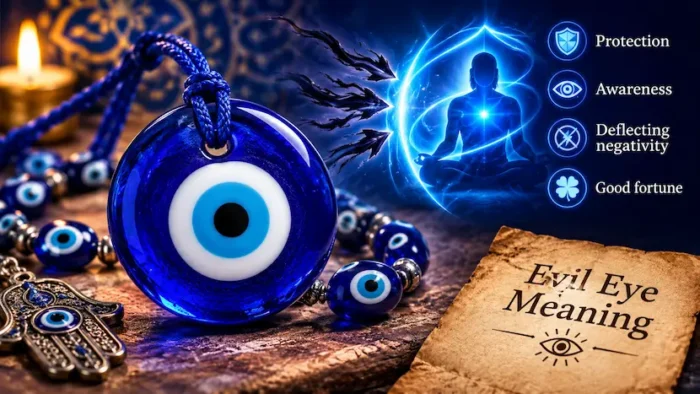 Mysticism