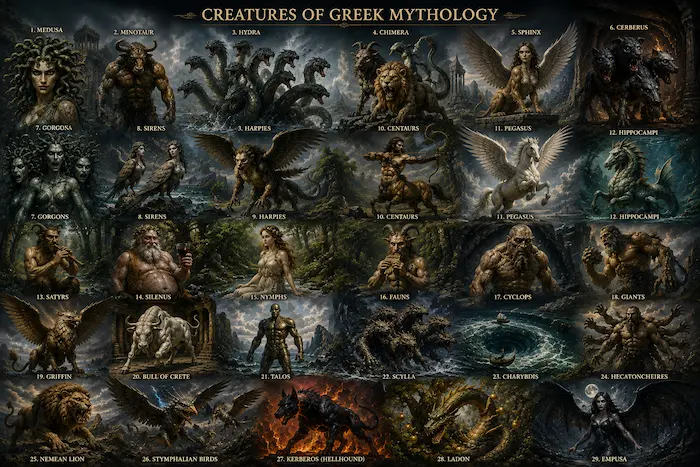
Greek mythology creatures are the monsters, hybrid beings, giants, legendary beasts, and mythical animals that appear throughout the myths of ancient Greece. They include figures such as Medusa, the Minotaur, the Lernaean Hydra, Cerberus, the Centaurs, and Pegasus. Some of the best-known figures in Greek mythology were hostile forces that gods and heroes had to defeat, while others guarded sacred places, served the Olympians, or carried heroes into battle.
This guide walks through the best known creatures in Greek myth, explaining what each one was, how it was commonly described, and the story, god, or hero most closely associated with it.
What Are Greek Mythology Creatures?
“Creature” is a broad modern umbrella term. Ancient Greek writers did not group these beings into a single tidy category, so the label covers a wide range: monsters, hybrid beings that mix human and animal forms, giants, supernatural beings, legendary beasts, and mythical animals.
The Lernaean Hydra is a clear example of a monster, a many-headed serpent best known for its battle with Heracles. A Centaur is a hybrid creature, human above the waist and horse below. Pegasus is a mythical animal, a horse with wings and no monstrous features at all.
Not every creature was evil or hostile. Many exist in the myths specifically as obstacles for heroes, but others helped mortals, served the gods, guarded treasure or sacred ground, or simply appeared as extraordinary animals within a larger story. Chiron the Centaur taught heroes. The Cyclopes of Hesiod’s tradition forged the thunderbolts of Zeus. The Ceryneian Hind belonged to Artemis and was never meant to be harmed at all.
Monsters in Greek Mythology
Most Greek mythology monsters appear in the same handful of roles. They stand as opponents to be defeated, guardians blocking a place or object, punishments sent by an angry god, or trials that prove a hero worthy. The creatures below are the most widely known examples.
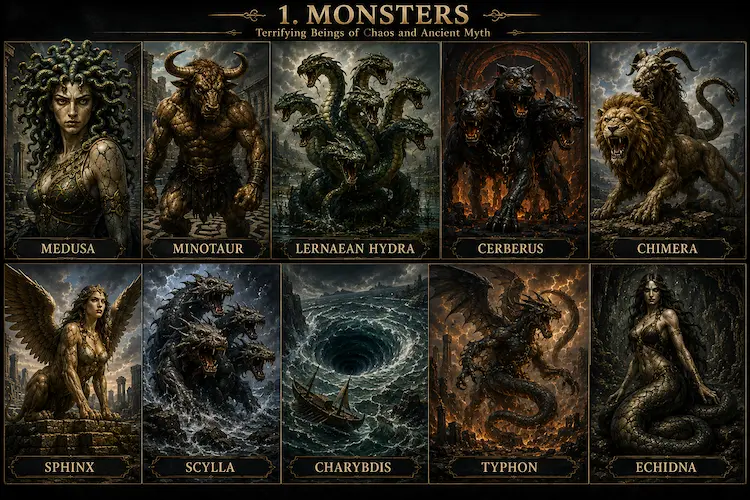
Medusa
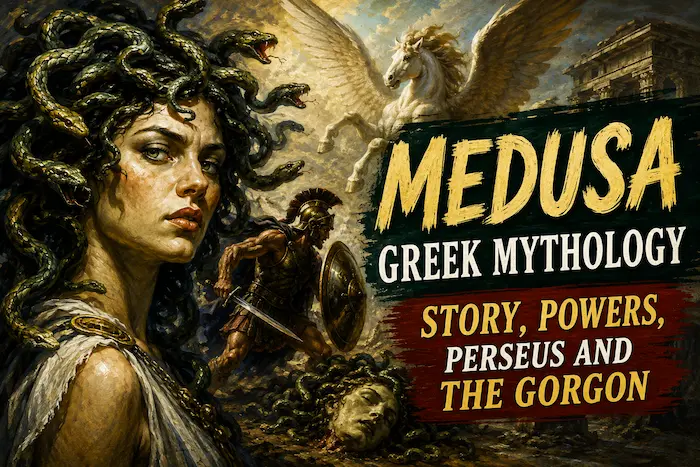
Medusa was one of the three Gorgons, sisters usually described as having snakes for hair and a face so terrible that anyone who met her gaze was turned to stone. Unlike her two sisters, Medusa was mortal, which is why she could be killed.
Her origins vary by source. In Hesiod’s Theogony, she is simply one of three monstrous sisters born to the sea deities Phorcys and Ceto, with no story of transformation attached. A much later account by the Roman poet Ovid describes her instead as a beautiful woman changed into a Gorgon after an incident in a temple of Athena. The second version is widely repeated today, but it should not be treated as the only or the original Greek tradition.
The hero Perseus killed Medusa with divine help. Guided by Athena and equipped with gifts that commonly include winged sandals, a cap of invisibility, a curved blade, and a special pouch for the head, he approached her while she slept and used a polished reflective surface so that he never had to look at her directly. He beheaded her, escaped her surviving sisters, and later used the severed head as a weapon that petrified his enemies. In many accounts he eventually gave the head to Athena, who set it on her aegis.
The Minotaur
The Minotaur was a creature with the body of a man and the head of a bull, kept on the island of Crete during the reign of King Minos. According to the usual tradition he was born to Minos’s wife Pasiphae after she conceived him with a bull sent by Poseidon.
Unable to control or kill the creature, Minos had the craftsman Daedalus build the Labyrinth, a maze so intricate that anyone placed inside could not find the way out. The Minotaur lived at its center and was fed young Athenians sent to Crete as tribute.
Theseus, prince of Athens, volunteered to join one of these groups. Ariadne, the daughter of Minos, fell in love with him and gave him a ball of thread so he could retrace his path through the maze. Theseus killed the Minotaur at the heart of the Labyrinth, then followed the thread back out and escaped with Ariadne. Ancient sources differ on whether he used a sword or his bare hands.
The Lernaean Hydra
The Hydra was a serpentine water monster that lived in the swamps of Lerna in the Argolid. Its defining trait is regeneration: when one of its heads was cut off, new heads grew in its place. Ancient authors give different numbers of heads, with nine being the most common figure, and one of them is often described as immortal.
Killing the Hydra was the second of the Twelve Labors of Heracles. Cutting alone got him nowhere, so his nephew Iolaus helped by searing each fresh stump with fire so it could not regrow. Heracles then buried the immortal head under a heavy rock. Afterward he dipped his arrows in the creature’s venomous blood, and those poisoned arrows go on to matter in several later myths, including his own death. Because Iolaus assisted him, King Eurystheus refused to count the labor.
Cerberus
Cerberus was the hound of Hades, the guard dog stationed at the entrance to the Underworld. His job was not only to keep the living out but to stop the dead from leaving. Art and literature most commonly show him with three heads, though descriptions are not uniform. Hesiod gives him fifty heads, some vase paintings show only two, and many accounts add a serpent for a tail or snakes along his back.
His most famous appearance is in the final labor of Heracles, who was ordered to bring Cerberus up from the Underworld. In the standard version Hades agreed to let him take the hound on the condition that he subdue it without weapons. Heracles wrestled Cerberus into submission, carried him up to show Eurystheus, and then returned him to the Underworld.
The Chimera
The Chimera was a fire-breathing hybrid monster, most often described with the front of a lion, a goat’s head rising from its back, and a serpent or dragon for a tail. Hesiod counts it among the offspring of Typhon and Echidna, and it was said to ravage the region of Lycia.
The hero Bellerophon was sent to destroy it. Riding the winged horse Pegasus, he was able to attack from above and stay clear of its flames. In one well known account he fixed a block of lead to the tip of his spear and drove it into the creature’s mouth, where the fire melted the metal and killed it from within.
The Sphinx
The Greek Sphinx was a hybrid creature with the head of a woman, the body of a lion, and the wings of a bird. She settled outside Thebes and blocked the road, killing travelers who could not answer her riddle.
The riddle asks what walks on four legs in the morning, two at midday, and three in the evening. Oedipus gave the answer: a human being, who crawls as an infant, walks upright as an adult, and leans on a staff in old age. Once the riddle was solved the Sphinx destroyed herself, most often by throwing herself from her rock, and Thebes was freed. Oedipus was rewarded with the throne of the city, which sets the rest of his tragedy in motion.
Scylla
Scylla was a sea monster who lived in a cliff overlooking a narrow strait, positioned directly across the water from the whirlpool Charybdis. Homer describes her as having six long necks, each ending in a head with three rows of teeth, and twelve dangling feet. She reached out from her cave to snatch sailors off passing ships.
Odysseus faced her on his way home from Troy. Advised that steering toward Charybdis risked losing the entire ship, he chose to pass close to Scylla instead and accepted the cost, losing six of his crew as she plucked them from the deck. Later writers add stories in which Scylla was originally a young woman transformed into a monster, but these transformation accounts are not part of Homer’s version.
Charybdis
Charybdis was a monstrous sea threat that took the form of a destructive whirlpool on the opposite side of the same narrow strait as Scylla. In Homer’s account she swallowed the sea three times a day and spat it back out, and any ship caught in the pull was lost.
Odysseus avoided her on his first passage by hugging Scylla’s cliff. He was less fortunate later, after his crew was destroyed. Drifting back to the same strait on a makeshift raft, he survived only by grabbing the branches of a fig tree above the whirlpool and hanging there until the timbers were spat out again.
Typhon
Typhon is one of the most formidable monsters in Greek mythology, described by Hesiod as the last child of Gaia, produced to challenge the rule of the Olympians. He is gigantic and serpentine, with coils in place of legs and, in Hesiod’s version, a hundred snake heads that spoke with different voices and spat fire.
His battle with Zeus is treated as a cosmic conflict. Zeus struck him down with thunderbolts and imprisoned him, most often beneath the earth in Tartarus or under Mount Etna, where later writers explain volcanic activity as Typhon stirring below. A separate tradition, preserved by Apollodorus, adds an episode in which Typhon briefly overpowers Zeus and removes his sinews before Zeus recovers and wins.
Typhon is paired with Echidna, and together they are named in common traditions as the parents of several famous monsters, including Cerberus, the Hydra, and the Chimera.
Echidna
Echidna was commonly described as partly woman and partly serpent, beautiful from the waist up and a great snake below, living in a cave far from gods and mortals. Her lasting title is mother of monsters, earned through the offspring attributed to her and Typhon.
Hesiod names Orthrus, Cerberus, and the Lernaean Hydra among her children, and the Chimera is generally counted in this family as well, though the Greek text leaves some ambiguity about which mother is meant. Other sources extend the list to the Sphinx, the Nemean Lion, the Colchian Dragon, and Ladon, and they do not always agree on which parent belongs to which creature. Genealogies in Greek mythology vary from author to author, so these lists are best read as traditions rather than a fixed family tree.
Hybrid Creatures in Greek Mythology
The creatures in this group are defined by mixture. Each one combines human and animal characteristics, or otherwise blends forms that do not belong together in nature. Unlike the monsters above, several of these appear as whole populations rather than single individuals, and their behavior ranges from dangerous to helpful.
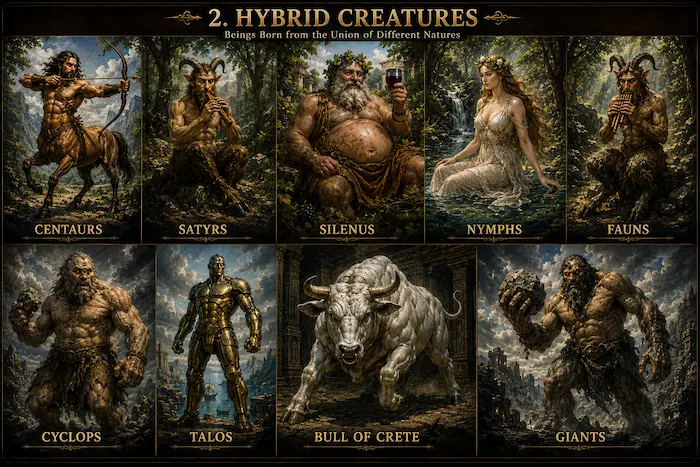
Centaurs
Centaurs had the upper body of a human joined to the body and legs of a horse. In most myths they live in the mountains and forests of Thessaly, and they are commonly portrayed as wild, quick to anger, and unable to handle wine. The best known story about them is the brawl at the wedding of Pirithous, where drunken Centaurs attacked the guests and started a war with the Lapiths.
Chiron is the important exception. Wise, skilled in medicine, music, and hunting, and given a different parentage from the rest of his kind, he served as tutor to a series of major figures including Achilles, Jason, and Asclepius. Where other Centaurs represent disorder, Chiron represents learning and restraint.
Satyrs
Satyrs were nature spirits with a mix of human and animal features. In earlier Greek art they are men with horse ears and tails and snub noses, while the goat legs and horns familiar today reflect later depictions and the Roman blending of Satyrs with fauns.
They belong to the retinue of Dionysus and appear wherever he does, connected with wine, music, dancing, wild countryside, and revelry. Their usual role in myth and drama is comic and disruptive rather than heroic, and they turn up constantly in vase painting and in satyr plays, the short humorous pieces staged alongside Athenian tragedies.
Sirens
Sirens were supernatural singers whose voices drew sailors off course and toward destruction. In traditional Greek depictions they are bird-women, shown with the body and wings of a bird and the head, and sometimes the arms, of a woman. The fish-tailed image that comes to mind today belongs to the later medieval merging of Sirens with mermaids and is not the original Greek form.
Their most famous appearance is in the Odyssey. Warned by Circe, Odysseus plugged his crew’s ears with beeswax and had himself tied to the mast so that he could hear the song and survive it. The ship passed, and the men rowed on without hearing anything at all.
Harpies
Harpies were winged female beings, usually described as women with the wings and talons of birds, and associated with sudden storm winds and with snatching things away. Their name is connected to a Greek verb meaning to seize, and in early poetry they carry people off without explanation.
Their clearest role in narrative is as agents of punishment. The blind seer Phineus was tormented by Harpies who stole or fouled his food every time he tried to eat. When the Argonauts arrived, the winged sons of Boreas, Zetes and Calais, drove the Harpies off, and in return Phineus gave Jason the guidance he needed to continue the voyage.
Cyclopes
The Cyclopes were giants with a single eye in the middle of the forehead, and Greek tradition describes two very different groups under that name.
In Hesiod, the Cyclopes are three divine craftsmen, Brontes, Steropes, and Arges, children of Uranus and Gaia. Freed by Zeus, they forged the thunderbolt he used to defeat the Titans, and later sources connect them to other divine weapons and workshops.
In Homer, the Cyclopes are something else entirely: lawless herdsmen living on a remote island without agriculture, ships, or assemblies. The most famous of them is Polyphemus, a son of Poseidon, who trapped Odysseus and his men in his cave and ate several of them. Odysseus got him drunk, gave his name as Nobody, and blinded his single eye with a sharpened stake. When the neighboring Cyclopes asked who was hurting him, Polyphemus answered that Nobody was, and no help came. The escape cost Odysseus dearly, since Polyphemus called on his father Poseidon, who hounded the hero for the rest of the voyage.
Giants
The Giants, or Gigantes, were enormous and powerful beings born of Gaia. Their defining episode is the Gigantomachy, the war they waged against the Olympian gods for control of the cosmos. According to a widespread tradition the gods could not finish the Giants on their own and needed the help of a mortal, a role filled by Heracles, whose arrows completed what the Olympians began.
The Giants are often confused with the Titans, but they are a separate group fighting a separate war. The Titans were the older generation of gods overthrown by Zeus in the Titanomachy, while the Gigantomachy comes afterward and is fought against the already established Olympian order.
Mythical Animals and Beasts in Greek Mythology
The creatures in this section are more animal than humanoid. Some are simply extraordinary versions of ordinary animals, larger, invulnerable, or sacred to a god, while others combine animal forms without any human element. Several of these Greek mythology beasts are best known as targets of the Twelve Labors of Heracles, and as a group these mythical animals show that not every remarkable being in Greek myth was a monster to be destroyed.
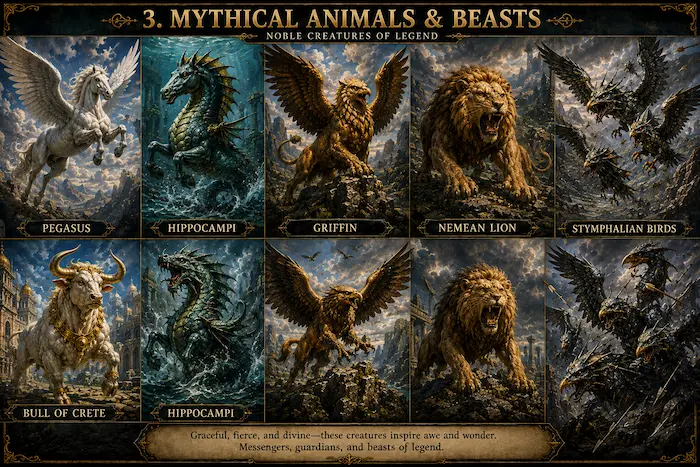
Pegasus
Pegasus was a winged horse, usually described as pure white and capable of flight. He was born from Medusa at the moment Perseus beheaded her, springing from her neck along with his brother Chrysaor. Perseus does not ride him. Pegasus comes into existence only after Medusa is already dead, and the hero completes his escape using winged sandals.
The rider associated with Pegasus is Bellerophon, who caught and tamed him, in the common account with the help of a golden bridle given by Athena. Mounted on Pegasus, Bellerophon killed the Chimera from the air. The partnership ended badly for the rider: when Bellerophon later tried to fly up to Olympus, he was thrown from the horse’s back. Pegasus continued to Olympus alone, and later tradition places him in the service of Zeus, carrying his thunder and lightning.
The Griffin
The Griffin was a hybrid beast with the head, wings, and front talons of an eagle joined to the body and hind legs of a lion. It appears far more often in Greek art than in Greek narrative, and it entered Greek imagination partly through contact with older Near Eastern imagery.
Its defining role in Greek tradition is that of a guardian. Writers including Herodotus place Griffins in the far north, where they watch over deposits of gold and fight the one-eyed Arimaspians who try to steal it. In art Griffins appear as protective figures on armor, vessels, and architecture, and they are linked with Apollo and with Nemesis.
The Nemean Lion
The Nemean Lion was an enormous lion that terrorized the region of Nemea, and its hide could not be pierced by arrows, spears, or blades. Killing it was the first of the Twelve Labors of Heracles.
When his weapons proved useless, Heracles trapped the lion in its cave by blocking one of the two entrances, then strangled it with his bare hands. Skinning the body posed its own problem, since nothing would cut the pelt. According to the usual account he solved this by using the lion’s own claws. From then on he wore the skin as armor, and the lion’s head as a hood, which is why he is so often shown in that form in ancient art.
The Cretan Bull
The Cretan Bull was a magnificent bull that ran wild on Crete during the reign of King Minos. In the standard tradition it is the same bull sent from the sea by Poseidon, and it is connected to the birth of the Minotaur through Pasiphae.
Capturing the bull alive was one of the Twelve Labors. Heracles wrestled it into submission, brought it back to Eurystheus, and it was then released, after which it made its way to the plain of Marathon on the Greek mainland. There it became known as the Marathonian Bull, and Theseus captured and killed it before his journey to Crete.
The Erymanthian Boar
The Erymanthian Boar was a giant wild boar that came down from Mount Erymanthos and ravaged the surrounding farmland. Heracles was ordered to bring it back alive, which made this labor a problem of capture rather than combat.
He drove the boar out of the thickets, chased it up into deep snow where it tired and sank, and bound it while it was trapped. He then carried the living animal on his shoulders back to Eurystheus. In the best known version of the scene, the king was so alarmed at the sight that he hid inside a large storage jar.
The Ceryneian Hind
The Ceryneian Hind was a deer sacred to Artemis, described as having golden antlers and bronze hooves and as being faster than an arrow in flight. Because the animal belonged to a goddess, the labor came with a strict condition: Heracles had to capture it without killing or wounding it.
The pursuit is said to have lasted a full year across long distances before he finally took the hind. When Artemis confronted him, he explained that he was acting under orders and promised to return the animal, and she allowed him to complete the labor.
The Stymphalian Birds
The Stymphalian Birds were a flock of aggressive birds that gathered at Lake Stymphalus in Arcadia, where they multiplied out of control and destroyed the surrounding crops. Later accounts describe them with metallic beaks, bronze claws, and feathers they could launch like darts.
Driving them out was one of the Twelve Labors. The birds sheltered in dense marshland where Heracles could not reach them on foot, so in the common version Athena supplied a bronze rattle, forged by Hephaestus, whose noise startled the flock into the air. Heracles shot many of them as they rose, and the survivors scattered and never returned.
Other Creatures of Greek Mythology
A number of smaller creatures appear in single episodes but remain well known because of the heroes and quests attached to them.
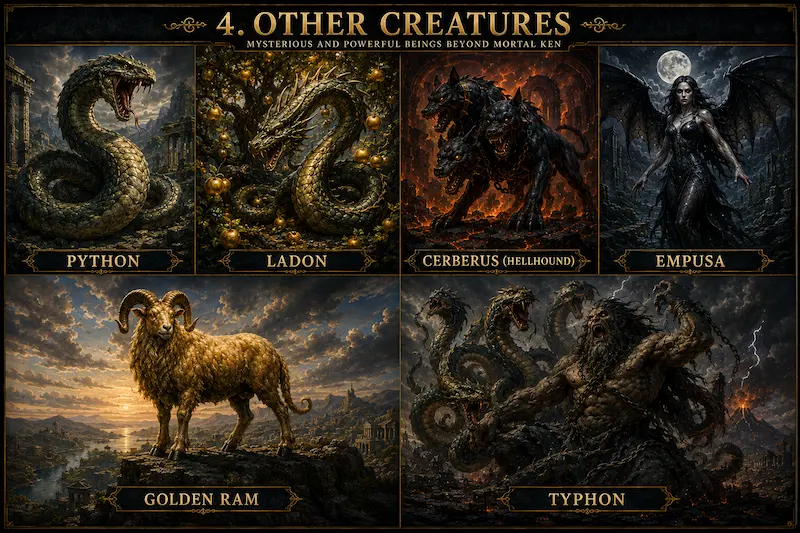
Python
Python was a great serpent or dragon that lived at Delphi and guarded the site before it became the sanctuary of Apollo. Apollo killed it with his arrows and claimed the oracle, and the god’s title Pythian and the name of the Pythia, the priestess who delivered his prophecies, are both connected to the creature.
Ladon
Ladon was the serpent or dragon that coiled around the tree of golden apples in the garden of the Hesperides, sometimes described as never sleeping and as having many heads. He appears in the labor in which Heracles is sent to fetch the apples, a task the hero completes either by dealing with Ladon directly or by persuading the Titan Atlas to retrieve them for him, depending on the version.
The Colchian Dragon
The Colchian Dragon was the sleepless serpent that guarded the Golden Fleece in a grove at Colchis. It is central to the voyage of the Argonauts: Jason could not take the fleece by force, and in the usual account Medea used a drug or an incantation to put the creature to sleep so that he could carry it away.
Orthrus
Orthrus was a two-headed dog and, in Hesiod’s genealogy, a brother of Cerberus. He guarded the cattle of the three-bodied giant Geryon on the island of Erytheia and was killed by Heracles during the labor in which the hero was sent to seize that herd.
Talos
Talos was a giant bronze automaton who patrolled the coast of Crete, circling the island and hurling rocks at approaching ships. His weak point was a single vein running through his body, sealed by a bronze nail. In the story of the Argonauts, Medea disabled him so that the nail was removed and the fluid inside drained out.
The Golden Ram
The Golden Ram was a flying ram with a fleece of gold, sent to rescue the children Phrixus and Helle. Helle fell during the flight into the strait that took her name, the Hellespont, while Phrixus reached Colchis, where the ram was sacrificed and its fleece hung in a sacred grove. That fleece is the object of the entire quest of Jason and the Argonauts.
Conclusion
Greek mythology filled its world with an unusually wide range of creatures, from lethal monsters like the Hydra and the Minotaur to hybrid beings like the Centaurs and supernatural animals like Pegasus. What ties them together is not what they looked like but how they functioned in the stories.
Nearly every one of these creatures exists in relation to something larger: a labor that defined a hero, a voyage home, a war among the gods, or a sacred place that needed a guardian. Reading them alongside the myths of Heracles, Perseus, Theseus, Odysseus, and Jason is the clearest way to understand why the Greeks imagined them in the first place.

About the Author
Dana Whitfield
I write about numerology, astrology, mythology, tarot, and world mystical traditions for Mystivora, drawing on years of independent research across comparative religion and symbolic systems. I approach each topic by cross-checking primary texts and established scholarship rather than repeating popular but unverified claims.