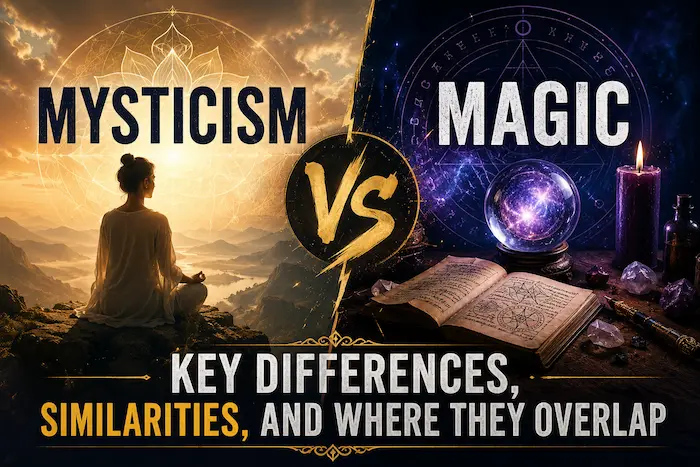
Mysticism primarily seeks direct experience of, or union with, ultimate reality, while magic uses intentional practices to obtain knowledge, influence circumstances, or produce a desired result. The traditions can overlap, but they are not identical.
The clearest way to separate the two is by purpose rather than by tools. A prayer, a ritual, a symbol, or a period of silent meditation is not automatically “mystical” or “magical” just because of what it looks like from the outside. What matters is why it is being done. Someone sitting in quiet contemplation, hoping only to feel closer to something greater than themselves, is engaged in a mystical act. Someone lighting a candle and speaking specific words with the intention of changing an outcome is engaged in a magical one. The line between the two, however, is rarely as sharp in practice as it is in theory.
Mysticism vs Magic at a Glance
| Category | Mysticism | Magic |
|---|---|---|
| Primary goal | Union, insight, awakening, or inner transformation | Change, knowledge, protection, influence, or a specific result |
| Main orientation | Inward or transcendent | Intentionally directed, inward or outward |
| Typical attitude | Receptivity, contemplation, or surrender | Will, intention, technique, or focused action |
| Common practices | Meditation, prayer, silence, devotion, contemplation | Rituals, spells, divination, invocations, symbols, talismans |
| Expected outcome | Mystical experience or transformation of consciousness | A spiritual, psychological, symbolic, or practical result |
| Relationship with the divine | The divine or ultimate reality is often central | May be religious, spiritual, esoteric, or secular |
| Name for the practitioner | Mystic | Magician or magical practitioner |
These are general tendencies, not universal rules. Individual traditions, teachers, and practitioners often blend elements from both columns, and some systems resist this kind of table altogether.
What Is Mysticism?
Mysticism refers to the pursuit, or the reported experience, of direct contact with the divine, with ultimate reality, with a sacred presence, or with a reality beyond the ordinary sense of self. It is less a single belief system than a family of practices and experiences found across many religions and philosophical traditions, all oriented toward something felt to be beyond the reach of ordinary thought or language. For a deeper breakdown, see our full guide on what mysticism means.

The Main Goal of Mysticism
Many mystical traditions describe their aim in similar terms, even when their theology differs:
- Direct spiritual experience, rather than secondhand belief
- Union or communion with the divine, however that is defined
- Transcending the ordinary sense of ego or separateness
- Gaining insight into the nature of reality itself
- Inner transformation, as opposed to simply accepting a set of doctrines
It is worth noting that not every mystical tradition frames its goal as literal “union with God.” Some describe it as awakening, liberation, dissolving illusion, or realizing a truth that was always present. The vocabulary shifts from tradition to tradition, but the emphasis on direct, transformative experience tends to remain constant.
Common Mystical Practices
Many mystical traditions use practices such as:
- Meditation
- Contemplative prayer
- Silence and stillness
- Chanting or repetitive sacred phrases
- Devotion to a deity, teacher, or ideal
- Self-examination
- Ascetic disciplines, such as fasting or simplified living
- Sustained, focused attention
These practices are best understood as methods that create conditions favorable to a mystical experience, not guarantees that one will occur. Many practitioners spend years in disciplined practice without the kind of breakthrough experience their tradition describes, while others report it arriving unexpectedly.
Mysticism Across Different Traditions
Mystical currents appear in many religious and philosophical traditions:
- Christian mysticism, including specific traditions such as Catholic mysticism, expressed through contemplative prayer and the writings of figures within monastic and contemplative orders
- Sufism, the mystical dimension of Islam, centered on love, remembrance, and direct experience of the divine
- Jewish mystical traditions, which explore hidden dimensions of scripture and the nature of the divine
- Hindu contemplative traditions, including yogic and Vedantic practices aimed at self-realization
- Buddhist meditation traditions, oriented toward insight into the nature of mind and reality
- Nature mysticism, a less institutional form centered on profound unity felt in the natural world
Each of these traditions has its own vocabulary, practices, and theological framework, and none of them should be treated as representative of all the others.
What Is Magic?
Magic, in this context, refers to the use of rituals, symbols, words, objects, intention, or esoteric systems to seek knowledge, protection, transformation, influence, or another desired result. It is a far broader and more contested term than mysticism, and its meaning shifts considerably depending on who is using it.
Anthropologists, religious scholars, occult practitioners, folklorists, and fiction writers all use the word “magic” to describe different things. In anthropology, it often refers to ritual practices believed to influence outcomes through means outside ordinary cause and effect. In occult and esoteric traditions, it frequently refers to structured systems of practice with their own internal logic, symbolism, and technique. In folklore, it describes practical rituals passed down through generations. In fantasy and entertainment, it describes fictional powers with no claim to being practiced in the real world.
The Main Goal of Magic
Because magic covers such a wide range of practices, its goals vary considerably:
- Protection from harm, misfortune, or negative influence
- Healing, whether physical, emotional, or spiritual
- Divination, or seeking knowledge of the future or the unseen
- Contact with spiritual entities or forces
- Personal transformation
- Gaining hidden or esoteric knowledge
- Influencing circumstances or events
- Producing a defined symbolic or practical result
It would be inaccurate to assume that every form of magic is aimed at controlling other people, forcing outcomes, or bending others to one’s will. Much of what falls under the umbrella of “magic,” historically and today, is directed at protection, healing, self-understanding, or communication with the sacred.
Common Magical Practices
Magical traditions share a recognizable set of practices, even across very different cultural and religious contexts:
- Rituals performed with specific steps, timing, or intention
- Spells and incantations
- Divination methods, such as reading cards, symbols, or natural signs
- Talismans and amulets
- Sigils and symbolic designs — see our guide to ancient symbols of power for examples across cultures
- Invocations addressed to a deity, spirit, or force
- Visualization
- Ceremonial tools, such as candles, herbs, or ritual instruments
How these practices are understood varies widely. Some practitioners interpret them literally, as directly affecting unseen forces. Others understand them psychologically, as ways of focusing intention and reshaping their own mindset. Still others see them primarily as symbolic, cultural, or devotional acts, valuable for what they represent rather than for any claimed external effect.
Ritual Magic Is Not the Same as Stage Magic
The word “magic” covers several distinct concepts that are easy to confuse:
- Ritual or spiritual magic refers to practices within religious, esoteric, or folk traditions, as discussed throughout this article.
- Stage magic and illusion refers to entertainment built on sleight of hand, misdirection, and staged effects, with no claim to supernatural causes.
- Fictional magic refers to powers and spells created for novels, films, and games.
- Figurative uses of “magical” describe something wonderful, delightful, or enchanting, such as a “magical evening,” without implying literal magic.
Keeping these meanings separate prevents confusion when the same word appears in spiritual practice, entertainment, fiction, and everyday speech.
The Key Differences Between Mysticism and Magic
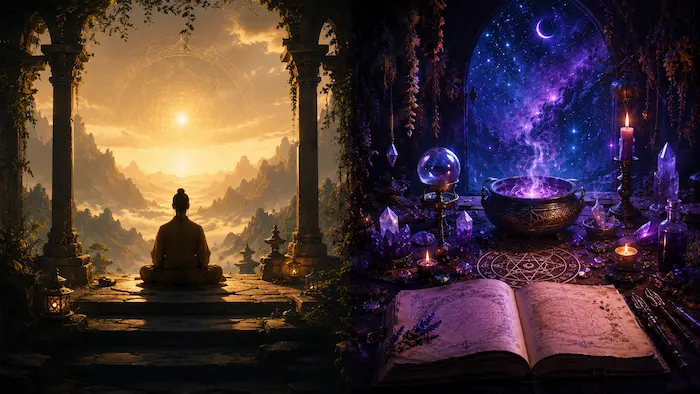
The clearest distinction between mysticism and magic usually concerns intention and purpose rather than the outward form a practice takes. Two people can perform what looks like the same ritual action for entirely different reasons, and that difference in reason is often what separates a mystical act from a magical one.
1. Union vs Influence
Mysticism usually seeks communion, direct experience, or insight, valued largely for its own sake. Magic generally seeks to direct intention toward a specific result, change, or form of knowledge. In mysticism, the “goal” is often the experience itself. In magic, the experience is frequently a means toward some further, defined end.
2. Receptivity vs Will
Mysticism often emphasizes openness, surrender, listening, or emptying the ego so that something greater can be encountered. Magic often emphasizes intention, concentration, will, technique, or symbolic action directed outward. Many traditions, however, contain both qualities at once. A mystic may need considerable discipline and will to sustain a meditative practice, and a magical practitioner may describe moments of surrender or receptivity as central to their work.
3. Inner Transformation vs Specific Results
Mysticism commonly values a transformation of consciousness, a shift in how the practitioner perceives reality or the self. Magic may aim at protection, divination, healing, knowledge, or another defined, often externally observable result. That said, some magical systems treat inner transformation as their highest goal, blurring this distinction considerably. Ceremonial and initiatory magical traditions in particular often frame personal transformation, not external results, as the true point of the work.
4. Contemplation vs Ritual Action
Mysticism may rely on silence, meditation, or contemplative prayer, practices with relatively little external structure. Magic often uses structured rituals, specific words, objects, precise timing, and symbolic correspondences. Yet mysticism can also involve ritual, particularly in liturgical or devotional contexts, and magic can include meditation as one of its core techniques. Neither practice is confined to a single method.
5. Relationship With the Divine
Mysticism frequently centers on God, the Absolute, sacred reality, emptiness, nonduality, or transcendence, depending on the tradition. Magic may involve gods, spirits, natural forces, symbolic systems, psychological models, or no deity at all. A magical practice can be deeply religious, loosely spiritual, entirely secular, or psychologically framed, while mysticism is almost always discussed in relation to something regarded as sacred or ultimate.
6. Direct Insight vs Applied Knowledge
Mystical knowledge is often described as immediate, experiential, intuitive, and difficult to put into words. Practitioners frequently say the experience defies full description. Magical knowledge, by contrast, is commonly organized into systems, correspondences, and techniques that practitioners apply through ritual, symbolism, timing, or method. Magic tends to be learned and transmitted as a body of applied knowledge, while mysticism is often described as something that must be personally experienced rather than simply studied.
What Do Mysticism and Magic Have in Common?
Despite their differences, mysticism and magic are not opposites in every sense. Their shared features help explain why the two are often confused or discussed together.
Engagement With Realities Beyond Ordinary Experience
Many forms of mysticism and magic engage with realities, meanings, or experiences believed to extend beyond ordinary perception. Depending on the tradition, these may be described as sacred presence, the divine, hidden forces, or symbolic dimensions of meaning.
Use of Symbols and Rituals
Both may use sacred words, visual symbols, repetition, music, chanting, gesture, prayer, meditation, or dedicated ritual settings. The presence of a symbol, repeated phrase, or ritual gesture does not by itself tell you whether a practice is mystical, magical, or both; context and intention shape the meaning of the act.
Discipline and Personal Experience
Many established mystical and magical traditions value sustained practice, concentration, ethical preparation, study, and direct personal experience rather than secondhand belief alone.
Altered States of Consciousness
Meditation, chanting, fasting, prayer, ritual, sensory control, and intense concentration can alter subjective experience. Not every altered state is understood as supernatural, however; practitioners and scholars may interpret such experiences psychologically, symbolically, spiritually, or culturally.
Can Mysticism and Magic Overlap?
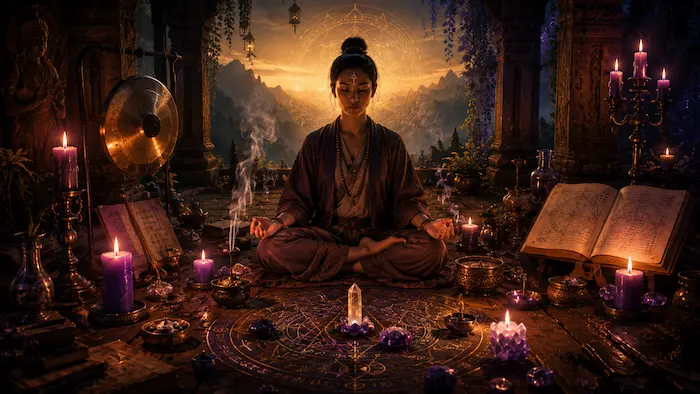
In practice, the boundary between mysticism and magic is often blurred rather than sharply drawn. The same outward practice can fall into either category, or both, depending on the intention behind it.
A single practice can be:
- Mystical, when it is used to seek union, revelation, or inner transformation
- Magical, when it is used toward a specific, defined result
- Both, when a practitioner seeks inner transformation and intentional change at the same time, without treating the two as contradictory
Can a Mystic Practice Magic?
Yes, depending on the tradition and the individual’s own definition of magic. A mystic may also make use of ritual, sacred symbols, divination, invocation, or protective practices, particularly within traditions that do not draw a hard line between contemplative and ritual life. Whether such practices are labeled “magic” often depends more on the tradition’s own vocabulary than on any strict theological rule.
Can a Magician Have Mystical Experiences?
Yes. Magical practices that involve meditation, ritual, visualization, devotion, or altered states can produce experiences that some practitioners interpret as mystical. A ceremonial ritual undertaken with sustained focus and discipline may lead to a sense of union, insight, or transcendence not unlike what mystics describe, even though the practice began with a specific magical intention.
Traditions Where Magic and Mysticism Intersect
Historical and esoteric examples include Hermeticism, Neoplatonic theurgy, Kabbalistic esotericism, Western ceremonial magic, esoteric Christianity, and some Pagan or occult traditions. These currents contain substantial internal diversity, so the examples should not be treated as proof that every practitioner defines magic and mysticism in the same way.
Can Someone Be Both a Mystic and a Magician?
Yes. The labels describe orientations and activities rather than fixed, mutually exclusive identities. A person may be primarily mystical, primarily magical, both mystical and magical, or neither despite using meditation or ritual for non-spiritual purposes. What matters most is the person’s underlying purpose, worldview, and interpretation of the practice.
Mystical vs Magical: What Is the Difference?
Beyond the traditions themselves, the words “mystical” and “magical” are often confused in everyday English, partly because they sound similar and partly because both suggest something extraordinary.
- Mystical relates to mysticism, spiritual mystery, transcendence, or direct sacred experience.
- Magical relates to magic, spells, supernatural effects, enchantment, or something exceptionally delightful.
Examples of Mystical and Magical
- She described a mystical experience during meditation.
- The novel contains magical creatures and enchanted objects.
- The cathedral had a mystical atmosphere.
- They spent a magical evening beneath the stars.
“Magical” is frequently used figuratively in everyday speech, describing anything wonderful, charming, or hard to explain, with no supernatural claim intended. “Mystical,” by contrast, usually implies spiritual mystery, transcendence, or a sense of the sacred, and is used more sparingly outside religious or contemplative contexts.
Mystical vs Mythical: Another Common Confusion
This is a brief but important distinction, since the two words are sometimes mixed up due to their similar sound.
- Mystical relates to spiritual mystery or mysticism, as discussed throughout this article.
- Mythical relates to myths, legends, or beings described in mythology, such as dragons or phoenixes.
A mystical experience, in other words, is a reported personal encounter with sacred or transcendent reality. A mythical creature is a being that appears in traditional stories and legends. The two words describe entirely different kinds of things, despite their similar sound.
Is Mysticism More Spiritual Than Magic?
It is tempting to assume that mysticism is simply the “more spiritual” or “purer” of the two, but the picture is more balanced than that.
Mysticism is almost always discussed within spiritual, religious, or contemplative contexts, which is part of why it carries a strong association with sacredness. Magic, however, can be spiritual, religious, folkloric, occult, psychological, fictional, or purely entertaining, depending on the context. This breadth does not automatically make mysticism morally superior to magic, nor does it make magic inherently less legitimate.
Neither term, by itself, tells us whether a practice is ethical, harmful, beneficial, selfish, or compassionate. The words describe orientation and method, not moral character.
Frequently Asked Questions About Mysticism and Magic
What is the difference between magic and mysticism?
Mysticism generally seeks direct experience, union, insight, or inner transformation, often through meditation, prayer, or contemplation. Magic uses intentional methods, such as ritual, symbol, and technique, toward knowledge, influence, protection, transformation, or a specific result. The core distinction lies in purpose: experience and union versus applied intention and outcome.
Is mystical similar to magical?
The words overlap in suggesting mystery and extraordinary experience, but they are not synonyms. “Mystical” is primarily spiritual or transcendent, describing sacred experience or atmosphere. “Magical” refers to magic in the ritual or supernatural sense, or, in everyday speech, to something wonderful or enchanting, often without any spiritual claim at all.
Is mysticism a form of magic?
Mysticism is not inherently a form of magic. It centers on direct experience of the divine or ultimate reality rather than on ritual technique aimed at a specific result. That said, mystical and magical practices do appear together in a number of traditions, particularly those built around ceremonial or esoteric systems that blend contemplation with ritual.
Can someone be both a mystic and a magician?
Yes. These categories describe different orientations and activities rather than fixed, mutually exclusive identities. A person can pursue direct spiritual experience while also practicing ritual or symbolic magic, particularly within traditions that combine both elements rather than treating them as opposites.
Is mystical the same as mythical?
No. “Mystical” concerns spiritual mystery, transcendence, or sacred experience. “Mythical” concerns myths, legends, and mythological beings, such as creatures found in traditional stories. Despite their similar sound, the two words describe unrelated concepts.
Conclusion
Mysticism and magic are often mentioned in the same breath, and for good reason: both engage with dimensions of experience beyond the purely ordinary, both rely on discipline and symbol, and both have been intertwined throughout history in traditions like Hermeticism and ceremonial magic. But at their core, the two remain distinct in purpose. Mysticism mainly seeks direct experience and inner transformation, valued largely for its own sake. Magic mainly applies intention, ritual, or symbolic method toward knowledge, influence, or a defined change. The two concepts stay distinct, even as their practices and goals frequently overlap in the lives of real practitioners.

About the Author
Dana Whitfield
I write about numerology, astrology, mythology, tarot, and world mystical traditions for Mystivora, drawing on years of independent research across comparative religion and symbolic systems. I approach each topic by cross-checking primary texts and established scholarship rather than repeating popular but unverified claims.
Related Articles
View All Articles → Mysticism