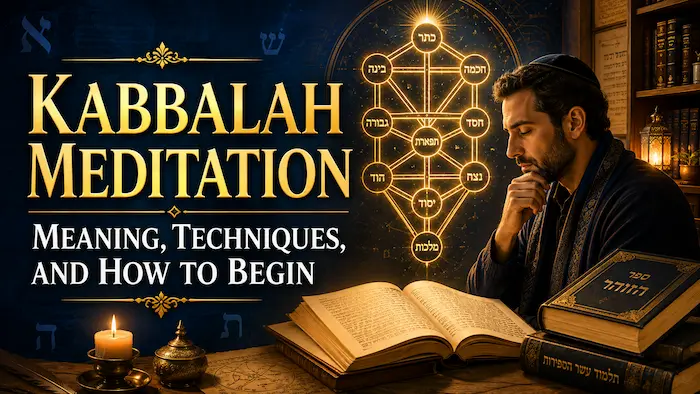
Kabbalah meditation is not one single, standardized technique. It is a broad family of contemplative practices connected to Jewish mysticism, developed across different schools and centuries for different purposes. Some methods center on prayer and focused intention. Others involve sacred texts, Hebrew letters, Divine Names, visualization, breath, or contemplation of the sefirot — the ten attributes through which Kabbalistic thought describes how the Infinite relates to creation.
Because these methods emerged from distinct traditions, they don’t share a single format or goal. A person exploring kabbalistic meditation today might encounter anything from a quiet reflection on a Hebrew word to advanced letter-combination practices that were historically reserved for trained students under close guidance.
This guide explains what Kabbalah meditation means, its major techniques, and how a beginner can start with a simple, grounded practice — while being clear about which methods require more experience, context, or guidance.
What Is Kabbalah Meditation?
Kabbalah meditation refers to contemplative practices shaped by Jewish mystical teachings. Depending on the tradition, the practitioner might concentrate on a prayer, a sacred text, a spiritual quality, a Hebrew letter, a Divine Name, or a Kabbalistic concept such as one of the sefirot.
Unlike some meditation styles built around emptying the mind, many forms of Kabbalah meditation actively direct the mind toward sacred meaning. The goal is often not blankness but focused awareness — of a text, a Divine attribute, a moral quality, or a sense of Divine presence.
A Simple Definition
Kabbalah meditation is a set of contemplative practices, rooted in Jewish mysticism, that use prayer, sacred text, visualization, or focused intention to cultivate awareness of the Divine and to refine the inner life of the practitioner.
Meditation, prayer, contemplation, visualization, and intention overlap heavily in this tradition rather than functioning as separate categories. Prayer can become meditative when approached with sustained focus. Contemplation can shade into visualization when a concept, like a Hebrew letter or a sefirah, is held in the mind’s eye. Intention, discussed below as kavanah, often functions as the thread that ties these activities together.
It would be inaccurate to define Kabbalah meditation as simply mindfulness dressed in Jewish symbols. The practices developed within a specific religious and theological framework, with their own aims, texts, and methods of transmission.
Kabbalah Meditation and Jewish Meditation
Jewish meditation is a broader category than Kabbalah meditation. Not every Jewish meditation practice is Kabbalistic — Jewish meditation can also include contemplative prayer, ethical reflection, chanting of psalms, silent reflection, or modern mindfulness-based approaches that draw little or nothing from Kabbalistic sources.
Kabbalistic meditation specifically draws on concepts, texts, or methods associated with the Kabbalistic tradition, such as the sefirot, Divine Names, Hebrew letter combinations, or the writings of specific Kabbalistic schools. The two terms overlap but are not interchangeable: all Kabbalistic meditation is a form of Jewish meditation, but not all Jewish meditation is Kabbalistic.
What Is the Purpose of Kabbalistic Meditation?
The goals of Kabbalistic meditation vary by school and by practitioner. Common aims include strengthening concentration during prayer, developing awareness of Divine presence, cultivating spiritual qualities such as compassion or discernment, deepening understanding of sacred texts, refining emotion and behavior, and moving toward a state traditionally called devekut. In many traditions, contemplation is also meant to connect directly to ethical action rather than remaining a private inner experience.
These practices are not presented here as a path to visions, prophecy, guaranteed enlightenment, healing, or supernatural power. Traditional sources describe varied and often modest goals centered on inner refinement and religious life.

Devekut: Drawing Closer to the Divine
Devekut is often translated as attachment, cleaving, or closeness to God. It describes a spiritual orientation — an ongoing effort to remain aware of and connected to the Divine — rather than a single, guaranteed altered state of consciousness.
Different Jewish mystical and Hasidic traditions understand and emphasize devekut differently. Some treat it as a rare, elevated achievement reached after years of religious discipline. Others describe it as something a person can cultivate in small ways throughout ordinary daily life, particularly through prayer and mindful action.
Kavanah: Focused Spiritual Intention
Kavanah refers to intention, direction of the heart, or focused awareness brought to prayer and sacred practice. It is one of the most accessible and frequently discussed concepts in Jewish spiritual life.
The distinction traditional sources draw is between reciting words mechanically, without engaged attention, and reciting the same words with understanding and intention. A blessing said quickly out of habit and the same blessing said while genuinely attending to its meaning are treated as spiritually different acts, even though the words are identical.
Because kavanah does not require advanced mystical training, Hebrew fluency, or esoteric knowledge, it sits at the center of many of the most accessible forms of Kabbalistic meditation.
Spiritual Awareness and Self-Refinement
Kabbalistic meditation is frequently connected to the cultivation of character traits: compassion, humility, patience, discernment, and a sense of responsibility toward others. Many traditional teachers treated inner contemplation and ethical conduct as inseparable — contemplation was meant to shape how a person behaved, not only how they felt.
This point matters because Kabbalah meditation is sometimes portrayed, especially in modern popular sources, mainly as a search for unusual inner experiences. Traditional sources place at least as much emphasis on ordinary virtues and ethical behavior.
Main Kabbalah Meditation Techniques
There is no single universal Kabbalah meditation method. Different schools, from medieval Spain to later Hasidic communities, developed distinct approaches with different aims, different levels of accessibility, and different degrees of religious training required. The techniques below are described in roughly ascending order of complexity, with beginner, intermediate, or advanced labels and relevant cautions.
1. Kavanah Meditation
This approach uses focused prayer or blessing as the meditative object. A simple version works as follows:
- Choose a short prayer, blessing, or sacred phrase.
- Learn its meaning before reciting it.
- Recite it slowly, rather than quickly.
- Maintain attention on the meaning of the words as you say them.
- When your attention wanders, gently return to the words without frustration.
- Close by connecting the prayer to a practical intention for the day.
Level: Beginner-friendly, when practiced without advanced mystical formulas or Divine Name combinations.
2. Hitbonenut: Deep Contemplation
Hitbonenut means sustained reflection or contemplation. A practitioner might contemplate a Divine attribute, a theological idea, a biblical verse, the relationship between the infinite and created existence, or a spiritual quality meant to shape behavior.
Hitbonenut is not passive daydreaming. It involves focused intellectual and emotional engagement with an idea, often held in the mind for an extended period rather than briefly noted and released.
This practice holds particular importance in some Hasidic traditions, notably Chabad, which teaches hitbonenut as a structured, step-by-step form of contemplation practiced before prayer. Not all forms of hitbonenut across different communities are identical in method or emphasis.
Level: Intermediate, depending on the complexity of the subject contemplated.
3. Sefirot Contemplation
The sefirot are ten attributes, emanations, or modes through which Kabbalistic teachings describe the relationship between the Infinite and the created world. A practitioner might reflect on the quality associated with a particular sefirah — for example, chesed (loving-kindness), gevurah (strength, restraint, or discernment), or tiferet (harmony, balance, or compassion) — and consider how that quality is or isn’t present in their own conduct.
This kind of contemplation can lead naturally into ethical self-examination: Where have I acted with excessive severity? Where have I failed to show kindness? Where is my life out of balance?
It is worth stating plainly: the sefirot are not physical organs, they are not the same as chakras, and they should not be presented as ten guaranteed “energy activations” that a person can trigger through meditation. They belong to a theological and symbolic framework, not a physiological one.
Level: Beginner to intermediate, depending on depth.
4. Hebrew Letter Visualization
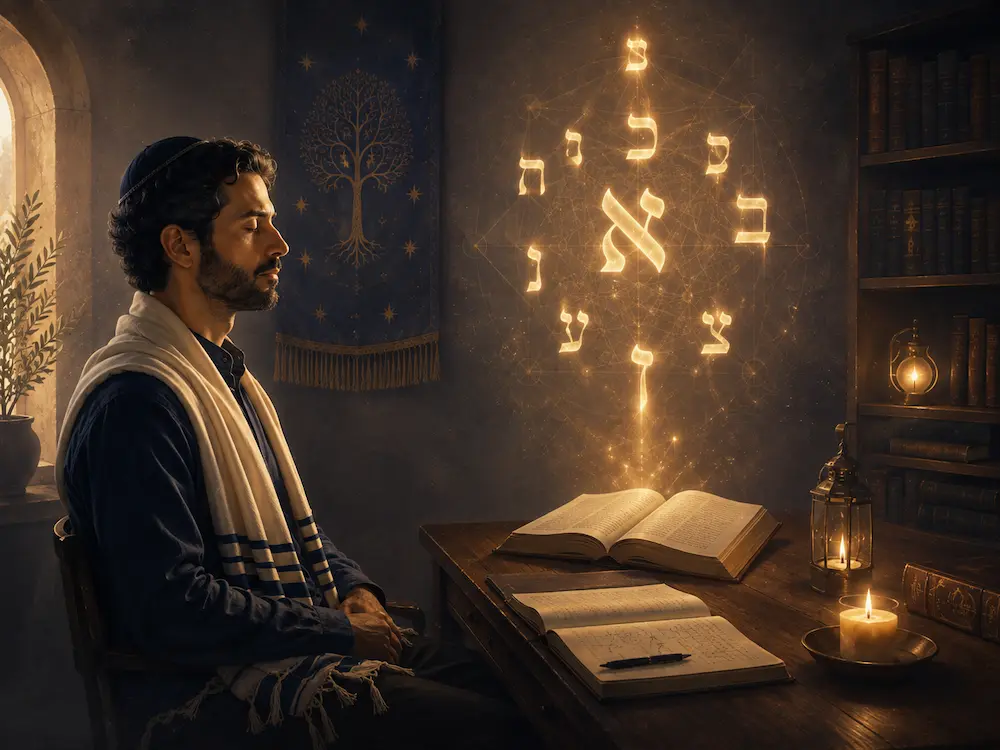
Some Kabbalistic traditions treat the twenty-two letters of the Hebrew alphabet as sacred forms carrying linguistic, symbolic, and contemplative significance, not merely as a writing system. Practices associated with this idea may involve looking at a letter, visualizing its form with eyes closed, pronouncing its sound, reflecting on a word or sacred association connected to it, and combining this visual focus with natural breathing.
Historical letter meditation, as described in Kabbalistic sources, is considerably more intricate than the modern habit of assigning a single fixed affirmation or “meaning” to each letter. Traditional sources vary in how they interpret the letters, and unsupported claims about fixed powers attached to individual letters should be treated with caution.
Level: Intermediate for basic visual contemplation.
5. Sacred Word, Prayer, or Psalm Meditation
This technique uses psalms, short prayers, biblical verses, sacred phrases, or repeated passages from traditional texts as the focus of meditation. The key distinction is between meaningful repetition — recitation joined with reflection and understanding — and mechanical chanting done without attention.
A practitioner might alternate between recitation, silence, reflection on the meaning of the words, and consideration of how the text applies personally.
Level: Beginner-friendly, when using familiar texts and natural breathing.
6. Abraham Abulafia’s Letter-Combination Method
Abraham Abulafia, a thirteenth-century Jewish mystic, developed a distinctive system now often associated with Prophetic or Ecstatic Kabbalah. Methods connected with his approach may involve combining Hebrew letters in structured sequences, writing out letter combinations, pronouncing letters together with vowel sounds, coordinating breath with recitation, visualizing letter forms, using controlled head or bodily movements, and progressively intensifying concentration.
This method appears frequently in modern discussions of Kabbalah meditation because it is one of the more fully documented historical systems and because later writers have made aspects of it more accessible to general readers. Scholarly overviews describe Abulafia’s core techniques as letter-combination practiced in written, spoken, and mental stages, paired with recitation of Divine Names, controlled breathing, and body posture.
This article does not provide a complete operational sequence for this method, and no legitimate source should present it as guaranteeing prophecy or mystical union. Historically, this system was taught within a structured framework, often understood as requiring real preparation and guidance.
Level: Intermediate to advanced. Modern readers most often encounter discussions of Abulafia’s system through later interpreters and scholars, including Aryeh Kaplan.

7. Divine Name Meditation
Some Kabbalistic systems involve contemplation of sacred Divine Names or their letter forms. This has a specifically religious context: Divine Names are not spells, and traditional systems generally connect their use to prayer, theology, the sefirot, and sacred intention rather than to obtaining arbitrary personal desires. Serious traditional sources do not present these practices as a shortcut to unrelated outcomes such as wealth or romantic success.
This article does not provide complex Divine Name combinations or instructions that imitate advanced ritual formulas, both because such material requires careful traditional context and because reducing it to a simple “how-to” misrepresents its role.
Level: Advanced, apart from conventional, simple prayer that happens to reference a Divine Name in its ordinary liturgical form.
8. Yichudim and Advanced Kavanot
Yichudim refers to mystical unifications associated especially with Lurianic Kabbalah — the system developed in the circle of Isaac Luria — and with later practices recorded by his student Hayim Vital. These practices involve advanced prayer intentions (kavanot), engagement with Divine Names, symbolic correspondences drawn from Kabbalistic cosmology, and the broader goal of spiritual restoration, known as tikkun.
Yichudim are not suitable as casual beginner exercises. This section is offered as educational context describing what these practices are and where they fit historically, not as a how-to guide.
Level: Advanced; traditionally transmitted within structured religious study.
9. Other Traditional Contemplative Methods
A few additional practices appear regularly in discussions of Jewish and Kabbalistic meditation.
Merkavah Contemplation
Merkavah mysticism relates to early Jewish mystical imagery of the Divine chariot, drawn from the biblical vision in the Book of Ezekiel, and to traditions of heavenly ascent described in early rabbinic-era texts. This is a historically significant but highly specialized area, and speculative visualization connected to it should not be presented as a universally accepted or beginner-appropriate practice.
Shiviti Contemplation
A shiviti is a visual devotional object, often containing sacred text or a Divine Name arranged artistically, traditionally placed where a person praying could see it. It is used to direct awareness toward the presence of God during prayer, functioning as a visual aid to kavanah rather than as a magical object.
Psalm 67 and Menorah Visualization
In some traditions, the text of Psalm 67 is arranged in the visual shape of a menorah for devotional contemplation, with the structure of the psalm’s letters mapped onto the seven branches. This is a devotional practice rather than one with verified or guaranteed effects, and it should be understood in that light.
Mishnah or Sacred Text Repetition
Contemplative repetition of sacred study material — where study, memory, sound, and sustained attention overlap — has long played a role in Jewish religious life. Repeating a passage from the Mishnah or another traditional text slowly and reflectively can function as a form of contemplative practice, distinct from analytical study alone.
How to Practice Kabbalah Meditation for Beginners
The exercise below is a realistic, gentle five- to ten-minute practice. It does not use Divine Name combinations or advanced letter permutations, both of which require deeper preparation and traditional guidance than a general introduction can responsibly provide.
Step 1: Choose a Spiritual Quality
Pick one accessible quality connected with the sefirot — loving-kindness, discernment, compassion, or balance are common starting points. Choose only one quality per session. Working with a single quality allows for real reflection, rather than a shallow pass through several ideas at once.
Step 2: Sit Comfortably and Settle the Attention
Sit in a comfortable position. Release unnecessary physical tension in the shoulders, jaw, and hands. Breathe naturally, without forcing the breath or holding it for extended periods. Spend a minute or two simply observing several breaths before moving on.

Step 3: Establish a Kavanah
Form one clear, simple intention for the session. A restrained example: “May this practice help me express compassion with wisdom today.” This is an intention to bring into daily life, not a request framed as a command to produce a specific outcome or manifestation.
Step 4: Contemplate the Quality
Reflect gently on a few questions: What does this quality actually mean? Where is it already present in my life? Where is it lacking? What would a balanced expression of it look like, neither excessive nor absent? What action could express it today?
Step 5: Return to a Word or Short Phrase
If your attention wanders, you can return to a single simple word connected with the quality you chose — for example, silently repeating “kindness” or “balance.” This article does not prescribe a specific sacred Hebrew pronunciation for this step, since doing so accurately requires more linguistic and religious context than a general beginner exercise can responsibly cover.
Step 6: Close With an Ethical Action
End the session by naming one practical, achievable commitment connected to the quality you contemplated — offering help to someone, offering an apology, setting a necessary boundary, listening more carefully in a conversation, or completing a neglected responsibility. This step is what connects inner contemplation to the traditional emphasis on ethical action, rather than leaving the practice as a purely private inner experience.
Key Concepts Used in Kabbalistic Meditation
| Concept | Simple meaning | Role in meditation | Typical level |
|---|---|---|---|
| Kavanah | Focused intention or direction of the heart | Anchors attention during prayer and contemplation | Beginner |
| Devekut | Attachment or closeness to God | Describes the broader spiritual orientation many practices aim toward | Varies by tradition |
| Sefirot | Ten attributes describing the Divine-creation relationship | Objects of ethical and spiritual contemplation | Beginner to intermediate |
| Ein Sof | The Infinite, limitless Divine reality | Emphasizes transcendence and the limits of concepts | Intermediate |
| Hebrew letters | The 22 letters of the Hebrew alphabet, treated as sacred forms | Focus of visualization and combination practices | Intermediate to advanced |
| Divine Names | Sacred names for God in Jewish tradition | Focus of advanced contemplative and liturgical practice | Advanced |
| Yichudim | Mystical unifications, especially in Lurianic Kabbalah | Advanced prayer intentions tied to tikkun | Advanced |
| Tikkun | Repair, restoration, or rectification | Connects contemplation to moral and spiritual repair | Ongoing, all levels |
The Sefirot and the Tree of Life
The Tree of Life is a symbolic arrangement of the ten sefirot, showing how they relate to one another in Kabbalistic thought. It holds a central place in Kabbalistic cosmology as a framework for describing how the Divine relates to creation, and it can serve as a structure for contemplation — reflecting on one sefirah at a time, or considering how several relate to one another. Readers who want a closer look at the Tree of Life and other visual symbols associated with the tradition can explore Kabbalah symbols and their meanings in more depth.

It should not, however, be reduced to a generic “energy map” detached from its theological context. Doing so tends to strip away the specific religious meaning the framework carries within Jewish mystical thought.
Ein Sof and the Limits of Human Understanding
Ein Sof means the Infinite, or the limitless Divine reality that precedes and underlies all defined attributes, including the sefirot. Contemplation of Ein Sof emphasizes Divine transcendence and the fundamental limits of ordinary human concepts and language when applied to the Divine.
Different Kabbalistic and philosophical schools have offered different interpretations of Ein Sof and its relationship to the sefirot, and no single interpretation should be presented as the only accepted view.
Tikkun: From Contemplation to Repair
Tikkun means repair, restoration, or rectification. In Kabbalistic thought, spiritual reflection is frequently linked to moral action, the quality of relationships, prayer, personal responsibility, and the restoration of balance — both within the individual and, in some traditions, within the wider order of creation.
Tikkun should not be reduced to personal self-improvement alone. Traditional sources generally frame it as connected to a larger sense of spiritual and communal repair, not simply individual betterment.
Origins and Major Traditions of Kabbalah Meditation
This section provides brief context for the techniques above rather than a full history of Kabbalah as a subject.
Abraham Abulafia and Prophetic Kabbalah
Abraham Abulafia (13th century) developed a distinctive system of letter combination, sacred Names, breath, movement, and ecstatic concentration, later categorized as Prophetic or Ecstatic Kabbalah. His approach differed significantly from the more theosophical, symbol-based Kabbalah associated with texts like the Zohar, focusing instead on techniques meant to induce heightened spiritual states through structured practice.
Isaac Luria, Kavanot, and Yichudim
Isaac Luria, known as the Ari, was a foundational figure in what is now called Lurianic Kabbalah, a system that reshaped later Jewish mystical thought. Luria left behind almost no writings of his own; his student Hayim Vital recorded much of his teaching, including detailed prayer intentions (kavanot) and mystical unifications (yichudim), along with the broader cosmological framework of tikkun — the repair of a fractured world.
Hasidic Contemplation and Hitbonenut
Later Hasidic traditions, beginning in the eighteenth century, placed strong emphasis on inward contemplation, prayer, emotional transformation, and sustained awareness of Divine presence in daily life, often through the practice of hitbonenut described earlier.
Hitbonenut should be distinguished from hitbodedut, a related but different practice especially associated with Rabbi Nachman of Breslov, involving personal, secluded, spontaneous prayer or conversation with God, often practiced outdoors and in one’s own words. Hitbodedut is not identical to every form of Kabbalistic meditation and represents a specific approach within the Breslov tradition.
Aryeh Kaplan and the Modern Revival
Aryeh Kaplan, an Orthodox rabbi and former physicist who died in 1983, played an important role in presenting Jewish meditation and Kabbalistic practices to modern English-language readers, drawing on historical sources including Abulafia’s writings. His books, including Jewish Meditation: A Practical Guide and Meditation and Kabbalah, remain widely cited introductions to the subject. Kaplan did not invent these techniques; his contribution was largely one of scholarly presentation and translation for a contemporary audience.
Kabbalah Meditation vs Mindfulness Meditation
| Kabbalah Meditation | Mindfulness Meditation | |
|---|---|---|
| Historical context | Jewish mystical tradition, centuries old, tied to specific schools | Rooted largely in Buddhist contemplative traditions, popularized in secular form in recent decades |
| Object of attention | Prayer, sacred text, Hebrew letters, Divine Names, sefirot, spiritual qualities | Breath, bodily sensation, present-moment awareness |
| Role of prayer | Often central | Generally absent in secular versions |
| Use of sacred text | Frequent | Rare or absent |
| Spiritual goal | Devekut, ethical refinement, Divine awareness | Present-moment clarity, reduced reactivity; goals vary by tradition or secular framing |
| Religious framework | Rooted in Judaism | May be religious (Buddhist) or fully secular |
| Accessibility for beginners | Some techniques accessible; others require guidance | Generally accessible with minimal preparation |
Both traditions can cultivate attention and reduce distraction. However, Kabbalah meditation often involves active contemplation directed toward specific sacred content, rather than bare, content-free awareness alone. Some modern teachers combine elements of the two systems, but this combination represents a contemporary adaptation rather than evidence that the two traditions are historically identical. Kabbalah meditation is not simply mindfulness with the Tree of Life layered on top; it carries its own history, texts, and aims.
Is Kabbalah Meditation Safe?
Gentle practices involving prayer, natural breathing, ethical reflection, and short contemplation are, in general, quite different in intensity from advanced ecstatic or esoteric methods. No claim here should be read as a medical guarantee — meditation is not a substitute for appropriate medical or mental health care.
Beginner-Friendly Practices
Kavanah, short prayer contemplation, psalm reflection, ethical sefirot contemplation, journaling alongside reflection, and natural breathing all fall into this category.
Practices That Require More Caution
Complex Divine Name combinations, yichudim, intensive breath manipulation, long periods of chanting, sleep deprivation, deliberate attempts to force visions, and practices specifically designed to produce extreme altered states all call for far more caution, experience, and traditional context than a beginner exercise involves.
When to Stop and Seek Support
A practitioner should stop a practice if it produces panic, persistent insomnia, severe disorientation, dissociation, distressing visions, or any loss of ordinary functioning. Not every unusual mental experience during meditation should be assumed to be a mystical awakening. If concerning symptoms occur, speaking with a qualified health professional is appropriate; for questions about traditional practice itself, an experienced Jewish teacher is the more suitable resource.
Common Misconceptions About Kabbalistic Meditation
Kabbalah Meditation Is Not Simply Manifestation
Traditional Kabbalistic practice is not primarily a method for attracting money, romance, or status. Its historical aims center on Divine awareness, prayer, ethical refinement, and religious life, not on producing specific material outcomes on command.
Hebrew Letters Are Not Magic Spells
Hebrew letters carry linguistic, scriptural, symbolic, and contemplative significance within Jewish tradition. This significance is real and worth taking seriously, but it is different from treating the letters as incantations capable of producing effects through mere recitation. For a broader explanation of the difference between contemplative spirituality and outcome-oriented ritual practice, see our guide to mysticism vs magic.
The Sefirot Are Not Chakras
Some modern writers draw comparisons between the sefirot and chakras, but the two systems arose in entirely different historical and religious contexts, with different underlying assumptions about the body, the Divine, and spiritual practice. A one-to-one correspondence between them should not be presented as established fact.
Visualization Is Not the Entire Practice
Kabbalistic spiritual life historically includes prayer, study, ethical conduct, communal life, and religious observance alongside contemplative visualization. Reducing the tradition to visualization techniques alone leaves out most of what has traditionally sustained it.
There Is No Single Standard Technique
Abulafian ecstatic methods, Lurianic kavanot, Hasidic hitbonenut, and modern guided meditations differ substantially from one another in method, aim, and historical context. Sources using the general label “Kabbalah meditation” may be describing very different practices, so it’s worth checking which specific tradition a given source is drawing from.
Do You Need to Be Jewish to Practice Kabbalah Meditation?
The honest answer distinguishes between different levels of engagement. Learning about Kabbalah, engaging in general spiritual contemplation inspired by its concepts, and respectfully studying Jewish prayers or sacred texts are different from performing advanced ritual or Divine Name practices that were developed within a specific religious and communal framework.
Kabbalah developed within Judaism and cannot be fully separated from Torah, Hebrew, Jewish prayer, religious interpretation, ethical obligations, and the traditions of specific communities. Non-Jewish readers can study Kabbalistic ideas and respectfully explore accessible contemplative practices, such as ethical reflection on the sefirot or general kavanah in personal prayer. What is generally discouraged, across many traditional perspectives, is claiming religious authority one does not have, inventing new rituals presented as authentic tradition, or extracting advanced practices from their context and presenting them as generic techniques.
This is not a blanket rule that closes off all engagement, nor is it a claim that every practice is universally open without qualification — the honest position sits between those two extremes.
Frequently Asked Questions
What is Kabbalah meditation?
Kabbalah meditation is a group of contemplative practices rooted in Jewish mysticism. Depending on the tradition, it may use prayer, sacred texts, Hebrew letters, Divine Names, visualization, the sefirot, or focused intention to cultivate spiritual awareness and ethical refinement. It is not one fixed method but a family of practices developed across different Kabbalistic schools.
How do you practice Kabbalah meditation?
A beginner can start by sitting comfortably, breathing naturally, choosing one spiritual quality such as compassion or discernment, and setting a clear kavanah, or intention. Reflect on what that quality means, notice where it is present or lacking in your life, and close with one practical action. Advanced letter combinations and Divine Name practices should not be attempted casually.
Is Kabbalah like Buddhism?
Kabbalah and Buddhism share some features found in many contemplative traditions, including sustained concentration, disciplined practice, and close observation of the inner life. Their foundations differ, however. Kabbalah developed within Judaism and centers on God, Hebrew scripture, prayer, and Jewish religious life, while Buddhism developed independently around teachings such as impermanence, dependent origination, and liberation from suffering.
Why is Kabbalah a secret?
Kabbalah is better described as esoteric than completely secret. Historically, many teachers limited advanced instruction to mature students who already had a strong foundation in Jewish scripture, law, and religious practice. The restriction was intended to reduce misunderstanding and misuse of complex mystical teachings. Many Kabbalistic texts are now publicly available, although some advanced practices are still taught through direct guidance.
Did Jesus teach the Kabbalah?
There is no reliable historical evidence that Jesus taught Kabbalah. Kabbalah developed as a recognizable body of Jewish mystical literature and terminology mainly in medieval Europe, many centuries after his lifetime. Renaissance Christian scholars later created forms of Christian Cabala by interpreting Jewish Kabbalistic sources through Christian theology, but that later movement does not show that Jesus himself taught Kabbalah.
Final Thoughts
Kabbalah meditation is best understood as a family of practices rather than a single method. The tradition includes prayer, contemplation, Hebrew letters, sacred texts, the sefirot, Divine Names, and focused intention, each developed within specific historical and religious contexts. Beginners are generally well served by starting with gentle, accessible practices — kavanah, sacred text reflection, and ethical contemplation of a single spiritual quality — while more advanced techniques call for greater knowledge, preparation, and traditional guidance.
The value of any Kabbalah meditation practice should be measured not only by unusual inner experiences, but by whether it contributes to greater awareness, responsibility, compassion, and ethical action in ordinary life.

About the Author
Dana Whitfield
I write about numerology, astrology, mythology, tarot, and world mystical traditions for Mystivora, drawing on years of independent research across comparative religion and symbolic systems. I approach each topic by cross-checking primary texts and established scholarship rather than repeating popular but unverified claims.
Related Articles
View All Articles → Mysticism