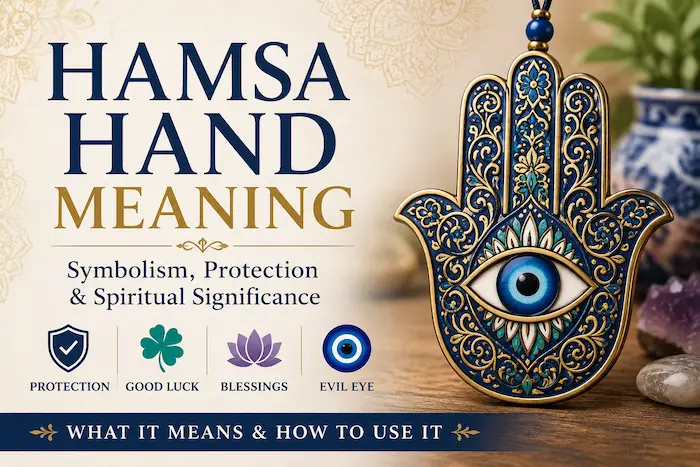
The hamsa hand meaning is usually summed up in four ideas: protection, good luck, blessings, and positive energy. The Hamsa Hand is a five-fingered hand symbol, most often shown with an open palm and a single eye at its center, and it appears across a wide range of Middle Eastern and North African cultural and religious traditions.
The symbol goes by several names. Hamsa and Khamsa come from a Semitic word for the number five. In Jewish contexts it is often called the Hand of Miriam, and in Islamic contexts the Hand of Fatima. Today it also turns up far outside those regions, on necklaces, wall hangings, and doorways around the world.
This guide explains what the Hamsa represents, why it is so closely linked to the Evil Eye, where the symbol is believed to have come from, and what changes when the hand faces up or down.
What Is the Hamsa Hand?
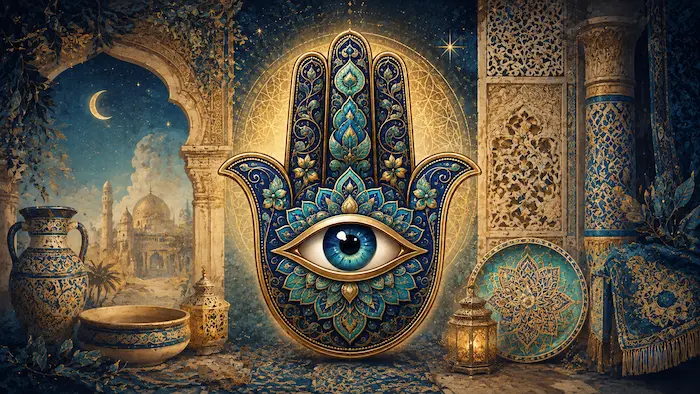
The Hamsa is an open right hand with five fingers, usually drawn as a flat, symmetrical shape. In its most recognizable form the two outer digits both look like thumbs, curving outward on either side, which gives the symbol its distinctive balanced outline. Realistic anatomy has never been the point.
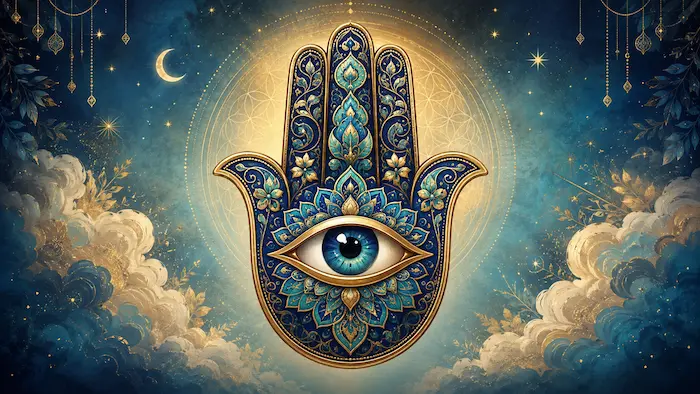
An eye is frequently placed in the middle of the palm. It is the single detail most people notice first, and it is the reason the Hamsa is so often confused with the Evil Eye symbol. Decorative versions may add fish, filigree, geometric patterns, or written blessings, depending on the tradition and the artist.
The symbol is known by several interchangeable names:
- Hamsa or Khamsa, the most common general terms
- Hand of Fatima, used mainly in Islamic and North African contexts
- Hand of Miriam, used mainly in Jewish contexts
- Hand of God or simply the protective hand, in more general usage
The name itself points to a number. Khamsa means five in Arabic, and the closely related Hebrew word for five is chamesh. The five fingers are central to how the symbol is read, and different traditions have attached their own meaning to that number.
What Does the Hamsa Hand Mean?
Protection sits at the center of the hamsa hand meaning, and it is the association shared most consistently across the cultures where the symbol is common. The open palm is understood as something that stops, deflects, or turns away negative energy and harm before it reaches a person, a family, or a home.
That protective sense is usually described in terms of unseen or unwanted influences: envy, ill will, bad intentions, or general misfortune. In everyday use, people place a Hamsa where it will be seen, which reflects the older idea that a visible protective sign does its work by being noticed.
Alongside protection, the Hamsa carries a set of positive associations:
- Good luck and general good fortune
- Blessings, including blessings on a home, a marriage, or a newborn
- Strength and steadiness in difficult circumstances
- Positive energy, in the sense of welcoming what is good rather than only blocking what is not
These meanings overlap rather than compete. A Hamsa given as a housewarming or wedding gift is normally intended as both a shield and a good wish at the same time. It is worth remembering that these are traditional and symbolic interpretations rather than claims that can be tested or proven.
Hamsa Hand and the Evil Eye
The Evil Eye is a belief found across the Mediterranean, the Middle East, North Africa, South Asia, and parts of Europe and Latin America. In its most common form, it holds that envy or an admiring but resentful look can bring misfortune to the person it lands on, often without the onlooker intending any harm. The idea appears under many names, including ayin hara in Hebrew, al-ayn in Arabic, and nazar in Turkish and Persian usage.
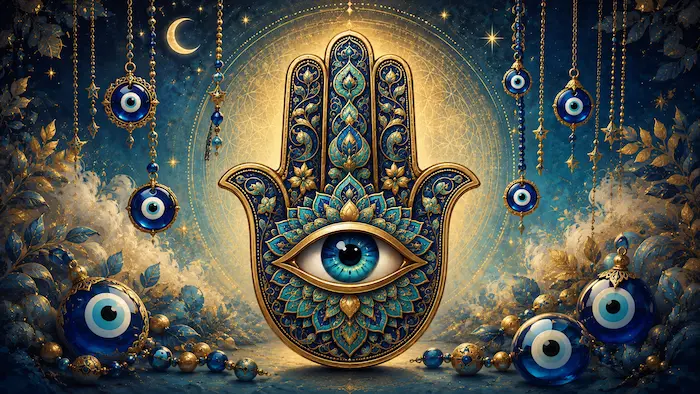
Where that belief exists, protective objects tend to exist alongside it, and a large part of the hamsa hand meaning recognized today comes from this connection. The Hamsa became one of the best known of those protective objects. An open hand reads naturally as a gesture of refusal or blocking, which makes it an intuitive counter-symbol to a harmful gaze.
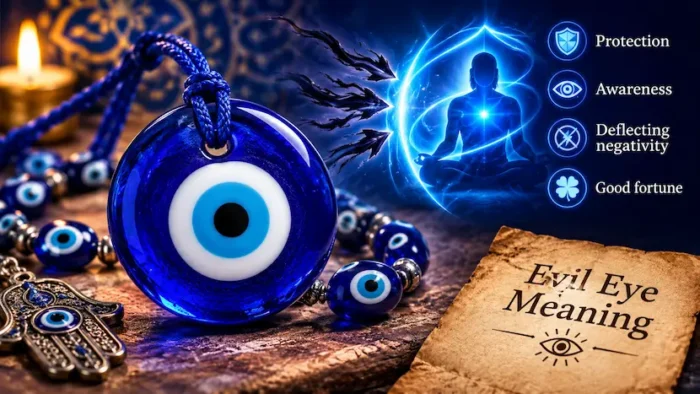
The Hamsa Hand and the Evil Eye are not the same symbol. The Evil Eye refers to the belief itself, and to the eye-shaped charms associated with it, such as the blue and white glass beads common in Turkey and Greece. The Hamsa is a hand-shaped symbol with its own history and its own religious associations.
The two are often combined because they answer the same concern. A Hamsa with an eye in the palm brings both protective ideas together in a single object, which is why the pairing has become so standard in modern jewelry that many people assume it was always one symbol.
What Does the Eye in the Hamsa Hand Mean?
The eye set into the palm is a watching, guarding eye rather than a threatening one. It is traditionally understood as a way of meeting the Evil Eye directly, returning the gaze instead of receiving it.
In practical terms, the eye is associated with protection against:
- The Evil Eye and harmful looks
- Envy and jealousy from others
- Bad intentions directed at a person or household
- General misfortune and bad luck
A Hamsa without an eye is still a complete symbol, and plenty of traditional designs leave the palm empty or fill it with patterns and script instead. The eye simply makes the protective purpose explicit. As with the symbol as a whole, these associations are cultural and spiritual rather than demonstrated effects.
Origin and History of the Hamsa Hand
The Hamsa has a long association with the Middle East and North Africa, but its precise origin is debated, and no single culture can be credited with inventing the symbol in the form used today.
Hand-shaped protective motifs appear in several ancient traditions. Similar hand images have been associated with ancient Mesopotamia, and the symbol is frequently linked to Carthage in North Africa, where an upraised hand appears in Punic religious art connected with the goddess Tanit. Protective hand amulets are also known from ancient Egypt and the wider Phoenician world. Scholars differ on how directly these earlier motifs connect to the modern Hamsa, and much of the popular history circulating online states these links far more confidently than the evidence allows.
Protective imagery of this kind was widespread in the ancient Mediterranean and was not limited to hands. The Greeks, for example, mounted the Gorgoneion, the head of Medusa in Greek mythology, on shields, temples, and household objects for broadly the same purpose, as an image meant to turn harm away. The impulse behind the Hamsa was not unusual in the ancient world.
What is clearer is the symbol’s later history. By the medieval period the Hamsa was established across North Africa and the Levant, and it was used by Muslim, Jewish, and Christian communities living in the same regions. Jewish communities in North Africa and the Middle East, particularly Sephardi and Mizrahi communities, carried the symbol with them through later migrations, which is one reason the Hamsa is now widely recognized in Israel and in Jewish communities elsewhere.
The most accurate summary is that the Hamsa developed as a shared regional symbol over a long period, rather than being invented once and borrowed afterward.
Hamsa Hand Meaning in Different Religions and Cultures
Because the Hamsa has circulated among neighboring communities for centuries, it has been adopted and explained in different ways. The core idea of protection stays fairly constant. What changes is the framework used to explain it, and in particular what the five fingers are said to represent.
Hamsa in Judaism: The Hand of Miriam
In Jewish tradition the symbol is often called the Hand of Miriam, after Miriam the prophetess, sister of Moses and Aaron. The name connects the symbol to a figure remembered for protection, guidance, and care for her people during the Exodus.
The Hamsa is used in Jewish contexts mainly as a sign of protection and blessing, frequently hung in homes or given at weddings and births. Many designs carry Hebrew text such as the Priestly Blessing, verses from Psalms, or the word for luck, which makes the object’s purpose explicit rather than leaving it to the shape alone.
The five fingers are commonly associated with the five books of the Torah. This is an interpretive connection rather than a formal religious requirement, and Jewish attitudes toward the symbol vary, with some communities embracing it warmly and others treating it as folk custom rather than religious practice.
Hamsa in Islam: The Hand of Fatima
In Islamic contexts, especially across North Africa and the Maghreb, the symbol is widely known as the Hand of Fatima, named for Fatima al-Zahra, the daughter of the Prophet Muhammad. She is honored for her faith, patience, and strength, and the association lends the symbol those qualities alongside its protective role.
The five fingers are often linked to the Five Pillars of Islam, and in some interpretations to the five daily prayers. Within Shia tradition the hand is sometimes associated with five revered figures of the Prophet’s household.
Practice is far from uniform. The Hamsa is popular in some Muslim communities as a cultural and decorative object, while other Muslims avoid amulets of any kind, viewing reliance on them as inconsistent with belief in God alone as protector. Both positions exist within Islam, and neither should be presented as the single Muslim view of the symbol.
Hamsa Hand Facing Up vs. Facing Down
The direction the hand points is the detail buyers ask about most often, and it is the one variable that shifts the hamsa hand meaning in everyday use. Orientation does change how the symbol is commonly read, though this distinction is best understood as a widely repeated modern convention rather than an ancient rule, and traditional designs do not always follow it.
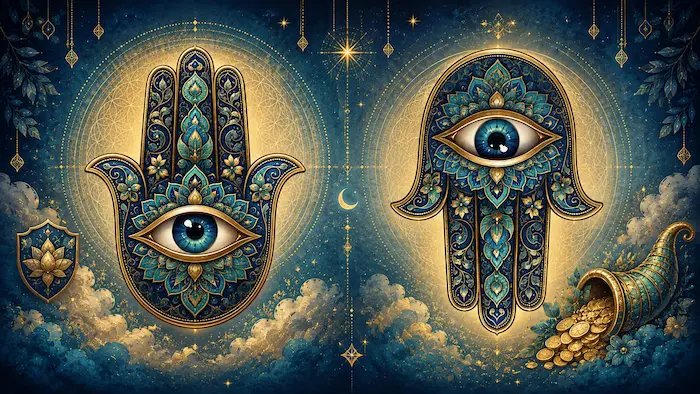
Hamsa Hand Facing Up Meaning
A Hamsa with the fingers pointing upward is read as a defensive symbol. The raised open palm resembles a gesture that says stop, which is why this orientation is associated with:
- Protection from harm
- Blocking or repelling negative energy
- Warding off the Evil Eye
- Defense against envy and ill intentions
Fingers on an upward Hamsa are sometimes shown spread apart, which is generally interpreted as strengthening that protective function.
Hamsa Hand Facing Down Meaning
A Hamsa with the fingers pointing downward is read as an open, receiving symbol, more like a hand extended in giving. It is commonly associated with:
- Blessings flowing toward the owner
- Abundance and prosperity
- Good luck and good fortune
- Welcoming positive energy into a home or life
Downward Hamsas often have the fingers held closely together, which is usually explained as gathering good fortune rather than letting it slip away.
Neither orientation is considered incorrect, and the two meanings are not treated as opposites in most traditions. Many people simply choose the one that matches what they want the object to represent.
How to Wear or Use the Hamsa Hand
The Hamsa is one of the most adaptable symbols in circulation, and it appears in both personal and household forms.
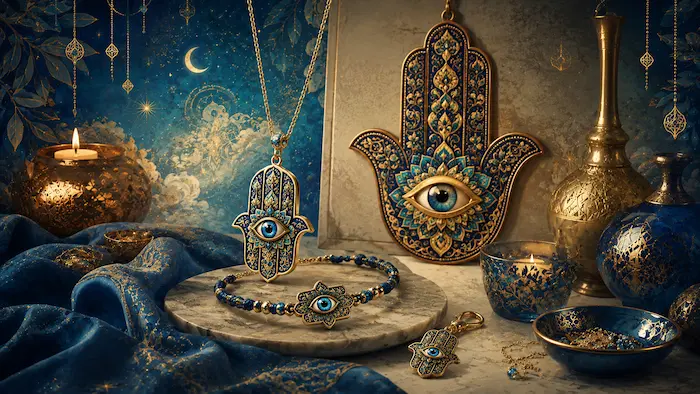
Worn as jewelry, it commonly takes the shape of:
- Necklaces and pendants, the most popular format by far
- Bracelets and charm bracelets
- Rings
- Earrings
In the home, it is used as:
- A wall hanging near an entrance or above a doorway
- A framed piece of art or ceramic tile
- A key holder, ornament, or small decorative object
- A gift for a new home, a wedding, or the birth of a child
Choosing an orientation is mostly a matter of intent. Someone drawn to the protective reading tends to choose an upward-facing Hamsa, while someone focused on blessings and abundance often prefers a downward-facing one. Both are widely available, and some designs are made to be turned either way.
No orientation, material, or placement guarantees a particular outcome. People wear the Hamsa for a range of reasons, including faith, cultural connection, family tradition, or simple appreciation of the design, and all of those are ordinary uses of the symbol.
Frequently Asked Questions
Is the Hamsa Hand a religious symbol?
The Hamsa has strong religious associations, particularly in Judaism and Islam, but it does not belong exclusively to any one faith. It has been used for centuries by neighboring communities across the Middle East and North Africa, each with its own explanation for the symbol. Today it is also worn widely as a cultural or decorative object by people with no religious connection to it, which is why its status depends heavily on context.
What is the difference between the Hamsa Hand and the Evil Eye?
The Hamsa is a hand-shaped symbol with five fingers, associated with protection, blessings, and good fortune. The Evil Eye refers to the belief that an envious or hostile gaze can cause misfortune, and to the eye-shaped charms used against it, such as blue glass beads. They appear together constantly because both are protective, and a Hamsa with an eye in the palm combines the two ideas in one object.
What does a Hamsa Hand with an eye mean?
It combines two protective ideas. The open hand is understood as blocking or turning away harm, and the eye in the palm is understood as watching for it, specifically guarding against the Evil Eye, envy, and bad intentions. Together they form the most familiar version of the symbol. The meaning is protective rather than threatening, and it is a traditional interpretation rather than a claim about proven effects.
Should the Hamsa Hand face up or down?
Neither direction is universally correct. An upward-facing Hamsa is generally associated with protection, blocking negativity, and warding off the Evil Eye. A downward-facing Hamsa is generally associated with blessings, abundance, and welcoming good fortune. This distinction is a common modern convention rather than a fixed rule, and traditional designs vary. Most people choose based on which meaning they want the object to carry.
Is it okay to wear a Hamsa Hand?
Many people wear the Hamsa as jewelry, as a protective symbol, or as a link to family or cultural heritage, and it is widely sold and worn internationally. The main consideration is respect. The Hamsa carries real religious and cultural significance for Jewish and Muslim communities in particular, so understanding what it means, and where it comes from, matters more than the object itself.
Conclusion
The hamsa hand meaning centers on protection. The five-fingered open hand is understood across many traditions as a symbol that turns away harm, envy, and misfortune, and it carries blessings, good luck, and positive energy alongside that protective role.
Its close link with the Evil Eye explains the watching eye so often placed in the palm, though the two remain separate symbols with separate histories. Jewish and Islamic traditions each read the five fingers in their own way, as do the many cultures that have shared the symbol across the Middle East and North Africa.
Orientation adds one final layer: facing up for protection, facing down for blessings, with neither considered more correct than the other.

About the Author
Dana Whitfield
I write about numerology, astrology, mythology, tarot, and world mystical traditions for Mystivora, drawing on years of independent research across comparative religion and symbolic systems. I approach each topic by cross-checking primary texts and established scholarship rather than repeating popular but unverified claims.