Athena Greek mythology centers on the Olympian goddess of wisdom, strategic warfare, and skilled craft. Athena is a daughter of Zeus, one of the Twelve Olympians, and the patron goddess of Athens, the city that carried her name and raised the Parthenon in her honor. Her birth was unlike that of any other Greek deity, since she emerged fully grown and already armed. Across the tradition she appears less as a distant power than as an active participant, advising Perseus, Heracles, and Odysseus, taking a firm side in the Trojan War, and punishing mortals whose confidence outran their judgment.
Who Is Athena in Greek Mythology?
Athena is one of the Twelve Olympians, the daughter of Zeus and the Oceanid Metis, and one of the most widely worshipped deities in the Greek world. She holds a permanent place on Olympus and is presented throughout Greek mythology as second to almost no one in influence, with a standing close to that of her father.
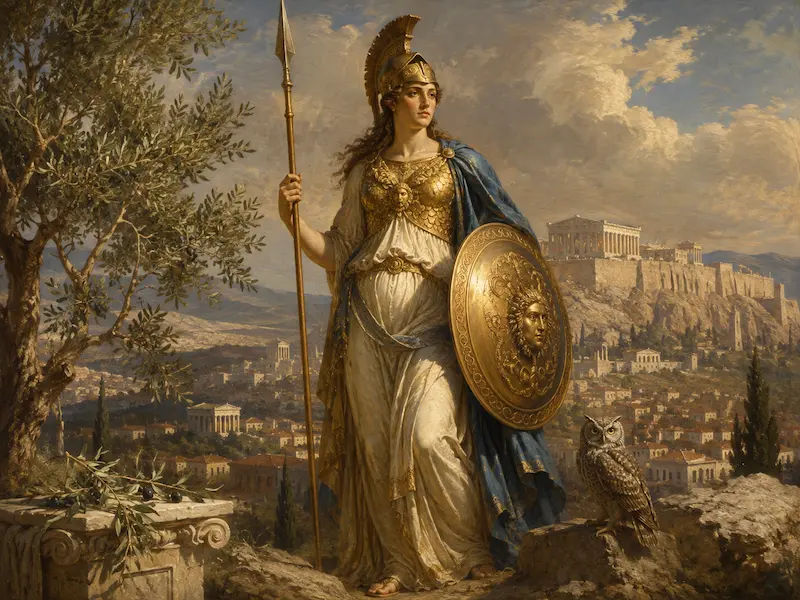
What defines Athena in Greek mythology is the combination of qualities she represents. She is tied to intelligence, planning, and good counsel, and at the same time to organized warfare, skilled craftsmanship, and the safety of cities. Those areas look unrelated at first, but they share one thing: each depends on knowledge applied deliberately rather than on raw force or instinct.
She also spends more time among mortals than most Olympians. When a Greek hero needs advice, equipment, or a plan he could not have devised alone, Athena is usually the deity who supplies it. Her Roman equivalent is Minerva.
What Is Athena the Goddess Of?
Athena is the goddess of wisdom, strategic warfare, crafts and weaving, and the protection of cities and heroes. Those four domains cover nearly every appearance she makes in myth and nearly every form her worship took across the Greek world.
Goddess of Wisdom
Wisdom is the domain most closely attached to her name, and Greek sources treat it as something practical rather than abstract. Athena represents intelligence in use: sound judgment, sensible counsel, and the ability to see how a situation will develop before it does.
This is not the wisdom of philosophy or contemplation. It is the wisdom of the person who chooses correctly under pressure. Homer repeatedly shows her supplying exactly that, arriving at the moment a decision has to be made and steering it. Her mother Metis, whose name itself means cunning intelligence, makes the association explicit at the level of parentage.
Goddess of Strategic Warfare
Athena governs the intelligent half of war. Her territory is planning, discipline, tactics, defensive preparation, and the organized conduct of a campaign, which is why Greek armies invoked her for success rather than only for courage.
Ares holds the other half. He represents combat as violence and rage, the experience of the battlefield once order has broken down. Greek poets kept the two apart deliberately and made no secret of which they preferred, since Athena defeats Ares whenever the two meet in the myths.
Goddess of Crafts and Weaving
Athena is the divine patron of skilled work with the hands. Potters, metalworkers, shipwrights, and carpenters all fell under her protection, and Greek craftsmen approached her as the source of technical ability rather than of inspiration.
Weaving is the craft most strongly identified with her. Textile production was central to Greek household economy and to the religious life of Athenian women, and Athena stands at the head of it. That association is what gives the myth of Arachne its force, since a mortal weaver claiming to match the goddess was challenging her in her own field.
Protector of Cities and Heroes
Athena’s role as a protector of cities is one of her oldest and most practical functions. She was worshipped as the guardian of the fortified center of a settlement, the place a community retreated to when attacked, and Athens is only the most famous example of a city that claimed her protection.
The same protective role extends to individuals. Athena attaches herself to heroes and helps them through counsel, disguise, and equipment rather than by fighting in their place. What she offers is almost always information or an advantage of method, which is consistent with everything else about her.
The Birth of Athena
The birth of Athena is one of the strangest episodes in the whole tradition. Metis, an Oceanid associated with cunning intelligence, was the first wife of Zeus. A prophecy warned that she would bear a daughter, and that a son born to her afterward would overthrow his father, repeating what Zeus had done to Cronus and Cronus had done to Uranus.
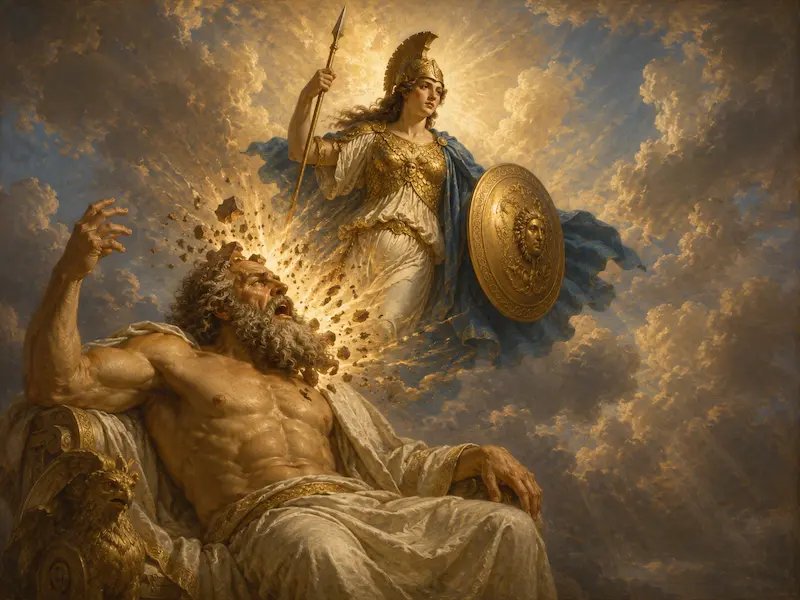
Zeus dealt with the threat by swallowing Metis while she was pregnant. Some time later he was seized by a violent pain in his head. In the standard account his skull was split open, and Athena stepped out fully grown and in armor. Hesiod is the earliest source for the essentials, and later writers name Hephaestus or Prometheus as the one who struck the blow.
The story is not decoration. By swallowing Metis, Zeus absorbs cunning intelligence into himself, and what emerges from his head is that intelligence in personal form. Athena has no infancy, no period of learning, and no development, because she is not a being who acquires wisdom over time. She arrives complete, already carrying the qualities of her mother and the authority of her father, and the myth encodes her nature rather than merely describing an unusual delivery.
Athena’s Family
Her immediate family is small. Her father is Zeus, king of the Olympian gods, and her mother is Metis, which places Athena among the second generation of Olympians and connects her, through Metis, to the older Titan lineage shown in the Greek mythology family tree.
Athena has no husband. She is one of the three virgin goddesses of the Greek pantheon, alongside Artemis and Hestia, and her permanent refusal of marriage is treated as part of her divine identity rather than as a temporary condition. Ancient sources attribute no consort to her and, in the mainstream tradition, no children.
Her relationship with Zeus is closer than that of most of his children, and several myths show her acting with his authority behind her. She is described as the only Olympian permitted to handle his weapons, which says a good deal about the trust the tradition assigns her.
Symbols of Athena
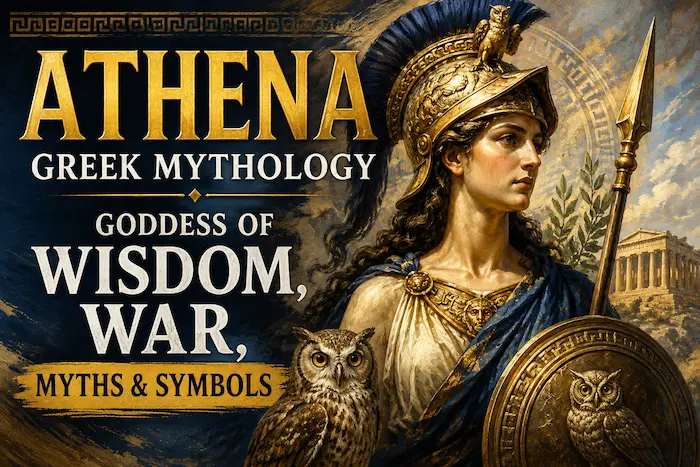
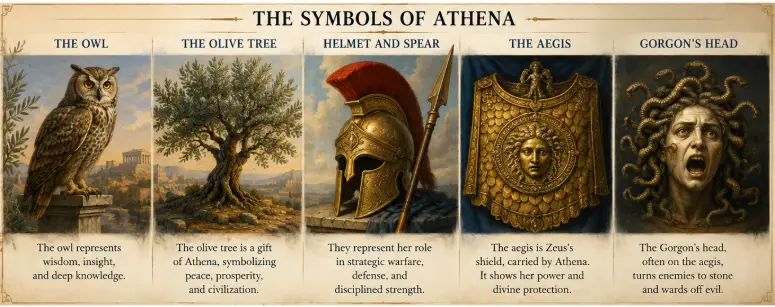
Greek artists identified Athena through a small and consistent set of attributes. A helmeted woman with a spear, an owl nearby and a snake-fringed cape across her chest, needed no name attached in ancient art.
The Owl
The owl is her best known symbol and the one most firmly attached to wisdom. Athena carries the Homeric epithet glaukopis, usually rendered as bright-eyed or owl-eyed, and the little owl of Athens appears beside her constantly in art.
Athens stamped the owl on its silver coinage for centuries, which spread the image far beyond Greece and made it one of the most recognizable emblems of the ancient world. The modern association between owls and knowledge descends more or less directly from that coinage.
The Olive Tree
The olive belongs to Athena because of the gift she offered to Athens, described in the section below. It represents the practical, cultivated side of her character rather than the martial side, since the olive fed the city, lit its lamps, and supplied one of its most valuable exports.
A sacred olive on the Acropolis was pointed out to visitors as the original tree she produced. The symbol ties her permanently to Athens and to the idea of prosperity secured through skill and cultivation.
Helmet and Spear
Athena is almost always shown armed. The crested helmet and the long spear mark her as a war deity, and the shield completes the equipment.
The way she carries it matters. Athena appears composed and upright rather than mid-fury, presented as a commander rather than a combatant, which visually separates her from Ares. Her armor stands for readiness and control instead of aggression.
The Aegis and Gorgon’s Head
The aegis is her most distinctive attribute. Ancient descriptions vary between a shield and a fringed goatskin cape worn across the shoulders, and it is regularly shown edged with snakes and bearing a terrifying face at its center.
That face is the Gorgoneion, the head of a Gorgon. Greek tradition connects it to Perseus, who gave the severed head of Medusa to Athena after his mission was complete. Whatever the origin, its function is clear enough: the aegis is an object of protection and of terror at the same time, and enemies who face it are expected to break.
Athena and the City of Athens
No Greek deity is bound to a single city as tightly as Athena is bound to Athens. The city took her as its patron, built its greatest temple for her, held its most important festival in her honor, and shared her name, a connection ancient writers debated without ever settling which came first.
The relationship went well beyond ceremony. Athens presented itself as a city of skill, craft, and intelligence, and it presented Athena as the reason. Civic identity and religious devotion reinforced each other continuously, and the goddess functioned as an argument for what the Athenians believed about themselves.
Athena and Poseidon’s Contest
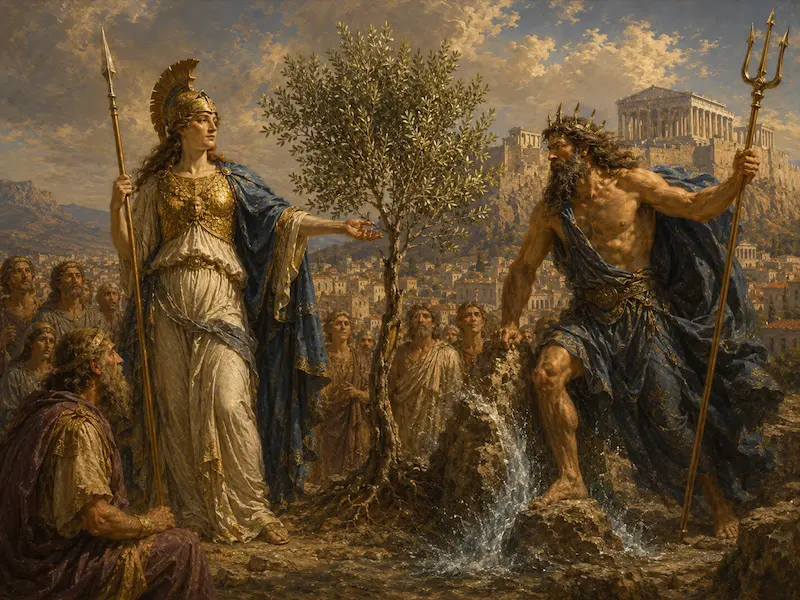
The founding myth of that relationship is a competition. Athena and Poseidon both wanted the city of Attica, and it was agreed that each would present a gift and that the better one would decide the outcome.
Poseidon struck the rock of the Acropolis with his trident and produced water. Most accounts describe a spring of salt water, and some traditions credit him instead with producing the first horse. Athena planted the olive tree.
The olive was judged the greater gift, since it provided food, oil, and timber where the spring provided nothing that could be drunk. Ancient sources differ on who made the judgment, naming the legendary king Cecrops, the assembled gods, or the citizens themselves depending on the version. Athena became patron of the city, and Poseidon retained a place in Athenian worship despite the loss.
Major Myths of Athena
The best-known Athena Greek mythology stories place her in three recurring roles: the protector who intervenes on behalf of a favored mortal, the strategist whose plan decides an outcome, and the goddess who answers arrogance with a punishment nobody negotiates.
Athena and Arachne
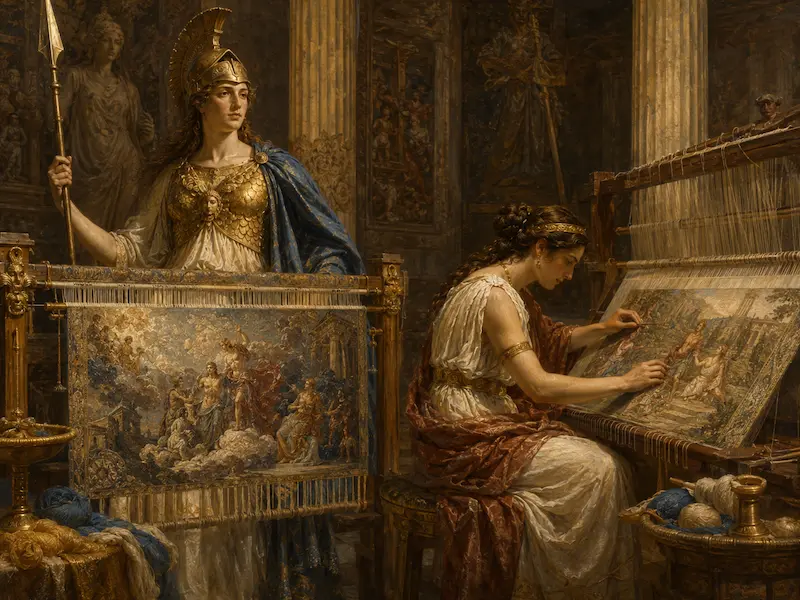
Arachne was a young woman of Lydia whose weaving was extraordinary enough to draw crowds. Ancient accounts differ on what exactly she did wrong. In some she denied having learned anything from Athena, in others she challenged the goddess directly to a contest.
The contest took place. Athena wove a design centered on her victory over Poseidon, surrounded by scenes of mortals punished for challenging the gods, which functioned as a warning as much as a display. Arachne wove scenes of gods deceiving and mistreating mortals, and the work was flawless.
What followed is told in different ways. In the version told at length by the Roman poet Ovid, Athena destroyed the web, Arachne hanged herself in despair, and the goddess transformed her into a spider so that she and her descendants would weave forever. Earlier Greek references to Arachne are brief and do not preserve the full narrative, so the detailed story that circulates today is largely Ovid’s. The core of the myth is stable regardless of version: a mortal met the goddess of weaving on her own ground and did not survive the meeting intact.
Athena, Perseus and Medusa
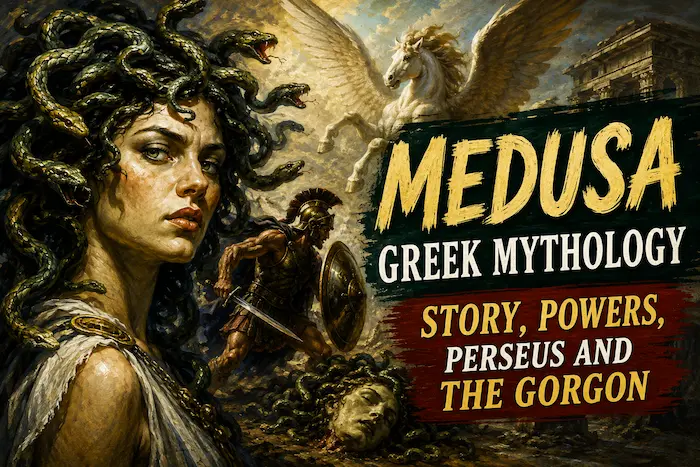
Perseus was sent to bring back the head of Medusa, a task designed to be fatal, and Athena is the reason it was not. She appears in the tradition as his guide from the beginning, directing him toward the beings who knew where the Gorgons lived and toward the equipment he would need.
Her most important contribution is a method rather than a weapon. Because the gaze of Medusa turned onlookers to stone, Perseus could not attack what he was looking at directly, and Athena supplied the solution: a polished reflective surface, usually described as a bronze shield, that let him see his target without meeting her eyes. The rest of his gear, including winged sandals and a cap of invisibility, comes from other divine sources in most accounts.
Perseus beheaded Medusa while she slept and escaped her immortal sisters. When the mission was over he gave the head to Athena, who set it on her aegis, which is how the Gorgoneion became a permanent part of her iconography.
Athena and the Greek Heroes
Athena is the patron goddess of heroic effort, and the pattern of her help is remarkably consistent. She rarely fights in a hero’s place. She provides the information, the object, or the plan that turns an impossible task into a solvable one.
- Heracles. She assists him repeatedly through the Labors, most memorably by supplying a bronze rattle that drove the Stymphalian birds out of their marsh when direct pursuit was impossible. She appears beside him constantly in Athenian vase painting, presented as his steady divine support.
- Perseus. She guides the entire Medusa expedition and supplies the reflective shield that makes the killing possible, then receives the Gorgon’s head afterward.
- Jason. She is credited with helping build the Argo, and one tradition has her fit into its prow a timber from the oracular oak at Dodona that could speak and give guidance to the crew.
- Odysseus. She is his protector across both Homeric epics, the closest and longest of all her attachments to a mortal.
Taken together, these relationships explain her reputation better than any list of powers. Athena is the deity you want on your side when the problem cannot be solved by strength.
Athena in the Trojan War
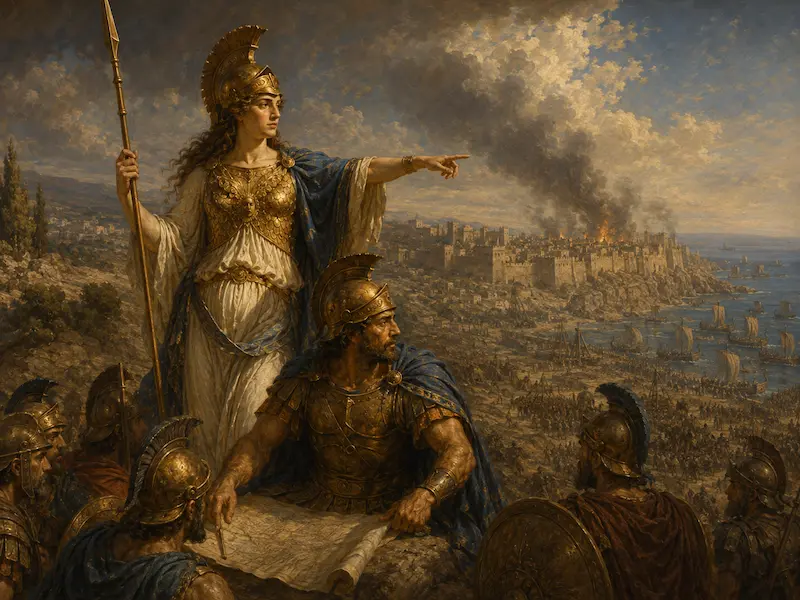
Among Athena Greek mythology stories, the Trojan War shows her strategic character especially clearly. Athena supports the Greeks throughout the conflict and works against Troy from beginning to end. The cause is usually traced to the Judgement of Paris, in which Hera, Athena, and Aphrodite competed for a golden apple marked for the fairest and Paris, a Trojan prince, was appointed to decide. Each goddess offered him something, and he chose Aphrodite, who had promised him the most beautiful woman in the world. Athena and Hera turned against Troy from that moment.
Her involvement in the fighting is constant and specific. In the Iliad she restrains Achilles from killing Agamemnon in the opening quarrel, giving him a reason to stop rather than an order. She strengthens Diomedes, guides the spear that wounds Ares, and later strikes Ares down herself. In the final duel she appears to Hector disguised as his brother Deiphobus, convincing him to stand and fight when he would otherwise have kept running.
The war ends with a trick rather than a battle, and Athena is connected to that as well. The wooden horse is built by the craftsman Epeius with her help, and the plan that finally takes the city belongs squarely to her territory. Her role in the conflict is a demonstration of the argument the Greeks made through her: wars are decided by intelligence.
Athena and Odysseus
Odysseus is the mortal Athena is closest to, and the reason is temperamental rather than sentimental. He is the most resourceful of the Greek heroes, known for cleverness, disguise, and calculated deception, which makes him the human version of what she governs. Homer has her say as much, describing the two of them as alike in wit and in the ability to plan.
She works with him constantly. She advises him during the war, and in the Odyssey she manages his return, intervening with the other gods on his behalf, disguising him as a beggar so he can enter his own house unrecognized, guiding his son Telemachus, and standing beside him during the confrontation with the suitors.
Their partnership is the clearest illustration of what Athena values. She does not favor Odysseus because he is the strongest Greek, since he plainly is not. She favors him because he thinks the way she does.
Worship of Athena
Athena was worshipped across the entire Greek world, in Sparta, Argos, Rhodes, and the Greek cities of Asia Minor as well as in Attica, usually as the protector of the citadel. Athens was the undisputed center of her cult.
Her sanctuary occupied the Acropolis, the rocky height above the city. The Parthenon, built there in the fifth century BCE during the Periclean building program, was the largest of her temples and housed the Athena Parthenos, a colossal statue of gold and ivory made by the sculptor Phidias. A second temple on the Acropolis, the Erechtheion, held a much older wooden image of the goddess that was treated as the holiest object in Athenian religion.
The Panathenaia was the central festival of the Athenian year, held annually with a far larger version, the Great Panathenaia, every four years. Its most important element was a procession that carried a newly woven robe, the peplos, up to the Acropolis and presented it to the goddess. Athenian women wove that robe, which tied the city’s greatest religious occasion directly to Athena’s role as goddess of weaving.
Athena’s Names and Epithets
Greek deities were approached under many titles, and each epithet identified a particular function rather than a separate god. Worshippers called on the aspect of Athena that suited the occasion, and three of her titles appear far more often than the rest.
Pallas Athena
Pallas is the epithet most commonly joined to her name, used in poetry from Homer onward. Ancient writers explained it in several ways, including a companion named Pallas whom Athena killed by accident and afterward commemorated, and a giant of that name defeated in the war against the Giants. Modern scholars have proposed connections to Greek words for a young woman and for brandishing a weapon. None of these explanations is settled, and the name is older than the stories told to account for it.
Athena Parthenos
Parthenos means maiden, and the title marks her permanent virginity. It is the name attached to the Parthenon, which takes its own name from the same word, and to the great statue that stood inside it. The epithet identifies the goddess as complete in herself and belonging to no household, which is a statement about her independence rather than only about her marital status.
Athena Polias
Polias means of the city, and this is the title under which Athena was worshipped as the guardian of the community itself. Athena Polias received the ancient wooden statue in the Erechtheion and the woven peplos of the Panathenaia, which makes it the most civic of her names. Many other Greek cities used the same title for their own protecting goddess.
Frequently Asked Questions About Athena
What is Athena the goddess of?
Athena is the goddess of wisdom, strategic warfare, crafts and weaving, and the protection of cities and heroes. Her wisdom is practical rather than philosophical, covering judgment, counsel, and planning. Her warfare is tactical rather than violent, which separates her from Ares. She was also worshipped widely as the guardian of a city’s fortified center, most famously at Athens.
Is Athena Zeus’s daughter or wife?
Athena is the daughter of Zeus, not his wife. His wife is Hera, who is also his sister. Athena’s mother is Metis, an Oceanid associated with cunning intelligence and the first wife of Zeus, whom he swallowed while she was pregnant. Athena was then born from the head of Zeus, which is why some retellings mistakenly describe her as having no mother at all.
Is the Greek goddess Athena a virgin?
Yes. Athena is one of the three virgin goddesses of the Greek pantheon, along with Artemis and Hestia. Her virginity is presented as permanent and as part of her divine identity rather than as a phase, and it is reflected in her title Parthenos, meaning maiden. Ancient sources give her no husband and, in the mainstream tradition, no children.
Who was Zeus’s favorite child?
Athena is the child most often described this way. Ancient sources show Zeus granting her requests, trusting her with his weapons, and treating her with a favor the other Olympians notice. Greek mythology never ranks his children formally, though, and there is no canonical list. The strongest accurate statement is that Athena is portrayed as unusually close to her father, not that any text names her his favorite.
Why did Zeus love Athena?
The myths present several reasons. Athena was born from Zeus himself and carries the intelligence of her mother Metis, which makes her an extension of his own authority. She is also consistently loyal, never joining the plots the other Olympians make against him, and her domains of wisdom and ordered warfare support the stability he is meant to guarantee. Ancient texts show the closeness without explaining it directly, so any account of the reasons is interpretation.

About the Author
Dana Whitfield
I write about numerology, astrology, mythology, tarot, and world mystical traditions for Mystivora, drawing on years of independent research across comparative religion and symbolic systems. I approach each topic by cross-checking primary texts and established scholarship rather than repeating popular but unverified claims.