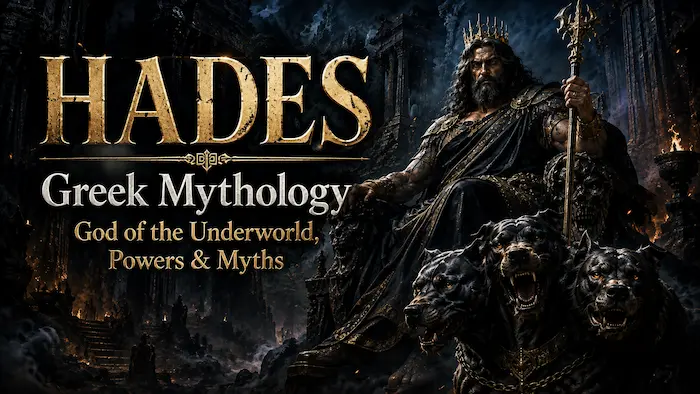
Hades Greek mythology centers on one of the most powerful and feared figures in the ancient Greek pantheon. Hades is the god of the dead and the ruler of the Underworld, the realm where human souls traveled after death. Son of the Titans Cronus and Rhea, and brother of Zeus and Poseidon, Hades claimed dominion over the kingdom beneath the earth following the defeat of the Titans. His name came to describe both the deity himself and the realm he governed, making Hades one of the few figures in Greek mythology whose identity was so completely bound to his domain.
Who Is Hades in Greek Mythology?
Hades is the god of the dead and the king of the Underworld in Greek mythology. He is a son of the Titans Cronus and Rhea and a brother of Zeus, Poseidon, Hera, Demeter, and Hestia. His wife is Persephone, daughter of Demeter, who rules alongside him as queen of the Underworld.
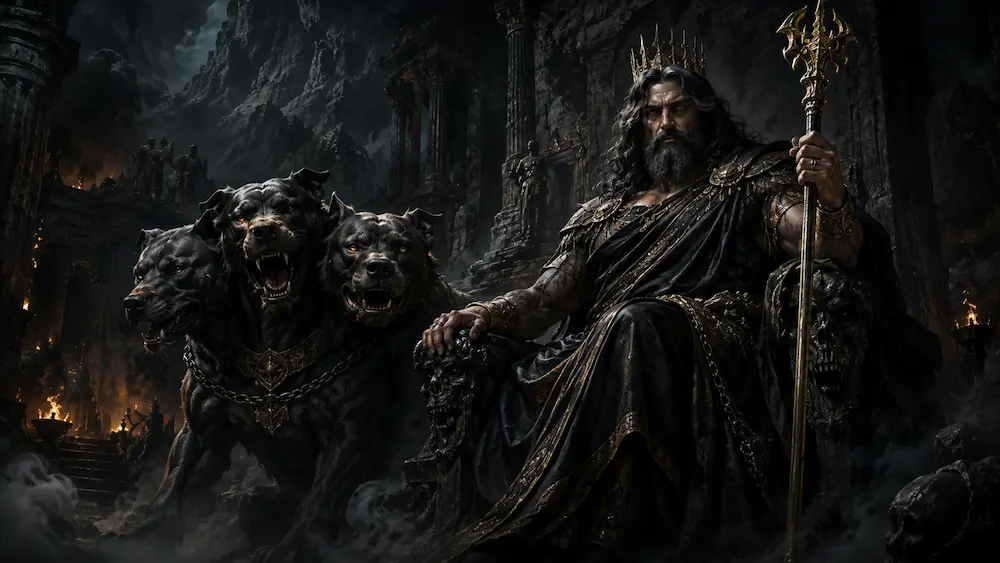
In ancient Greek religious tradition, the name “Hades” referred to both the god and to his realm. Homer used it exclusively as the name of the deity, but later writers transferred the name to the place itself, so that references to “going to Hades” described the journey to the land of the dead rather than an encounter with the god personally. Hades is not the god of death (that role belonged to Thanatos), but rather the ruler and sovereign of the domain where the dead reside.
Unlike his brothers Zeus and Poseidon, who figured prominently in stories set on Olympus and across the mortal world, Hades rarely left his kingdom. He was described by Homer as the most hated of all the gods by mortals, not because of cruelty but because his domain represented the final destination that no living person wished to reach. The ancient Greeks also knew him as Plouton, a euphemistic title meaning “the wealthy one,” reflecting his association with the precious metals and fertile soils hidden beneath the earth.
Hades’ Family and Origins
Hades was born to Cronus and Rhea, king and queen of the Titans, along with five siblings: Hestia, Demeter, Hera, Poseidon, and Zeus. A full picture of this divine family appears in the Greek mythology family tree. Cronus had received a prophecy that one of his own children would overthrow him, just as he had overthrown his own father Uranus. To prevent this, he swallowed each child as they were born. Hades, Hestia, Demeter, Hera, and Poseidon all suffered this fate.
When Rhea gave birth to Zeus, she concealed the infant and deceived Cronus into swallowing a stone wrapped in cloth. Zeus was raised in secret and, once grown, forced Cronus to disgorge his swallowed siblings. Hades and his brothers and sisters emerged and, together with Zeus, waged war against Cronus and the Titans in the conflict known as the Titanomachy. During this war, the Cyclopes, freed from their own imprisonment, provided weapons to the three brothers: a thunderbolt for Zeus, a trident for Poseidon, and a helmet for Hades. According to Pseudo-Apollodorus, this helmet rendered its wearer invisible, earning it the name the Helm of Darkness.
How Hades Became God of the Underworld
After the Titans were defeated and imprisoned in Tartarus, Zeus, Poseidon, and Hades divided the cosmos among themselves by drawing lots. Zeus won the sky and the heavens. Poseidon received the sea. Hades drew the third portion: the dark realm of the dead, the Underworld. The earth and Mount Olympus were held in common by all three brothers.
This division established Hades as the god of the Underworld in Greek mythology, with authority equal in principle to that of his brothers over their respective domains. He ruled what ancient sources called the “mists and darkness,” a vast kingdom beneath the earth where all mortal souls eventually came to reside. From the moment of this division, Hades made the Underworld his permanent home. Unlike Zeus and Poseidon, who traveled freely between realms and played active roles in mortal affairs, Hades remained in his kingdom and rarely ventured above ground. An overview of the major Greek gods and how their domains related to one another provides useful context for understanding this cosmic division.
The Underworld in Greek Mythology
The Underworld in Greek mythology is the realm of the dead, the great subterranean kingdom governed by Hades and Persephone. Ancient Greek writers described it as a dark and dismal place: not a site of punishment for all souls, but the universal destination of the dead. Homeric accounts portrayed it as lying beneath the earth, a shadowy domain populated by the shades of the deceased.
Upon death, a soul would be guided toward the Underworld, where it would cross into Hades’ kingdom and join the company of those who had died before. Hades and Persephone presided as king and queen of this realm, maintaining its order and boundaries. Hades was known to keep the gates closed and to ensure that no shade could escape back to the world of the living, a function that made him both feared and respected as the enforcer of the boundary between life and death.
Within the Underworld, different regions served different purposes. Elysium was reserved for virtuous and heroic souls who had earned a blessed afterlife. Tartarus, located far below even the main body of the Underworld, served as a prison for those who had committed the gravest offenses. The Asphodel Meadows were the destination for ordinary souls who had lived neither particularly virtuous nor particularly wicked lives.
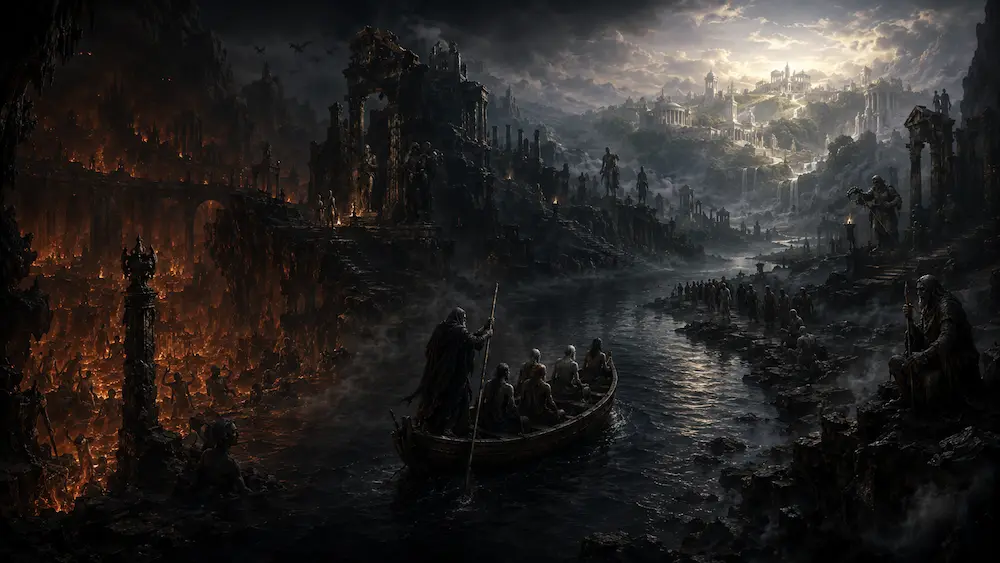
The River Styx
The River Styx is among the most prominent features of the Underworld in Greek mythology. Its name derived from the Greek word meaning “to hate,” and it formed a boundary between the living world and the realm of the dead. The Styx is described in later sources as encircling the Underworld, though earlier Greek accounts more often named the Acheron as the river across which Charon ferried souls. Both rivers appear together in the fuller traditions preserved by Roman poets such as Virgil.
Charon was the ferryman of the dead. He transported the souls of those who had received proper burial rites across the boundary river into Hades’ kingdom. Souls were expected to pay a coin (the “obol of Charon”) as payment for the crossing. This belief led to the Greek practice of placing a coin in the mouth or on the eyes of the deceased during burial rites. Those who had not been buried and could not pay were said to wander the shores for a hundred years before being admitted.
The Styx also held significance beyond its role as a boundary for the dead. The gods themselves swore their most binding oaths by its waters, and such an oath was considered unbreakable even by the Olympians. This sacred quality made the River Styx far more than a geographical feature of the Underworld: it was a foundation of divine law itself.
Cerberus
Cerberus is the monstrous hound that guarded the entrance to the Underworld. Ancient sources most commonly described him as having three heads, and he was set at the gates to prevent the living from entering and the dead from leaving. He was closely associated with Hades, serving as his companion and the most visible symbol of the Underworld’s impassable boundary. Cerberus is among the most recognizable of all Greek mythology creatures tied directly to the gods.
Cerberus allowed the shades of the dead to enter Hades’ kingdom but permitted no one to leave. His presence at the gates reinforced the finality of death in Greek religious thought. The few figures who managed to pass Cerberus (Heracles, Orpheus, and in Roman tradition Aeneas) did so under extraordinary circumstances and with divine sanction. For most mortals, the guardian hound represented the absolute nature of Hades’ sovereignty over his realm.
Tartarus
Tartarus is a distinct region in Greek cosmology, separate from the main body of the Underworld. In Hesiod’s Theogony, Tartarus is described as a primordial entity, one of the first forces to exist in the universe, as well as a physical place. It was positioned as far below Hades’ realm as the earth lies below the heavens: a sunless abyss of extraordinary depth. Homer’s Iliad explicitly distinguished Tartarus from the realm of Hades, placing it as a pit lying as far beneath the Underworld as the earth lies beneath heaven.
In its earliest conception, Tartarus functioned primarily as a prison for beings who threatened the order of the cosmos. After the Titanomachy, Zeus confined the defeated Titans within Tartarus, with the Hecatoncheires set as their guards. Typhon, the monstrous giant who challenged Zeus for dominion of the world, was also imprisoned there after his defeat.
In later mythological traditions, Tartarus evolved to include a punitive function for mortals who had committed severe transgressions. Figures such as Tantalus, Sisyphus, Ixion, and the Danaides were assigned eternal punishments in Tartarus for crimes against the gods or against the laws of hospitality. This later conception placed Tartarus as the lowest and most terrible section of the Underworld, reserved for the worst offenders, the opposite of Elysium, where the blessed dead resided. It is important to note that Tartarus was not the same as the Underworld as a whole: most souls went to Hades’ kingdom, not to Tartarus.
Hades and Persephone
The most significant myth directly involving Hades concerns his marriage to Persephone. Persephone was the daughter of Demeter, goddess of the harvest, and Zeus. According to the Homeric Hymn to Demeter and other ancient sources, Hades desired a wife and petitioned Zeus, who consented to the arrangement without informing Demeter. As Persephone was gathering flowers in a meadow, Hades appeared and brought her down to the Underworld.
Demeter, devastated by the loss of her daughter, searched the earth and in her grief withdrew her favor from the land, causing crops to fail and famine to spread. Zeus was forced to intervene when it became clear that humanity would perish. He sent Hermes to the Underworld to negotiate Persephone’s return.
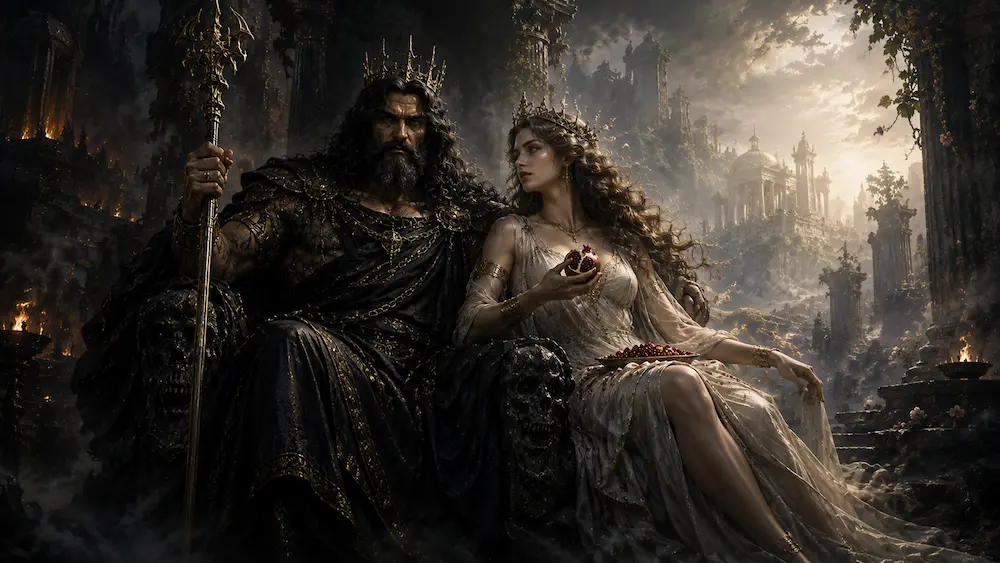
However, before departing, Persephone had consumed pomegranate seeds. Ancient sources differ on the number of seeds and the exact circumstances (whether she ate them unknowingly, as suggested by the language of the Homeric Hymn, or under some degree of compulsion, as other traditions imply) but the result was binding. A compromise was reached: Persephone would spend a portion of each year in the Underworld with Hades and the remainder above ground with her mother. From this arrangement, Persephone became queen of the Underworld, ruling alongside Hades as his equal in the governance of the dead.
Ancient Greek tradition linked this myth to the agricultural year. When Persephone remained in the Underworld, Demeter’s sorrow caused the earth to lie bare and unproductive. When Persephone returned, the land blossomed. This association between the myth and the cycle of seasons appears in sources from the Homeric Hymn onward and was one of the foundational explanations for seasonal change in Greek religious thought.
Famous Myths About Hades
Hades appears far less frequently in Greek mythology than most major Olympian figures. His preference for his own realm and his detachment from mortal affairs meant that direct interaction with him was rare and always significant. In Hades Greek mythology stories, the myths that feature him generally center on the Underworld and involve mortals or heroes who had reason to descend into his kingdom.
Orpheus and Eurydice
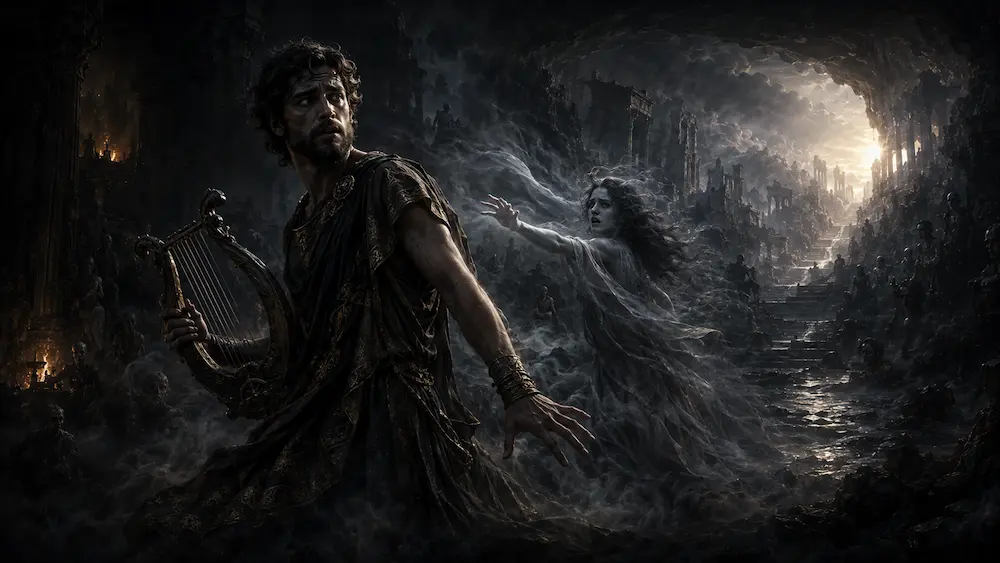
One of the most celebrated myths involving Hades is the story of Orpheus and Eurydice. Orpheus was a legendary musician whose skill with the lyre was said to move even stones and rivers. When his wife Eurydice died from a serpent’s bite, Orpheus descended into the Underworld to seek her return.
He appeared before Hades and Persephone and played his lyre, pleading for Eurydice’s release. According to Ovid’s Metamorphoses, his music stilled the very punishments of the Underworld. Hades and Persephone, moved by Orpheus’ song, agreed to let Eurydice return to the living world on one condition: Orpheus must walk ahead of her and not look back until both had fully left the Underworld.
Orpheus held to this condition until the very threshold of the upper world. At that moment, overcome with uncertainty or longing, he turned to see if Eurydice followed. She was there, but had not yet fully crossed into the living world. She was drawn back into the Underworld, and Orpheus lost her a second time. The story illustrated Hades’ uncompromising sovereignty: he had granted an extraordinary exception, and when the terms were broken, the outcome was final.
Heracles and Cerberus
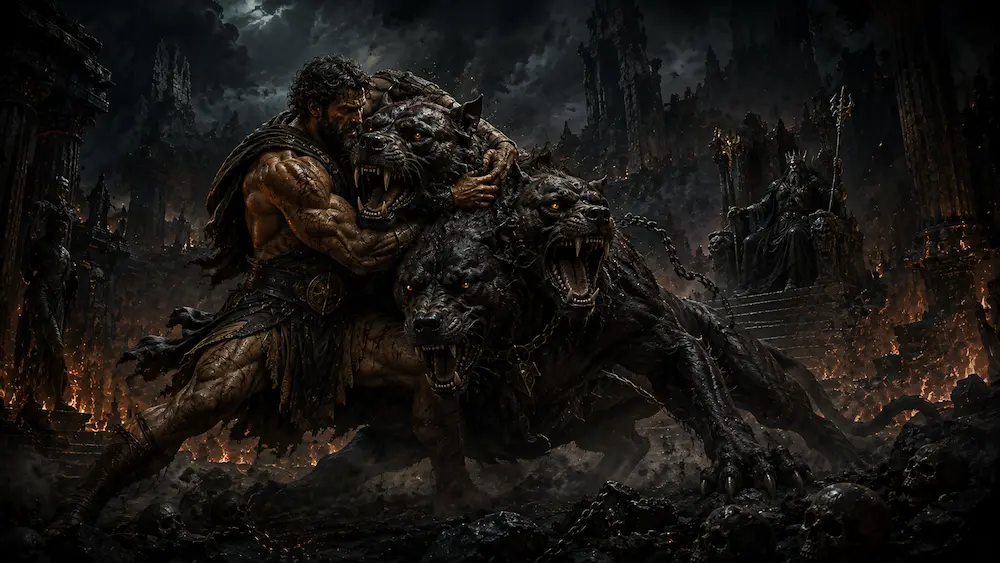
One of the Twelve Labors assigned to Heracles required him to descend into the Underworld and bring Cerberus back to the upper world alive, without using weapons. This labor was considered the most dangerous of all, requiring Heracles to enter the realm of the dead and confront its king directly.
According to Pseudo-Apollodorus, Heracles made his way to the Underworld and presented his request to Hades. Hades agreed to allow Heracles to take Cerberus, on the condition that he overpower the hound without weapons. Heracles subdued Cerberus using his own strength and carried him to the surface, fulfilling the labor. He subsequently returned Cerberus to the Underworld. The myth demonstrated that even Hades’ kingdom and its guardian were not entirely beyond the reach of the greatest Greek heroes, but also that such access required both divine permission and extraordinary physical capability.
Hades’ Powers
As king of the Underworld, Hades held absolute authority over his realm and all who resided within it. His primary domain was the governance of the dead: he maintained the boundaries of his kingdom, received the souls of all mortals who died, and enforced the finality of death by preventing shades from returning to the living world. Ancient sources describe him using a staff to drive the shades into his realm, and depict him as a sovereign figure whose word over matters of death was final.
Hades also held authority over the hidden wealth of the earth. Precious metals, gems, and the fertile soil that nourished crops all lay within his subterranean domain. This association gave rise to his most common epithet, Plouton, “the wealthy one.” Ancient writers including Hesiod noted that Hades was considered the possessor and source of all the metals held within the earth.
The Helm of Darkness, granted to Hades by the Cyclopes during the Titanomachy, rendered its wearer invisible. In ancient sources, it was occasionally lent to other figures: Athena used it during the Trojan War, and Perseus received it when pursuing the Gorgon Medusa. The helm connected Hades to invisibility and the unseen world, appropriate for a god whose name was sometimes interpreted as meaning “the Unseen One.”
Symbols of Hades
Ancient depictions of Hades most commonly showed him enthroned in his palace, holding a royal scepter or staff. Pindar described this scepter as the staff he used to guide souls into his kingdom, and it served as a symbol of his sovereignty over the dead. In ancient art, Hades appears as a dark-bearded, regal figure, recognizably similar to Zeus and Poseidon in bearing, but more somber in aspect.
In a second mode of representation, Hades appears as Plouton, pouring fertility from a cornucopia. This image emphasized his association with the subterranean wealth of the earth and acknowledged a more beneficent aspect of his divine nature.
The Helm of Darkness is among his most distinctive attributes. Cerberus, who appears at his side in ancient artwork, functioned as both companion and emblem. Keys appear in ancient sources as another attribute of Hades, reflecting his function as keeper of gates that no living soul could open. The Theoi project records the key of Hades and Cerberus as his ordinary attributes. Sacred plants associated with the Underworld include the asphodel, which covered the meadows of the dead, and the white poplar, connected to Hades through myth.
Hades in Ancient Greek Worship
Hades occupied an unusual position in ancient Greek religion. Homer described him as the god most hated by mortals, not out of moral judgment, but because of what he represented. The ancient Greeks were deeply reluctant to speak his name directly, preferring euphemistic titles that acknowledged his power without invoking the dread associated with his primary name.
The most common of these epithets was Plouton, “the wealthy one,” which became so prevalent that Plato noted people preferred it to pronouncing the name Hades directly. He was also called Zeus Katachthonios, “the Zeus of the Underworld,” acknowledging his rank as sovereign of his domain. Other epithets included Clymenus, “the renowned,” and Eubouleus, “good counselor,” which projected a more accessible aspect of his character.
Formal worship of Hades was rare. Pausanias noted that the Eleans maintained a sacred enclosure and temple dedicated to Hades, the only dedicated temple to him he encountered in his extensive travels. Even this temple was opened only once a year, with entry restricted to the priest alone. In funerary contexts, black animals were sacrificed to Hades, and the blood was allowed to fall into the ground rather than being burned on an altar. Those making such offerings traditionally turned their faces away. An Oracle of the Dead in Thesprotia, said to be located near one of the entrances to the Underworld, represented another significant site where the living sought contact with Hades’ realm.
Hades in Greek and Roman Mythology
Hades is a Greek deity, and his mythology developed within the context of ancient Greek religion. When the Romans adapted Greek religious traditions, they identified their own gods with Greek counterparts. The Roman equivalent of Hades was Pluto, a name derived directly from the Greek epithet Plouton. Romans also used the names Dis and Orcus for the same deity.
Pluto and Hades shared essentially the same mythological background: both ruled the Underworld, both were brothers of Jupiter and Neptune (the Roman equivalents of Zeus and Poseidon), and both were central to the myth of the abduction of Proserpina, the Roman name for Persephone. Ancient Greek writers had already begun using “Plouton” as a preferred alternative to “Hades” before Roman influence became dominant, so the Roman adoption of Pluto was partly a continuation of existing Greek practice.
Where differences exist between the two traditions, they tend to reflect subtle shifts in emphasis rather than fundamental changes in myth. Pluto is sometimes described with a somewhat more prominent association with wealth and abundance, while Hades carries more of the austere, fearsome quality that ancient Greek texts attributed to the lord of the dead. In modern discussions of classical mythology, Hades and Pluto are generally understood to refer to the same divine figure across two related traditions.
Conclusion
Hades holds a unique place in Greek mythology as the ruler of the Underworld and guardian of the realm of the dead. From his role in the division of the cosmos to his marriage with Persephone and his appearances in myths such as Orpheus and Eurydice, Hades represents the ancient Greek understanding of death, the afterlife, and the unseen world beneath the earth. Although often feared, he was not portrayed simply as an evil god, but as a powerful and necessary ruler who maintained order within the Underworld.

About the Author
Dana Whitfield
I write about numerology, astrology, mythology, tarot, and world mystical traditions for Mystivora, drawing on years of independent research across comparative religion and symbolic systems. I approach each topic by cross-checking primary texts and established scholarship rather than repeating popular but unverified claims.