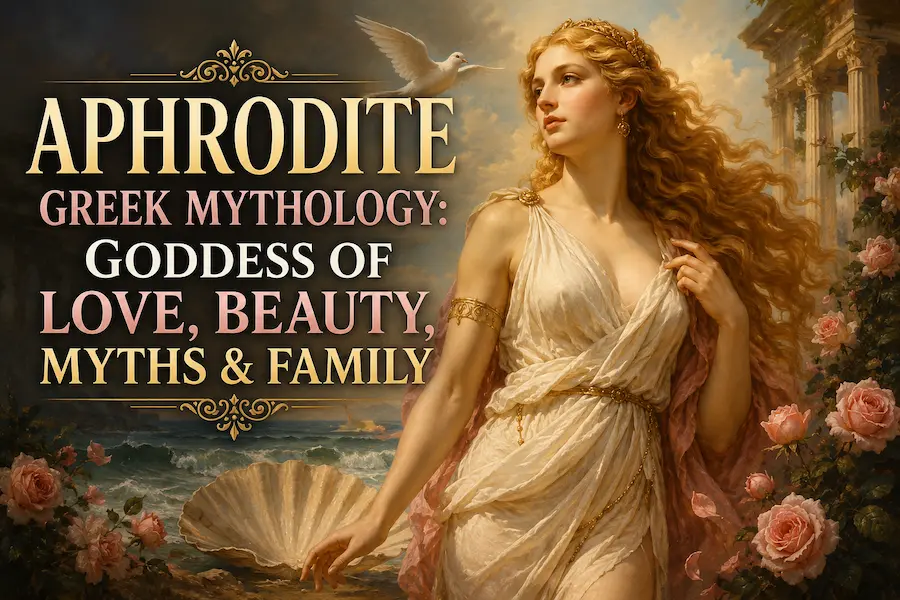
Aphrodite is the Greek goddess of love, beauty, desire, and fertility, and one of the twelve Olympian deities. Ancient writers credit her with a power that almost no one could resist, the ability to awaken attraction in gods, mortals, and animals alike. That power placed her at the center of some of the most consequential stories in Greek myth, including the Judgment of Paris and the events leading to the Trojan War. Her origins are told in more than one way. In one tradition she rises fully formed from the sea, in another she is a daughter of Zeus. The Romans identified her with Venus. This guide to Aphrodite Greek mythology covers who she was, how she was born, her powers and symbols, her family and lovers, and the major myths in which she appears.
Who Is Aphrodite in Greek Mythology?
In Greek mythology, Aphrodite is consistently an Olympian goddess, one of the principal deities who dwelled on Mount Olympus under the rule of Zeus. Unlike gods tied to a single natural force, her authority covered a wide field of human and divine experience centered on attraction and union.
In Greek mythology, Aphrodite was the goddess of:
- Love, both affectionate and passionate
- Beauty, especially idealized physical beauty
- Desire and longing
- Sexual attraction between partners
- Fertility and procreation, including the reproduction of animals and the natural world
Her influence worked on gods and mortals alike. Among the Olympian gods she could make even powerful deities act against their own interests, and among mortals she governed attraction, desire, and the emotional turmoil that came with both.
Her cult was especially strong on Cyprus and Cythera, which is why poetry often calls her Cypris or Cytherea. The Romans identified her with Venus, and many later artworks and texts use that name for the same goddess.
The Birth and Origins of Aphrodite
In discussions of Aphrodite Greek mythology, her origins are told through two major ancient traditions. Greek mythology does not preserve one single account of where Aphrodite came from, and ancient writers did not treat the different versions as a problem to be solved. Each belonged to a different poetic tradition, and both remained in circulation for centuries.
Aphrodite Born from the Sea Foam
The most famous version comes from Hesiod’s Theogony. In that account, the Titan Cronus attacks his father Uranus, the sky, and casts the severed parts into the sea. Where they fall, a white foam gathers around them, and from that foam a goddess grows.
Hesiod connects her name to the Greek word for foam, aphros, and describes her coming ashore first at Cythera and then at Cyprus, where grass sprang up beneath her feet. Eros and Himeros, personifications of love and desire, accompany her from the moment of her arrival.

This version makes Aphrodite older than Zeus and the other Olympians, since she belongs to the primordial generation of the cosmos rather than to the family born on Olympus.
Aphrodite as the Daughter of Zeus and Dione
The Homeric poems tell it differently. In the Iliad, Aphrodite is the daughter of Zeus and the goddess Dione. The clearest moment comes in Book 5, when Aphrodite is wounded on the battlefield at Troy and flees to Olympus, where Dione comforts her as a mother comforts a daughter.
This is a separate tradition, not an error or a contradiction that needs fixing. Greek myth circulated orally across many regions before it was written down, and different communities preserved different genealogies for the same deity. Ancient audiences encountered both without treating either as false.
Aphrodite’s Powers
Aphrodite’s abilities are consistently tied to attraction rather than force. Ancient sources rarely present her as a fighter, and when she enters battle she is quickly overmatched. Her strength lies in what she can make others feel.
Her main powers and domains include:
- Stirring love and desire in gods, mortals, and animals, often against the will of the person affected
- Granting or enhancing beauty and charm, making a person irresistible to others
- Presiding over sexual attraction and the beginning of relationships
- Governing fertility and procreation, extending to the natural world and its reproduction
- Influencing the course of events indirectly, by turning someone’s affection toward a particular person
The Homeric Hymn to Aphrodite states that only three goddesses were immune to her influence, Athena, Artemis, and Hestia, all of whom remained apart from marriage and desire. Every other divine and mortal being was, at least in principle, subject to her.
Her one recurring magical object is the kestos himas, usually translated as an embroidered band or girdle worn across the chest. In Iliad Book 14, Hera borrows it to distract Zeus, and the text describes it as holding all the powers of persuasion and longing.
Symbols of Aphrodite
Aphrodite is identified in ancient art and literature by a small set of recurring attributes. Some come from her myths, others from her cult and from the animals and plants associated with her worship.

- Dove. The bird most closely linked to her cult, shown beside her in art and sometimes drawing her chariot.
- Apple. The golden apple of the Judgment of Paris is the best known example, and apples appear elsewhere in Greek tradition as tokens of courtship.
- Rose. Roses were among the flowers connected with her in poetry. In some later versions of the Adonis myth, the red rose is explained by blood shed during her mourning.
- Myrtle. Used in her worship and in wedding contexts, and regularly named by ancient writers as sacred to her.
- Seashell or scallop shell. A reference to her sea birth, and the standard visual shorthand for the goddess rising from the water.
- Mirror. An attribute of her role as goddess of beauty, signaling adornment rather than vanity in the modern moral sense.
Aphrodite’s Family
Aphrodite’s place in the Greek mythology family tree shifts somewhat depending on which source you read. Her parentage varies between traditions, the parentage of some of her children is reported differently by different authors, and her marriage is described in terms that not every ancient text agrees on. What follows reflects the versions that appear most consistently in surviving literature.
Who Were Aphrodite’s Parents?
In Hesiod’s tradition, Aphrodite has no mother in the usual sense. She is born from the sea foam that formed around the severed parts of Uranus, which makes her a product of the primordial generation rather than a child of Olympian parents.
In the Homeric tradition, she is the daughter of Zeus and Dione, a goddess whose own role in myth is otherwise limited. Both accounts were known and repeated in antiquity, and neither replaced the other.
Who Was Aphrodite’s Husband?
Aphrodite’s husband is Hephaestus, the smith god of fire and craft. The marriage is presented most clearly in the Odyssey, where the bard Demodocus sings about the couple in front of the Phaeacian court.
Ancient poets treat the pairing of the goddess of beauty with the lame smith god as an unlikely match, and the marriage is never portrayed as a happy or romantic one. Homer’s Iliad and Hesiod’s Theogony name a different wife for Hephaestus, Charis in the former and Aglaia in the latter, another example of parallel traditions.
That dissatisfaction sets up the most famous story involving all three figures, Aphrodite’s affair with Ares and Hephaestus’s response to it.
Aphrodite’s Lovers
Three relationships dominate the surviving accounts.
- Ares. The god of war is her most prominent divine lover and the father of several of her children. Their affair is the subject of a well known episode discussed below.
- Adonis. A strikingly beautiful mortal youth whose story is preserved mainly in later sources rather than in Homer or Hesiod. Aphrodite’s love for him ends in loss.
- Anchises. A Trojan noble and herdsman whom Aphrodite approaches in disguise. Their union produces Aeneas.
Each of these appears in fuller form in the myths section below.
Aphrodite’s Children
Aphrodite’s most frequently named children are:
- Eros, the god of desire. In Hesiod he is a primordial force who exists before Aphrodite, but in later tradition he is widely described as her son, sometimes with Ares as the father. Both versions circulated.
- Phobos and Deimos, personifications of fear and terror, named as sons of Aphrodite and Ares. They accompany their father into battle.
- Harmonia, daughter of Aphrodite and Ares in Hesiod’s account, who later marries Cadmus, the founder of Thebes.
- Aeneas, her son by the mortal Anchises, and the only major child of hers born to a human father.
Other offspring appear in scattered sources, but these are the figures who recur across the main body of Greek literature.
Major Myths About Aphrodite
Among the best-known Aphrodite Greek mythology stories, her influence is often felt through desire rather than direct action. She sets events in motion by shaping what people want, and the consequences unfold from there. The myths below are the ones in which her role is decisive.
Aphrodite, Ares and Hephaestus
Married to Hephaestus but drawn to Ares, Aphrodite carried on an affair with the war god while her husband was occupied at his forge. In the version sung by Demodocus in Odyssey Book 8, the sun god Helios sees the two together and reports what he has seen to Hephaestus.
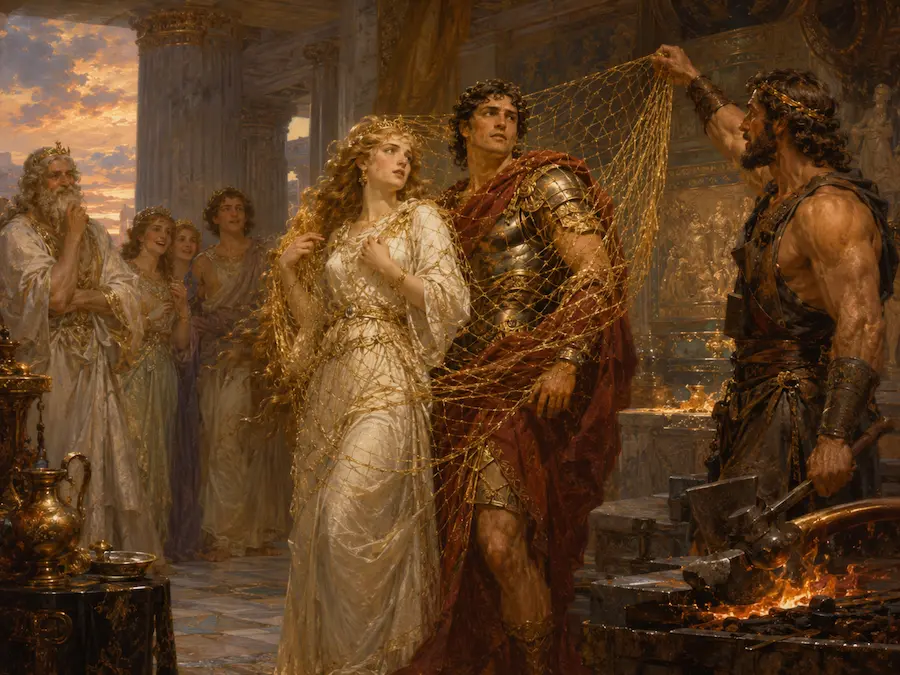
Hephaestus responds with craft rather than confrontation. He forges a net of chains so fine that it is nearly invisible and so strong that no one can break it, then fixes it above and around his bed. He announces that he is leaving for Lemnos, and once he is gone, Ares comes to Aphrodite and the two are caught in the net.
Hephaestus then calls the other gods to come and see. They gather and laugh at the trapped pair, turning the scene into a public humiliation rather than a punishment. Poseidon eventually persuades Hephaestus to release them by guaranteeing that Ares will pay compensation, and Aphrodite withdraws to her sanctuary at Paphos on Cyprus.
Aphrodite and Adonis
Adonis was a mortal youth of exceptional beauty, and Aphrodite fell in love with him. The story does not appear in Homer or Hesiod and is known mainly from later Greek and Roman writers, so the details vary more than in the older myths.
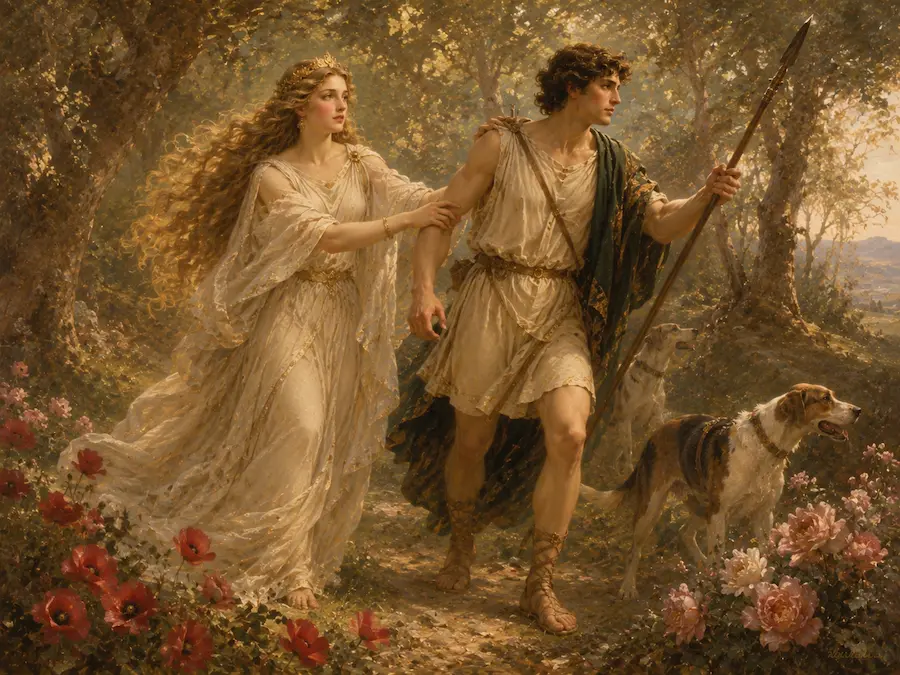
In one widely repeated version, Aphrodite hid the infant Adonis in a chest and entrusted him to Persephone, who refused to give him back once she saw him. The dispute was settled by dividing his year between the two goddesses, with part of it left to Adonis himself.
Adonis was a passionate hunter, and Aphrodite warned him against dangerous game. He ignored the warning and was killed by a wild boar. She reached him as he was dying, and her grief became the core of the myth. In Ovid’s telling, the anemone flower springs from his blood. Adonis was mourned annually in ritual laments performed by women in several Greek cities.
Aphrodite and Anchises
Anchises was a mortal, a member of the Trojan royal line who herded cattle on Mount Ida. According to the Homeric Hymn to Aphrodite, Zeus caused the goddess to fall in love with him, in part so that she could not boast of having made every god fall for a mortal while remaining untouched herself.
Aphrodite came to Anchises disguised as a mortal princess and concealed her divinity until after their union. When she revealed who she was, she told him that she would bear him a son and warned him not to boast about what had happened. The son was Aeneas, raised at first by mountain nymphs before being brought to his father.
Aeneas matters because he survives. He fights on the Trojan side in the Iliad, protected repeatedly by gods, and later became one of the most important surviving heroes of the Trojan tradition and a major figure in Roman mythology.
The Judgment of Paris
The dispute began at the wedding of Peleus and Thetis, where Eris, the goddess of strife, threw down a golden apple marked for the fairest. Hera, Athena, and Aphrodite each claimed it, and Zeus refused to judge between them.
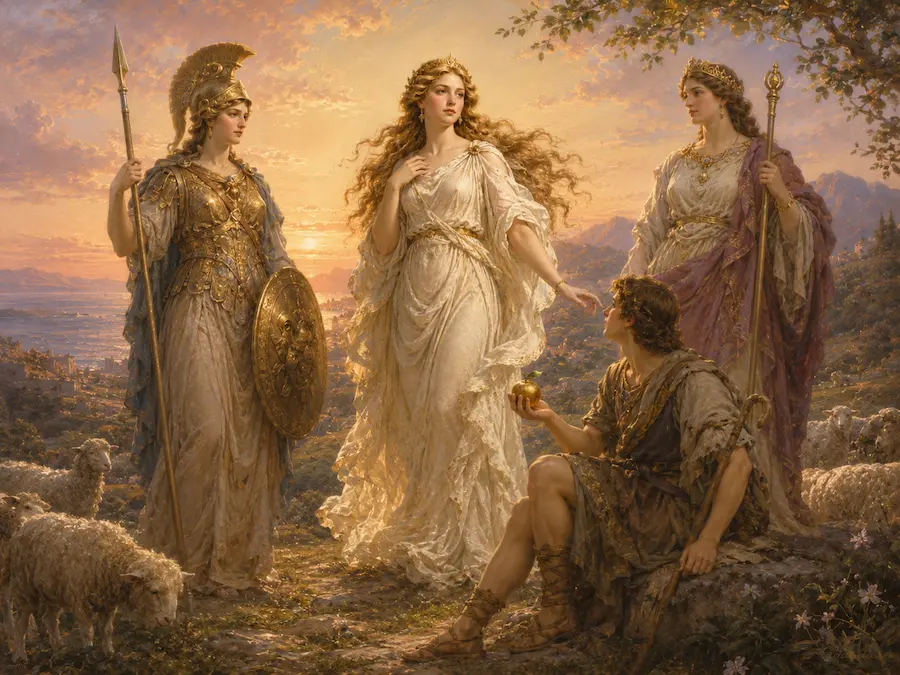
The decision was handed to Paris, a prince of Troy who was living as a herdsman on Mount Ida. Each goddess offered him something in exchange for the apple. Hera offered power and rule over great kingdoms, Athena offered victory in war and skill in battle, and Aphrodite offered him the most beautiful woman in the world.
Paris chose Aphrodite. The woman she promised was Helen, who was already married to Menelaus, king of Sparta. Paris took her to Troy, and the Greek response to that act became the Trojan War. The judgment also explains the divine alignments in the war itself, with Hera and Athena set firmly against Troy.
Aphrodite and the Trojan War
Aphrodite’s promise to Paris is the direct cause of the conflict, and she remains involved once the fighting begins. In the Iliad she supports the Trojans, and Paris in particular.
In Book 3, when Menelaus is on the point of killing Paris in single combat, Aphrodite wraps him in mist and carries him back to the safety of his own bedchamber. She then compels a reluctant Helen to go to him, in a scene that shows her power used as pressure rather than persuasion.
In Book 5 she intervenes on the battlefield to rescue her son Aeneas, and the Greek hero Diomedes wounds her in the hand. She drops Aeneas, who is saved by Apollo, and returns to Olympus in tears, where Zeus tells her that warfare is not her province. Later, in Book 21, Athena knocks her down during the fighting among the gods.
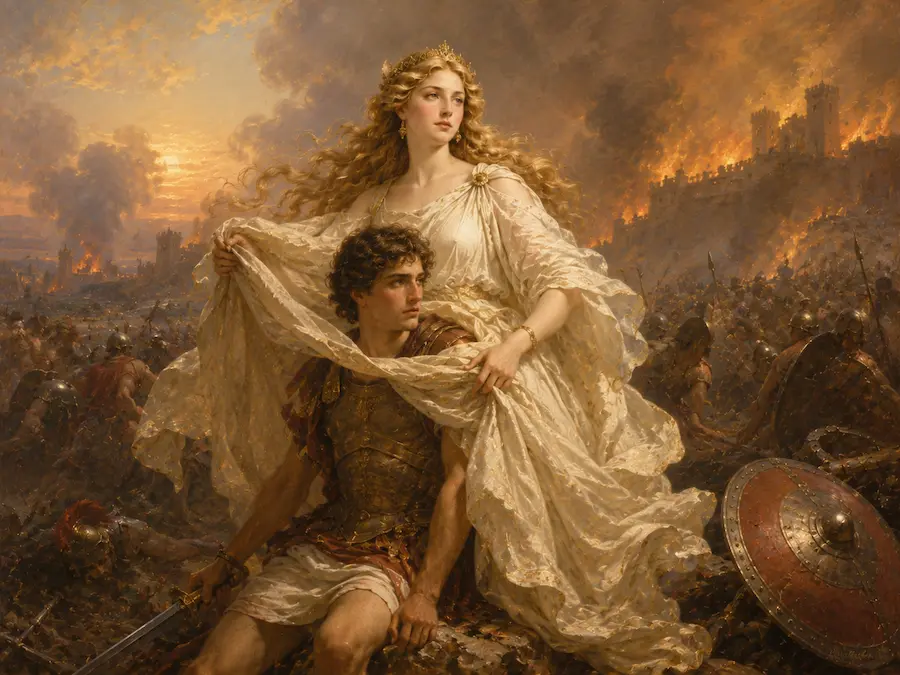
These episodes define her role. She is not a battlefield power, yet the war exists because of what she set in motion, and her protection of Paris and Aeneas shapes who survives it.
How Was Aphrodite Represented in Greek Art?
Greek artists portrayed Aphrodite as the standard of idealized female beauty, with balanced proportions and a calm, composed expression rather than dramatic emotion.
Early representations show her clothed. From the fourth century BC onward, nude and partially draped figures became common, a shift usually traced to the Aphrodite of Knidos by Praxiteles, which presented the goddess undressed for the bath and was widely copied in antiquity.
She is normally identified by her attributes rather than by facial features. Doves, an apple, a mirror, a shell, or a small figure of Eros at her side all serve as markers, and poses grouped under the title Aphrodite Anadyomene show her rising from the water.
The best known surviving example is the Aphrodite of Milos, commonly called the Venus de Milo, a Hellenistic marble statue now in the Louvre. Its partial drapery and missing arms have made it the most recognizable image of the goddess in the modern world.
Frequently Asked Questions About Aphrodite
What was Aphrodite known for?
Aphrodite was known as the Greek goddess of love, beauty, desire, and fertility. Her defining ability was to create attraction in gods and mortals, often overriding their own intentions. Because of this, she appears at the turning point of many myths involving relationships, marriage, and rivalry, including the Judgment of Paris and the chain of events that led to the Trojan War.
Who did Aphrodite actually love?
Greek mythology gives no single definitive answer. Ares is her most prominent lover and the partner named most often in the sources, including the account of their affair in the Odyssey. Adonis is the relationship most associated with grief, since she mourned him after his death. Anchises was her notable mortal lover and the father of Aeneas. Ancient texts describe these relationships without ranking one above the others.
What was Aphrodite’s curse?
There is no single official curse in Greek mythology known as “Aphrodite’s curse.” What the sources do show is a pattern of punishment. Those who insulted her or neglected her worship were often made to fall into destructive or shameful desire. In Euripides’ Hippolytus, she causes Phaedra to fall in love with her stepson, with fatal results. In another tradition, she afflicts Eos with unending desire for mortal men.
How was Aphrodite born?
Two traditions coexist. In Hesiod’s Theogony, Cronus casts the severed parts of Uranus into the sea, foam gathers around them, and Aphrodite is born fully grown from that foam before coming ashore at Cythera and Cyprus. In the Homeric tradition, she is the daughter of Zeus and the goddess Dione. Neither version was regarded in antiquity as the correction of the other.
Who was Aphrodite married to?
Aphrodite was married to Hephaestus, the Olympian god of fire, metalworking, and craft. The Odyssey describes the marriage, and ancient poets treat it as a mismatch rather than a love match. Her affair with Ares stands in deliberate contrast to it, and the episode in which Hephaestus traps the two lovers in an unbreakable net is the best known story about the marriage.
Conclusion
Aphrodite stands among the most influential figures in Greek myth because her power reaches far beyond beauty alone. As the goddess of love, desire, attraction, and fertility, she shapes relationships between gods and mortals and plays a decisive role in stories such as the Judgment of Paris, the Trojan War, and the myths of Ares, Adonis, and Anchises. Her unusual birth traditions, distinctive symbols, complex family ties, and enduring presence in ancient art make Aphrodite Greek mythology one of the clearest examples of how desire can alter the course of both divine and human lives.

About the Author
Dana Whitfield
I write about numerology, astrology, mythology, tarot, and world mystical traditions for Mystivora, drawing on years of independent research across comparative religion and symbolic systems. I approach each topic by cross-checking primary texts and established scholarship rather than repeating popular but unverified claims.
Related Articles
View All Articles → Mythology