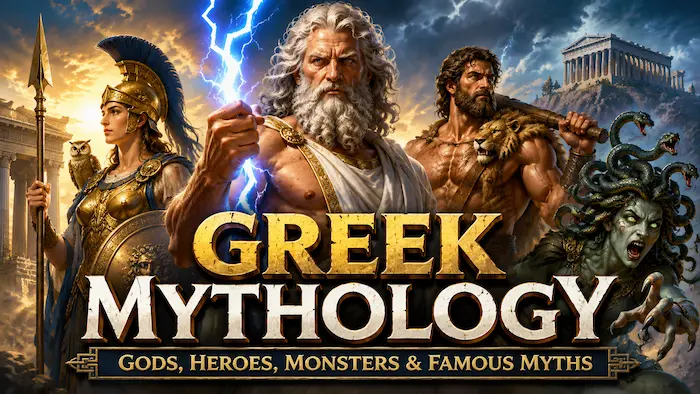
Greek mythology is the body of myths and stories that belonged to the culture and religion of ancient Greece. These stories explain how the world came into being, describe a family of powerful gods who ruled from Mount Olympus, follow heroes who fought monsters and armies, and record the strange creatures that lived at the edges of the known world. They were told, sung, performed and written down over more than a thousand years.
This guide covers the essentials: what Greek mythology is, where our knowledge of it comes from, how the Greeks explained the creation of the world, who the major gods and heroes were, which monsters appear most often, and the famous Greek myths that are still retold today.
What Is Greek Mythology?
Greek mythology is the collection of traditional stories told by the ancient Greeks about their gods, heroes, the natural world and the origins of human life. The Greeks did not treat these stories as fiction in the modern sense. Myths sat at the centre of religious practice, civic identity and public entertainment. Temples were built for the gods described in myth, festivals reenacted their stories, and cities traced their founding to heroes and divine ancestors.
The subject matter is broad. Some myths explain natural phenomena, such as why the seasons change or why the sun crosses the sky. Others describe the relationships and rivalries among the gods. A large group of stories deals with mortal heroes who accomplish something extraordinary, often with divine help and often at great personal cost. Another group concerns ordinary human beings who attract the attention of a god, usually with unhappy results.
One point matters more than any other for understanding ancient Greek mythology: it is not a single book and not a single continuous story. There is no Greek equivalent of a unified scripture. What survives is a large, uneven collection of poems, plays, histories, hymns and later summaries, written across many centuries in different regions by authors with different aims. Versions of the same myth often disagree. A hero’s parents, the number of his opponents, or the ending of a story can vary from one source to another. Athens told certain myths one way, Thebes another. Treating Greek myths as a fixed canon misrepresents how they actually worked.
Origins and Sources of Greek Mythology
Almost everything known about Greek mythology comes from written texts, artwork and archaeological remains. The written sources are the most detailed, but they were produced long after the stories themselves began circulating.
Greek Myths Began as an Oral Tradition
Before they were written down, Greek myths were spoken and sung. Professional performers travelled between communities reciting long poems from memory, adapting them to their audience and to the occasion. Ordinary storytelling within families and at religious festivals did the same work on a smaller scale. Because of this, myths existed in many parallel forms at once, and there was often no single universally accepted version.
Some elements of these stories are very old. Names including Zeus, Hera, Poseidon, Athena, Artemis and Dionysus appear on Linear B clay tablets from Mycenaean palaces of the Bronze Age, centuries before the earliest surviving Greek poetry. These tablets are administrative records rather than stories, so they confirm the presence of divine names and cults rather than the plots of later myths.
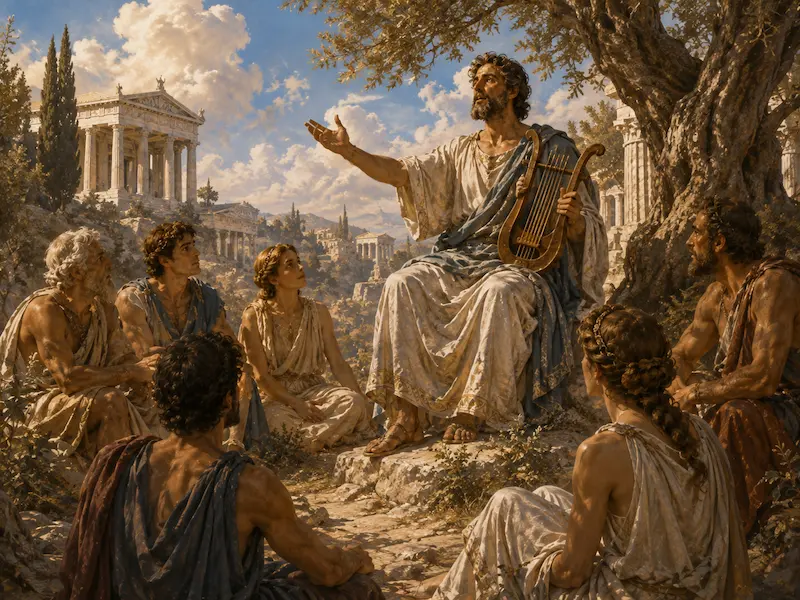
Homer
Homer is the earliest Greek poet whose work survives in full, and the two epics attributed to him are the foundation of the written tradition. They were probably composed in the eighth century BCE, drawing on much older oral material. Ancient readers treated Homer as the central authority on the gods and heroes, and Greek education was built around his poems.
The Iliad covers a short stretch of the tenth year of the Trojan War, the long siege of the city of Troy by a coalition of Greek kings. Its subject is the anger of the hero Achilles, his withdrawal from the fighting after a quarrel with the Greek commander Agamemnon, and the consequences that follow. The gods are active throughout, taking sides and intervening directly in the battle.
The Odyssey follows Odysseus, king of Ithaca, on his ten-year attempt to return home after Troy falls. It moves between his encounters with monsters, sorceresses and hostile gods, and the situation in Ithaca, where his wife Penelope is besieged by suitors who assume he is dead. Together the two poems supply much of what is known about the Trojan War and about how the Greeks imagined the relationship between mortals and gods.
Hesiod
Hesiod worked at roughly the same period as Homer, or slightly later, and his poems serve a different purpose. Where Homer tells stories, Hesiod organises them.
The Theogony is a genealogical poem describing the birth of the gods and the sequence of divine rulers, from the first beings that emerged at the beginning of the world through the Titans to the final establishment of Zeus as king. It is the single most important source for the Greek creation story and for the family relationships between gods.
Works and Days is a poem of practical and moral instruction addressed to Hesiod’s brother, covering farming, justice and the right way to live. Along the way it preserves several major myths, including the story of Prometheus and the first woman, Pandora, and the account of the ages of humanity.
Greek Plays and Later Writers
From the fifth century BCE onward, Athenian tragedy became a second great vehicle for myth. Playwrights took familiar stories and reworked them for the stage, changing emphasis, motive and sometimes outcome.
Aeschylus wrote the Oresteia, a trilogy following the murder of Agamemnon on his return from Troy and its aftermath. Sophocles produced Oedipus the King and Antigone, both drawn from the myths of Thebes. Euripides, the most unconventional of the three, wrote Medea, The Bacchae and The Trojan Women, often presenting gods and heroes in a harsher light than earlier tradition.
Myth continued to be reshaped after the classical period. Apollonius of Rhodes wrote about Jason and the Argonauts in the third century BCE, while later Greek writers such as Pseudo-Apollodorus compiled handbooks that preserved many myths and variant traditions.
The Creation of the World in Greek Mythology
The standard Greek account of creation comes mainly from Hesiod’s Theogony, with additional material from later sources. It describes a succession of divine rulers, each overthrown by his own offspring, ending with Zeus.
Chaos and the Beginning of the World
In Hesiod’s version, the first thing that existed was Chaos. The Greek word does not mean disorder in the modern sense but something closer to a gap, a void or an open space. From or alongside Chaos came Gaia (the Earth), Tartarus (the deep pit beneath the earth) and Eros (the force of attraction and generation).
Gaia produced Uranus, the sky, who then became her partner. Their union produced the first great generation of divine beings: twelve Titans, three one-eyed Cyclopes and three Hecatoncheires, monstrous figures with a hundred hands each. Uranus feared these children and pushed them back inside Gaia rather than allow them to be born, which caused her great pain and set the first conflict in motion.
Cronus and the Titans
Gaia asked her children to act against Uranus, and only Cronus, the youngest Titan, agreed. Cronus overthrew his father and took power. In Hesiod, the violence of this succession also gives rise to other divine beings, including Aphrodite. Other ancient sources give Aphrodite a different parentage, one example of how Greek traditions could vary.
Cronus ruled with his sister Rhea during what later Greek writers described as a golden age for humanity. Warned that he would be overthrown by his own son, he swallowed each child Rhea bore: Hestia, Demeter, Hera, Hades and Poseidon. When her sixth child was due, Rhea hid the newborn Zeus and gave Cronus a stone wrapped in cloth, which he swallowed without noticing.
Zeus and the Rise of the Olympian Gods
Zeus was raised in secret, most often said to be in a cave on Crete. When he came of age he forced Cronus to disgorge the swallowed children, who emerged fully grown and joined him. The resulting war between the Olympians and the Titans, called the Titanomachy, lasted ten years.
Zeus released the Cyclopes and Hecatoncheires from imprisonment and gained their support. The Cyclopes forged Zeus’s thunderbolt, Poseidon’s trident and Hades’ helmet of invisibility. With these allies, the Olympians defeated the Titans and confined most of them in Tartarus, while Atlas was condemned to hold up the sky.
The three brothers then divided the cosmos by lot. Zeus took the sky and overall kingship, Poseidon the sea, and Hades the underworld, with the earth left as common ground. From this point Zeus rules from Mount Olympus, and the myths shift from cosmic succession to the affairs of the Olympian gods and the mortals who deal with them.
The Main Greek Gods and Goddesses
Mount Olympus, a real mountain in northern Greece and the highest in the country, was imagined as the home of the principal gods. They lived there as a household, with Zeus at its head, holding council, arguing, forming alliances and interfering constantly in human affairs.
Greek gods were not abstract or remote. They had bodies, appetites, favourites and grudges. What separated them from humans was immortality and power rather than moral perfection. Each god had one or more spheres of influence covering some part of nature or human life, and worship was largely a matter of approaching the right god for the right need.
Objects associated with the gods, such as Zeus’s thunderbolt and Athena’s aegis, could also serve as symbols of divine power.
The Twelve Olympian Gods
| Greek god | Main role and domain |
|---|---|
| Zeus | King of the gods, ruler of the sky, thunder, kingship, oaths and hospitality |
| Hera | Queen of the gods, goddess of marriage, women and family |
| Poseidon | God of the sea, earthquakes and horses |
| Athena | Goddess of wisdom, strategic warfare, craft and the city of Athens |
| Apollo | God of prophecy, music, poetry, archery, healing and light |
| Artemis | Goddess of the hunt, wild animals, wilderness and childbirth |
| Aphrodite | Goddess of love, beauty and desire |
| Ares | God of war, particularly its violence and bloodshed |
| Demeter | Goddess of grain, agriculture and the harvest |
| Dionysus | God of wine, vegetation, ecstasy and theatre |
| Hephaestus | God of fire, metalworking and craftsmanship |
| Hermes | Messenger of the gods, god of travel, trade, thieves and boundaries |
The list of twelve was standard in outline but not fixed in detail. Ancient sources sometimes include Hestia and omit Dionysus, and some regional lists differ again. The number twelve mattered more than the exact membership.
A few relationships help explain many Greek myths. Zeus and Hera are husband and wife, while several major Olympians, including Athena, Apollo, Artemis, Ares, Hermes and Dionysus, are children of Zeus in different traditions.
Other Important Greek Gods
Several other important deities also appear throughout Greek mythology.
Hades rules the underworld, the realm of the dead, which also carries his name. He is not a figure of evil and is not the Greek equivalent of a devil. He is a stern administrator of the dead who rarely leaves his kingdom.
Hestia is goddess of the hearth, the household and the sacred fire of the city. She is one of the six children of Cronus and Rhea and appears in few narratives, but her cult was central to daily domestic and civic religion.
Eros is the god of desire. In Hesiod he is one of the primordial forces present near the beginning of the world. In later tradition he becomes a younger figure, the son of Aphrodite, armed with arrows that cause love in whoever they strike. Both versions circulated side by side.
Heroes in Greek Mythology
A hero in Greek mythology is usually a mortal of exceptional strength, intelligence or ability who accomplishes deeds beyond ordinary human capacity. Many heroes have one divine parent, placing them between the human and divine worlds without automatically making them immortal. Unlike the gods, Greek heroes were generally mortal, although a few traditions give exceptional figures a different fate.
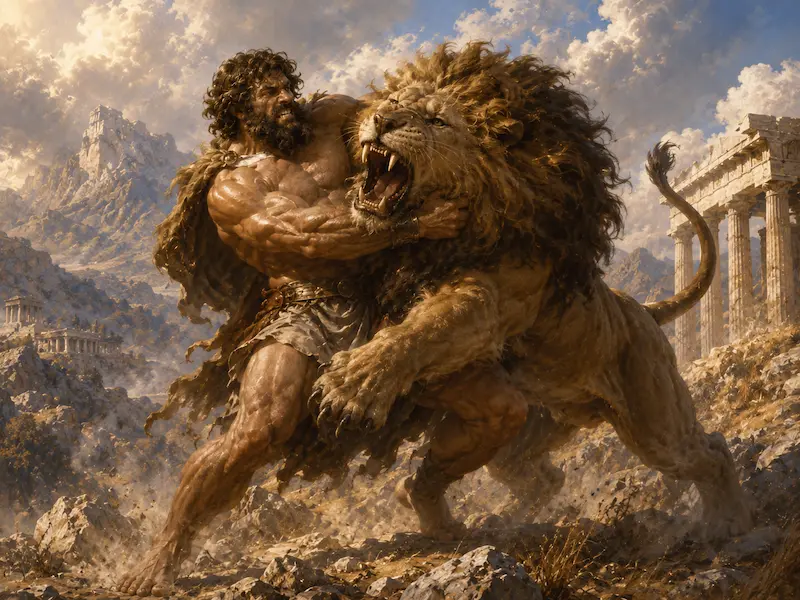
Heracles
Heracles is one of the most prominent Greek heroes, the son of Zeus and the mortal woman Alcmene. His extraordinary strength appears from infancy, while Hera pursues him with hostility because of his parentage.
His most famous story is the Twelve Labours, a sequence of near-impossible tasks performed for King Eurystheus. In a major ancient tradition, the labours serve as expiation after Heracles kills his family during a divinely induced fit of madness. After his death, some traditions describe Heracles as being received among the gods.
Achilles
Achilles was the son of the mortal Peleus and the sea goddess Thetis, and the greatest fighter among the Greeks at Troy. The Iliad opens with his quarrel with Agamemnon and his refusal to fight, which allows the Trojans to push the Greeks back to their ships.
He returns to battle only after his close companion Patroclus is killed by the Trojan prince Hector, and he kills Hector in revenge. Achilles knew he was choosing a short life with lasting fame over a long and obscure one. He dies before Troy falls, shot by Paris with the help of Apollo, an event described in later sources rather than in the Iliad itself. The story of his mother dipping him in the river Styx and leaving one heel vulnerable is a late addition and does not appear in Homer.
Perseus
Perseus was the son of Zeus and Danaë, a princess whose father had shut her away to prevent her from bearing a son. Sent on what was intended to be a fatal errand by King Polydectes, he was tasked with bringing back the head of the Gorgon Medusa, whose gaze turned onlookers to stone.
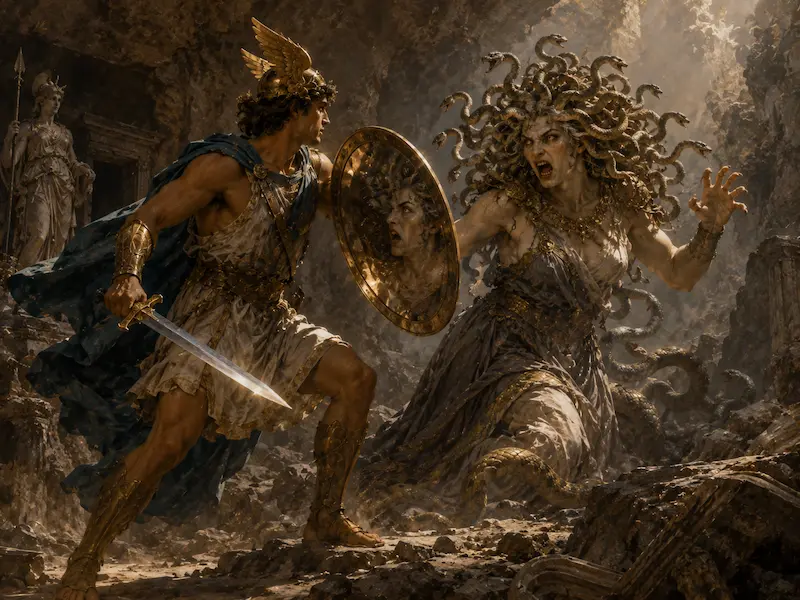
Equipped by the gods with a reflective shield, winged sandals, a cap of invisibility and a curved blade, he killed Medusa by looking at her reflection rather than directly. On his way home he rescued Andromeda from a sea monster and later married her. He is one of the few major heroes whose story ends without disaster.
Theseus
Theseus was the national hero of Athens, credited in myth with unifying the region of Attica under Athenian rule. His defining adventure was the killing of the Minotaur, a bull-headed creature kept in the Labyrinth on Crete, to which Athens was forced to send young people as tribute.
Theseus volunteered to go as one of the victims and killed the Minotaur inside the maze. His later myths include further adventures as well as political failure and exile.
Jason
Jason led the expedition of the Argonauts, a crew of heroes who sailed the ship Argo to the distant kingdom of Colchis at the eastern edge of the Black Sea. His goal was the Golden Fleece, the hide of a winged ram, which he needed in order to reclaim the throne of Iolcus from his uncle Pelias.
Jason succeeded with the help of Medea, the king’s daughter and a powerful sorceress who fell in love with him and betrayed her family to assist him. Their relationship later ended catastrophically after Jason abandoned her for another marriage, the subject of Euripides’ Medea.
Odysseus
Odysseus, king of Ithaca, appears in both Homeric poems. At Troy he is valued for intelligence, persuasion and cunning rather than raw fighting ability, and later tradition credits him with devising the wooden horse that ended the siege.
The Odyssey follows his ten-year journey home, during which he loses his entire crew and faces the anger of Poseidon after blinding the god’s son, the Cyclops Polyphemus. Odysseus eventually returns to Ithaca in disguise and reclaims his household from the suitors who have occupied it.
Monsters and Creatures in Greek Mythology
Monsters are a constant presence in Greek myths. Some are the offspring of primordial beings, some are punishments inflicted by gods, and some are simply what the Greeks imagined existing beyond the boundaries of settled land. In hero myths they usually function as the obstacle that defines the hero, and several of them appear in more than one story.
| Creature | Description and role |
|---|---|
| Medusa and the Gorgons | Three sisters with snakes for hair whose gaze turned people to stone. Medusa alone was mortal and was killed by Perseus. |
| Cyclopes | One-eyed giants. In Hesiod they are skilled smiths who forge Zeus’s thunderbolt. In the Odyssey they are lawless shepherds, one of whom, Polyphemus, traps Odysseus and his men. |
| Minotaur | A creature with a bull’s head and a man’s body, born to Pasiphaë, wife of King Minos, and confined in the Labyrinth on Crete. Killed by Theseus. |
| Hydra | A many-headed water serpent from the swamp of Lerna that grew new heads when one was cut off. Killed by Heracles as his second labour. |
| Chimera | A fire-breathing hybrid of lion, goat and serpent that ravaged Lycia. Killed by the hero Bellerophon. |
| Pegasus | A winged horse that sprang from Medusa’s body when Perseus killed her. Later ridden by Bellerophon against the Chimera. |
| Centaurs | Beings with the upper body of a man and the lower body of a horse, usually depicted as wild and violent. The centaur Chiron is the exception, a learned healer who tutored several heroes. |
| Sphinx | A creature with a woman’s head, a lion’s body and wings that guarded Thebes and killed travellers who could not answer its riddle. Defeated by Oedipus. |
| Harpies | Winged female creatures who snatched away food and people. They torment the blind prophet Phineus in the story of the Argonauts. |
| Cerberus | A multi-headed dog, most often described with three heads, who guarded the entrance to the underworld and prevented the dead from leaving. Brought up to the surface by Heracles as his final labour. |
Famous Greek Myths
The stories below are among the best-known Greek myths. Each survives in multiple versions, and these summaries follow commonly told forms.
Prometheus and the Gift of Fire
Prometheus was a Titan who sided with Zeus during the war against the Titans and who took a particular interest in human beings. After a dispute over how sacrifices should be divided between gods and mortals, Zeus withheld fire from humanity.
Prometheus stole the fire, in Hesiod’s account carrying it away hidden in a hollow fennel stalk, and gave it to human beings.
Zeus punished Prometheus by chaining him to a rock, where an eagle ate his liver each day and it regrew overnight. Heracles eventually freed him. In Hesiod, humanity is punished separately through Pandora, whose jar releases suffering into the world.
The Twelve Labours of Heracles
In a major ancient tradition, Heracles kills his wife and children during a fit of madness sent by Hera. Seeking purification, he is directed to serve King Eurystheus and perform the tasks set for him.
The labours send Heracles across the Greek mythical world. Among the best known are killing the Nemean Lion and Lernaean Hydra, capturing the Ceryneian Hind and Cretan Bull, cleaning the Augean Stables, obtaining the golden apples of the Hesperides, and bringing Cerberus up from the underworld. Other tasks involve the Erymanthian Boar, Stymphalian Birds, Mares of Diomedes, belt of Hippolyta and cattle of Geryon.
Some traditions explain that the original assignment was ten tasks, with two rejected by Eurystheus and replaced, producing the familiar total of twelve. Ancient sources also differ on some details and ordering.
Perseus and Medusa
King Polydectes of Seriphos wanted to marry Danaë and saw her son Perseus as an obstacle. He tricked the young man into promising to bring him the head of Medusa, expecting him not to return.
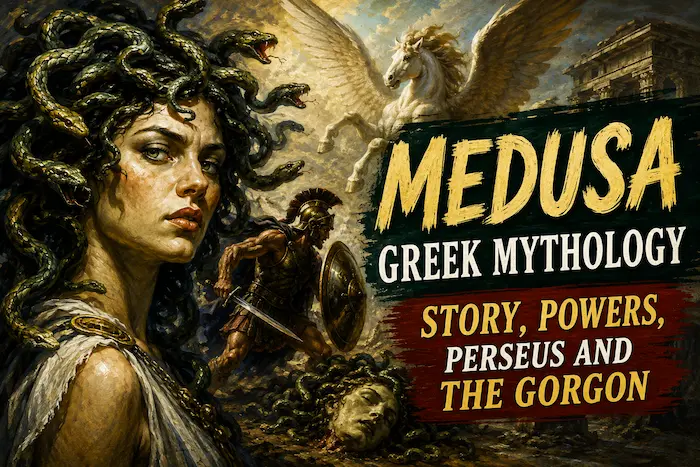
Medusa was one of three Gorgon sisters and the only mortal one. Anyone who met her gaze turned to stone. Guided by Athena and Hermes, Perseus obtained divine equipment that allowed him to approach the Gorgons safely.
He approached Medusa while she slept, watching her reflection in his polished shield rather than looking at her directly, and cut off her head. Pegasus emerged from her body. Perseus escaped her surviving sisters using the cap of invisibility, and returned to Seriphos, where he used the head to turn Polydectes to stone. The head was afterwards given to Athena, who set it on her shield.
Theseus and the Minotaur
King Minos of Crete had defeated Athens and imposed a tribute: at fixed intervals the city had to send young men and women to be sent into the Labyrinth, an intricate maze designed by the craftsman Daedalus, where the Minotaur would kill them.
Theseus, son of the Athenian king Aegeus, volunteered to go with one group. On Crete, Minos’s daughter Ariadne fell in love with him and gave him a ball of thread, which he unwound as he entered so he could retrace his route. He found the Minotaur, killed it, and led the others back out.
Theseus sailed away with Ariadne but later left her on Naxos, where many versions say Dionysus found and married her. Theseus had agreed to raise white sails on his return if he survived, but he forgot and left the black sails in place. Seeing them, his father Aegeus believed Theseus was dead and threw himself into the sea.
King Midas and the Golden Touch
Midas, king of Phrygia, showed hospitality to Silenus, an elderly companion of Dionysus, who had wandered off and been found by Midas’s people. In gratitude Dionysus offered him any gift he chose. Midas asked that everything he touched turn to gold.
The gift worked exactly as requested, which was the problem. Food turned to metal in his hands and drink turned to metal at his lips, and he faced starving in the middle of enormous wealth. He begged Dionysus to take the gift back and was told to wash in the river Pactolus, which removed the power and, in the Greek explanation, accounted for the gold found in that river.
Narcissus
Narcissus was a young man of exceptional beauty who rejected those who loved him. In the best-known later version, the nymph Echo is among those he rejects and wastes away until only her voice remains.
In response to the suffering he caused, a god (usually Nemesis) arranged that Narcissus should experience unreturnable love. Stopping to drink at a still pool, he saw his own reflection and became fixed on it, unable to leave and unable to reach what he saw. He died beside the water, and a flower grew in his place.
Persephone and Hades
Persephone was the daughter of Zeus and Demeter, goddess of grain and agriculture. While she was gathering flowers, the earth opened and Hades carried her down into the underworld to be his queen, in most accounts with the agreement of Zeus.
Demeter searched for her daughter and, on learning what had happened, withdrew her power from the earth. Crops failed and nothing grew. With humanity facing starvation and the gods losing their sacrifices, Zeus ordered Hades to release Persephone.
Before Persephone left, she ate pomegranate seeds in the underworld, which prevented her from leaving permanently. The compromise was that she would spend part of each year with Hades and the rest with Demeter. Her absence was connected with the barren part of the agricultural year, while ancient sources differ on exactly how long she remained below.
The Trojan War
The Trojan War is the largest single narrative in Greek mythology, drawing in dozens of major figures. It began with a dispute among three goddesses (Hera, Athena and Aphrodite) over which was the most beautiful. Paris, a prince of Troy, was appointed to judge and chose Aphrodite, who had promised him the most beautiful woman in the world.
That woman was Helen, already married to Menelaus, king of Sparta. Paris took her to Troy. Menelaus and his brother Agamemnon assembled a coalition of Greek kings, including Achilles, Odysseus, Ajax, Diomedes and Nestor, and besieged the city. On the Trojan side stood King Priam, his son Hector, Paris and their allies. The gods took sides and intervened repeatedly.
The siege lasted ten years and ended through deception rather than force. The Greeks built a large hollow wooden horse, concealed soldiers inside it and pretended to sail away. The Trojans brought it into the city, and the hidden force opened the gates at night. Troy was destroyed, its men killed and its women taken as captives. Most of the victorious Greek leaders met bad ends of their own, either on the voyage home or after arriving.
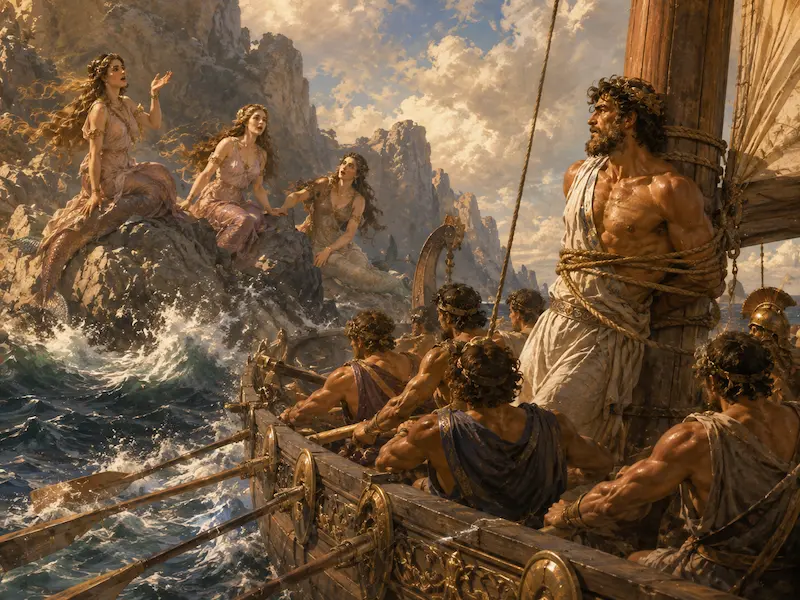
The Journey of Odysseus
The Odyssey takes up after the fall of Troy. Odysseus sets out for Ithaca with his ships and crew and takes ten years to arrive, arriving alone.
The journey includes some of the best-known episodes in Greek myth. Odysseus blinds the Cyclops Polyphemus, encounters the enchantress Circe, consults the dead, sails past the Sirens, passes Scylla and Charybdis, and eventually loses his remaining crew after they kill the forbidden cattle of the sun god. After years on Calypso’s island, he finally reaches Ithaca.
In Ithaca he arrives disguised as a beggar, gathers information, reveals himself to his son Telemachus and a few loyal servants, and kills the suitors who have spent years consuming his household and pressing his wife Penelope to remarry.
The poem centres on Odysseus’ determination to return home and recover his place in Ithaca. Even when offered the chance to remain elsewhere, he continues toward Penelope, his household and his kingdom.
The Legacy of Greek Mythology
Greek myths passed into Roman literature, where authors such as Virgil and Ovid retold them for new audiences. They later became recurring subjects in European painting, sculpture and literature, especially from the Renaissance onward.
Greek theatre shaped Western drama directly. The tragedies of Aeschylus, Sophocles and Euripides are still performed and adapted, and the structures they established continue to inform how stories are built for the stage and screen.
The influence continues in contemporary books, films and games that reuse Greek gods, heroes and monsters. Greek mythology also survives in everyday English through terms such as odyssey, narcissism, Achilles heel, chimera and labyrinth.

About the Author
Dana Whitfield
I write about numerology, astrology, mythology, tarot, and world mystical traditions for Mystivora, drawing on years of independent research across comparative religion and symbolic systems. I approach each topic by cross-checking primary texts and established scholarship rather than repeating popular but unverified claims.