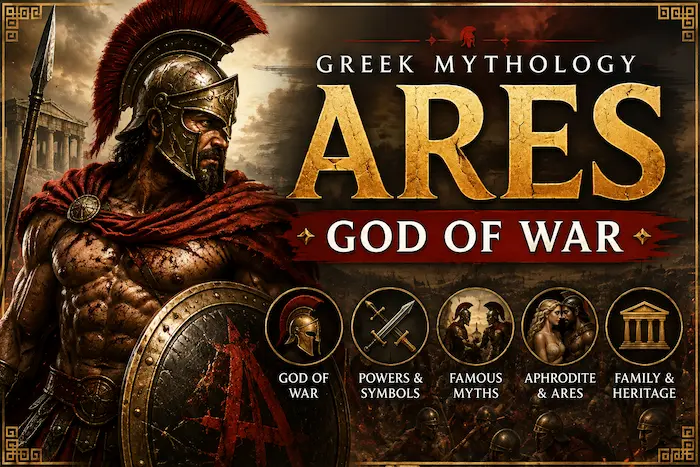
Greek mythology Ares god: Ares is the Greek god of war and one of the Twelve Olympians, generally described as the son of Zeus and Hera. In Greek mythology he represents the parts of warfare that no amount of planning can control: bloodshed, rage, physical combat and the chaotic fury of battle itself. Athena is also a war deity, but she stands for strategy and discipline, which is why the two are so often set against each other. Ancient writers rarely treated Ares gently. He is wounded, trapped and humiliated more often than any other Olympian, and Homer has Zeus call him the most hateful of the gods. Yet he was genuinely worshipped, he fathered figures as feared as Phobos and Deimos, and his affair with Aphrodite became one of the most famous scandals on Olympus.
Who Is Ares in Greek Mythology?
Ares is the Olympian god of war, and in most accounts he is the son of Zeus and Hera, which makes him one of the few Olympians born to two of the highest gods rather than to Zeus and a lesser consort. He belongs to the generation of the Twelve Olympians who ruled from Mount Olympus after the defeat of the Titans, and he sits among them as the divine embodiment of armed conflict.
Calling him simply the god of war undersells how specific his role actually is. The Greeks did not treat warfare as a single idea with a single patron. They separated the intelligence of war from the experience of war, and Ares received the second half. He personifies the noise, the slaughter, the panic and the sheer physical brutality of the battlefield: what war feels like once the plans have collapsed and the fighting has begun.
Greek literature reflects that with a striking lack of affection. Ares is described as bloodstained, insatiable in battle and quick to change sides. Homer gives him the epithet of a curse to mortals, and in the Iliad even his own father tells him he is the most hated of all the gods on Olympus because strife and slaughter are all he loves. That literary hostility is real and worth understanding, but it should not be mistaken for the whole picture, because Greek communities still built him sanctuaries and still called on him before they fought.
| Attribute | Ares |
|---|---|
| Greek name | Ares (Ἄρης) |
| Roman equivalent | Mars |
| Parents | Zeus and Hera |
| Home | Mount Olympus, with strong mythic links to Thrace |
| Main role | God of war and battle |
| Key domains | Warfare, violence, bloodshed, courage, battle fury |
| Famous symbols | Spear, shield, helmet, armour, war chariot |
| Usual companions | Phobos, Deimos, Eris, Enyo |
| Major epithet | Enyalios |
| Main ancient sources | Homer’s Iliad and Odyssey, Hesiod, Apollodorus, Pausanias |
Ares as the Greek God of War
Everything attached to Ares in ancient tradition points back to the same thing: the act of fighting. He is not a god of victory, not a god of empire and not a god of military administration. He is the god of combat as an experience.
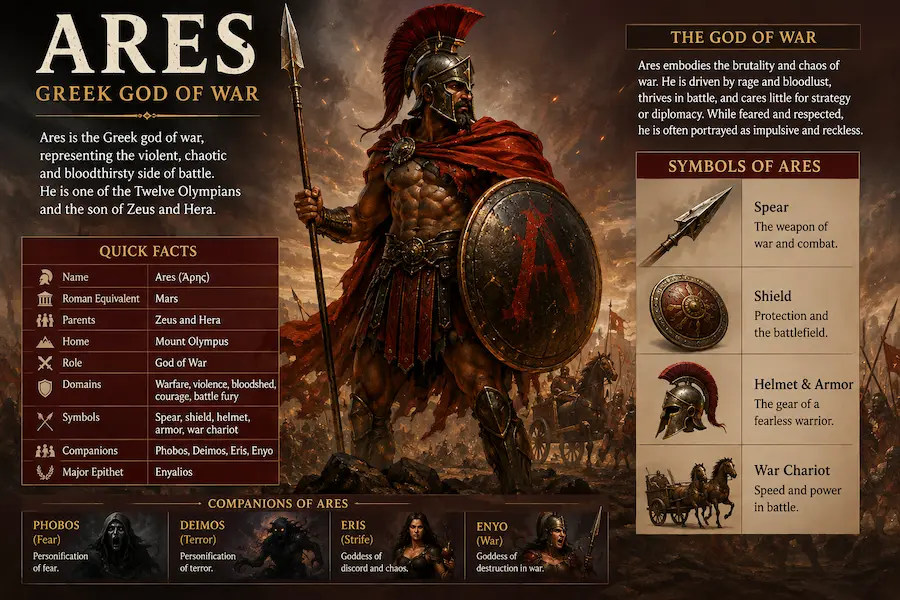
War, Violence and Battle Fury
The Greek mythology war god is associated with armed conflict, hand to hand fighting, bloodshed, aggression and the frenzy that takes hold of soldiers in the middle of a fight. Ancient poets connect him with the din of battle, with the dust and the shouting, and with the moment when a formation breaks apart into individual men trying to kill each other.
His usual companions make the point better than any description. Two of his sons, Phobos (Fear) and Deimos (Terror or Dread), attend him in battle. Eris, the goddess of strife, and Enyo, a goddess of war and destruction, appear alongside him as well. These are not tactical assets. They are the emotional conditions that armies generate and then suffer from, and the Greeks grouped them around Ares because he governs the same territory.
Courage belongs here too, but a specific kind of courage. Ares is invoked for the nerve to stand in the line and fight, not for the judgement to decide whether the fight is worth having. That distinction runs through everything about him and explains why Greek writers admired what he supplied while distrusting the god who supplied it.
Strength and Combat
Ares is consistently described as immensely strong, physically imposing and formidable in a direct fight. He does not command from behind the lines. He enters the battlefield himself, fights in person and is treated as a genuine physical threat when he does.
What makes him unusual is that this never translates into invincibility. Greek myth repeatedly allows him to lose. He is wounded by a mortal hero with divine assistance, he is knocked down by Athena, he is captured and confined by two giants, and he is trapped and publicly shamed by Hephaestus. No other Olympian of his rank accumulates that many defeats.
The pattern is deliberate rather than accidental. Greek storytellers used Ares to argue that raw force, on its own, is not enough. When he is beaten it is almost always by intelligence, skill or craft, which is exactly the lesson those stories exist to deliver.
Weapons of Ares
Ares is depicted with the equipment of a Greek warrior rather than with unique divine objects. A spear is his primary weapon and his most constant attribute in art. A sword serves as his secondary weapon, and he carries a shield and wears a helmet, breastplate and greaves.
He is also associated with a war chariot, drawn in poetic accounts by immortal horses, with Phobos and Deimos frequently named as the ones who harness or drive it. Notably, none of this gear is magical. Where Zeus has the thunderbolt and Hades has the helm of invisibility, Ares fights with the same weapons a mortal soldier would recognise, which is entirely consistent with a god who represents the human experience of battle.
Ares vs Athena: Two Greek Gods of War
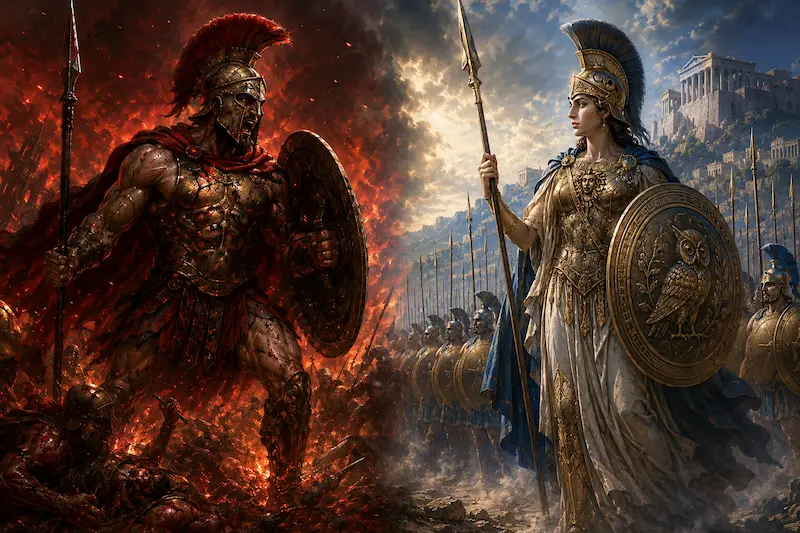
Greek religion assigned warfare to two deities because the Greeks understood war as two different things at once. Ares Greek mythology stories place him inside the fighting itself. Athena governs everything that decides how the fighting goes.
| Aspect | Ares | Athena |
|---|---|---|
| Concept of war | Battle as violence | War as an organised undertaking |
| Core qualities | Rage, bloodshed, physical force | Strategy, planning, discipline |
| Approach | Chaotic and uncontrolled | Tactical and deliberate |
| Typical outcome in myth | Frequently wounded or defeated | Consistently successful |
| Wider domains | Almost exclusively war | Wisdom, craft, civic defence |
Athena wins their encounters, and Greek poets made sure of it. In the Iliad she guides the spear that wounds Ares and drives him off the field, and later, during the open fighting among the gods, she strikes him down with a boundary stone and stands over him. The message is not subtle: the goddess of tactical warfare defeats the god of brute violence whenever the two meet.
Their opposition is at its clearest in the Trojan War, where they support opposite sides. Athena backs the Greeks, Ares fights for the Trojans, and the war becomes a running argument between two ideas of how battles are won. Athena is also the patron of a city, Athens, and of organised civic defence, which gave her a settled place in Greek life that Ares never held in the same way.
Neither god is presented as unnecessary. Athena cannot supply the raw aggression that makes soldiers fight, and Ares cannot supply the discipline that makes them win. Greek tradition simply made no secret of which one it respected more.
Symbols and Appearance of Ares
Ares is portrayed as a warrior, and in Greek and Roman art he appears in two main forms: a bearded, fully armoured fighter in the earlier tradition, and a young, athletic, often nude or lightly armed figure in later work. Both versions keep the same identifying equipment, and it is the equipment rather than the face that marks him out.
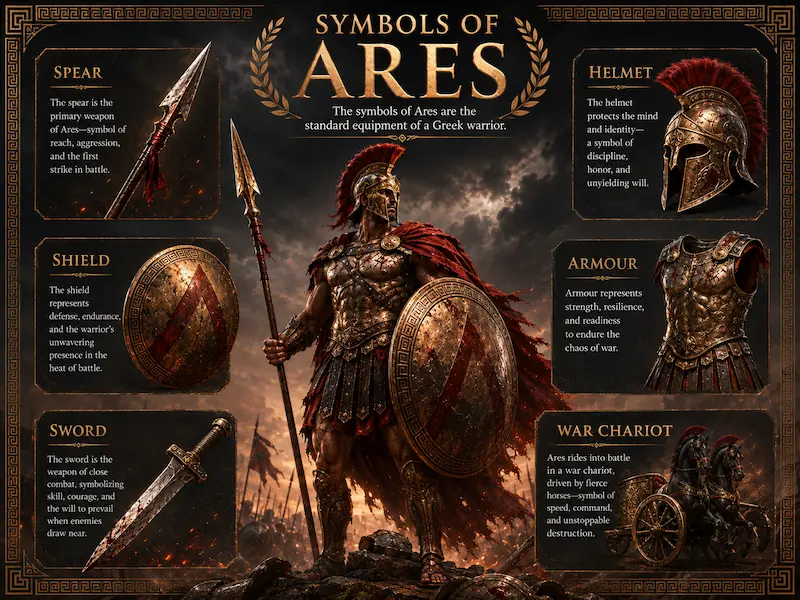
He is shown with a crested helmet, a spear, a round shield, a sword and body armour, and he is often accompanied by a chariot. Ancient sources also connect him with certain animals, though these associations are looser and less consistently reported than his weapons. Dogs and vultures are the two named most often, both of them creatures that ancient audiences would have associated directly with the aftermath of a battle. The serpent or dragon of Thebes, killed by Cadmus, was described as sacred to Ares, which is how the Theban royal line ended up linked to him.
| Symbol | Association |
|---|---|
| Spear | Combat and warfare, his principal weapon |
| Shield | The battlefield and the fighting line |
| Helmet and armour | Warrior identity |
| Sword | Close combat |
| Chariot | War, movement across the battlefield |
| Dog and vulture | Animals linked with battlefields in ancient sources |
Taken together, these symbols say something precise about him. There is no crown, no sceptre, no instrument of judgement and no emblem of craft or wisdom. Everything Ares carries is something a soldier would carry, which reinforces the central fact about him: he is the god of the fighting itself and of very little else.
Ares’ Family
Ares sits close to the centre of the Olympian household, and his position in the wider Greek mythology family tree explains a good deal about how ancient writers handled him.
Parents of Ares
Ares is the son of Zeus, king of the gods, and Hera, queen of the gods and Zeus’ wife. This is the standard Greek account, given by Hesiod and assumed throughout Homer.
His parentage places him in the second Olympian generation, among the children born after the Titans were overthrown, and it gives him a legitimacy that many of Zeus’ better-liked children do not have. Apollo, Artemis, Hermes and Dionysus were all born to other mothers. Ares is a full son of both reigning gods, which makes the hostility directed at him in Greek literature more pointed rather than less.
A separate Roman tradition, recorded much later by Ovid, has Juno conceive Mars alone with the help of a magical flower. That belongs to Roman literature and to the figure of Mars, and it should not be read back into the Greek account of Ares.
Siblings of Ares
His full siblings, the other children of Zeus and Hera, are usually given as Hephaestus, the god of fire and metalworking, Hebe, goddess of youth, and Eileithyia, goddess of childbirth. Some traditions state that Hera produced Hephaestus without Zeus, one of several places where ancient accounts disagree with each other.
Among his many half siblings by Zeus, the ones that matter for his own myths are Athena, his opposite and his most persistent rival, Apollo, Artemis, Hermes and the hero Heracles, who becomes one of his more dangerous opponents. Hephaestus deserves particular attention, since the affair with Aphrodite sets the two brothers directly against each other.
Children of Ares
Ares fathered a large number of children across Greek myth, and three of them are far better known than the rest. All three are usually named as children of Ares and Aphrodite.
- Phobos. The personification of fear and panic, who attends his father in battle.
- Deimos. The personification of terror and dread, almost always paired with his brother.
- Harmonia. The goddess of harmony and concord, and the exception in this family. She married Cadmus and became the ancestor of the royal house of Thebes, which is why Thebes claimed descent from Ares.
Other children appear across the tradition, and several matter for the stories below. Alcippe, his daughter by Aglaurus, is the reason for the killing that leads to his trial. Cycnus, a son who challenged travellers, brings him into conflict with Heracles. He is also named in various accounts as father of Diomedes of Thrace, of King Oenomaus and of the Amazons through Otrera, though these genealogies vary by source and by region.
Ares and Aphrodite
The affair between Ares and Aphrodite is the most famous story attached to either of them, and its best known version is sung by the bard Demodocus in Book 8 of the Odyssey.
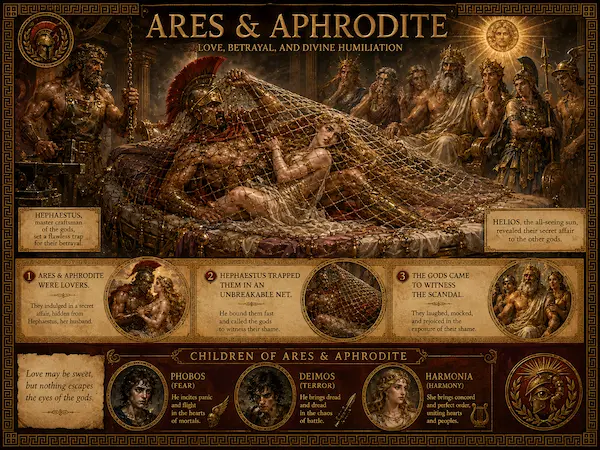
In that account Aphrodite is married to Hephaestus, the craftsman god, and Ares is her lover. Helios, the sun, sees everything that happens on earth, and he tells Hephaestus what has been going on. Hephaestus responds in the way that suits him best. He forges a net of chains so fine that it cannot be seen and so strong that it cannot be broken, fixes it to his own bed, and announces that he is leaving for the island of Lemnos.
Ares and Aphrodite are caught the moment they use the bed. Hephaestus returns and calls the other gods to come and look, and the male Olympians arrive to find the two of them trapped and unable to move. The scene ends in laughter rather than punishment, with the gods joking about the situation, and Poseidon eventually persuading Hephaestus to release the pair. Ares departs for Thrace and Aphrodite for Cyprus.
The episode is a compressed portrait of Ares. He is powerful, he is caught, and he is beaten by craft rather than by force, which is precisely what happens to him everywhere else in Greek myth.
Their union produced Phobos and Deimos, the personifications of fear and terror who follow their father into battle, and Harmonia, whose name means harmony and whose parentage the Greeks read as a deliberate paradox: love and war together producing concord. Some traditions add Eros to the list, though his parentage is one of the least stable points in Greek mythology.
One clarification matters here. Aphrodite should not be described without qualification as the wife of Ares. In the tradition that made this story famous she is married to Hephaestus, and Ares is her lover. Elsewhere in Greek literature Hephaestus has a different wife, one of the Graces, and the pairings shift from author to author. Ares and Aphrodite are a long term couple with children in the mythological record, but a marriage between them is not the standard ancient account.
Famous Myths About Ares
Ares appears throughout Greek myth, though rarely as the hero of his own story. He tends to enter someone else’s narrative, cause damage, and then come off badly. Five episodes are told more often than the rest.
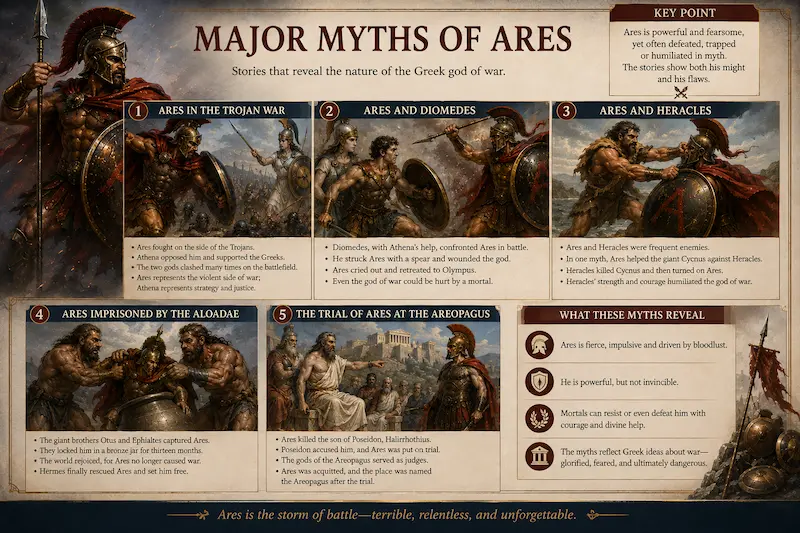
Ares in the Trojan War
The Iliad gives Ares more page time than any other text, and it is not flattering. Ares fights for the Trojans, which in itself is presented as a betrayal, since he had assured Hera and Athena that he would support the Greeks and then changed sides. Aphrodite’s attachment to the Trojan cause is usually given as the reason.
On the field he does what he does everywhere. He drives the Trojans forward, spreads panic through the Greek lines and kills without discrimination. Homer describes him as a god who does not care which side wins, and Ares’ own inconsistency in the poem supports the description.
He is opposed at every stage by Athena, and the two of them turn the war into a demonstration of their competing methods. She engineers his defeat twice, first by helping Diomedes wound him and later by knocking him flat with a stone during the fighting among the gods in Book 21. Zeus receives his complaints both times without sympathy. In one of the most quoted passages of the poem, Zeus tells his son that he is the most hateful to him of all the gods on Olympus, because quarrels, wars and battles are the only things he ever loves.
Ares and Diomedes
The single most revealing Ares episode occurs in Book 5 of the Iliad. Diomedes, a Greek hero fighting under Athena’s protection, is having the best day of his life. He has already wounded Aphrodite, and Athena now climbs into his chariot beside him, takes the reins herself and makes him briefly invisible to the war god.
When Ares thrusts at Diomedes, Athena turns the spear aside. Diomedes then drives his own weapon into the god’s body with Athena pushing it home. Ares bellows with a sound Homer compares to the shout of nine or ten thousand men, terrifying both armies, and flees to Olympus to complain to his father about the wound.
The importance of this scene is hard to overstate. A mortal, admittedly with a goddess in his chariot, has wounded the god of war and driven him from the battlefield. It is Homer’s clearest statement of where Ares stands: dangerous, loud, genuinely powerful, and still no match for skill directed by intelligence.
Ares and Heracles
Ares also loses a confrontation with Heracles, and the cause is his son Cycnus. Cycnus ambushed travellers on the road to Delphi, killing them and taking their offerings, and by some accounts he was building a temple from their bones. Apollo, whose pilgrims were the victims, set Heracles against him.
The two fought in single combat, and Heracles killed Cycnus with Athena assisting him again. Ares then attacked Heracles directly to avenge his son. In the version told in the Shield of Heracles, Athena deflects his spear and Heracles wounds him in the thigh, forcing him off the field. Other accounts have Zeus end the fight by throwing a thunderbolt between them before it can go further.
The details vary between sources, but the shape of the story does not. Ares fights on behalf of a son who was killing pilgrims, and he loses.
Ares Imprisoned by the Aloadae
Otus and Ephialtes, known together as the Aloadae, were twin giants of enormous strength and even greater ambition. They are best remembered for threatening to pile Mount Ossa on Mount Olympus and Mount Pelion on Ossa in order to storm the home of the gods.
Before that, according to a passage in Book 5 of the Iliad, they captured Ares and shut him inside a bronze jar. He remained there for thirteen months, and Homer says he might have died in it had their stepmother Eriboea not told Hermes what had happened. Hermes stole him out of the vessel, worn down and barely holding on.
It is worth pausing on how strange this is. The god of war was overpowered by two young giants, sealed in a container, and had to be rescued by the god of messengers and thieves. No other Olympian suffers anything comparable, and the story is one of the strongest pieces of evidence that Greek poets were prepared to treat Ares as a figure who could be beaten.
The Trial of Ares at the Areopagus
Halirrhothius was a son of Poseidon. According to the traditional account preserved by Apollodorus and referred to by Athenian dramatists, he assaulted Alcippe, the daughter of Ares and Aglaurus, and Ares killed him for it.
Poseidon demanded justice for his son, and Ares was tried on a hill in Athens before a court of the gods. He was acquitted, on the grounds that he had acted as a father defending his daughter. This is the only place in Greek myth where Ares is judged and found in the right.
Greek tradition connected the story to the Areopagus, the rocky hill northwest of the Acropolis whose name was understood to mean the hill of Ares, and which housed one of the most respected homicide courts in the ancient world. The connection was a Greek explanation for the site rather than a historical record of its origin, and the actual etymology of the name is not certain. What the story does show is that the Athenians associated their most solemn court with this myth, which sits oddly alongside the negative portrait of Ares in poetry.
Ares vs Mars: Are They the Same God?
Mars is the Roman god commonly identified with Ares, and the identification is genuine. As Roman writers absorbed Greek literature, the myths told about Ares were retold about Mars with the names exchanged, and in mythological terms the two are largely interchangeable.
In religious and cultural terms they are not. Mars was not simply a Roman translation of Ares. He was an older Italic deity with his own history, including an early connection to agriculture and the protection of fields, and Rome gave him a standing that Ares never held in Greece.
| Aspect | Ares in Greek tradition | Mars in Roman tradition |
|---|---|---|
| Literary portrayal | Frequently negative or critical | Dignified and respected |
| Religious rank | Worshipped, but secondary among the Olympians | Among Rome’s most important gods, second only to Jupiter |
| National role | No special tie to any leading Greek state | Father of Romulus and ancestor of the Roman people |
| Outcome in myth | Often wounded, trapped or humiliated | Rarely shown as defeated |
| Civic presence | Limited number of major sanctuaries | Campus Martius, the month of March, major state festivals |
The practical difference is one of prestige. Greek writers used Ares to represent something they found necessary but distasteful. Romans used Mars to represent their own military identity and their descent as a people, which meant treating him with a respect no Greek poet extended to Ares.
Worship of Ares in Ancient Greece
Ares did receive worship, and this deserves stating plainly, because the literary portrait leads many readers to assume he did not. Sacrifices were made to him, sanctuaries were dedicated to him, and armies invoked him before fighting.
His cult was nonetheless narrower than those of Zeus, Athena, Apollo or Demeter. He had fewer major temples, fewer festivals and no great panhellenic sanctuary comparable to Delphi or Olympia. Pausanias, who catalogued Greek sacred sites in the second century CE, records his temples and altars in scattered places rather than as a dominant presence.
Several locations are consistently associated with him. Athens had a temple of Ares in the Agora, moved there from the deme of Acharnae during the Roman period, and Athenian ephebes swore their military oath invoking him among other gods. Pausanias describes a sanctuary of Ares at Geronthrae in Laconia, from which women were excluded, and notes cult sites elsewhere in the Peloponnese. Thebes maintained a strong mythological link to him through Harmonia and the spring guarded by his serpent. Thrace, in the far north, is repeatedly named in poetry as his home, which reflects how Greek authors placed the god of violent war at the edges of their own world.
What emerges is a god approached for a specific and limited purpose. Ares was called on for success in the fighting itself, not for prosperity, wisdom, healing or civic order. Greek religious practice separated a god’s usefulness from a god’s likeability more comfortably than modern readers tend to expect, so the harsh treatment of Ares in poetry should not be read as evidence that the Greeks universally hated him or refused him worship.
Frequently Asked Questions About Ares
Why did Zeus hate Ares?
The idea comes mainly from Book 5 of the Iliad, where Zeus tells the wounded Ares that he is the most hateful to him of all the Olympians because he loves nothing but strife, war and fighting. Homer is characterising Ares through his father’s contempt. It is one literary scene rather than proof of permanent hatred across all Greek tradition, and Zeus still has him healed.
Who is Ares’ worst enemy?
Greek mythology never names an official worst enemy. Athena is the strongest candidate, since she opposes him repeatedly and represents the approach to warfare that defeats his own. Heracles is his most persistent mortal opponent, fighting him over the death of Cycnus. Hephaestus and the Aloadae also humiliate him, though in single episodes rather than ongoing rivalries.
What is Ares god known for?
Ares is best known as the Greek god of war, specifically the violence, bloodshed, rage and chaos of battle rather than its strategy. He is also known for his affair with Aphrodite and the trap Hephaestus set for them, for fathering Phobos and Deimos, and for the string of myths in which the god of war himself is wounded, captured or defeated.
What is the difference between Ares and Athena?
Ares represents war as physical violence: bloodshed, fury and chaotic combat. Athena represents war as an intelligent activity: strategy, discipline, tactics and organised defence. Both are war deities, but they stand for opposite halves of the same subject, and Greek myth almost always shows Athena getting the better of him when they meet.
Is Ares the same god as Mars?
Mars is the Roman counterpart of Ares, and by the classical period the myths told about them were essentially the same stories. Their cultural roles were not identical. Mars held a far more honoured position in Roman religion, ranking near Jupiter and standing as the father of Romulus, while Greek writers treated Ares as necessary but largely unloved.
Conclusion
Ares is the Greek god of war in its most physical form: the fighting itself, with all the bloodshed, rage and disorder that comes with it. That narrow focus is what separates him from Athena, who governs the strategy and discipline that decide battles, and who defeats him whenever the two meet in myth.
His stories return to the same idea from different directions. He is wounded by Diomedes, beaten by Heracles, sealed in a jar by two giants and caught in a net by his own brother, and each time force alone proves insufficient. Alongside those defeats sit his affair with Aphrodite, his children Phobos, Deimos and Harmonia, and a real if limited place in Greek worship, which together make him one of the most contradictory figures on Olympus.

About the Author
Dana Whitfield
I write about numerology, astrology, mythology, tarot, and world mystical traditions for Mystivora, drawing on years of independent research across comparative religion and symbolic systems. I approach each topic by cross-checking primary texts and established scholarship rather than repeating popular but unverified claims.