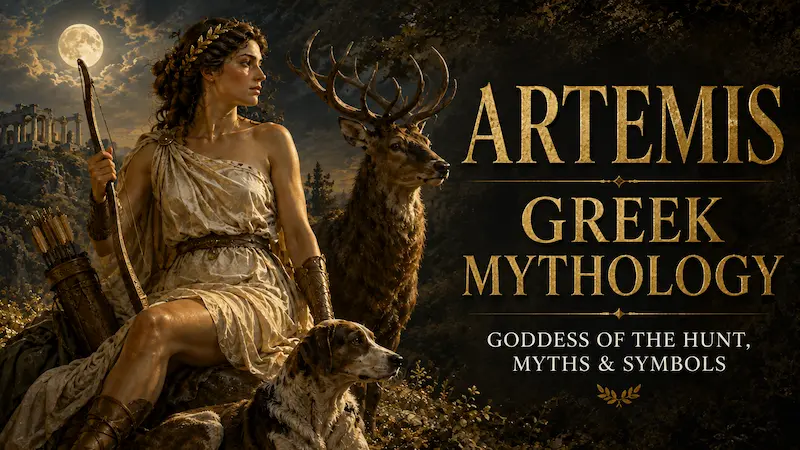
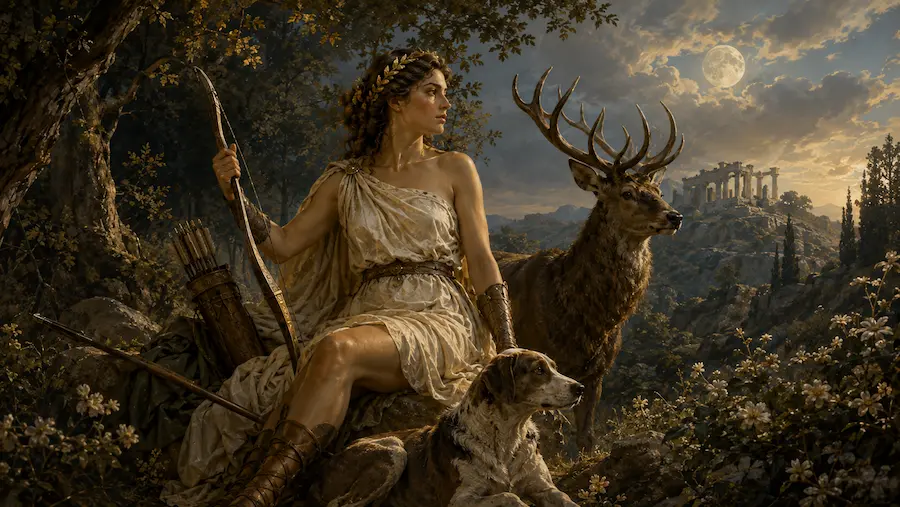
Artemis Greek mythology centers on the goddess of the hunt, the wilderness, and wild animals. Artemis is one of the Twelve Olympians, the daughter of Zeus and the Titaness Leto, and the twin sister of Apollo. She is pictured as a young huntress moving through mountains and forests with a bow and a quiver, and she is one of the few major goddesses who never marries. Alongside hunting and wild nature, ancient Greeks connected her with chastity, with the protection of girls and young women, and with childbirth. Later tradition added a strong link to the Moon, though that association developed over time rather than starting with her.
Who Is Artemis in Greek Mythology?
Artemis is a major Olympian goddess in Greek mythology, the daughter of Zeus and Leto and the twin sister of Apollo. She holds a permanent seat among the Twelve Olympians, and she was worshipped across the Greek world from Arcadia and Attica to the coast of Asia Minor.
What sets her apart from most goddesses of her rank is her independence. Artemis is a virgin goddess who refuses marriage, and Greek writers present that refusal as a permanent condition rather than a phase. She lives outside the settled world of households and cities, in the mountains and uncultivated ground where wild animals live. Homer gives her the title Mistress of Animals, which captures her double role: she hunts, and she also guards what she hunts.
Artemis also watched over girls and unmarried young women as they moved toward adulthood, and she was invoked by women in childbirth. Both roles sit oddly beside her own permanent virginity and are explained below.
What Is Artemis the Goddess Of?
Artemis is the goddess of the hunt, the wilderness, and wild animals. She is also the goddess of chastity, the protector of girls and young women, and a divinity invoked during childbirth. In later Greek and Roman tradition she became closely identified with the Moon. Her domains are less scattered than that list suggests, because nearly all of them concern things that live at the edge of the ordered human world: wild country, wild animals, and the stages of a young woman’s life before marriage.
Goddess of the Hunt
Hunting is the role Artemis is known for above all others. Greek poets describe her ranging across mountains and woodland with a bow, striking game at a distance, and hunting in the company of nymphs. Later accounts such as Callimachus’ hymn describe the Cyclopes forging her bow and arrows.
Real hunters treated her as the divinity who governed their success. Spoils and first portions of a kill were dedicated to Artemis, and the myths in which she punishes a hunter show what the Greeks believed happened when that respect was withheld.
Goddess of Wilderness and Wild Animals
Artemis rules the land the Greeks did not farm. Mountains, forests, groves, marshes, and rough grazing ground all fall under her, and she is at home in exactly the places a Greek city was not.
Her relationship with animals runs deeper than hunting. Greek tragedy describes her as protective toward the young of wild animals even as she hunts the grown ones, which is not a contradiction in Greek terms. She governs the whole system of wild life, including the killing that belongs to it, and offense against her animals is punished as directly as offense against her person.
Artemis, Chastity and Young Women
Artemis is a virgin goddess, one of three in the Greek pantheon along with Athena and Hestia. Callimachus tells the story of Artemis as a small child asking Zeus for eternal virginity, a bow, and the mountains to roam, and receiving all three. She expected the same chastity from the nymphs who followed her, and the myth of Callisto turns entirely on that requirement.
Greek religion also connected her closely with girls and unmarried young women. At Brauron in Attica, girls served her in a rite in which they were called bears, and brides commonly dedicated their childhood toys or a lock of hair to Artemis before marriage. She presided over the stage before adulthood and then released her worshippers from it.
Artemis and Childbirth
A virgin goddess who protects women in labor looks strange at first, but the two roles were joined in Greek practice. Under titles such as Locheia, Artemis was invoked by women giving birth and was associated with Eileithyia, the goddess of labor itself. One tradition explains this through her own birth, since accounts preserved by later mythographers have Artemis born before Apollo and helping Leto deliver her twin.
The role has a darker half. Homer and later poets attribute the sudden death of women, including deaths in childbirth, to her arrows, in the same way that sudden deaths of men were credited to Apollo. She was the goddess women called on at the moment of greatest danger and the one blamed when it went wrong.
Was Artemis the Goddess of the Moon?
Not originally. Her early and central domains are hunting, wild nature, and wild animals, and the oldest Greek sources present her that way without lunar associations. The traditional goddess of the Moon in Greek mythology is Selene, a Titan who personifies the Moon itself and drives it across the night sky. Selene is the Moon in a way Artemis never was.
From the Classical period onward, Greek writers began linking Artemis with Selene, and the identification became routine in Hellenistic and Roman poetry, where Artemis and her Roman counterpart Diana are described in openly lunar terms. Later art reinforced it with a crescent above her head. Artemis acquired a lunar identity over centuries rather than being born with one.
Artemis’ Family and Birth
Artemis belongs to the second generation of Olympians, the children of Zeus. Her immediate family is small and matters constantly in her myths, because so many of her actions are taken on behalf of her mother or alongside her twin.
Parents of Artemis
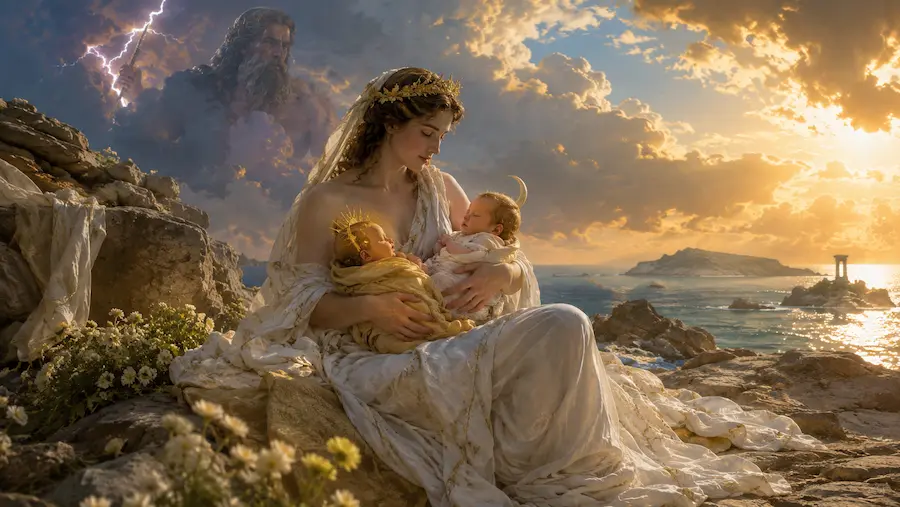
The father of Artemis is Zeus, king of the Olympian gods. Her mother is Leto, a Titaness and the daughter of the Titans Coeus and Phoebe, which places Artemis on the branch of the Greek mythology family tree where the Titan generation joins the younger Olympians.
Leto’s relationship with Zeus made her a target for Hera, his wife, whose anger in the myths falls on the women involved with Zeus and on their children rather than on Zeus himself. That hostility shapes the entire birth story of the twins and explains why Artemis and Apollo react so violently whenever their mother is insulted.
Artemis and Apollo
Apollo is the twin brother of Artemis, and the pair are treated almost as a unit in Greek art and poetry. Both are archers, both strike suddenly from a distance, and both appear together whenever Leto needs defending. The destruction of Niobe’s children is the best-known example, and other traditions have the twins punish the giant Tityos for attacking their mother.
Their domains complement each other rather than overlap. Apollo is tied to cities, temples, prophecy, and civic order, while Artemis belongs to the wild country beyond the settlements, which is part of why they were so often worshipped together.
The Birth of Artemis
The best-known account of the birth comes through the tradition around the Homeric Hymns. Pregnant with the twins and pursued by Hera’s hostility, Leto wandered from place to place, and no land would receive her, since sheltering her meant risking Hera’s anger. The small, rocky island of Delos finally accepted her. In the hymn tradition Hera then keeps Eileithyia, the goddess of labor, away from the island, so the birth is delayed until the other goddesses intervene.
Ancient sources do not agree on every detail. The version in which Artemis is born first and then helps her mother deliver Apollo appears in later mythography and is not universal. There were also competing claims about the birthplace itself, most notably a site called Ortygia, which some ancient writers placed near Delos and others near Ephesus. Delos remains the dominant tradition, but it was never the only one.
Powers and Attributes of Artemis
The abilities Greek sources actually attribute to Artemis are consistent and fairly narrow. She is an unmatched archer whose arrows do not miss, and a hunter at home in terrain no ordinary person could cross. She holds authority over wild animals, able to send a beast against a whole region, as she does at Calydon, or to protect an animal that belongs to her.
She protects girls and young women, and she is invoked at childbirth. She also punishes, and the myths are blunt about the form that takes. Artemis brings sudden death and disease with her arrows, especially to women, transforms mortals who offend her, as she does to Actaeon, and withdraws favor from communities that neglect her rites.
Her independence and her permanent virginity belong on this list as well. In Greek terms these are not personality traits but part of her divine identity, and any challenge to them counts as an attack on the goddess herself.
Symbols and Sacred Animals of Artemis
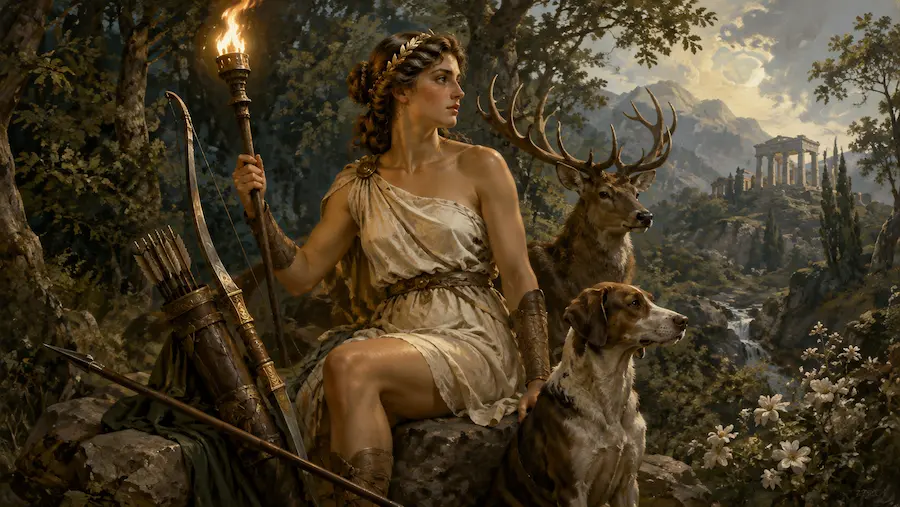
Ancient artists identified Artemis by a small set of objects and animals. A young woman in a short hunting tunic with a bow, a deer at her side, needed no label in Greek art.
Bow and Arrows
The bow is her principal weapon and her clearest symbol. It links her to hunting, to precision, and to power exercised at a distance, which is exactly how she acts in the stories. Her arrows also carry her punishments, since the daughters of Niobe fall to them and Greek poets explain sudden female deaths the same way. Apollo shares the weapon, which is one reason the twins appear together so often.
Deer and Stag
The deer is the animal most closely tied to Artemis. Vase painting and sculpture show her with a deer at her side or holding one, and deer stand for the wild country and the hunt at the same time.
The strength of the association explains two of her best-known myths. The Ceryneian Hind was sacred to her and could not be harmed, which is why Heracles had to capture it alive, and in the tradition where Iphigenia is rescued it is a deer that appears on the altar in her place.
Hunting Dogs
Hounds accompany Artemis in art and in poetry, and Callimachus describes Pan giving her a pack of hunting dogs prized for their speed and endurance. They support the picture of her as a working huntress. Dogs also carry the sharpest irony in her mythology, since Actaeon, a hunter himself, is torn apart by his own hounds after he offends her.
Other Symbols of Artemis
The quiver appears with her almost as consistently as the bow, and the hunting spear belongs to her as well. Torches appear in certain cults, where she is honored as a bringer of light, a title that later helped connect her to the Moon.
Major Myths About Artemis
The myths below do most of the work of defining her. Several exist in versions that flatly disagree, and those disagreements are part of the tradition rather than errors to be smoothed over.
Artemis and Actaeon
Actaeon was a Theban hunter and a grandson of Cadmus. His story ends with Artemis transforming him into a stag and his own hunting dogs bringing him down, unable to recognize their master.
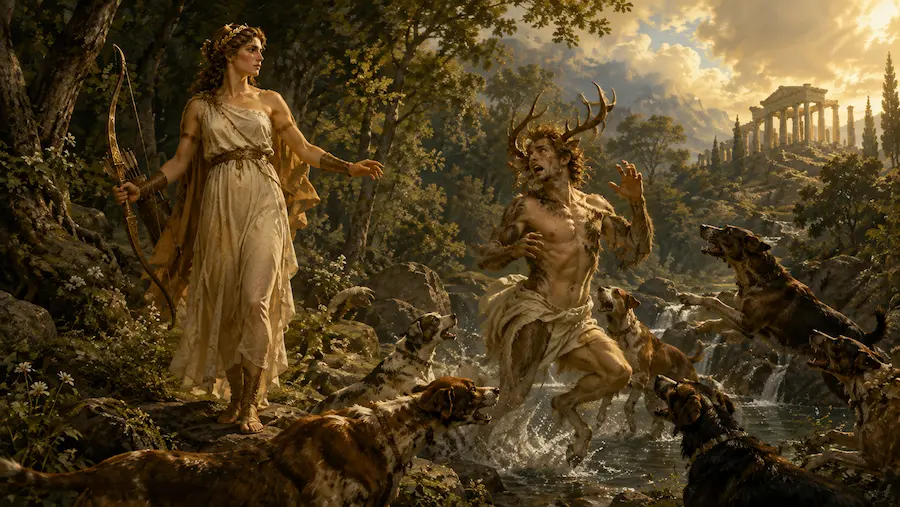
Why he was punished depends on the source. In the version told by the Roman poet Ovid, the one most people know, Actaeon stumbles by accident onto Artemis bathing in a woodland spring. Earlier Greek traditions give different reasons. In one, he boasted that he was a better hunter than Artemis. In another, he pursued the goddess herself, and a further account connects his offense to Semele. The older explanations have nothing to do with bathing.
What holds across versions is the principle. A mortal crosses a boundary around Artemis, through arrogance or by accident, and the punishment falls without negotiation.
Artemis and Orion
Orion was a giant hunter, and the traditions link him to Artemis through that shared skill. In several accounts they hunt together, and some ancient writers suggest an attachment between them, though the sources disagree about its nature.
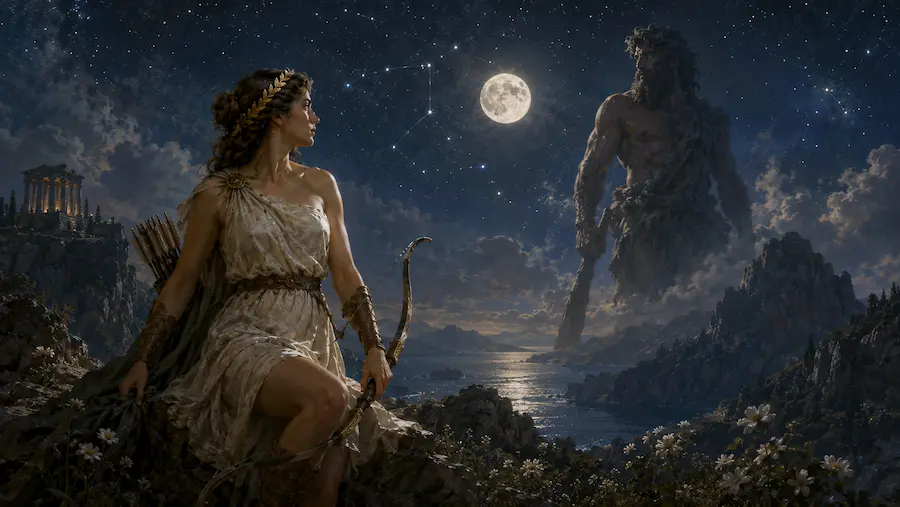
His death is told in incompatible ways. In one tradition, Artemis kills him herself after he offends her or attacks one of her companions. In another, Gaia sends an enormous scorpion against him after he boasts that he could kill every animal on earth, and the scorpion rather than the goddess causes his death. A later version has Apollo trick Artemis into shooting at a distant target in the sea, which turns out to be Orion’s head.
These are separate stories rather than stages of one story, and combining them produces a version no ancient author told. What they share is the ending, in which Orion is placed among the stars as the constellation that still carries his name.
Artemis and Callisto
Callisto was an Arcadian follower of Artemis, one of the companions bound to the chastity the goddess required. Zeus approached her, and in Ovid’s telling he did so disguised as Artemis herself.
The pregnancy was discovered, in the common version when the group bathed together, and Callisto was expelled and transformed into a bear. Who performs the transformation varies by source, with some accounts crediting Artemis, some Hera, and others Zeus, who changes her to hide what happened. Her son Arcas became an ancestral figure of the Arcadians, and most traditions end with the pair set in the sky, Callisto as the Great Bear.

Artemis and Niobe
Niobe was a queen of Thebes who boasted publicly that she had many children while Leto had only two, and that this made her the greater mother. The insult was aimed at Leto, and the twins answered it. Apollo killed Niobe’s sons and Artemis killed her daughters, shooting them down with their bows. Ancient sources give different numbers of children, so the tally is not the point of the story.
Niobe was left alive and eventually turned to stone, weeping, in a rock formation Greek travelers identified on Mount Sipylus. The myth is the clearest demonstration of Artemis’ loyalty to her mother.
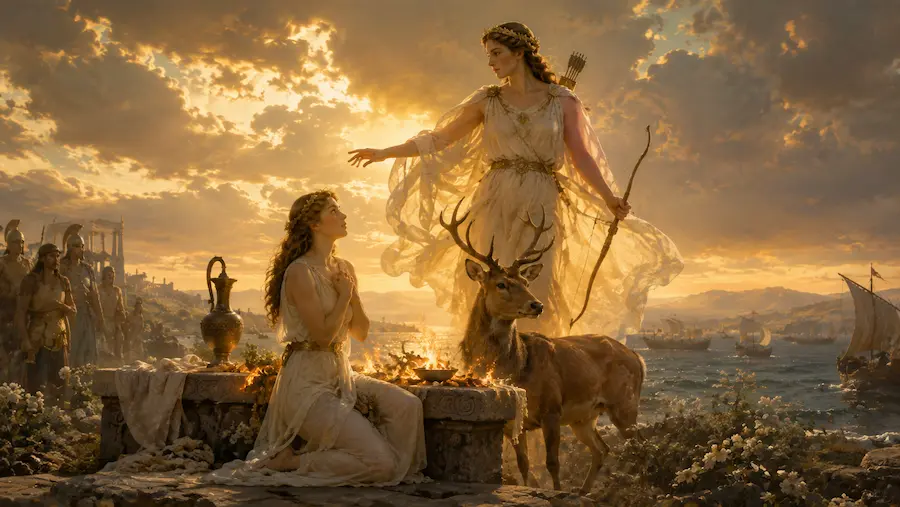
Artemis and Iphigenia
The Greek fleet gathered at Aulis to sail for Troy and could not leave, held in place by the wind. The cause was Artemis, angered by Agamemnon, usually because he killed a stag in a grove sacred to her and boasted about the shot. The seer Calchas announced that she required the sacrifice of Agamemnon’s daughter Iphigenia, who was brought to Aulis under the pretext of a marriage to Achilles.
The endings differ sharply. In Aeschylus, the sacrifice is carried out, and it becomes the reason Clytemnestra later kills her husband. In the tradition Euripides follows, Artemis substitutes a deer at the last moment and carries Iphigenia away to the land of the Tauri, where she serves as her priestess. Both versions were current in antiquity.
Artemis and the Calydonian Boar
King Oeneus of Calydon made his harvest offerings to the gods and left Artemis out. The omission was probably careless rather than deliberate, and it made no difference.
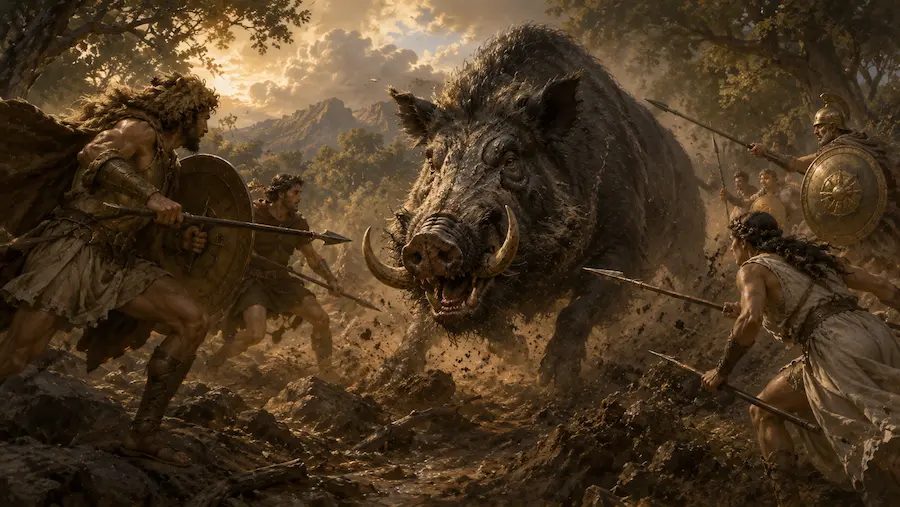
Artemis sent an enormous wild boar against his kingdom. The animal destroyed crops, killed livestock, and made the farmland unusable. Oeneus’ son Meleager gathered heroes from across Greece to hunt it down, one of the famous joint expeditions of Greek myth, with Atalanta credited in the usual account with the first wound. The hunt ended badly, in a quarrel over the spoils that cost Meleager his life. From the perspective of Artemis, the lesson sits earlier: a single neglected sacrifice was enough to ruin a kingdom.
Worship of Artemis
Artemis was among the most widely worshipped Greek deities, and her cults varied enormously by region.
The Temple of Artemis at Ephesus
Ephesus, on the coast of Asia Minor, was the greatest center of her worship. The temple there, funded in part by King Croesus of Lydia in the sixth century BCE, was built on a scale that impressed every ancient visitor who described it, and it was counted among the Seven Wonders of the Ancient World. It was destroyed by arson in 356 BCE, rebuilt larger, damaged in later raids, and eventually abandoned. Only fragments and one reassembled column stand on the site today.
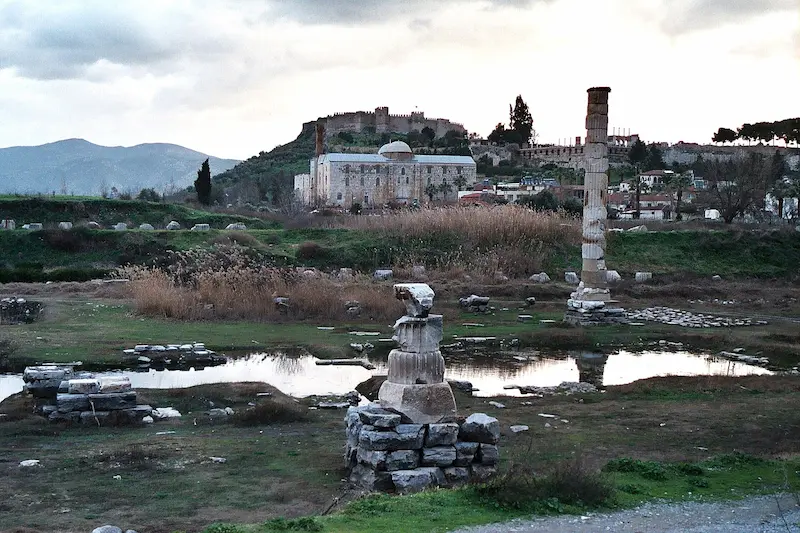
The goddess worshipped there was not quite the huntress of mainland Greek myth. Her cult statues show her standing rigid and richly ornamented, wearing a crown shaped like a city wall, covered with rows of oval objects whose meaning scholars still debate, and decorated with animals. Most historians understand her as an older Anatolian goddess whose worship the Greeks encountered in Ionia and identified with their own Artemis.
Worship Across the Greek World
Elsewhere, Artemis was honored in forms that reflected local concerns. At Brauron in Attica, her sanctuary was tied to rites for girls before marriage. At Sparta, her cult as Artemis Orthia involved endurance tests for young men. In Arcadia she was worshipped in her most straightforwardly wild form, and at Delos she was honored beside Apollo.
Greek worshippers approached her under many titles, including Agrotera, the goddess of the wild, and Locheia, the goddess invoked at childbirth. Each name pointed to a specific function rather than to a different goddess, which is how one deity could cover hunting, girlhood, childbirth, and the untouched countryside at once.
Artemis and Diana
Diana is the Roman goddess identified with Artemis. She had her own Italian cult before Greek influence arrived, most famously in the sacred grove at Lake Nemi, where she was worshipped as a goddess of woodland and the hunt.
As Roman writers absorbed Greek literature, the myths of Artemis transferred wholesale to Diana. The stories of Actaeon, Callisto, and Niobe are best known today in the Latin versions Ovid told, and the two goddesses share the same core: hunting, wild country, chastity, and, in later tradition, the Moon.
FAQs About Artemis
What is Artemis the main goddess of?
Artemis is mainly the goddess of the hunt, the wilderness, and wild animals. Those three domains account for most of her appearances in myth and most of her worship. She is also the goddess of chastity, a protector of girls and young women, and a divinity invoked during childbirth. Her association with the Moon belongs to later tradition rather than to the earliest sources.
Did Artemis ever fall in love?
Greek sources do not agree. Artemis is a virgin goddess who rejects marriage, and most traditions keep her entirely apart from romance. The exception is Orion, whom some ancient writers connect to her closely enough to suggest an attachment. Other versions of the same myth describe no such feeling and have her kill him for an offense. Calling them lovers overstates what the sources actually say.
Why did Artemis protect her virginity?
In the mythology, her virginity is something she asked for and kept. Callimachus describes her requesting eternal chastity from Zeus as a child, along with a bow and the mountains, and receiving all of it. Chastity marks her independence from marriage and from any household, which is what allows her to belong to the wild country instead.
Who did Artemis turn into a girl?
The story behind this question is that of Siproites, a Cretan hunter. According to the mythographer Antoninus Liberalis, Siproites saw Artemis bathing while out hunting and was transformed into a woman rather than killed. The myth survives in a single sentence and nothing more. It is often confused with the story of Actaeon, who was changed into a stag and killed by his own hounds for a comparable offense.
Is Artemis the goddess of the Moon?
She became one, but she did not begin as one. In the earliest Greek tradition, Artemis is the goddess of hunting and wild nature, and Selene is the divine personification of the Moon. Greek writers started identifying the two from the Classical period onward, and the connection became standard in Hellenistic and Roman poetry. Artemis is therefore best described as a goddess who acquired lunar associations over time.

About the Author
Dana Whitfield
I write about numerology, astrology, mythology, tarot, and world mystical traditions for Mystivora, drawing on years of independent research across comparative religion and symbolic systems. I approach each topic by cross-checking primary texts and established scholarship rather than repeating popular but unverified claims.